Ancient Greek Art Ap Art History

0.0(0)
Studied by 0 people
call kaiCall Kai
learnLearn
examPractice Test
spaced repetitionSpaced Repetition
heart puzzleMatch
flashcardsFlashcards
GameKnowt Play
Card Sorting

1/34

encourage image

There's no tags or description

Looks like no tags are added yet.

35 Terms

1
New cards

Caryatid

  • Male: Atlantid

  • A building column that is shaped like a female figure 

  • Have to be carefully executed because weight of the building rests on the thin points of a body’s structure (neck and legs)

  • All have long hair and solid gowns to stabilize building 


2
New cards

Contrapposto

  • A graceful arrangement of the body based on tilted shoulders and hipes and bent knees

  • Relaxed way of standing with knees bent and shoulders tilted


3
New cards
  • Encaustic


Mixture of pigment and wax that is applied to the statue while hot

4
New cards

Entasis

  • An almost imperceptible convex tapering (an apparent swelling in the shaft or column)

  • The floor surves upward in the center of the facade to drain off rainwater


5
New cards

Isocephalism

The tradition of depicting heads of figures on the same level

6
New cards

Klin

An oven used for making pottery

7
New cards

Kouros

  • Female: kore

  • Kourous → young male

  • An archaic Greek sculpture of a standing youth

  • These figures stand frontally, bolt upright, and with squarish shoulders

  • Hair is knotted, ears are curilcue (fancifully curved)

  • Figures are cut free from stone as much as possible

  • Arms sometimes attached to thighs

  • One foot placed in front of the other as in mid-stride

  • Most figures smile to give sense of life


8
New cards

Krater

  • A large ancient Greek bowl used for mixing water and wine

  • Bowl for mixing water and wine because Greeks never drank their wine straight

  • 3 different types of Kraters 

    • Calyx krater

    • Column krater

    • Bell krater

  • Meander (also called Greek key or Greek fret)→ maze-looking pattern that is typical in Greek Art

    • Consists of a continuous, intricate line folded repeatedly at right angles, creating a geometric, labyrinth-like border


9
New cards

Mosaic

A decoration using pieces of stone, marble, or colored glass, called tesserae, that are cemented to a wall or a floor

10
New cards

Palaestra

  • an ancient Greek open-air exercise and wrestling court, typically surrounded by columned porticoes or colonnades

  • Used for training in wrestling, boxing, and other athletic events

  • Features a rectangular central open-air court surrounded by a colonnade (often Doric) with adjoining small rooms used for undressing, oiling, bathing, and socializing


11
New cards

Peplos

  • A garment worn by women in ancient Greece, usually full length and tied at the waist

  • Figure in Peplos Kore is wearing peplos


12
New cards

Portico

An entranceway to a building having columns supporting a roof

13
New cards

slip (in regards to painting a vase)

a liquefied mixture of clay and water used by ancient potters (most famously in Greek pottery) as a sort of "paint" to decorate ceramic vessels before they were fired

14
New cards

Stele

  • Plural: stelae

  • An upright stone slab used to mark a grave or a site


15
New cards

Anavysos Kouros

  • 530 BCE → from ARCHAIC PERIOD (600-480 BC)

  • Marble and paint

  • From Anavysos, Greece

  • Encaustic (mixture of pigment and wax that is applied to the statue while hot)

  • Grave marker, replacing huge vases of Geometric period

  • Not a real portrait, but a general representation of ideal warrior

  • Rigidly frontal

  • Emulates stance of Egyptian sculpture, but is nude

  • Arms and legs cut free from stone

  • Freestanding with legs appearing to stride forward

    • In contrast to many Egyptian works that are reliefs or are attached to stone

  • Hair is knotted and falls in neatly braided rows down the back

  • Eyes wide open

  • Squarish shoulders

  • Face is masklike

  • Named after young military hero Kroisos

    • Inscription at base identifies him

  • Some paint survives, which would have given sculpture greater life

  • “Archaic smile” meant to enliven sculpture


<ul><li><p><span style="background-color: transparent; font-family: &quot;Times New Roman&quot;, serif;">530 BCE → from <strong>ARCHAIC PERIOD (600-480 BC)</strong></span></p></li><li><p><span style="background-color: transparent; font-family: &quot;Times New Roman&quot;, serif;">Marble and paint</span></p></li><li><p><span style="background-color: transparent; font-family: &quot;Times New Roman&quot;, serif;">From Anavysos, Greece</span></p></li><li><p><span style="background-color: transparent; font-family: &quot;Times New Roman&quot;, serif;"><em>Encaustic</em> (mixture of pigment and wax that is applied to the statue while hot)</span></p></li><li><p><span style="background-color: transparent; font-family: &quot;Times New Roman&quot;, serif;">Grave marker, replacing huge vases of Geometric period</span></p></li><li><p><span style="background-color: transparent; font-family: &quot;Times New Roman&quot;, serif;">Not a real portrait, but a general representation of ideal warrior</span></p></li><li><p><span style="background-color: transparent; font-family: &quot;Times New Roman&quot;, serif;">Rigidly frontal</span></p></li><li><p><span style="background-color: transparent; font-family: &quot;Times New Roman&quot;, serif;">Emulates stance of Egyptian sculpture, but is nude</span></p></li><li><p><span style="background-color: transparent; font-family: &quot;Times New Roman&quot;, serif;">Arms and legs cut free from stone</span></p></li><li><p><span style="background-color: transparent; font-family: &quot;Times New Roman&quot;, serif;">Freestanding with legs appearing to stride forward</span></p><ul><li><p><span style="background-color: transparent; font-family: &quot;Times New Roman&quot;, serif;">In contrast to many Egyptian works that are reliefs or are attached to stone</span></p></li></ul></li><li><p><span style="background-color: transparent; font-family: &quot;Times New Roman&quot;, serif;">Hair is knotted and falls in neatly braided rows down the back</span></p></li><li><p><span style="background-color: transparent; font-family: &quot;Times New Roman&quot;, serif;">Eyes wide open</span></p></li><li><p><span style="background-color: transparent; font-family: &quot;Times New Roman&quot;, serif;">Squarish shoulders</span></p></li><li><p><span style="background-color: transparent; font-family: &quot;Times New Roman&quot;, serif;">Face is masklike</span></p></li><li><p><span style="background-color: transparent; font-family: &quot;Times New Roman&quot;, serif;">Named after young military hero Kroisos</span></p><ul><li><p><span style="background-color: transparent; font-family: &quot;Times New Roman&quot;, serif;">Inscription at base identifies him</span></p></li></ul></li><li><p><span style="background-color: transparent; font-family: &quot;Times New Roman&quot;, serif;">Some paint survives, which would have given sculpture greater life</span></p></li><li><p><span style="background-color: transparent; font-family: &quot;Times New Roman&quot;, serif;">“Archaic smile” meant to enliven sculpture</span></p></li></ul><p></p>
16
New cards

Peplos Kore

  • C. 530 BCE → from ARCHAIC PERIOD (600-480 BC)

  • Marble and paint

  • From Acropolis, Athens, Greece

  • Broken hand fitted in the socket and probably held an attribute

  • May have been a goddess

  • Hand emerges into our own space, breaks out of the mold of static Archaic statues

  • Tightened waist

  • Breasts revealed beneath drapery

  • So-called because she is named for the peplos, traditionally thought to be one of the four garments she is wearing

    • Figure is wearing clothing called “peplos”

  • Rounded and naturalistic face

  • Much of the paint still remains, animating the face and hair

  • Hair falls naturally beside her body


<ul><li><p><span style="background-color: transparent; font-family: &quot;Times New Roman&quot;, serif;">C. 530 BCE → from <strong>ARCHAIC PERIOD (600-480 BC)</strong></span></p></li><li><p><span style="background-color: transparent; font-family: &quot;Times New Roman&quot;, serif;">Marble and paint</span></p></li><li><p><span style="background-color: transparent; font-family: &quot;Times New Roman&quot;, serif;">From Acropolis, Athens, Greece</span></p></li><li><p><span style="background-color: transparent; font-family: &quot;Times New Roman&quot;, serif;">Broken hand fitted in the socket and probably held an attribute</span></p></li><li><p><span style="background-color: transparent; font-family: &quot;Times New Roman&quot;, serif;">May have been a goddess</span></p></li><li><p><span style="background-color: transparent; font-family: &quot;Times New Roman&quot;, serif;">Hand emerges into our own space, breaks out of the mold of static Archaic statues</span></p></li><li><p><span style="background-color: transparent; font-family: &quot;Times New Roman&quot;, serif;">Tightened waist</span></p></li><li><p><span style="background-color: transparent; font-family: &quot;Times New Roman&quot;, serif;">Breasts revealed beneath drapery</span></p></li><li><p><span style="background-color: transparent; font-family: &quot;Times New Roman&quot;, serif;">So-called because she is named for the <em>peplos</em>, traditionally thought to be one of the four garments she is wearing</span></p><ul><li><p><span style="background-color: transparent; font-family: &quot;Times New Roman&quot;, serif;">Figure is wearing clothing called “peplos”</span></p></li></ul></li><li><p><span style="background-color: transparent; font-family: &quot;Times New Roman&quot;, serif;">Rounded and naturalistic face</span></p></li><li><p><span style="background-color: transparent; font-family: &quot;Times New Roman&quot;, serif;">Much of the paint still remains, animating the face and hair</span></p></li><li><p><span style="background-color: transparent; font-family: &quot;Times New Roman&quot;, serif;">Hair falls naturally beside her body</span></p></li></ul><p></p>
17
New cards

Spear Bearer, sculpted by Polykleitos

  • C. 450-440 BCE → from CLASSICAL PERIOD (480-323 BCE)

  • Roman marble copy from bronze original

  • Greek name: Doryphoros

  • Idea of a canon (rule for standard of beauty developed for artists to follow) was not new to ancient Greeks

    • Standard of average human body in Ancient Greek sculptures → 1:7 ratio

    • Every length of human body was 7 heads

  • Canon → a body of rules of laws in Greek art that outlined the ideal mathematical proportion of a figure

  • Presence of Contrapposto

    • Tension, natural shift in hips, not completely level

  • Closed stance

  • Alternating tense and relaxed elements of the body

    • Left arm and right leg are relaxed

    • Right arm and left leg are tensed

  • Blocklike solidity

  • Broad shoulders, thick torso, muscular body

  • Movement restrained, Spartan ideal of body

  • Warrior and athlete

  • Hand once held a spear

  • He averts his gaze

    • You may admire him, but he doesn’t recognize the admiration

  • Found in Pompeii in a place for athletic training


<ul><li><p><span style="background-color: transparent; font-family: &quot;Times New Roman&quot;, serif;">C. 450-440 BCE → from <strong>CLASSICAL PERIOD (480-323 BCE)</strong></span></p></li><li><p><span style="background-color: transparent; font-family: &quot;Times New Roman&quot;, serif;">Roman marble copy from bronze original</span></p></li><li><p><span style="background-color: transparent; font-family: &quot;Times New Roman&quot;, serif;">Greek name: <strong><em>Doryphoros</em></strong></span></p></li><li><p><span style="font-family: &quot;Times New Roman&quot;, serif;">Idea of a <strong>canon</strong> (rule for standard of beauty developed for artists to follow) was not new to ancient Greeks</span></p><ul><li><p><span style="font-family: &quot;Times New Roman&quot;, serif;">Standard of average human body in Ancient Greek sculptures → 1:7 ratio</span></p></li><li><p><span style="font-family: &quot;Times New Roman&quot;, serif;">Every length of human body was 7 heads</span></p></li></ul></li><li><p><span style="background-color: transparent; font-family: &quot;Times New Roman&quot;, serif;">Canon → a body of rules of laws in Greek art that outlined the ideal mathematical proportion of a figure</span></p></li><li><p><span style="background-color: transparent; font-family: &quot;Times New Roman&quot;, serif;">Presence of Contrapposto</span></p><ul><li><p><span style="background-color: transparent; font-family: &quot;Times New Roman&quot;, serif;">Tension, natural shift in hips, not completely level</span></p></li></ul></li><li><p><span style="background-color: transparent; font-family: &quot;Times New Roman&quot;, serif;">Closed stance</span></p></li><li><p><span style="background-color: transparent; font-family: &quot;Times New Roman&quot;, serif;">Alternating tense and relaxed elements of the body</span></p><ul><li><p><span style="background-color: transparent; font-family: &quot;Times New Roman&quot;, serif;">Left arm and right leg are relaxed</span></p></li><li><p><span style="background-color: transparent; font-family: &quot;Times New Roman&quot;, serif;">Right arm and left leg are tensed</span></p></li></ul></li><li><p><span style="background-color: transparent; font-family: &quot;Times New Roman&quot;, serif;">Blocklike solidity</span></p></li><li><p><span style="background-color: transparent; font-family: &quot;Times New Roman&quot;, serif;">Broad shoulders, thick torso, muscular body</span></p></li><li><p><span style="background-color: transparent; font-family: &quot;Times New Roman&quot;, serif;">Movement restrained, Spartan ideal of body</span></p></li><li><p><span style="background-color: transparent; font-family: &quot;Times New Roman&quot;, serif;">Warrior and athlete</span></p></li><li><p><span style="background-color: transparent; font-family: &quot;Times New Roman&quot;, serif;">Hand once held a spear</span></p></li><li><p><span style="background-color: transparent; font-family: &quot;Times New Roman&quot;, serif;">He averts his gaze</span></p><ul><li><p><span style="background-color: transparent; font-family: &quot;Times New Roman&quot;, serif;">You may admire him, but he doesn’t recognize the admiration</span></p></li></ul></li><li><p><span style="background-color: transparent; font-family: &quot;Times New Roman&quot;, serif;">Found in Pompeii in a place for athletic training</span></p></li></ul><p></p>
18
New cards

Helios, Horses, and Dionysos

  • C. 438-432 BCE → from CLASSICAL PERIOD (480-323 BCE)

  • Marble

  • Parthenon Sculptures, also called the Elgin Marbles

  • East pediment of the Parthenon

  • Shows the birth of Athena from the head of Zesus, and other deities watching

  • Two seated figures are the goddesses Demeter and Persephone

  • Sculptures comfortably sit in the triangular space of the pediment

  • Classical art

  • Contrapposto 


<ul><li><p><span style="background-color: transparent; font-family: &quot;Times New Roman&quot;, serif;">C. 438-432 BCE → from <strong>CLASSICAL PERIOD (480-323 BCE)</strong></span></p></li><li><p><span style="background-color: transparent; font-family: &quot;Times New Roman&quot;, serif;">Marble</span></p></li><li><p><span style="background-color: transparent; font-family: &quot;Times New Roman&quot;, serif;">Parthenon Sculptures, also called the Elgin Marbles</span></p></li><li><p><span style="background-color: transparent; font-family: &quot;Times New Roman&quot;, serif;">East pediment of the Parthenon</span></p></li><li><p><span style="background-color: transparent; font-family: &quot;Times New Roman&quot;, serif;">Shows the birth of Athena from the head of Zesus, and other deities watching</span></p></li><li><p><span style="background-color: transparent; font-family: &quot;Times New Roman&quot;, serif;">Two seated figures are the goddesses Demeter and Persephone</span></p></li><li><p><span style="background-color: transparent; font-family: &quot;Times New Roman&quot;, serif;">Sculptures comfortably sit in the triangular space of the pediment</span></p></li><li><p><span style="background-color: transparent; font-family: &quot;Times New Roman&quot;, serif;">Classical art</span></p></li><li><p><span style="background-color: transparent; font-family: &quot;Times New Roman&quot;, serif;">Contrapposto&nbsp;</span></p></li></ul><p></p>
19
New cards

Plaque of the Ergastines

  • C. 438-432 BCE → from CLASSICAL PERIOD (480-323 BCE)

  • Marble

  • Scene from the Panathenaic Procession Frieze from the Parthenon depicting the Panathenaic Procession, held every four years to honor Athena

  • Isocephalism

    • All the figures are on the same ground line

  • Contrapposto

    • Natural stance seen in figures → Classical sculptures

  • Peplos 

    • Garment worn by women in ancient Greece

  • Ergastine 

    • Ancient Athenian young women depicted in classical Greek Art

  • First time in Greek art showing a depiction of a human event on a temple

  • Higher up the relief placement, the more three dimensional the relief was carved, to be seen better from below

  • Procession began at the Dipylon Gate, passed through the agora, ended at the Parthenon

  • Athenians placed a new peplos on the statute of Athena

  • Six Ergastines, young women in charge of weaving Athena’s peplos, are greeted by two priests

  • Isocephalism → the tradition of depicting heads of figures on the same level

  • New theory: not the Panathenaic Procession, but the story of the legendary Athenian king, Erechtheus, who sacrificed one of his daughters to save the city of Athens; told to do so by the Oracle of Delight


<ul><li><p><span style="background-color: transparent; font-family: &quot;Times New Roman&quot;, serif;">C. 438-432 BCE → from <strong>CLASSICAL PERIOD (480-323 BCE)</strong></span></p></li><li><p><span style="background-color: transparent; font-family: &quot;Times New Roman&quot;, serif;">Marble</span></p></li><li><p><span style="background-color: transparent; font-family: &quot;Times New Roman&quot;, serif;">Scene from the <strong>Panathenaic Procession Frieze from the Parthenon</strong> depicting the Panathenaic Procession, held every four years to honor Athena</span></p></li><li><p><span style="background-color: transparent; font-family: &quot;Times New Roman&quot;, serif;">Isocephalism</span></p><ul><li><p><span style="background-color: transparent; font-family: &quot;Times New Roman&quot;, serif;">All the figures are on the same ground line</span></p></li></ul></li><li><p><span style="background-color: transparent; font-family: &quot;Times New Roman&quot;, serif;">Contrapposto</span></p><ul><li><p><span style="background-color: transparent; font-family: &quot;Times New Roman&quot;, serif;">Natural stance seen in figures → Classical sculptures</span></p></li></ul></li><li><p><span style="background-color: transparent; font-family: &quot;Times New Roman&quot;, serif;">Peplos&nbsp;</span></p><ul><li><p><span style="background-color: transparent; font-family: &quot;Times New Roman&quot;, serif;">Garment worn by women in ancient Greece</span></p></li></ul></li><li><p><span style="background-color: transparent; font-family: &quot;Times New Roman&quot;, serif;">Ergastine&nbsp;</span></p><ul><li><p><span style="background-color: transparent; font-family: &quot;Times New Roman&quot;, serif;">Ancient Athenian young women depicted in classical Greek Art</span></p></li></ul></li><li><p><span style="background-color: transparent; font-family: &quot;Times New Roman&quot;, serif;">First time in Greek art showing a depiction of a human event on a temple</span></p></li><li><p><span style="background-color: transparent; font-family: &quot;Times New Roman&quot;, serif;">Higher up the relief placement, the more three dimensional the relief was carved, to be seen better from below</span></p></li><li><p><span style="background-color: transparent; font-family: &quot;Times New Roman&quot;, serif;">Procession began at the Dipylon Gate, passed through the agora, ended at the Parthenon</span></p></li><li><p><span style="background-color: transparent; font-family: &quot;Times New Roman&quot;, serif;">Athenians placed a new peplos on the statute of Athena</span></p></li><li><p><span style="background-color: transparent; font-family: &quot;Times New Roman&quot;, serif;">Six Ergastines, young women in charge of weaving Athena’s peplos, are greeted by two priests</span></p></li><li><p><span style="background-color: transparent; font-family: &quot;Times New Roman&quot;, serif;">Isocephalism → the tradition of depicting heads of figures on the same level</span></p></li><li><p><span style="background-color: transparent; font-family: &quot;Times New Roman&quot;, serif;">New theory: not the Panathenaic Procession, but the story of the legendary Athenian king, Erechtheus, who sacrificed one of his daughters to save the city of Athens; told to do so by the Oracle of Delight</span></p></li></ul><p></p>
20
New cards
  • Victory Adjusting her Sandal


  • C. 410 BCE → from CLASSICAL PERIOD (480-323 BCE)

  • Marble

  • From the Temple of Athena Nike

  • Graceful winged figure modeled in high relief

  • Deeply incised drapery lines reveal body, wet drapery


<ul><li><p><span style="background-color: transparent; font-family: &quot;Times New Roman&quot;, serif;">C. 410 BCE → from <strong>CLASSICAL PERIOD (480-323 BCE)</strong></span></p></li><li><p><span style="background-color: transparent; font-family: &quot;Times New Roman&quot;, serif;">Marble</span></p></li><li><p><span style="background-color: transparent; font-family: &quot;Times New Roman&quot;, serif;">From the Temple of Athena Nike</span></p></li><li><p><span style="background-color: transparent; font-family: &quot;Times New Roman&quot;, serif;">Graceful winged figure modeled in high relief</span></p></li><li><p><span style="background-color: transparent; font-family: &quot;Times New Roman&quot;, serif;">Deeply incised drapery lines reveal body, wet drapery</span></p></li></ul><p></p>
21
New cards

Grave Stele of Hegeso, sculpted by Kallimachos

  • C. 410 BCE → from CLASSICAL PERIOD (480-323 BCE)

  • From Athens, Greece

  • Painted marble

  • Hierachy of scale

    • Seated figure is Kallimachos

  • Contrapposto

    • Seen in servant figure

    • Classical period artwork → graceful and natural

  • Erected in Dipylon cemetery in Athens

  • Attributed to the sculptor Kallimachos

  • In Geometric Period, Greeks used kraters to mark graves

  • Archaic Greeks used kouroi or stelae; this is Classical work

  • Commemorates the death of Hegeso

    • Inscription identifies her and her father

    • Acts like tombstone

  • Genre scene: woman examining a piece of jewelry from a jewelry box handed to her by a standing servant

    • May represent a dowry

  • Jewelry painted in, not visible


<ul><li><p><span style="background-color: transparent; font-family: &quot;Times New Roman&quot;, serif;">C. 410 BCE → from <strong>CLASSICAL PERIOD (480-323 BCE)</strong></span></p></li><li><p><span style="background-color: transparent; font-family: &quot;Times New Roman&quot;, serif;">From Athens, Greece</span></p></li><li><p><span style="background-color: transparent; font-family: &quot;Times New Roman&quot;, serif;">Painted marble</span></p></li><li><p><span style="background-color: transparent; font-family: &quot;Times New Roman&quot;, serif;">Hierachy of scale</span></p><ul><li><p><span style="background-color: transparent; font-family: &quot;Times New Roman&quot;, serif;">Seated figure is Kallimachos</span></p></li></ul></li><li><p><span style="background-color: transparent; font-family: &quot;Times New Roman&quot;, serif;">Contrapposto</span></p><ul><li><p><span style="background-color: transparent; font-family: &quot;Times New Roman&quot;, serif;">Seen in servant figure</span></p></li><li><p><span style="background-color: transparent; font-family: &quot;Times New Roman&quot;, serif;">Classical period artwork → graceful and natural</span></p></li></ul></li><li><p><span style="background-color: transparent; font-family: &quot;Times New Roman&quot;, serif;">Erected in Dipylon cemetery in Athens</span></p></li><li><p><span style="background-color: transparent; font-family: &quot;Times New Roman&quot;, serif;">Attributed to the sculptor Kallimachos</span></p></li><li><p><span style="background-color: transparent; font-family: &quot;Times New Roman&quot;, serif;">In Geometric Period, Greeks used kraters to mark graves</span></p></li><li><p><span style="background-color: transparent; font-family: &quot;Times New Roman&quot;, serif;">Archaic Greeks used kouroi or stelae; this is Classical work</span></p></li><li><p><span style="background-color: transparent; font-family: &quot;Times New Roman&quot;, serif;">Commemorates the death of Hegeso</span></p><ul><li><p><span style="background-color: transparent; font-family: &quot;Times New Roman&quot;, serif;">Inscription identifies her and her father</span></p></li><li><p><span style="background-color: transparent; font-family: &quot;Times New Roman&quot;, serif;">Acts like tombstone</span></p></li></ul></li><li><p><span style="background-color: transparent; font-family: &quot;Times New Roman&quot;, serif;">Genre scene: woman examining a piece of jewelry from a jewelry box handed to her by a standing servant</span></p><ul><li><p><span style="background-color: transparent; font-family: &quot;Times New Roman&quot;, serif;">May represent a dowry</span></p></li></ul></li><li><p><span style="background-color: transparent; font-family: &quot;Times New Roman&quot;, serif;">Jewelry painted in, not visible</span></p></li></ul><p></p>
22
New cards

Winged Victory of Samothrace (AKA Nike of Samothrace)

  • C. 190 BCE → from HELLENISTIC PERIOD (323-30 BCE) 

  • Marble

  • From Samothrace, Greece

    • Found in 1863 in situ on Samothrace

  • Nike is always with Nike

  • Figure is on a boat

  • Visible wind from portrayal of drapery

  • Meant to stand in or above a fountain cascading water around rocks below, similar to a figurehead of a boat

  • Wet drapery look imitates the water playing on the wet body

  • Shows evidence of invisible wind on her body

  • Dramatic twist and contrapposto of the torso

  • Monumentality of the figure

  • Her missing right arm may have raised a victory crown or held an open hand in greeting

    • Perhaps she was landing on the prow of a ship

  • The boat at the base is a battleship with oarboxes and traces of a ram

  • Probably built to commemorate a naval victory in 190 BCE

    • Nike is symbol of victory


<ul><li><p><span style="background-color: transparent; font-family: &quot;Times New Roman&quot;, serif;">C. 190 BCE → from <strong>HELLENISTIC PERIOD (323-30 BCE)&nbsp;</strong></span></p></li><li><p><span style="background-color: transparent; font-family: &quot;Times New Roman&quot;, serif;">Marble</span></p></li><li><p><span style="background-color: transparent; font-family: &quot;Times New Roman&quot;, serif;">From Samothrace, Greece</span></p><ul><li><p><span style="background-color: transparent; font-family: &quot;Times New Roman&quot;, serif;">Found in 1863 <em>in situ</em> on Samothrace</span></p></li></ul></li><li><p><span style="background-color: transparent; font-family: &quot;Times New Roman&quot;, serif;">Nike is always with Nike</span></p></li><li><p><span style="background-color: transparent; font-family: &quot;Times New Roman&quot;, serif;">Figure is on a boat</span></p></li><li><p><span style="background-color: transparent; font-family: &quot;Times New Roman&quot;, serif;">Visible wind from portrayal of drapery</span></p></li><li><p><span style="background-color: transparent; font-family: &quot;Times New Roman&quot;, serif;">Meant to stand in or above a fountain cascading water around rocks below, similar to a figurehead of a boat</span></p></li><li><p><span style="background-color: transparent; font-family: &quot;Times New Roman&quot;, serif;">Wet drapery look imitates the water playing on the wet body</span></p></li><li><p><span style="background-color: transparent; font-family: &quot;Times New Roman&quot;, serif;">Shows evidence of invisible wind on her body</span></p></li><li><p><span style="background-color: transparent; font-family: &quot;Times New Roman&quot;, serif;">Dramatic twist and contrapposto of the torso</span></p></li><li><p><span style="background-color: transparent; font-family: &quot;Times New Roman&quot;, serif;">Monumentality of the figure</span></p></li><li><p><span style="background-color: transparent; font-family: &quot;Times New Roman&quot;, serif;">Her missing right arm may have raised a victory crown or held an open hand in greeting</span></p><ul><li><p><span style="background-color: transparent; font-family: &quot;Times New Roman&quot;, serif;">Perhaps she was landing on the prow of a ship</span></p></li></ul></li><li><p><span style="background-color: transparent; font-family: &quot;Times New Roman&quot;, serif;">The boat at the base is a battleship with oarboxes and traces of a ram</span></p></li><li><p><span style="background-color: transparent; font-family: &quot;Times New Roman&quot;, serif;">Probably built to commemorate a naval victory in 190 BCE</span></p><ul><li><p><span style="background-color: transparent; font-family: &quot;Times New Roman&quot;, serif;">Nike is symbol of victory</span></p></li></ul></li></ul><p></p>
23
New cards

Athena from the Pergamon Altar

  • C. 175-150 BCE → from HELLENISTIC PERIOD (323-30 BCE) 

  • Marble

  • Detail of the frieze from the east front of the altar from “Altar of Zesus and Athena at Pergamon”

  • Gigantomachy → epic, cosmic war in Greek mythology between the Olympian Gods and the Giants, who were the offspring of Gaia (Earth) and Uranus (Sky)

  • Describes the battle between the gods and the giants

    • The giants, as helpless tools, were drapped up the stairs to worship the gods

  • The god’s victory over the giants offers a parallel to Alexander the Great’s defeat of the Persians

  • Deeply carved figures overlap one another

    • Masterful handling of spatial illusion

  • Dramatic intensity of figures, movement

    • Heroic musculature

  • Athena grabs Alkyoneos by the hair and drags him up the stair to worship Zesus

  • Nike on right crowns Athena in victory

  • Gaia, earth goddess, looks on in horror and pleads for the fate of her sons, the giants


<ul><li><p><span style="background-color: transparent; font-family: &quot;Times New Roman&quot;, serif;">C. 175-150 BCE → from <strong>HELLENISTIC PERIOD (323-30 BCE)&nbsp;</strong></span></p></li><li><p><span style="background-color: transparent; font-family: &quot;Times New Roman&quot;, serif;">Marble</span></p></li><li><p><span style="background-color: transparent; font-family: &quot;Times New Roman&quot;, serif;">Detail of the frieze from the east front of the altar from “Altar of Zesus and Athena at Pergamon”</span></p></li><li><p><span style="background-color: transparent; font-family: &quot;Times New Roman&quot;, serif;">Gigantomachy → epic, cosmic war in Greek mythology between the Olympian Gods and the Giants, who were the offspring of Gaia (Earth) and Uranus (Sky)</span></p></li><li><p><span style="background-color: transparent; font-family: &quot;Times New Roman&quot;, serif;">Describes the battle between the gods and the giants</span></p><ul><li><p><span style="background-color: transparent; font-family: &quot;Times New Roman&quot;, serif;">The giants, as helpless tools, were drapped up the stairs to worship the gods</span></p></li></ul></li><li><p><span style="background-color: transparent; font-family: &quot;Times New Roman&quot;, serif;">The god’s victory over the giants offers a parallel to Alexander the Great’s defeat of the Persians</span></p></li><li><p><span style="background-color: transparent; font-family: &quot;Times New Roman&quot;, serif;">Deeply carved figures overlap one another</span></p><ul><li><p><span style="background-color: transparent; font-family: &quot;Times New Roman&quot;, serif;">Masterful handling of spatial illusion</span></p></li></ul></li><li><p><span style="background-color: transparent; font-family: &quot;Times New Roman&quot;, serif;">Dramatic intensity of figures, movement</span></p><ul><li><p><span style="background-color: transparent; font-family: &quot;Times New Roman&quot;, serif;">Heroic musculature</span></p></li></ul></li><li><p><span style="background-color: transparent; font-family: &quot;Times New Roman&quot;, serif;">Athena grabs Alkyoneos by the hair and drags him up the stair to worship Zesus</span></p></li><li><p><span style="background-color: transparent; font-family: &quot;Times New Roman&quot;, serif;">Nike on right crowns Athena in victory</span></p></li><li><p><span style="background-color: transparent; font-family: &quot;Times New Roman&quot;, serif;">Gaia, earth goddess, looks on in horror and pleads for the fate of her sons, the giants</span></p></li></ul><p></p>
24
New cards

Seated Boxer

  • C. 100-50 BCE → from HELLENISTIC PERIOD (323-30 BCE) 

  • Bronze

  • From Rome, Italy

  • Rare Hellenistic bronze

  • May have been part of a group or perhaps a single sculpture with a head turned to face unseen opponent

  • Older man, past his prime, morally defeated look

  • Smashed nose

  • Lips sunken in to suggest broken teeth

  • Cauliflower ears

  • Nude fighter

  • Hands wrapped in leather bands

  • Blood denoted in copper

    • Dripping from his face and onto his right arm and thigh

  • Copper used to highlight on his lips, nipples, straps on leather gloves, wounds on head

  • Great emotion

  • May have been a good luck charm for athletes 

    • Evidence of toes worn away by touching


<ul><li><p><span style="background-color: transparent; font-family: &quot;Times New Roman&quot;, serif;">C. 100-50 BCE → from <strong>HELLENISTIC PERIOD (323-30 BCE)&nbsp;</strong></span></p></li><li><p><span style="background-color: transparent; font-family: &quot;Times New Roman&quot;, serif;">Bronze</span></p></li><li><p><span style="background-color: transparent; font-family: &quot;Times New Roman&quot;, serif;">From Rome, Italy</span></p></li><li><p><span style="background-color: transparent; font-family: &quot;Times New Roman&quot;, serif;">Rare Hellenistic bronze</span></p></li><li><p><span style="background-color: transparent; font-family: &quot;Times New Roman&quot;, serif;">May have been part of a group or perhaps a single sculpture with a head turned to face unseen opponent</span></p></li><li><p><span style="background-color: transparent; font-family: &quot;Times New Roman&quot;, serif;">Older man, past his prime, morally defeated look</span></p></li><li><p><span style="background-color: transparent; font-family: &quot;Times New Roman&quot;, serif;">Smashed nose</span></p></li><li><p><span style="background-color: transparent; font-family: &quot;Times New Roman&quot;, serif;">Lips sunken in to suggest broken teeth</span></p></li><li><p><span style="background-color: transparent; font-family: &quot;Times New Roman&quot;, serif;">Cauliflower ears</span></p></li><li><p><span style="background-color: transparent; font-family: &quot;Times New Roman&quot;, serif;">Nude fighter</span></p></li><li><p><span style="background-color: transparent; font-family: &quot;Times New Roman&quot;, serif;">Hands wrapped in leather bands</span></p></li><li><p><span style="background-color: transparent; font-family: &quot;Times New Roman&quot;, serif;">Blood denoted in copper</span></p><ul><li><p><span style="background-color: transparent; font-family: &quot;Times New Roman&quot;, serif;">Dripping from his face and onto his right arm and thigh</span></p></li></ul></li><li><p><span style="background-color: transparent; font-family: &quot;Times New Roman&quot;, serif;">Copper used to highlight on his lips, nipples, straps on leather gloves, wounds on head</span></p></li><li><p><span style="background-color: transparent; font-family: &quot;Times New Roman&quot;, serif;">Great emotion</span></p></li><li><p><span style="background-color: transparent; font-family: &quot;Times New Roman&quot;, serif;">May have been a good luck charm for athletes&nbsp;</span></p><ul><li><p><span style="background-color: transparent; font-family: &quot;Times New Roman&quot;, serif;">Evidence of toes worn away by touching</span></p></li></ul></li></ul><p></p>
25
New cards

Erechtheion (including caryatids)

  • Ca. 421-405 BCE → from CLASSICAL PERIOD (480-323 BCE) 

  • From Acropolis, Athens, Greece

  • Caryatid → structural column but also an aesthetic appeal


    • Difficult to build because need to be strong to support structure but also be attractive

      • Each figure has one leg is bent while the other is straight for more stability

    • Example of contrapposto


<ul><li><p><span style="background-color: transparent; font-family: &quot;Times New Roman&quot;, serif;">Ca. 421-405 BCE → from <strong>CLASSICAL PERIOD (480-323 BCE)&nbsp;</strong></span></p></li><li><p><span style="background-color: transparent; font-family: &quot;Times New Roman&quot;, serif;">From Acropolis, Athens, Greece</span></p></li><li><p><span style="background-color: transparent; font-family: &quot;Times New Roman&quot;, serif;"><strong>Caryatid</strong> → structural column but also an aesthetic appeal</span></p><ul><li><p></p></li><li><p><span style="background-color: transparent; font-family: &quot;Times New Roman&quot;, serif;">Difficult to build because need to be strong to support structure but also be attractive</span></p><ul><li><p><span style="background-color: transparent; font-family: &quot;Times New Roman&quot;, serif;">Each figure has one leg is bent while the other is straight for more stability</span></p></li></ul></li><li><p><span style="background-color: transparent; font-family: &quot;Times New Roman&quot;, serif;">Example of contrapposto</span></p></li></ul></li></ul><p></p>
26
New cards

The Parthenon, Temple of Athena Parthenos, designed by ancient Greek architects Iktinos and Kallikrates

  • C. 447-438 BCE → from CLASSICAL PERIOD (480-323 BCE) 

  • From Acropolis, Athens, Greece

  • Former classical Greek temple on the Athenian Acropolis

  • Dedicated to the goddess Athena Parthenos (“Athena the Virgin”)

  • Constructed under the leadership of Perciles after the Persian sack of Athens in 480 BCE destroyed the original Acropolis

  • Pericles used the extra funds in the Persian war treasury to build the Acropolis

    • Greek allies were furious

  • Greek predilection for algebra and geometry omnipresent in the design of this building

    • Parts can be expressed as x=2y+1

    • Thus, there are 17 columns on the side (x) and 8 columns in the front (y)

    • Ratio of the length to the width is 9:4

    • Proportions are the same for the cella

  • Entasis 

    • An almost imperceptible convex tapering (an apparent swelling) in the shaft or column

    • The floor curves upward in the center of the facade to drain off rainwater

  • Unusually light interior had two windows in the cella

  • Floor curves upward in the center of the facade to drain off rain water and to deflect appearance of sagging at the ends

  • The columns at the ends are surrounded by light, which alters their appearance, so they are made thicker in order to look the same as the other columns

  • Ionic elements in a Doric temple → rear room contains Ionic capitals, frieze on interior in Ionic 

  • Interior build to house a massive statute of Athena, to whom the building was dedicated

    • Statute made of gold and ivory over a wooden core


<ul><li><p><span style="background-color: transparent; font-family: &quot;Times New Roman&quot;, serif;">C. 447-438 BCE → from <strong>CLASSICAL PERIOD (480-323 BCE)&nbsp;</strong></span></p></li><li><p><span style="background-color: transparent; font-family: &quot;Times New Roman&quot;, serif;">From Acropolis, Athens, Greece</span></p></li><li><p><span style="background-color: transparent; font-family: &quot;Times New Roman&quot;, serif;">Former classical Greek temple on the Athenian Acropolis</span></p></li><li><p><span style="background-color: transparent; font-family: &quot;Times New Roman&quot;, serif;">Dedicated to the goddess Athena Parthenos (“Athena the Virgin”)</span></p></li><li><p><span style="background-color: transparent; font-family: &quot;Times New Roman&quot;, serif;">Constructed under the leadership of Perciles after the Persian sack of Athens in 480 BCE destroyed the original Acropolis</span></p></li><li><p><span style="background-color: transparent; font-family: &quot;Times New Roman&quot;, serif;">Pericles used the extra funds in the Persian war treasury to build the Acropolis</span></p><ul><li><p><span style="background-color: transparent; font-family: &quot;Times New Roman&quot;, serif;">Greek allies were furious</span></p></li></ul></li><li><p><span style="background-color: transparent; font-family: &quot;Times New Roman&quot;, serif;">Greek predilection for algebra and geometry omnipresent in the design of this building</span></p><ul><li><p><span style="background-color: transparent; font-family: &quot;Times New Roman&quot;, serif;">Parts can be expressed as x=2y+1</span></p></li><li><p><span style="background-color: transparent; font-family: &quot;Times New Roman&quot;, serif;">Thus, there are 17 columns on the side (x) and 8 columns in the front (y)</span></p></li><li><p><span style="background-color: transparent; font-family: &quot;Times New Roman&quot;, serif;">Ratio of the length to the width is 9:4</span></p></li><li><p><span style="background-color: transparent; font-family: &quot;Times New Roman&quot;, serif;">Proportions are the same for the cella</span></p></li></ul></li><li><p><span style="background-color: transparent; font-family: &quot;Times New Roman&quot;, serif;">Entasis&nbsp;</span></p><ul><li><p><span style="background-color: transparent; font-family: &quot;Times New Roman&quot;, serif;">An almost imperceptible convex tapering (an apparent swelling) in the shaft or column</span></p></li><li><p><span style="background-color: transparent; font-family: &quot;Times New Roman&quot;, serif;">The floor curves upward in the center of the facade to drain off rainwater</span></p></li></ul></li><li><p><span style="background-color: transparent; font-family: &quot;Times New Roman&quot;, serif;">Unusually light interior had two windows in the cella</span></p></li><li><p><span style="background-color: transparent; font-family: &quot;Times New Roman&quot;, serif;">Floor curves upward in the center of the facade to drain off rain water and to deflect appearance of sagging at the ends</span></p></li><li><p><span style="background-color: transparent; font-family: &quot;Times New Roman&quot;, serif;">The columns at the ends are surrounded by light, which alters their appearance, so they are made thicker in order to look the same as the other columns</span></p></li><li><p><span style="background-color: transparent; font-family: &quot;Times New Roman&quot;, serif;">Ionic elements in a Doric temple → rear room contains Ionic capitals, frieze on interior in Ionic&nbsp;</span></p></li><li><p><span style="background-color: transparent; font-family: &quot;Times New Roman&quot;, serif;">Interior build to house a massive statute of Athena, to whom the building was dedicated</span></p><ul><li><p><span style="background-color: transparent; font-family: &quot;Times New Roman&quot;, serif;">Statute made of gold and ivory over a wooden core</span></p></li></ul></li></ul><p></p>
27
New cards

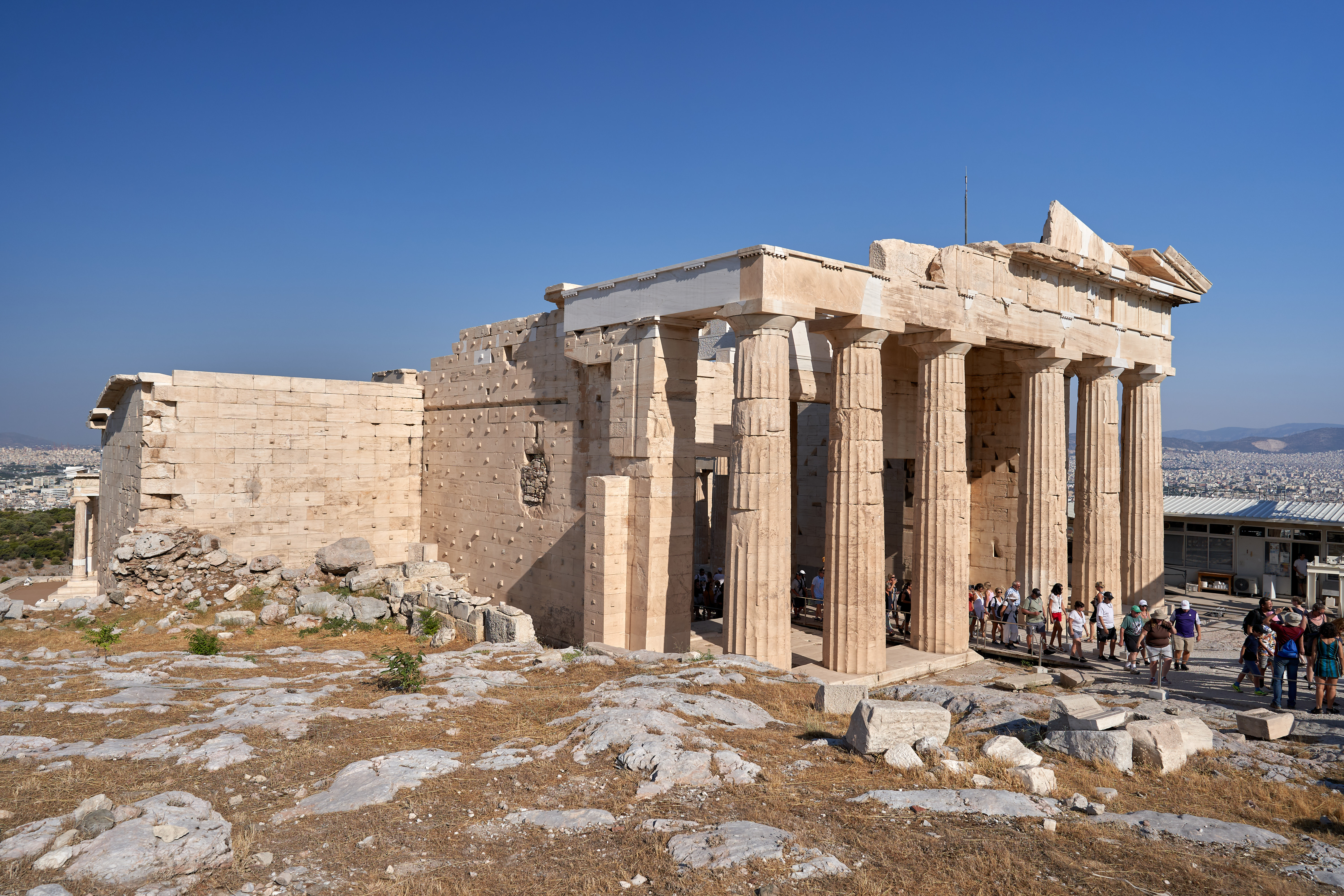
Propylaea by ancient Greek architect Mnesikles

  • C. 437-432 BCE → from CLASSICAL PERIOD (480-323 BCE)  

  • From Acropolis, Athens, Greece

  • Doric columns

  • The name given to monumental gates or entranceways to a specific space, usually to a temple or religious complex

  • No sculptural decoration, but its north wing was originally a dining hall that later became the earliest known museum (meaning “home of the muses,” a gallery built specifically to house a collection of paintings for public view)

  • Propylaea is an entryway


<ul><li><p><span style="background-color: transparent; font-family: &quot;Times New Roman&quot;, serif;">C. 437-432 BCE → from <strong>CLASSICAL PERIOD (480-323 BCE)&nbsp;&nbsp;</strong></span></p></li><li><p><span style="background-color: transparent; font-family: &quot;Times New Roman&quot;, serif;">From Acropolis, Athens, Greece</span></p></li><li><p><span style="background-color: transparent; font-family: &quot;Times New Roman&quot;, serif;"><strong>Doric</strong> columns</span></p></li><li><p><span style="background-color: transparent; font-family: &quot;Times New Roman&quot;, serif;">The name given to monumental gates or entranceways to a specific space, usually to a temple or religious complex</span></p></li><li><p><span style="background-color: transparent; font-family: &quot;Times New Roman&quot;, serif;">No sculptural decoration, but its north wing was originally a dining hall that later became the earliest known museum (meaning “home of the muses,” a gallery built specifically to house a collection of paintings for public view)</span></p></li><li><p><span style="background-color: transparent; font-family: &quot;Times New Roman&quot;, serif;">Propylaea is an entryway</span></p></li></ul><p></p>
28
New cards
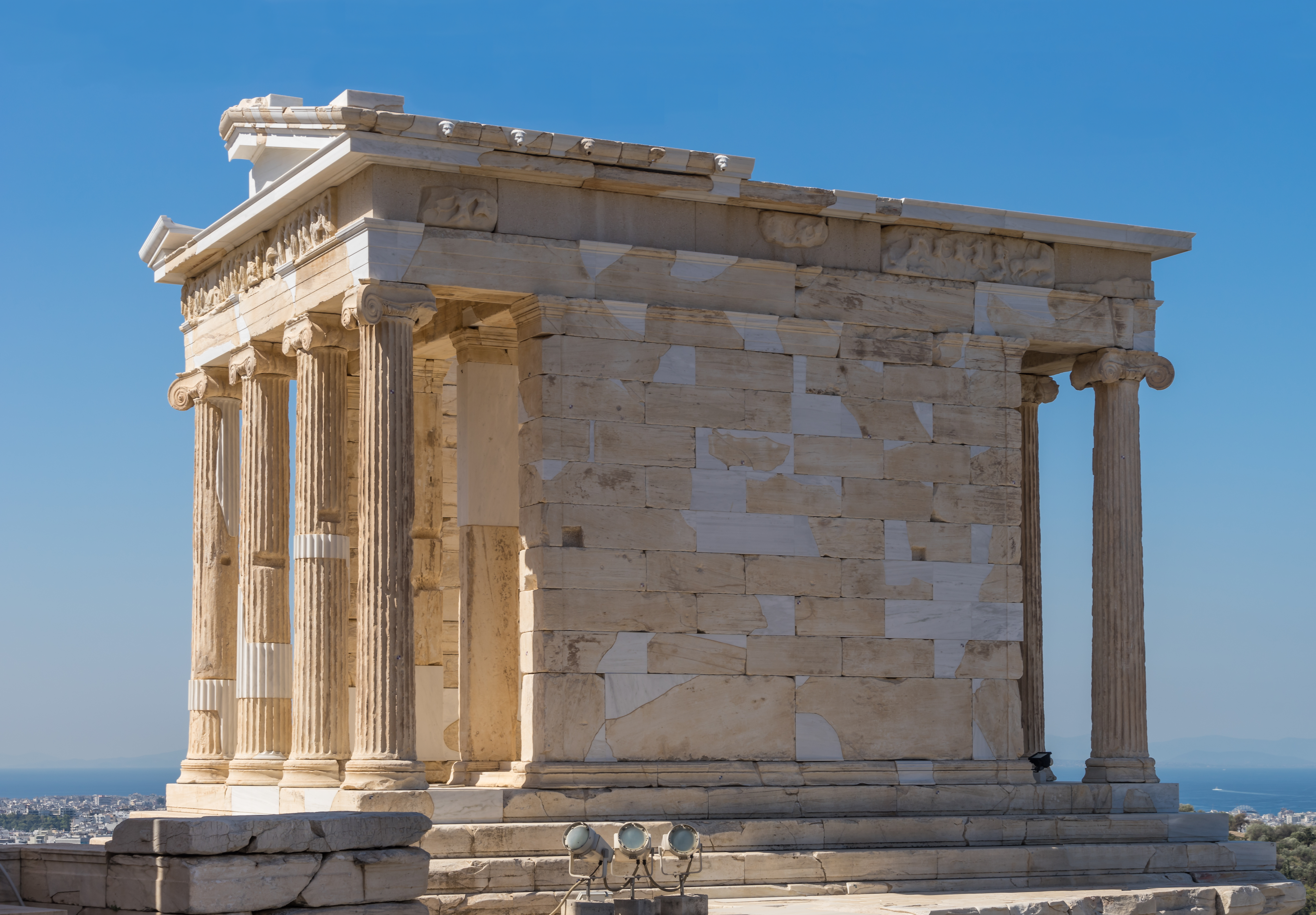
  • Temple of Athena Nike designed by architect Kallikrates


  • C. 425 BCE → from CLASSICAL PERIOD (480-323 BCE) 

  • From Athens, Greece

  • Amphiprostyle → having four columns in the front and four in the back

    • Both sides (two sides) have rows of columns

  • Built to commemorate the Greek victory over the Persians in the Battle of Marathon

    • Part of the frieze (broad horizontal band of painted, sculpted, or ornamental decoration) was dedicated to the battle of Marathon that turned the tide against the Persians

  • Many images of victory on the temple

  • Near the Propylaea 

  • Covered in reliefs that depict Nike (means victory) in many forms

    • Holding up trophies and Persian spoils

    • Bringing sacrificial bulls to Athena

    • Nike Adjusting her Sandal surrounding the Temple of Athena Nike

      • From Acropolis, Athens, Greece

      • Ca. 410 BC

      • Marble

      • Graceful winged figure modeled in high relief

      • Deeply incised drapery lines reveal body, wet drapery

<ul><li><p><span style="background-color: transparent; font-family: &quot;Times New Roman&quot;, serif;">C. 425 BCE → from <strong>CLASSICAL PERIOD (480-323 BCE)&nbsp;</strong></span></p></li><li><p><span style="background-color: transparent; font-family: &quot;Times New Roman&quot;, serif;">From Athens, Greece</span></p></li><li><p><span style="background-color: transparent; font-family: &quot;Times New Roman&quot;, serif;"><strong>Amphiprostyle</strong> → having four columns in the front and four in the back</span></p><ul><li><p><span style="background-color: transparent; font-family: &quot;Times New Roman&quot;, serif;">Both sides (two sides) have rows of columns</span></p></li></ul></li><li><p><span style="background-color: transparent; font-family: &quot;Times New Roman&quot;, serif;">Built to commemorate the Greek victory over the Persians in the Battle of Marathon</span></p><ul><li><p><span style="background-color: transparent; font-family: &quot;Times New Roman&quot;, serif;">Part of the frieze (broad horizontal band of painted, sculpted, or ornamental decoration) was dedicated to the battle of Marathon that turned the tide against the Persians</span></p></li></ul></li><li><p><span style="background-color: transparent; font-family: &quot;Times New Roman&quot;, serif;">Many images of victory on the temple</span></p></li><li><p><span style="background-color: transparent; font-family: &quot;Times New Roman&quot;, serif;">Near the Propylaea&nbsp;</span></p></li><li><p><span style="background-color: transparent; font-family: &quot;Times New Roman&quot;, serif;">Covered in reliefs that depict Nike (means victory) in many forms</span></p><ul><li><p><span style="background-color: transparent; font-family: &quot;Times New Roman&quot;, serif;">Holding up trophies and Persian spoils</span></p></li><li><p><span style="background-color: transparent; font-family: &quot;Times New Roman&quot;, serif;">Bringing sacrificial bulls to Athena</span></p></li><li><p><span style="background-color: transparent; font-family: &quot;Times New Roman&quot;, serif;"><strong>Nike Adjusting her Sandal </strong>surrounding the Temple of Athena Nike</span></p><ul><li><p><span style="background-color: transparent; font-family: &quot;Times New Roman&quot;, serif;">From Acropolis, Athens, Greece</span></p></li><li><p><span style="background-color: transparent; font-family: &quot;Times New Roman&quot;, serif;">Ca. 410 BC</span></p></li><li><p><span style="background-color: transparent; font-family: &quot;Times New Roman&quot;, serif;">Marble</span></p></li><li><p><span style="background-color: transparent; font-family: &quot;Times New Roman&quot;, serif;">Graceful winged figure modeled in high relief</span></p></li><li><p><span style="background-color: transparent; font-family: &quot;Times New Roman&quot;, serif;">Deeply incised drapery lines reveal body, wet drapery</span></p></li></ul></li></ul></li></ul><p></p>
29
New cards

Altar of Zesus and Athena at Pergamon

  • C. 175 BCE → from HELLENISTIC PERIOD (323-30 BCE) 

  • Marble 

  • Altar placed on an elevated platform up a dramatic flight of stairs

  • Conscious effort to be in dialogue with the Panathenaic Frieze on the Parthenon

  • 7.5-foot-high frieze over 400 feet long wraps around monument

  • Contains an altar dedicated to Zeus

  • Ionic columns frame monument

  • Parallels made between King Attalos I’s victories over the Gauls in a recent war, Alexander the Great’s defeat of the Persians, and the gods’ defeat over the giants in mythology


<ul><li><p><span style="background-color: transparent; font-family: &quot;Times New Roman&quot;, serif;">C. 175 BCE → from <strong>HELLENISTIC PERIOD (323-30 BCE)&nbsp;</strong></span></p></li><li><p><span style="background-color: transparent; font-family: &quot;Times New Roman&quot;, serif;">Marble&nbsp;</span></p></li><li><p><span style="background-color: transparent; font-family: &quot;Times New Roman&quot;, serif;">Altar placed on an elevated platform up a dramatic flight of stairs</span></p></li><li><p><span style="background-color: transparent; font-family: &quot;Times New Roman&quot;, serif;">Conscious effort to be in dialogue with the Panathenaic Frieze on the Parthenon</span></p></li><li><p><span style="background-color: transparent; font-family: &quot;Times New Roman&quot;, serif;">7.5-foot-high frieze over 400 feet long wraps around monument</span></p></li><li><p><span style="background-color: transparent; font-family: &quot;Times New Roman&quot;, serif;">Contains an altar dedicated to Zeus</span></p></li><li><p><span style="background-color: transparent; font-family: &quot;Times New Roman&quot;, serif;">Ionic columns frame monument</span></p></li><li><p><span style="background-color: transparent; font-family: &quot;Times New Roman&quot;, serif;">Parallels made between King Attalos I’s victories over the Gauls in a recent war, Alexander the Great’s defeat of the Persians, and the gods’ defeat over the giants in mythology</span></p></li></ul><p></p>
30
New cards

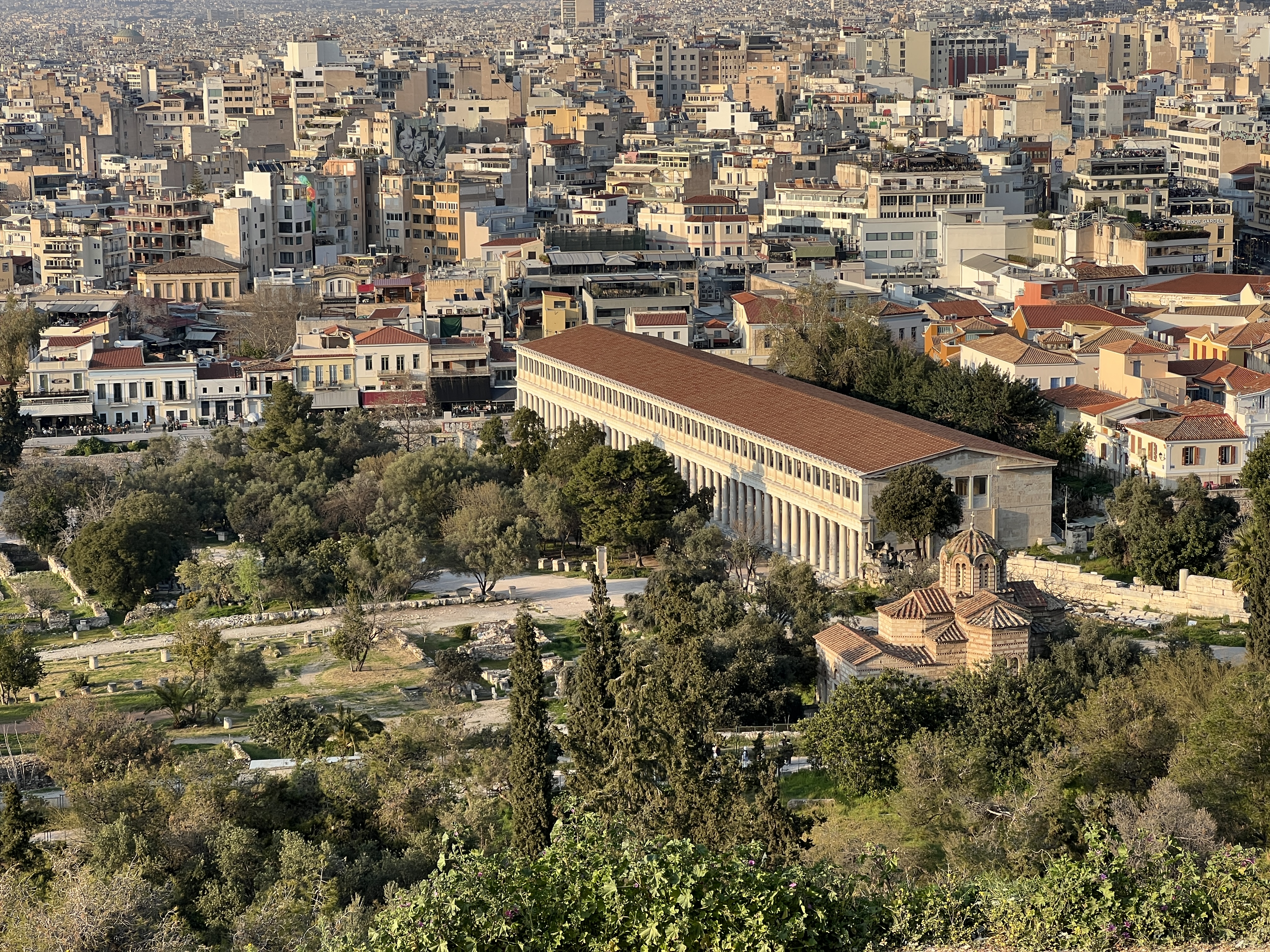
Athenian Agora

  • C. 600-150 BCE → from ALL THREE PERIODS [Archaic (600-480 BCE) + Classical (480-400 BCE), Late Classical (400-323 BCE) + Hellenistic (323-30 BCE)]

  • From Athens, Greece

  • A plaza at the base of the Acropolis in Athens that contained commercial, civic, religious, and social buildings

    • Ceremonies took place here

  • Setting for the Panathenaic Festival, ceremonies and parades to honor Athena

  • The Panathenaic War cuts through the plaza from the northwest to the southeast corners

  • Plaza surrounded by important buildings including:

    • A bouleuterion → a chamber used by a council of citizens

    • A tholos → a round temple-like structured manned by a group of senators 24 hours a day for emergency meetings

      • A circular shrine

    • Several stoas → a covered walkway with columns on one side and a wall on the other

<ul><li><p><span style="background-color: transparent; font-family: &quot;Times New Roman&quot;, serif;">C. 600-150 BCE → from <strong>ALL THREE PERIODS </strong>[Archaic (600-480 BCE) + Classical (480-400 BCE), Late Classical (400-323 BCE) + Hellenistic (323-30 BCE)]</span></p></li><li><p><span style="background-color: transparent; font-family: &quot;Times New Roman&quot;, serif;">From Athens, Greece</span></p></li><li><p><span style="background-color: transparent; font-family: &quot;Times New Roman&quot;, serif;">A plaza at the base of the Acropolis in Athens that contained commercial, civic, religious, and social buildings</span></p><ul><li><p><span style="background-color: transparent; font-family: &quot;Times New Roman&quot;, serif;"><u>Ceremonies</u> took place here</span></p></li></ul></li><li><p><span style="background-color: transparent; font-family: &quot;Times New Roman&quot;, serif;">Setting for the Panathenaic Festival, ceremonies and parades to honor Athena</span></p></li><li><p><span style="background-color: transparent; font-family: &quot;Times New Roman&quot;, serif;">The Panathenaic War cuts through the plaza from the northwest to the southeast corners</span></p></li><li><p><span style="background-color: transparent; font-family: &quot;Times New Roman&quot;, serif;">Plaza surrounded by important buildings including:</span></p><ul><li><p><span style="background-color: transparent; font-family: &quot;Times New Roman&quot;, serif;">A <strong>bouleuterion</strong> → a chamber used by a council of citizens</span></p></li><li><p><span style="background-color: transparent; font-family: &quot;Times New Roman&quot;, serif;">A <strong>tholos</strong> → a round temple-like structured manned by a group of senators 24 hours a day for emergency meetings</span></p><ul><li><p><span style="background-color: transparent; font-family: &quot;Times New Roman&quot;, serif;">A circular shrine</span></p></li></ul></li><li><p><span style="background-color: transparent; font-family: &quot;Times New Roman&quot;, serif;">Several <strong>stoas</strong> → a covered walkway with columns on one side and a wall on the other</span></p></li></ul></li></ul><p></p>
31
New cards

Niobides Krater by Niobid Painter

  • C. 460-450 BCE → from CLASSICAL PERIOD (480-323 BCE)

  • Clay  

  • Founded in Orvieto, Italy

  • Red figure painting

  • Used for parties and celebrations

    • Used for wine (diluting wine with water)

  • Not all figures on vase are on the same ground

    • Artist experiments with depth

    • More realistic

  • Called the Niobid Krater because on one side is depicted the killing of Niobid’s children

    • Niobid bragged about her fertility to the god Leto, who had only two children

    • Leto’s two children, Apollo and Artemis, seek revenge by killing Niobid’s twelve

    • Niobid punished for her hubris

  • Other side of vase, story is subject of scholarly debate

    • One theory is that it represents Hercules surrounded by heroes in arms and Athena

    • Another theory is that the warriors of Maranthon place themselves under the protection of Hercules

  • First time in vase painting that isocephalism (tradition of depicting heads of figures on same level) has been discarded

    • May have been the influence of wall paintings


<ul><li><p><span style="background-color: transparent; font-family: &quot;Times New Roman&quot;, serif;">C. 460-450 BCE → from <strong>CLASSICAL PERIOD (480-323 BCE)</strong></span></p></li><li><p><span style="background-color: transparent; font-family: &quot;Times New Roman&quot;, serif;">Clay&nbsp;&nbsp;</span></p></li><li><p><span style="background-color: transparent; font-family: &quot;Times New Roman&quot;, serif;">Founded in Orvieto, Italy</span></p></li><li><p><span style="background-color: transparent; font-family: &quot;Times New Roman&quot;, serif;">Red figure painting</span></p></li><li><p><span style="background-color: transparent; font-family: &quot;Times New Roman&quot;, serif;">Used for parties and celebrations</span></p><ul><li><p><span style="background-color: transparent; font-family: &quot;Times New Roman&quot;, serif;">Used for wine (diluting wine with water)</span></p></li></ul></li><li><p><span style="background-color: transparent; font-family: &quot;Times New Roman&quot;, serif;">Not all figures on vase are on the same ground</span></p><ul><li><p><span style="background-color: transparent; font-family: &quot;Times New Roman&quot;, serif;">Artist experiments with depth</span></p></li><li><p><span style="background-color: transparent; font-family: &quot;Times New Roman&quot;, serif;">More realistic</span></p></li></ul></li><li><p><span style="background-color: transparent; font-family: &quot;Times New Roman&quot;, serif;">Called the Niobid Krater because on one side is depicted the killing of Niobid’s children</span></p><ul><li><p><span style="background-color: transparent; font-family: &quot;Times New Roman&quot;, serif;">Niobid bragged about her fertility to the god Leto, who had only two children</span></p></li><li><p><span style="background-color: transparent; font-family: &quot;Times New Roman&quot;, serif;">Leto’s two children, Apollo and Artemis, seek revenge by killing Niobid’s twelve</span></p></li><li><p><span style="background-color: transparent; font-family: &quot;Times New Roman&quot;, serif;">Niobid punished for her hubris</span></p></li></ul></li><li><p><span style="background-color: transparent; font-family: &quot;Times New Roman&quot;, serif;">Other side of vase, story is subject of scholarly debate</span></p><ul><li><p><span style="background-color: transparent; font-family: &quot;Times New Roman&quot;, serif;">One theory is that it represents Hercules surrounded by heroes in arms and Athena</span></p></li><li><p><span style="background-color: transparent; font-family: &quot;Times New Roman&quot;, serif;">Another theory is that the warriors of Maranthon place themselves under the protection of Hercules</span></p></li></ul></li><li><p><span style="background-color: transparent; font-family: &quot;Times New Roman&quot;, serif;">First time in vase painting that isocephalism (tradition of depicting heads of figures on same level) has been discarded</span></p><ul><li><p><span style="background-color: transparent; font-family: &quot;Times New Roman&quot;, serif;">May have been the influence of wall paintings</span></p></li></ul></li></ul><p></p>
32
New cards

Alexander Mosaic from the House of Faun

  • C. 310 BCE → from HELLENISTIC PERIOD (323-30 BCE) 

  • Mosaic 

  • Roman copy of c. 100 BCE

  • Alexander at left: young, brave, forthright, assured of success

  • Darious in center right on chariot: horrified, weakly ceding the victory

    • His charioteer commands the horses to make their escape 

  • Crowded, with nervous excitement

  • Roman floor mosaic based on an original Greek mural painting, found at Pompeii

  • Extremely complex interweaving of figures

  • Perhaps a copy of mural made by Philxenos of Eretria for King Cassander

  • Alternative theory: made by Helen of Egypt, one of the few female Greek artists who have come down to us


<ul><li><p><span style="background-color: transparent; font-family: &quot;Times New Roman&quot;, serif;">C. 310 BCE → from <strong>HELLENISTIC PERIOD (323-30 BCE)&nbsp;</strong></span></p></li><li><p><span style="background-color: transparent; font-family: &quot;Times New Roman&quot;, serif;">Mosaic&nbsp;</span></p></li><li><p><span style="background-color: transparent; font-family: &quot;Times New Roman&quot;, serif;">Roman copy of c. 100 BCE</span></p></li><li><p><span style="background-color: transparent; font-family: &quot;Times New Roman&quot;, serif;">Alexander at left: young, brave, forthright, assured of success</span></p></li><li><p><span style="background-color: transparent; font-family: &quot;Times New Roman&quot;, serif;">Darious in center right on chariot: horrified, weakly ceding the victory</span></p><ul><li><p><span style="background-color: transparent; font-family: &quot;Times New Roman&quot;, serif;">His charioteer commands the horses to make their escape&nbsp;</span></p></li></ul></li><li><p><span style="background-color: transparent; font-family: &quot;Times New Roman&quot;, serif;">Crowded, with nervous excitement</span></p></li><li><p><span style="background-color: transparent; font-family: &quot;Times New Roman&quot;, serif;">Roman floor mosaic based on an original Greek mural painting, found at Pompeii</span></p></li><li><p><span style="background-color: transparent; font-family: &quot;Times New Roman&quot;, serif;">Extremely complex interweaving of figures</span></p></li><li><p><span style="background-color: transparent; font-family: &quot;Times New Roman&quot;, serif;">Perhaps a copy of mural made by Philxenos of Eretria for King Cassander</span></p></li><li><p><span style="background-color: transparent; font-family: &quot;Times New Roman&quot;, serif;">Alternative theory: made by Helen of Egypt, one of the few female Greek artists who have come down to us</span></p></li></ul><p><br></p>
33
New cards

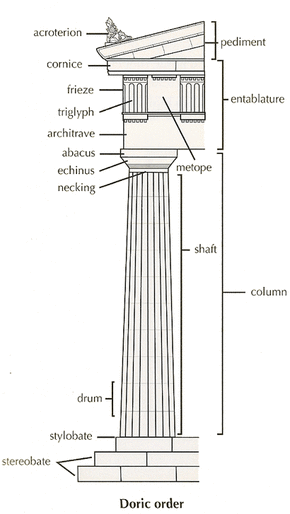
DORIC ORDER

  • Oldest, simplest, and most massive of the Greek orders

  • Doesn’t have base → stands directly on the stylobate

  • Shaft: stouter, heavier proportions, features shallow flutes and slight outward curve (entasis)

  • Capital: plain and understated, consisting of rounded, cushion-like echinus topped by square slab called abacus

  • Entablature: features a frieze marked by alternating triglyphs (grooved blocks) and metopes (sculpted or painted panels)

  • Example → The Parthenon in Athens


<ul><li><p><span style="background-color: transparent; font-family: &quot;Times New Roman&quot;, serif;">Oldest, simplest, and most massive of the Greek orders</span></p></li><li><p><span style="background-color: transparent; font-family: &quot;Times New Roman&quot;, serif;">Doesn’t have base → stands directly on the stylobate</span></p></li><li><p><span style="background-color: transparent; font-family: &quot;Times New Roman&quot;, serif;"><strong>Shaft</strong>: stouter, heavier proportions, features shallow flutes and slight outward curve (<strong>entasis</strong>)</span></p></li><li><p><span style="background-color: transparent; font-family: &quot;Times New Roman&quot;, serif;"><strong>Capital</strong>: plain and understated, consisting of rounded, cushion-like <strong>echinus</strong> topped by square slab called<strong> abacus</strong></span></p></li><li><p><span style="background-color: transparent; font-family: &quot;Times New Roman&quot;, serif;"><strong>Entablature</strong>: features a frieze marked by alternating <strong>triglyphs</strong> (grooved blocks) and <strong>metopes</strong> (sculpted or painted panels)</span></p></li><li><p><span style="background-color: transparent; font-family: &quot;Times New Roman&quot;, serif;">Example → <strong>The Parthenon in Athens</strong></span></p></li></ul><p></p>
34
New cards

IONIC ORDER

  • Originates in Ionia

  • Offers from more slender, graceful, ornate aesthetic

  • Base: a molded circular base supports the column

  • Shaft: taller and slenderer with deeper flutes

  • Capital: distinctively marked with twin spiral scrolls called volutes

  • Entablature: features a continuous (unbroken) sculpted relief frieze rather than triglyphs and metopes

  • Example → The Erechtheion on the Acropolis


<ul><li><p><span style="background-color: transparent; font-family: &quot;Times New Roman&quot;, serif;">Originates in Ionia</span></p></li><li><p><span style="background-color: transparent; font-family: &quot;Times New Roman&quot;, serif;">Offers from more slender, graceful, ornate aesthetic</span></p></li><li><p><span style="background-color: transparent; font-family: &quot;Times New Roman&quot;, serif;"><strong>Base</strong>: a molded circular base supports the column</span></p></li><li><p><span style="background-color: transparent; font-family: &quot;Times New Roman&quot;, serif;"><strong>Shaft</strong>: taller and slenderer with deeper flutes</span></p></li><li><p><span style="background-color: transparent; font-family: &quot;Times New Roman&quot;, serif;"><strong>Capital</strong>: distinctively marked with twin spiral scrolls called <strong>volutes</strong></span></p></li><li><p><span style="background-color: transparent; font-family: &quot;Times New Roman&quot;, serif;"><strong>Entablature</strong>: features a continuous (unbroken) sculpted relief frieze rather than triglyphs and metopes</span></p></li><li><p><span style="background-color: transparent; font-family: &quot;Times New Roman&quot;, serif;">Example → <strong>The Erechtheion on the Acropolis</strong></span></p></li></ul><p></p>
35
New cards

CORINTHIAN ORDER

  • The latest and most elaborate of Greek orders

  • Later heavily favored by the Romans

  • Base: an ornate, decorative base supports the column

  • Shaft: tall, slender, and fluted

  • Capital: deeply carved and elaborate, decorated with stylized, spiky acanthus leaves rising beneath small corner volutes

  • Example → The Temple of Olympian Zeus


<ul><li><p><span style="background-color: transparent; font-family: &quot;Times New Roman&quot;, serif;">The latest and most elaborate of Greek orders</span></p></li><li><p><span style="background-color: transparent; font-family: &quot;Times New Roman&quot;, serif;">Later heavily favored by the Romans</span></p></li><li><p><span style="background-color: transparent; font-family: &quot;Times New Roman&quot;, serif;"><strong>Base</strong>: an ornate, decorative base supports the column</span></p></li><li><p><span style="background-color: transparent; font-family: &quot;Times New Roman&quot;, serif;"><strong>Shaft</strong>: tall, slender, and fluted</span></p></li><li><p><span style="background-color: transparent; font-family: &quot;Times New Roman&quot;, serif;"><strong>Capital</strong>: deeply carved and elaborate, decorated with stylized, spiky <strong>acanthus leaves</strong> rising beneath small corner volutes</span></p></li><li><p><span style="background-color: transparent; font-family: &quot;Times New Roman&quot;, serif;">Example → <strong>The Temple of Olympian Zeus</strong></span></p></li></ul><p></p>