Ch 23-24 Physiology- Yui Hisanaga
 Call Kai
 Learn
 Practice Test
 Spaced Repetition
 Match
 Flashcards
 Knowt Play
1/14

There's no tags or description
Looks like no tags are added yet.
15 Terms
What does it mean that there is a dynamic balance that exists between energy intake and output?
What 3 things add up to create energy intake?
What includes energy intake?
What includes energy output?
It means that when energy intake and output are balanced, body weight remains stable, but when they are not, body weight will change.
Energy Intake = heat + work + storage
Energy Intake: includes all energy in the nutrients we eat, digest, and absorb.
Energy Output: energy loss as heat (50%), energy used to do work (which is driven by ATP) and energy that’s stored as fat or glycogen.
Where are the 2 hypothalamic centers? How do we know this exists?
Hint: rats
There are 2 classic theories for regulation of eating: Glucostatic Theory and Lipostatic Theory. What are both of their characteristics?
2 Hypothalamic Centers:
Feeding Center
Satiety Center
We know these exists, because in rats when we stimulate the feeding center, the fat will eat and eat, even if that means it’ll lead to death. Additionally, we know that the satiety center exists because when we stimulate that, the rats will not eat at all.
Regulation of Eating: How we know when to eat/when we get hungry
Glucostatic Theory: monitored by amount of glucose in our body
Food intake is regulated by glucose metabolism by hypothalamic centers.
Lipostatic theory: monitored by amount of fat in our body
Food intake is regulated by signals (leptin) that are sent from the body’s fat stores to the brain, which inhibits neuropeptide Y (powerful appetite-stimulator) .

What is metabolism?
What is anabolism and catabolism?
What might ingested biomolecules be used for?
Metabolism: sum of all chemical reactions in the body
Anabolism: (building macromolecules from smaller molecules)
Pathways in which complex molecules are synthesized from simpler substances (makes bonds require energy)
Catabolism: (breaking down complex molecules into smaller molecules)
Pathways in which complex molecules are broken down into smaller substances. (breaking bonds releases energy)
Ingested biomolecules: may be used for
Energy
Synthesis
Storage
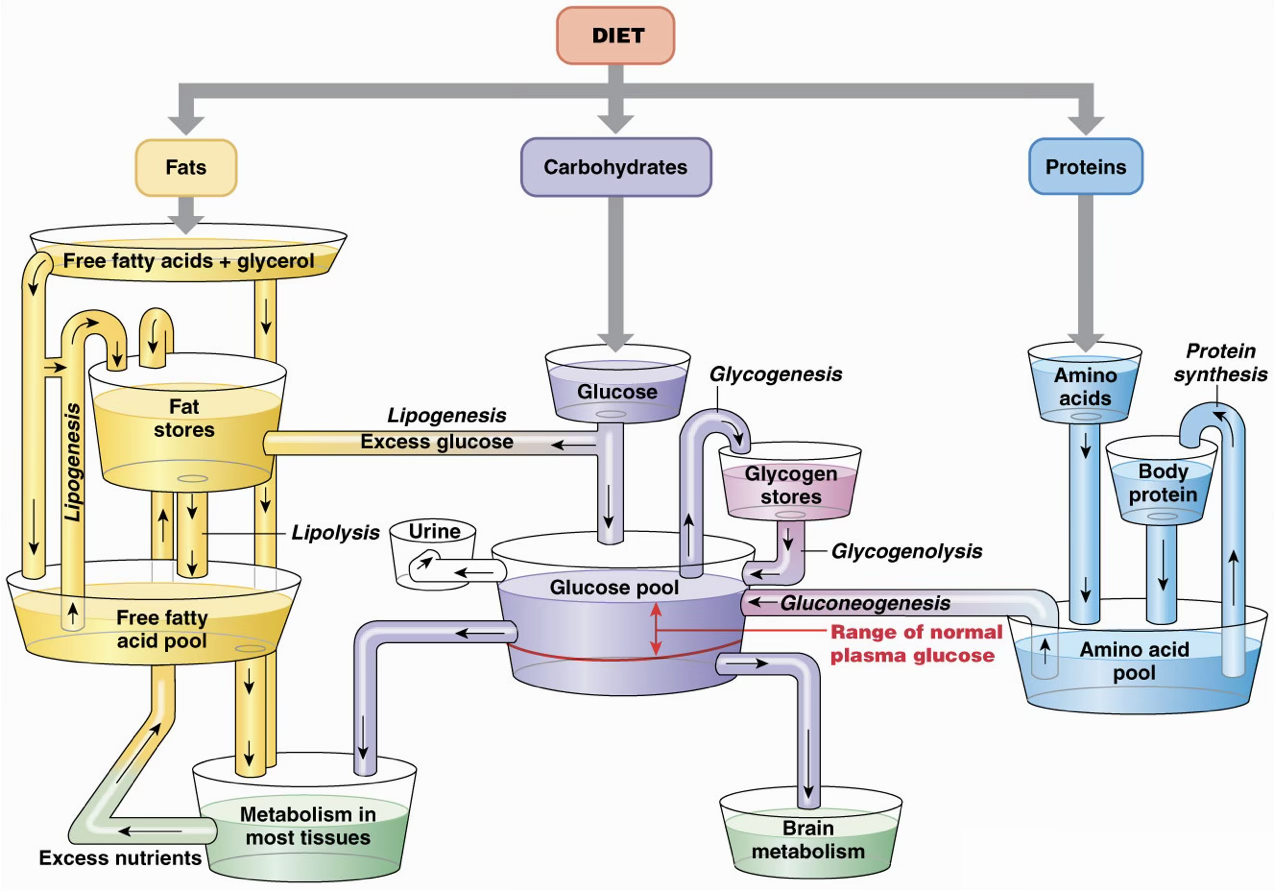
Be able to understand + know what’s going on in this diagram.
What is happening in the Fed-State Metabolism in carbohydrates (mainly glucose)? (3 things)
In the fed-state metabolism, carbohydrates (mainly glucose are..)
Used immediately for energy
Stored as glycogen (glycogenesis)
Excess that’s converted to fat and stored in adipose (lipogenesis)
What is happening in the Fasted-State Metabolism in carbohydrates? (mainly glucose)? (1 thing)
Glycogen is broken down in liver and muscle (glycogenolysis) to yield free glucose
What is happening in the Fed-State Metabolism in proteins (amino acids)?
(3 things)
Used by tissues for protein synthesis
Can be converted into metabolic intermediates if needed for energy
Excess can be converted to fat and stored in adipose (lipogenesis)
What is happening in Fasted-State Metabolism in proteins (amino acids)? (2 things)
Proteins broken down into individual amino acids
Amino acids can be deaminated and converted into glucose (gluoconeogenesis)
What is happening in the Fed-State Metabolism in fats? (fatty acids, tri-glycerides, and cholesterol) (3 things)
Stored as triglycerides in liver and adipose tissue (lipogenesis)
Cholesterol incorporated into cell membranes and steroids
Used for lipoprotein (delivery systems) synthesis
What is happening in the Fasted-State Metabolism in fats? (fatty acids, tri-glycerides, and cholestrol) (3 things)
Triglycerides broken down into fatty acids and glycerol (lipolysis)
Fatty acids used for aerobic respiration (beta oxidation)
Glycerol may be converted into glucose (gluconeogenesis)
Be able to understand all of these terms and categorize into absorptive or post-absorptive.
Glycogenolysis, Lipogenesis, Gluconeogenesis, Lipolysis, Protein Synthesis, and Glycogenesis
What is insulin and glucagon? When is it dominated? Where are they secreted and by what?
Insulin: signals anabolism when nutrients are plentiful during fed state. made by beta cells.
Dominated during fed state.
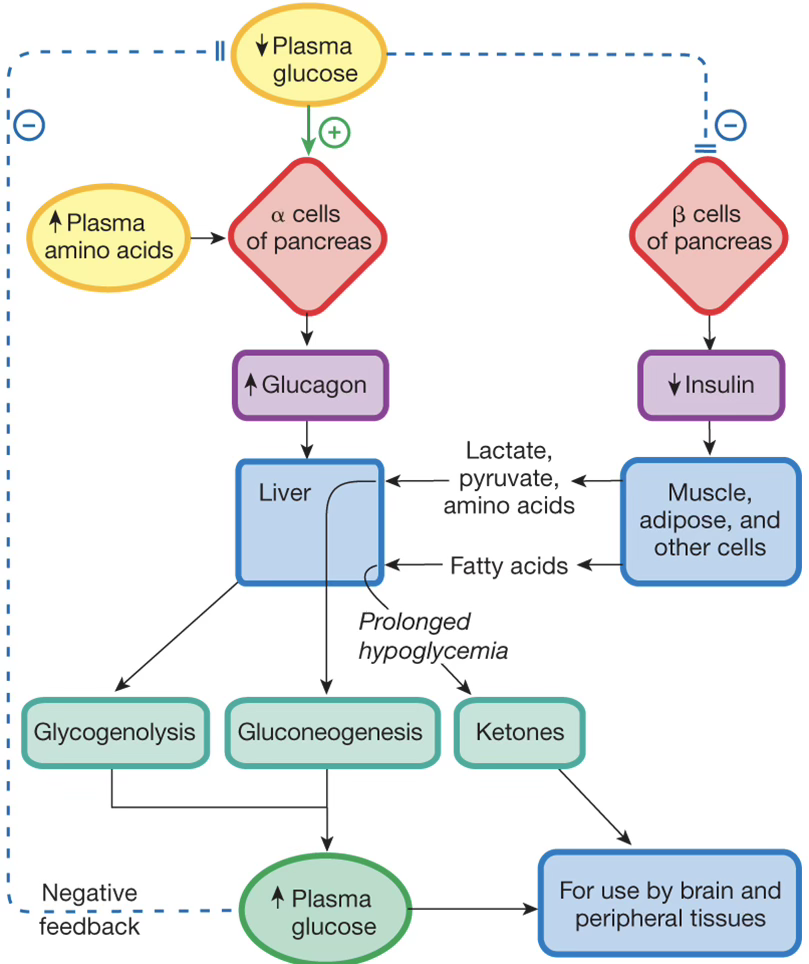
Glucagon: signals catabolism when nutrients are not plentiful. during fasted state. made by alpha cells.
Dominated during fasted state.
Alpha and Beta cells are apart of islet of langerhans.
What are the 4 stimuli for secretion of insulin?
What are the 3 ways that it lowers plasma glucose?
Stimuli for secretion:
Increased plasma glucose
Increased plasma amino acids
Feed forward effects of GI hormones (gastrin and CCK) because of the release of these hormones, the pancreas starts to release insulin before digested food molecules even cross the intestinal wall. prevents hyperglycemia
Increased parasympathetic activity (rest and digest) and decreased sympathetic activity.
Lowers plasma glucose by:
Increasing glucose transport into most insulin-sensitive cells
Enhances cellular utilization and storage of glucose
Inhibits enzymes that promote glycogenolysis, gluconeogenesis, and lipolysis.
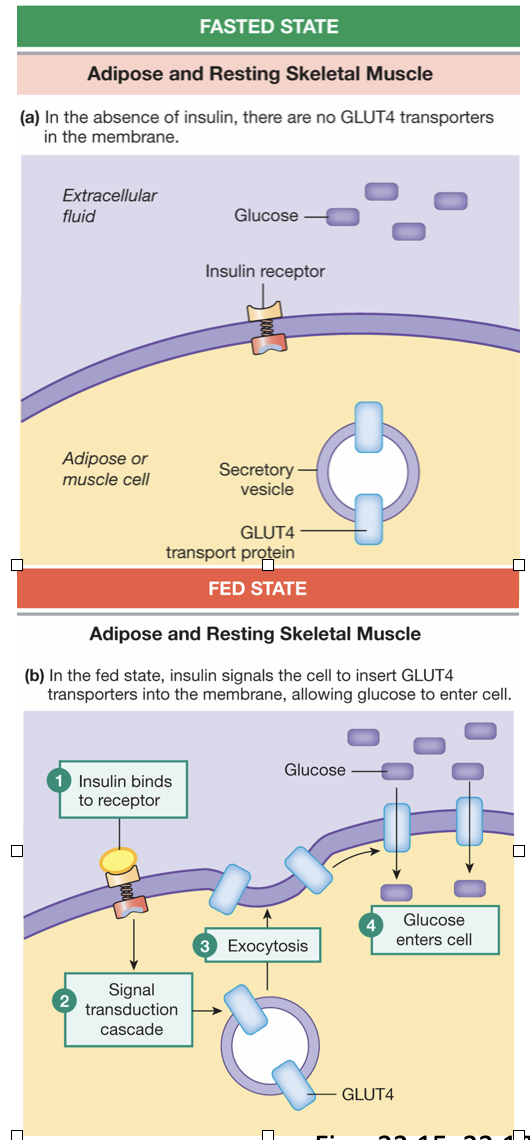
What is the difference in adipose and resting in skeletal muscle, during the fasted and fed state?
Fasted:
In the absence of insulin, there are no GLUT4 transports in membrane.
Fed:
In the presence of insulin, insulin signals the cell to insert GLUT4 transporters to the membrane, which allows glucose to enter the cell.
What are the 2 stimuli for secretion of glucagon?
Where is the primary tissue?
What are the 2 ways that it increases plasma glucose?
Stimuli:
Decreased plasma glucose
Increased plasma amino acids
Primary Tissue: Liver
Increases plasma glucose by:
Stimulating glycogenolysis
Stimulate gluconeogenesis