Eukaryote Diversity L11
 Call Kai
 Learn
 Practice Test
 Spaced Repetition
 Match
 Flashcards
 Knowt Play
1/40

There's no tags or description
Looks like no tags are added yet.
41 Terms
Metabolic Diversity
Based upon how the microbes obtain energy
Functional Diversity
Based upon what the cells are doing, often includes metabolic diversity
Morphological diversity
Based upon the visual appearance of the cells
Phylogenetic diversity
Based upon the evolutionary relationship between microbes (BASED UPON 18s rRNA)
What are the 5 Protist Phyla’s
Archaeplastida
SAR Clade
Excavates
Amoebozoa
Haptophytes
Characteristics of Excavata: DIPLOMONADS and PARABASALIDS
Conserved energy via FERMENTATION
Unicellular, flagellated
Lack mitochondria and chloroplasts
Anoxic environment as symbionts or parasites
Characteristics of Excavata: KINETOPLASTIDS
Unicellular, free living or parasitic flagellated
Has KINETOPLASTS (a mass of DNA) in their mitochondrion
Characteristics of Excavata: EUGLENIDS
NON-PATHOGENIC
Line in aquatic habitats
Chemotrophs and phototrophic
SAR Clade: Alveolata
They have ALVEOLI which are cytoplasmic sacs located just under the cytoplasmic membrane
What are the three kinds of alveolates
Ciliates: use cilia for movement
Dinoflagellates: use flagellum for movement
Apicomplexans: animal parasites
Ciliates
Posses cilia
Have two nuclei (Micronuclei and macronuclei)
Dinoflagelletes
Move in a spinning motion with flagella
Aquatic phototrophic alveolates
Can be toxic causing ‘red tides’
Apicomplexans
non-phototrophic obligate parasites
Cause malaria and toxoplasmosis
spread via sporozites
Have apicoplats (degenerate chloroplasts)
SAR Clade : Stamenopiles
Chemoorganotrophic and phototrophic microbes
Have flagella with short, hair-like extensions
Include: Diatoms, oomycetes, golden algae, brown algae
SAR Clade: Stramenopiles: Diatoms
Planktonic phytoplankton
Cell walls are made of silica
Asexual reproduction which always produces smaller cells
SAR Clades: Stramenopiles: Oomycetes
Water molds, previously thought to be fungi
Cell walls are made of cellulose
Decomposers in aquatic environments
SAR Clades: Stramenopiles: Golden and Brown Algae
Golden algae are mostly unicellular
Contain Chl c
Brown Algae are MULTICELLULAR and macroscopic
Colour comes from carotenoid pigments
SAR Clade: Rhizaria
Unique threadlike cytoplasmic extrusions called PSEUDOPODIA which are used for movement and feeding
SAR Clade: Rhizaria: Chlorarachniophyes
Marine and freshwater
Amoeba-like phototrophs that develop a flagellum for dispersal
SAR Clade: Rhizaria: Foraminiferans
Marine only
Have an ornate calcium carbonate test which does not decay easily
SAR Clade: Rhizaria: Radiolarians
Mostly planktonic
Tests are made on silica and have radial symmetry
Strictly heterotrophic, eating bacteria
Radiating spines help organism to float
In areas of ocean receiving enough light, there is a common relationship with algal symbionts
Haptophytes: Coccolithophores
Unicellular free living aquatic phototrophs
Two flagella, two chloroplasts
Haptonema (used for attachment and defense)
Rigid polysaccharide plates called coccoliths in this case
Ecologically important in carbon cycling, including the ‘biological pump’
Amoebozoa
Terrestrial and aquatic protists that use lobe-shaped PSEUDOPODIA for movement and feeding
Amoebozoa: Gymnamoebas
Free-living protists
Aquatic and soil environments
Move by cytoplasmic streaming which is called amoeboid movement
Example: Amoeba
Amoebozoa: Entamoebas
PARASITES
oral cavities or intestinal tract of animals
Entamoeba histolytica: can cause amebic dysentery
Amoebozoa: Slime molds
Previously thought to be fungi due to similar life cycle and fruiting bodies that produce SPORES
Groups: acelluar and cellular slime molds
Amoebozoa: Plasmodial (acellular slime mold)
Vegetative forms are masses of protoplasm of INDEFINITE SIZE AND SHAPE
degrade rotting organic matter and feed by endocytosis
Large mass with contain up to 10,00 nuclei
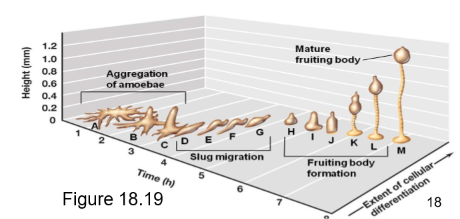
Amoebozoa: Cellular slime mold
STRICTLY AMOEBOID CELLS
Starved cells release compounds detected by other cells which form aggregate around signaling cell, forming multicellular PSEUDOPLASMODIUM
Endocytosis to feed on bacteria and yeast
Cells pile on top, bottom cell forms stalk
Tip cells produce spores that germinate
Archaeplastida (Algae)
Only groups that originated from primary endosymbiotic events
Archaeplastida: Green Algae
CHLOROPHYTES
mostly freshwater
Chl a and Chl b
Unicellular, filaments to colonial
Archaeplastida: Red Algae
RHODOPHYTES
Mostly marine
Chl a and phycoerythrin
Multicellular and lack flagella
Seaweed and source of agar
Coralline important in reefs
Fungi
Are CHEMOORGANOTROPHS
ABSORPTIVE HETEROTROPHS
Secrete enzymes to break down complex, molecules extracellularly
Ecological success due to:
Large variety of enzymes
HIGH SURFACE TO VOLUME RATIO
Fungi Structure
Cell walls made of CHITIN
Reproduce both sexually (SPORE production) and asexually (BUDDING, SPORE PRODUCTION, FRAGMENTATION)
Multi-cellular filaments (hyphae)
Single cells (Yeast)
Some species grow as either filaments or yeasts or both
Fungi Reproduction
Asexually (Budding, spore production, fragmentation)
Sexual productions process:
Ascospores (in a sac)
Basidiospore (end of a club shaped structure)
Zygospores
Zoospores (motile spores)
Sexual produces spores are resistant to drying, heating and freezing
Spores distributed by WATER

Classification of Fungi
Microsporidia
Chytridiomycota
Mucoromycota
Glomeromycota
Ascomycota
Basidiomycota

Fungi: Microsporidia
Lack mitochondria
Parasitic that only exist as spores outside the host
Fungi: Chytridiomycota
Usually microscopic
Can be single celled or consist of a small mycelium
Produce a zoospore with single, posterior flagellum
Aquatic and moist habitats
Whole organism is transformed into an reproductive structure
Fungi: Mucoromycota
FOOD SPOILAGE
Soil and decaying plant material
Coenocytic (multinucleated)
Zygospores (Sexual spored)
Example: Bread mold
Fungi: Glomeromycota
MYCORRHIZAL ASSOCIATIONS
Symbiotic relationships with plant roots
Endomycorrihizae
Coenocytic (multinucleated)
Zygospores (sexual spored)
Fungi: Ascomycota
Range from simple YEAST forms to filamentous cup fungi and morels
Filamentous forms with septate hyphae
asexual reproduction by conidiospores
aquatic and terrestrial environments
asexual and sexual reproduction
Fungi: Basidiomycota
Sexual reproduction forms BASIDIUM (structure where haploid basidiospores are produced)
Fruiting body = basidiocarp
Examples:
