OCR A Level Physics - Chapter 8 - Current and Charge
 Call Kai
 Learn
 Practice Test
 Spaced Repetition
 Match
 Flashcards
 Knowt Play
1/88

There's no tags or description
Looks like no tags are added yet.
89 Terms
What is the definition of electric current?
Which condition must be satisfied for current to flow?
1) The *rate of flow of charge* (i.e. the amount of charge passing a point per unit time)
2) There must be a potential difference for current to flow
What is the equation that links charge transferred, current and time
Charge transferred = Current x Time
Q = I * t
Coulombs = Amperes x seconds
Hence what is current in simple terms?
Finish the sentence: If a current of 1 A is flowing...
1) It is the amount of charge passing a given point in a circuit per unit time
2) there is 1 coulomb of charge transferred per second
What is electric charge?
What are the two types of charge?
Finish the sentence: Objects with charges...
1) A physical property of particles or objects that causes them to attract or repel each other without touching
2) Positive and negative
3) interact and exert forces on each other: *like charges repel* and *opposite charges attract*
What is the unit of electric charge?
What is the definition of this unit?
1) Coulomb
2) the Coulomb is defined as the electric charge flowing past a point in one second when there is an electrical current of 1A
What are the base units of the Coulomb?
As
What is the definition of a charge carrier?
Any particle that has electric charge
What is relative charge?
What is elementary charge?
Hence what is the relative charge of a proton, Sodium cation and an oxide anion?
1) *Relative charge* is the charges on a particle measured against the constant "e"
2) *Elementary charge* (e) is the actual charge on a single proton, equal to: 1.6 x 10^-19 COULOMBS
3) A proton has a relative charge of *+1e* (the sign is very important)
A sodium cation also has a relative charge of *+1e*
An oxide anion has a relative charge of *-2e*
Charge question:
The current in a lamp is 6.2A. Calculate the number of electrons passig through one point in the lamp in 2 minutes?
Q = 6.2 * 120 = 744
744/e = 4.7 x 10^21
What is the net charge on an object?
What is the equation for net charge?
If two electrons were removed from a material?
If two electrons were added to the material?
1) The size of the overall charge on the object after electrons have have been added or removed, which is represented as a multiple of "e"
2) Q = +-ne (where n = number of electrons either added or removed and e = elementary charge)
3) If 2 electrons were removed from a material, the material will become positi:
charge = +2e
= +3.2 x 10^19
4) If 2 electrons were added to a material, the material will become negative meaning:
charge = -2e
= -3.2 x 10^19
*REMEMBER - A NEGATIVE SIGN IMPLIES ELECTRONS HAVE BEEN* *ADDED WHEREAS A POSITIVE SIGN SHOWS ELECTRONS HAVE* *BEEN REMOVED*
What does it mean by charge on an object being *quantised*
(not pronounced quantisized)
It means that the charge can only have certain values - only integer multiples of e (1.6 x 10^-19)
This is because you can never have "half a proton or electron" transferred to or from a material, only full charges
E.g. an object with 12 added electrons will have a net charge of -12e and a total charge of -1.92 x 10^-18
Does electric current always necessarily mean a flow of electrons?
No - it can mean a flow of ions or any other charge carriers
e.g. in the brain, electric current in the nerve cells involves sodium and potassium ions passing through different parts of the membrane surrounding each cell.
1) How can metals conduct electricity?
3) Why might there be a large current?
1) Metals have giant ionic crystalline structure formed of fixed positive ions surrounded by free delocalised electrons.
2) When there is a potiential difference across the ends of a wire in a complete circuit, then electrons are attracted to the positive side. This flow of electrons is the electric current
3) There are *more electrons passing a given point in a second*, e.g. in a wire with a larger cross section or a metal with a higher number density
4) There maybe the *same number of electrons moving faster* through the metal
What is conventional current?
How is it different to electric current in a metal wire?
1) The direction of electric current from the positive terminal of a source to a negative terminal.
THIS IS FOR ALL TYPES OF CURRENT, whether it be electrons or ions.
2) The direction of electric current here is in the opposite direction of conventional current, because the charge carriers are electrons - which move from the negative terminal to positive terminal
What are electrolytes?
What are the charge carriers in electrolytes?
1) An ionic solution or molten ionic compound that conducts electricity because it contains ions.
2) Positive and negative ions, NOT ELECTRONS - hence electric current is caused by the flow of these ions
What are the two types of electrolytes?
1) Molten ionic compounds
2) Ionic solutions (ionic compounds dissolved in a solvent)
What happens when an ionic compound dissolves in water?
1) Compound disassociates into positive cations and negative ions
How does electrolysis work?
1) Two electrodes (anode and cathode) are placed into an electrolyte, like aqueous NaCl
2) When a potential difference is applied, Na+ cations migrate towards the cathode, accept an electron and become Na atoms
3) Cl- anions migrate to the anode, and donate an electron to become Cl atoms. These donated electrons flow through the wires.
4) There is an electric current generated, due to the flow of ions (charge) through the solution, and a flow of electrons through the metal part of the circuit

Finish the sentence: Charge must be...
What is the law of the conservation of charge?
Finish the sentence: The total amount of charge in the universe is...
1) conserved
2) Electric charge can neither be created or destroyed
3) constant
What is Kirchhoff's first law?
Why?
1) At a junction in a circuit (point) the total current entering the junction is EQUAL to the total current leaving the junction
Hence ΣI(in) = ΣI(out)
2) This is a consequence of the conservation of charge.
Current = charge per unit time
Since charge cannot be destroyed, the total number of charge carriers entering a point IN A GIVEN TIME *must* equal the total number of charge carriers leaving that same point during that time
Do Kirchhoff's law practice:
DO IT
What is the definition of number density?
Finish the sentence: The higher the number density of a metal...
1) The number of free charge carriers per m3 of material
2) the greater the number of free electrons per m3, and so the better the conductor
Finish the sentences:
Conductors have a very high number density of the order...
Insulators have a much much lower number density, with semiconductors in between the two with number density around...
1) 10^28
2) 10^17
Finish the sentence: The conductivity of semiconductors depend on...
temperature, since at higher temperatures free electrons can move faster and hence there is a greater amount of charge flowing per unit time = HIGHER CURRENT
Do charge carriers move fast or slow?
If charge carriers flow so slowly, how does an electrical appliance like a light switch on so quickly?
1) Relatively slow, party because of the free electrons (type of charge carrier) colliding with metal cations in a wire as they drift through towards the positive terminal
2) Since all the free electrons in the wire move at the same time, the light turns on instantaneously.
What is the definition of mean drift velocity?
It is the average velocity that a charge carrier attains when an electric current flows.
How can you calculate number density, from the density of a material and the molar mass?
*n = Na . ρ . x /Mr*
number density = Avogadro constant x density of material x number of free electrons per atom / molar mass
What is the equation that relates, current through a material, number density of that material, cross sectional area, mean drift velocity, and elementary charge?
*I = Anev*
I = Current in Amps
A = CSA in m^2
n = number density of material, in m^-3
e = elementary charge in Coulombs
v = mean drift velocity in m/s
*MAKE SURE EVERYTHING IS IN SI UNITS FIRST*
ALSO REMEMEMBER ELECTRONS ARE USUALLY SLOW
How can you derive I = Anev?
1) Draw out a cylindrical wire
2) Let *L* be the displacement of a charge carrier (electron) in some time *t*
3) Also let *A* equal the cross sectional area of the material (wire)
4) Number of electrons flowing within this volume will be density x volume, hence = nV
5) The total charge passing through this volume will therefore be *neV* ---> QsubV = neV
6) Current = charge/time
7) I = neV/t
8) *I = neA(L/t)*
9) displacement/time gives the velocity of the electrons
10) Hence *I = neAv*
11) Hence *I = Anev*

Question on I = Anev:
A copper wire has a cross sectional area of 7.85 x 10^-7 m2
The number density of copper = 8.50 x 10^28 m-3
Calculate the mean drift velocity when the current is 1.40 A
1.31 x 10^-4 m/s
What is the relationship between CSA and drift velocity?
Prove it
Why is this the case?
If the radius of a wire halves, what happens to mean drift velocity?
1) They are inversely proportional to each other
2) I = Anev
v = I/Ane
According to Kirchhoff's first law, the current must stay the same, and n,e stay the same anyway (obv)
hence: *v α 1/A*
3) In order to maintain the same current (rate of flow of charge), electrons must flow faster through narrower wires
4) r = r/2
Hence area is now quartered
since area is inv prop to velocity, the velocity increases by a factor of 4
What is the point of using an internationally recognised set of symbols?
So that scientists and engineers around the world can construct similar circuits to test and verify claims made by anyone working in this field
What are the 3 key rules for circuit diagrams?
1) Only use the correct circuit symbols
2) Do not leave any gaps between wires
3) Use straight lines drawn with pencil and ruler, but free hand sketch will be adequate in assessments
What is the difference between a battery and a cell?
A battery is actually two or MORE cells connected end to end, i.e. in series
What is the definition of potential difference?
What is the meaning of one volt?
Finish the sentence: We use the term potential difference, and NOT electromotive force in cases where charge carriers...
Finish the sentence: The greater the p.d...
1) It is defined as the energy change per unit charge, when electrical energy is transferred out of a circuit to another form (light, sound etc...)
2) 1 volt is the p.d. across a component when 1J of energy is transferred per coulomb of charge
3) *DO WORK THEMSELVES*, and hence lose energy to other forms as they pass through a component. Hence we use the term potential difference (electrical energy -----> other forms)
4) the more energy per unit charge is transferred from electrical energy to other forms
What is the equation that relates potential difference, work done and charge?
V = E/Q
V = p.d. in volts
E = Energy transferred by charge in joules
Q = charge in coulombs
What is the purpose of a voltmeter?
Finish the sentence: Voltmeters are always connected in...
Finish the sentence: An ideal voltmeter should have an...
1) A voltmeter is a device that measures the amount of potential difference between two locations of charge separation (i.e. across a component)
2) parallel - so that the p.d. across them is the same as the p.d across the component
3) infinite resistance, so that no current passes through the voltmeter itself - this is not reality but voltmeters have resistance > 10^6 ohms
What is e.m.f?
Finish the sentence: We use the term electromotive force, and NOT potential difference in cases where...
Finish the sentence: The greater the e.m.f...
1) Electromotive force is defined as the energy change per unit charge, when other forms of energy are transferred to electrical energy
2) *WORK IS DONE ON THE CHARGE CARRIERS* - meaning that the charges gain energy, as they pass through a component like a cell, battery, or power pack.
3) The more energy per unit charge has been transferred into electrical energy (often transferred from chemical energy stored in a battery)
What are some sources of e.m.f ?
Solar cells, dynamos, alternators, thermocouples
What is the equation for e.m.f?
The same as for p.d. but replace the big V symbol for ε
For batteries should we use the term e.m.f or p.d.?
1) e.m.f, because they do work on charge carriers, transferring energy from chemical form to electrical energy
P.D. calculation
Calculate the energy transferred in 4 hours by an electrical heater that draws a current of 15A when the p.d. across it is 90V
19 MJ (2.s.f)
FINISH THE SENTENCES
Resistors have a...
ALL components (even cells)...
Hence each component...
It takes energy to push charge carriers through a component...
1) Known resistance
2) have their own resistances
3) resists the flow of charge carriers through it
4) and so the higher the resistance of that component, the more energy it takes, and hence the larger the share of p.d. it takes
What is the definition of resistance?
What is the equation for resistance?
What is the definition of the Ohm?
1) The ratio between the potential difference across a component and the current flowing through it
2) R = V/I
R = resistance in *Ω*
V = p.d. in *V*
I = current in *I*
3) 1 Ω = 1V x 1A^-1
Hence a component with 1Ω resistance will have a p.d. of 1V across it per amp of current
Hence a component with 500Ω resistance will have a p.d. of 500V when there is a current of 1A through it, or for example a p.d of 1000V through it when there is a current of 2A through it
What is Ohm's law?
i.e. he found out that when the p.d. across a wire doubled...
1) "For a metallic conductor kept at a constant temperature, the current in the wire is DIRECTLY PROPORTIONAL to the p.d. across it"
2) the current also doubled
As temperature of a conductor increases why does resistance also increase?
1) Temp inc = positive ions in the wire have more internal energy and vibrate with greater amplitude about their fixed, mean positions
2) As a result, ions collide more frequently with the free electrons (charge carriers) in the metal, so therefore the overall rate of flow of charge decreases ---> so resistance has increased
What is the point of an IV characteristic of a conductor?
It shows the relationship between the electric current in a component and the potential difference across it
*IV Characteristics for a resistor:*
Fixed resistors are designed to ensure their resistance is...
Hence the IV characteristic of a fixed resistor is...
This shows that for a fixed resistor...
This means that a fixed resistor obeys...
The fact that the graph stays the same even when current is reversed shows that...
Does a steeper line show higher or lower resistance?
1) constant, regardless of typical changes in temperature as current is varied
2) A *straight line through the origin*
3) the potential difference across it is DIRECTLY PROPORTIONAL to the CURRENT flowing through it
4) Ohm's Law and is an *ohmic condcutor*, and the resistance remains constant
5) The resistor behaves in the same way regardless of the polarity of the battery
6) A steeper line shows a lower resistance: this is because for a certain increase in p.d. the current increases by a larger amount than for a shallower line
*IV Characteristics for a filament lamp:*
The IV characteristic of a filament light bulb is...
This shows that for a filament light bulb...
This means that a filament light bulb does not obey...
The fact that the graph stays the same even when current is reversed shows that...
1) cubic-esque curve through the origin
2) the potential difference is NOT DIRECTLY PROPORTIONAL the current through it
3) ohm's law, and is therefore a *non-ohmic component*
4) the filament bulb behaves in the same way regardless of the polarity
Why is a filament bulb non-ohmic?
1) It is non ohmic because the potential difference is not directly proportional to the current, and this is due to the change in temperature of the wire
2) As the p.d. increases, so does the current, and hence so does the rate of flow of charge through the filament
3) High current enhances the heating effect resulting in an increase in temperature. This increase causes lattice ions to vibrate with greater amplitude and collide more frequently with free electrons, and this causes an increase in resistance.
4) This means that increasing p.d. by the same amount (for already high levels of p.d.) results in a smaller increase in the current, compared to the same increase in p.d. when the p.d. was initially low. This causes the graph to flatten out as p.d. is increases.
i.e. let's say I increase p.d. by 5 volts, the current initially increases by 10 amps.
Then I increase p.d. by another 5 volts, but the current this time only increases by 7 amps.
~EXTREMELY IMPORTANT POINT ABOUT IV CHARS~
Now, having said all that, repeat after me:
Resistance has NOTHING to do with the gradient of an IV graph.
Resistance is NOT the inverse of the gradient. It isn't. It's just not. Do the maths. Try it out.
The rest of you might still secretly think it's true. Banish this misconception forever from your minds.
THE WAY YOU SHOW HOW RESISTANCE IS CHANGING FOR AN IV GRAPH IS BY PICKING POINTS ON THE GRAPH AND CALCULATING THE RESISTANCE AT THOSE POINTS BY USING V/I
What is the purpose of a fixed resistor in a circuit when measuring the IV characteristic of a diode?
At high p.d. the diode has very low resistance, which results in a high current. The resistor is used as a protective resistor to limit the current at high p.d. and hence protect the diode from damage.
(high current damages diodes)
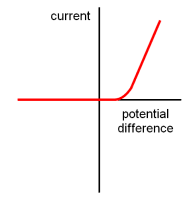
*IV Characteristics for a diode:*
The IV characteristic of a diode is...
This shows that for a diode...
This means that a diode does not obey...
The fact that the graph DOES not stay the same for negative values of current shows that...
1) as shown in the diagram --->
2) potential difference is *NOT PROPORTIONAL* to current
3) Ohm's law, so it is a non-ohmic component, and that the *RESISTANCE IS NOT CONSTANT*
4) the diode's behaviour depends on its polarity
What is an LED?
Finish the sentence: They only emit light of...
1) A light emitting diode which is made out of a material that emits light when the p.d. is high enough so that it conducts electricity
2) *SINGLE specific wavelength*, unlike filament light bulbs
What are the advantages of using an LED compared to a filament light bulb? (3)
1) LEDs are MUCH more efficient than filament bulbs, and hence require less energy to run
2) They last longer
3) They only emit light at particular wavelengths, so they can be used for coloured lighting
What are some common uses of an LED?
1) Arrays of LEDs are used in *car headlamps*
2) *Simple indicators* in circuits to show the direction of current through a particular part of the circuit - they light up when current flows through them, showing which part of the circuit is live
What is a diode?
A semiconductor device which only allows current in a particular direction ONLY, hence the terminals must be connected in a certain way
P1) How does the current through a diode vary as the potential difference is varied?
P2) What effect does this have on the function of an LED?
1) For *negative values of p.d.* the resistance of the diode is INFINTE - with the p.d. in this direction THE DIODE DOESN'T CONDUCT
2) INITIALLY for *positive values of p.d.* the current remains at *0A* (infinite resistance).
3) However at and after certain p.d. *(threshold p.d.)* the resistance gradually starts to drop. Above this value, the resistance *drops sharply* for every small increase in p.d.
4) *As p.d. increases resistance continues to drop*. The increasing gradient of the graph shows that *for a small increase in p.d., there is* *a large increase in current*
P2) When the threshold p.d. is achieved *the LED lights up*, and gets brighter and brighter as the p.d. increase
*DIFFERENT LEDs have different values for TP.D. - related to the colour of light they emit*
What is the threshold p.d. for a typical silicon diode?
0.7V
What are the four factors that affect the resistance of a wire?
1) Temperature
2) Material of the wire
3) Length of wire (L)
4) Cross-sectional area of the wire (A)
Finish the sentence: The term resistance only refers to...
Whereas resistivity is...
FOR EXAMPLE: copper wires may have different resistances as their lengths and CSAs differ, but copper (the material) has its own unique *resistvity*
1) a SPECIFIC COMPONENT
2) an *electrical property of a material* (like electron density) which allows you to calculate the resistance *given the dimensions* of a specified material
1) Finish the sentence: for any wire, doubling its LENGTH...
2) Hence:
3) What is the relationship between LENGTH of wire and RESISTANCE?
4) Finish the sentence: for a given p.d., doubling the CROSS SECTIONAL AREA will...
5) Hence wires with larger cross sections will...
6) So what is the relationship between resistance of a wire and its cross sectional area?
7) Finally we can combine these two relationships to give...
8) What is the constant of proportionality in this relationship, and hence what is the equation for resistance?
1) doubles the p.d. across it (for a given current)
2) since the current through the wire is constant the RESISTANCE must have also doubled *(V = IR)*
3) *R α L*
4) double the CURRENT in the wire, so the resistance must have halved
*(R = V/I ----> resistance is inversely proportional to current)*
5) have a lower resistance
6) *R α 1/A*
7) *R α L/A*
8) Constant of proportionality is *ρ*
Hence *R = ρL/A*
How do we define resistivity?
What is the equation for resistance?
The *resistivity of a material* at a *GIVEN TEMPERATURE* is the product of the resistance of a component made of that material and its CSA, divided by its length
R = ρL/A
R = Resistance in *Ω*
ρ = Resistivity in *Ωm*
L = Length of component in *m*
A = Cross sectional area of component in *m^2*
Example Question on resistivity:
Nichrome has a resistivity of 1.50 x 10^-6 Ωm
Calculate the resistance of a wire made from 80cm of nichrome and a radius of 2.0 x 10^-4 m
9.5Ω (2 s.f.)
Finish the sentence: Like resistance, when temperature increases...
so does resistivity
How does resistivity depend on if a material is a conductor/ insulator/ or semiconductor?
1) Conductors have resistivities on the order if 10^-8 Ωm
2) Insulators have *much higher resistivities*, on the order of 10^16
3) Semiconductors have resistivities in between
Finish the sentence: Whenever there is current in a component...
energy is transferred from the power source to that component. If the circuit is broken then no current flows through the component and hence no energy transferred
What is power (electrical power)
How to derive the equation for electrical power?
How to derive the other equations for electrical power?
1) The rate of energy transfer by an electrical component is called its electrical power.
P(general) = E/t
E(electrical) = QV
P = QV/t
P = ItV/t
*P = IV*
2) P = IV
V = IR
P = IR x R
*P = (I^2)R*
3) P = IV
I = V/R
P = (V/R) x V
*P = (V^2)/R*
ELECTRICAL POWER QUESTION:
A typical tablet charge has a power of 12W compared with a 6W mobile charger
Calculate the current drawn by a 12W charger when the p.d. 5.0V
I = 2.4A
ELECTRICAL POWER QUESTION 2
Calculate the energy transferred into heat in 2.0 minutes by a 2900W kettle
3.5 times 10 to the power of 9
JOULES
What is the point of an electricity meter in a house?
It accurately records the transfer of energy from the national grid to the house - All electricity supplied to the house passes through this meter
What does the energy transferred to each individual device, and hence how much it costs to run, depend upon? (3)
What does this mean in layman's terms?
1) The *POWER* of the device (how much energy it transfers per unit time)
2) How *LONG THE DEVICE IS USED FOR*
This is because we need these two variables to calculate energy transferred ---> E = Pt
3) A POWERFUL microwave may be cheaper to run than a LESS POWERFUL ONE, if it is used for a shorter time (i.e. the food cooks quicker)
Why don't we use the joule when measuring energy usage in houses?
What unit of ENERGY do we use instead?
What is the definition of a kilowatt-hour?
Kilowatt-hour is NOT a measure of...
What is 1kWh in joules
Hence what is the equation for energy transferred in kWh?
1) It's too small of a unit
2) the *kilowatt-hour* (kWh)
3) 1kWh is defined as the energy transferred by a device with a power of 1000W operating for a time of 1 hour
4) POWER
5) 1kWh = 1000W x 3600s
= 3.6 MJ
6) Energy(kWh) = Power(kW) x Time(h)
What does the cost of each kWh of electrical energy depend upon on?
The particular tariff from the electricity company - i.e. how much money per kWh
ELECTRICITY kWh QUESTION
How much does it cost to charge an electric car, if the charger is rated at 40W and it takes 8 hours to charge it, and the tariff is 22p per kWh
7.04p
What is Kirchhoff's second law?
What is the same law algebraically?
Which Law is this linked to and how?
What is the meaning of a closed loop?
1) The sum of the e.m.fs around a closed loop is *EQUAL* to the sum of the p.d.s around the same closed loop
2) *∑ε = ∑V (around a closed loop)*
3) This is linked to the *conservation of energy* since 2nd law states that:
The total energy transferred TO charges (*∑e.m.f*) is ALWAYS equal to the the total energy transferred FROM the charges as they move around the circuit (∑*p.d.*)
i.e. NO ENERGY IS LOST - ONLY TRANSFERRED/ DISSIPATED
4) A closed loop is a single possible path for the current - in a *series* circuit there is ONLY ONE CLOSED LOOP, but in a *parallel* circuit there are MANY LOOPS
What is a series circuit?
How does current behave in a series circuit?
How does p.d. behave in a series circuit?
b) If two components have the same resistance, how will the e.m.f be shared across them?
c) In series circuits with sources of *9V and 12V* connected in opposite directions, how can we deduce if there is a current flowing and in which direction?
1) A circuit that has only one path for current to flow - i.e. it is a single loop from ONE TERMINAL of a source of e.m.f, BACK TO THE OTHER
2) *CURRENT IS THE SAME IN EVERY POSITION* - since there is only a single path for current to flow and charge is never used up, the current is the same
3) *SUM of P.D.s ACROSS COMPONENTS = E.M.F* - i.e. emf is shared across all components
b) The p.d. across both components will be the same - SHARED EQUALLY
c) If sources are connected with *opposing polarities*, the total e.m.f will be 12V - 9V = 3V, and resulting in a current in the direction which the 12V cell is facing
1) What is a parallel circuit?
2) How does current behave in a parallel circuit?
b) The greater the resistance of a branch...
c) If branch 1 has twice the resistance of branch 2...
3) How does p.d. behave in a series circuit?
b) If one branch contains several different components...
THIS ONLY WORKS IF THERE ARE 2 BRANCHES
1) A parallel circuit has two or more paths for current to flow through - i.e. there are numerous loops
2) *CURRENT SPLITS AT A JUNCTION BETWEEN MULTIPLE PATHS* - since Kirchhoff's law states that current in = current out, when a branch is made in a circuit, part of the current passes through this branch while the rest of it passes through other branches
b) The smaller the current that passes through it
c) then it will have*half the current of branch 2* flowing through it - i.e. 2/3 of the current input to that junction will go through branch 2, and only 1/3 will go through branch 1 (1/3 x 2 = 2/3 ---> 2/3 + 1/3 = 1)
3) *P.D. ACROSS EACH BRANCH IS THE SAME AS SOURCE e.m.f* - this is because Kirchoff's second law says the p.d. across each loop = source e.m.f
4) sum of p.d.s of these components = source e.m.f
How does resistance work in a series circuit?
How can we derive this expression?
So as you add resistors in series...
1) *TOTAL RESISTANCE = SUM OF RESISTANCES OF INDIVIDUAL COMPONENTS*- R(t) = R1 + R2....
2) We know from K1 that I is the same everywhere in a series circuit, and that total e.m.f = total p.d - V(t) = V1 + V2...
Replace V with IR:
IR(t) = (IR)1 + (IR)2...
We can cancel out I since it is a constant, and hence:
R(t) = R1 + R2....
3) Total resistance increases
How does total resistance change when resistors are added in parallel?
What is the expression for resistance in a parallel circuit?
How can we derive this expression?
1) As resistors are added in parallel -> the *TOTAL RESISTANCE DROPS* - this is because the additional resistors provide another path for the current, and hence increasing the CSA of conductor, thereby reducing resistance
2) *1/Rt = 1/R1 + 1/R2 + 1/R3*
3) Let I(t) be current before there is any branching:
I(t) = I1 + I2 + I3....
Due to K2, the p.d. across each branch is constant, and is equal to V. Let us divide both sides of the equation by V:
I(t)/V = I1/V + I2/V + I3/V...
V = IR, so R = V/I and hence 1/R = I/V. Hence:
1/R = 1/R1 + 1/R2 + 1/R3...
In a parallel circuit how can you figure out the proportions of current passing through each branch if you know their resistances? (8)
1) Let's say you have a very typical parallel circuit with 2 branches (total 1 branch for the source battery, and 2 other branches with a resistor in each
2) In the first branch the resistance is *5Ω*, and in the second branch the resistance is *45Ω* ----> Hence the resistance in *R2 is 9x R1*
3) Add these two resistances up = *50Ω*
4) Hence R1 accounts fro 5/50 = *1/10th* of this total numerical resistance
5)...And R2 accounts fro 45/50 = *9/10ths* of this total numerical resistance
6) What's interesting is that the current has the SAME relation but in exactly in the opposite way:
7) i.e. *9/10ths of the CURRENT passes through R1* (the one with 5Ω) and *1/10th of the CURRENT passes through R2* (the one with 45Ω)
8) LOOK: The current passing through *R1 is 9x R2*
IMPORTANT CONFUSION ABOUT P.D. in a parallel circuit
T) What's the takeout of this misconception?
1) In this circuit there are *2 LOOPS*
- The SMALL loop only concerning the first light bulb, *L1*, and the cell
- The BIG loop concerning the second light bulb, *L2*, and the cell ONLY - i.e. *the big rectangle* (not including the middle branch)
2) Kirchoff's second law says that the sum of the p.d.s in a single loop must add up to the source e.m.f:
i.e. if the e.m.f was 10V, the p.d. across both the light bulbs would be identical, at 10V
However if I added another identical light bulb, *L3*, and I placed it so that it was part of the long side of the rectangle but above the branch of L1:
It means that L3 has hijacked both loops, which means that now:
L1 + L3 = 10V
and: L2 + L3 = 10V
which results in the p.d. of L1 and L2 decreasing from 10V :(
T) ALWAYS LABEL THE LOOPS IN A CIRCUIT

IMPORTANT CONCEPT ABOUT BULB BRIGHTNESS?
1) How bright a bulb is depends on its power output.
If a bulb as a 60W power output compared to a 50W power output than it will be brighter
Power is determined by the current flowing through x the p.d. across
So its not actually a higher voltage bulb or higher current bulb which determines brightness but its *POWER*
When there's a question about which method of paying for electricity is cheaper, what's the shortcut to doing it?
1) Note down the DIFFERENCE in tariff and then multiply by the TOTAL ENERGY CONSUMPTION
If a single copper ion discharges and produces 2 electrons into a circuit during electrolysis...
So if you had 50 electrons going through the circuit...
There will only be half the number of copper ions compared to electrons, because it is a *Cu 2+ ion*
There will be 50/2 = 25 number of copper atoms deposited on the cathode
When to use P = I^2R and when to use P=V^2/R ?
Use P = I^2R when the current is constant
Use P = V^2/R when the p.d is constant
How to solve any type of circuit question?
1) Label the loops
2) Label the nodes
3) Add current directions randomly
4) use junction rule and loop rule and find equations
5) Solve simultaneously
In some cases, a thermistor can go up in smoke (get destroyed)?
1) When the thermistor is connected, current flows and power is converted/heat energy produced (in the thermistor)
2) This causes the temperature of the thermistor to rise and its resistance to fall
3) Increased current flow so more heat energy produced
4) Cycle continues until thermistor overheats/is destroyed
Explain the term mean drift
velocity? (3 marks)
1) The free electrons make collisions with metal ions and this gives them a random velocity
2) The free electrons drift towards the positive end of the supply along the length of the wire
3) The distance travelled per unit time along the length of the wire is called mean drift velocity