Chemistry chapter 9
 Call Kai
 Learn
Learn Practice Test
 Spaced Repetition
 Match
Match Flashcards
 Knowt Play
1/57

Earn XP
Description and Tags
does not include 9.11 so far
Name | Mastery | Learn | Test | Matching | Spaced | Call with Kai | Chat |
|---|
No analytics yet
Send a link to your students to track their progress
58 Terms
Kinetic energy (KE)
The total energy of an object is a sum of its kinetic energy, associated with the motion of an object.

Potential energy (PE)
Energy associated with its position or composition
Thermal energy
Energy associated with the temperature of an object, always flows from hot to cold
Chemical energy
A type of potential energy associated with relative positions of electrons and nuclei in atoms and molecules
Energy (in Joules)
The capacity to do work (aka move), or transfer heat
Internal energy (E)
The sum of the kinetic and potential energies of all the particles (molecules/ions) that compose of the system.

Change in internal energy
The sum of the heat transferred (q) and the work done (w). Also deltaE can be written as Efinal-Einitial, or Eproducts-Ereactants, both mean the same as one another.

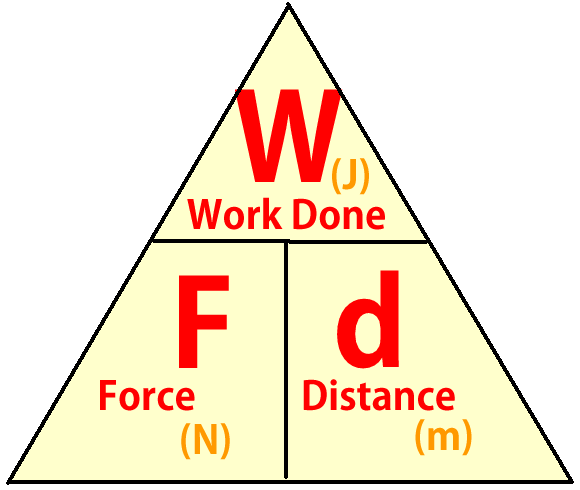
Work
The result of a force acting through a distance (or think of it as a force acting over a distance). Use w=F*d for when you have a constant force F acting over a distance d
Heat (q)
The flow of energy due to temperature difference difference.

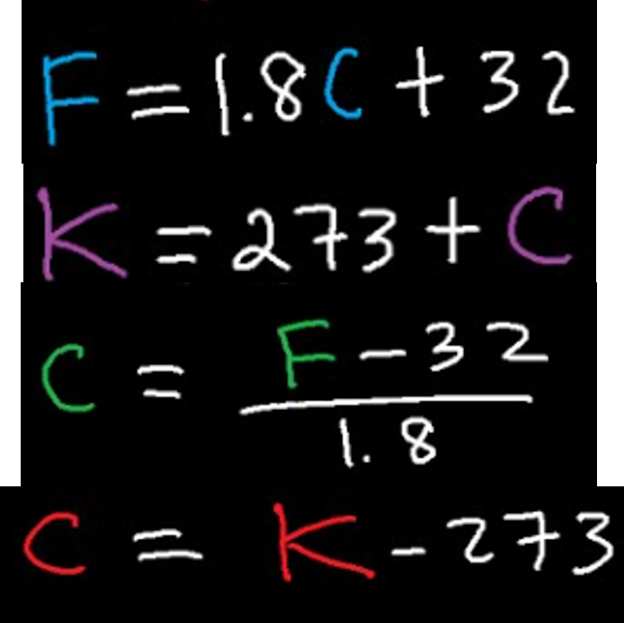
Temperature
Temperature: the measure of the average amount of kinetic energy a system contains

Exothermic
System loses thermal energy, change in energy is NEGATIVE. Transfer of energy from system to surroundings. The reaction gives off energy as it occurs, -, system gives off energy.


Endothermic
System gains thermal energy, change in energy is POSITIVE. Transfer of energy from the surroundings to the system. The reaction absorbs energy as it occurs, +, system absorbs energy.

First law of thermodynamics
The total energy of the universe is constant
calorie (cal), lowercase
The amount of energy required to raise the temperature of 1g of water by 1 Celsius, 1cal = 4.184J

Calorie (Cal), uppercase
1 Cal = 1000 cal

Law of conservation of energy
Energy cannot be created, nor destroyed. Energy may be transferred between objects or converted from one form to another
kJ to J
1kJ=1000J

State function (Delta followed by letter)
A property for which the change in the property does NOT depend on the path taken, and is determined only by the difference in the final and initial state. The value of a change in a state function is always the difference between its final and initial values.

The amount of energy lost by a system must exactly equal the amount gained by the surroundings

*Specific* Heat Capacity (Cs)
The amount of heat reuiqred to raise the temperature of 1 gram of the substance by 1 Celsius, units are in J/g*Celsius

Heat Capacity (C)
The quantity of heat required to change its temperature by 1 Celsius, units are in J/Celsius

Thermal equilibrium
The point at which there is no additional net transfer of heat between a system and its surroundings
Water has a higher heat capacity than iron
Molar heat capacity
The amount of heat required to raise the temp of one mole of a substance by 1 Celsius, Units are J/mol*Celsius
Heat exchange
In a heat exchange, when solving, while yes qsys=qsurr, remember one of them must at least be negative.

Thermal energy transfer example

Work formula for pressure-volume work
Use for problems that contain P-V work, like in pistons or balloons where a gas expands or contracts against an external pressure, Pext, which can be at 1atm or another number. The negative sign indicates that work done by the system (expansion), is considered negative because energy is transferred from the system to the surroundings.

101.3J=1L*atm
Given on exam


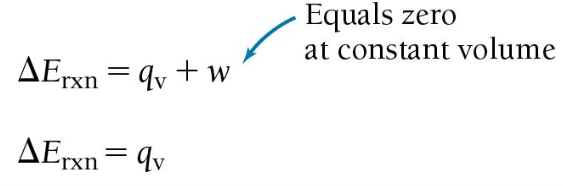
If a reaction is given out at constant volume, then deltaV=0, and w=0, meaning the heat given off, called the heat at constant volume, (qv), is equal to the change in internal energy
Standard heat exchanges setup for coffee-cup calorimetry and bomb calorimetry
Also for bomb calorimeters, it’s qrxn=-qcal (basically the same since solution = surroundings = calorimeter)

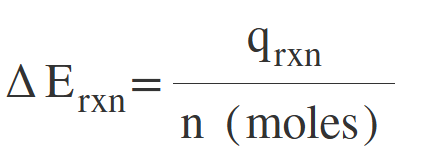
Change in internal energy for a reaction
To find change in internal energy of the reaction per mole, do heat of the reaction divided by n (moles)

Density Triangle
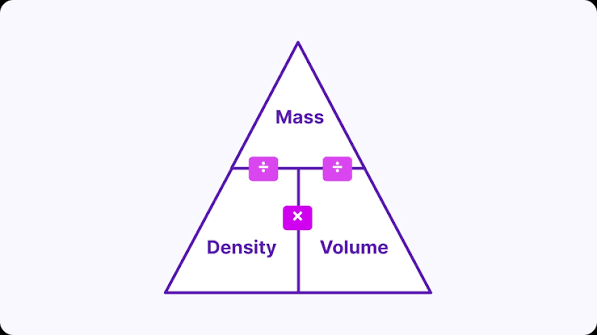
Mole Triangle

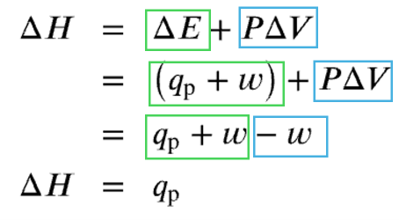
Enthalpy
The enthalpy of a system is a sum of its internal energy and the product of its pressure and volume

Change in enthalpy
The change in enthalpy for any process occurring under constant pressure. The change in enthalpy is equal to heat at constant pressure. For a reaction, the change in enthalpy of a reaction is the heat that’s emitted or absorbed during a chemical reaction under conditions of constant pressure.
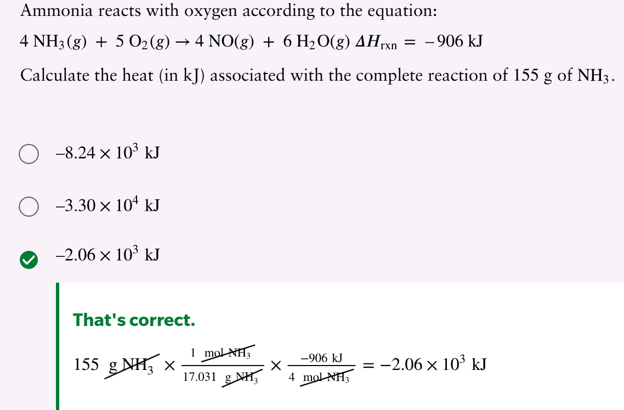
If you see a problem that is worded like “What is the heat associated with the reaction”
think of a ratio
Calorimetry
In calorimetry, we measure the thermal energy exchanged between the reaction (system) and the surroundings by observing the change in temperature of the surroundings

Hess’s law
The change in enthalpy (DeltaH) for a stepwise process is the sum of the enthalpy changes of the steps. Use these for bond energy problems, where you have to draw lewis structures. The bonds broken are on the left, the products, the bonds formed is the product, on the right, apply a negative sign to the bonds formed when calculating.

Standard enthalpy of a reaction
Products minus reactants, don’t forget to multiply by the coefficients. Don’t make the products negative like in the normal enthalpy of reaction. If you have to write the equation for the standard enthalpies of formation, first combine all the formulas in their standard state on the reactants side. Then, balance the coefficients with the product side.

The 7 diatomic elements (additional 3)
GASES: N2, O2, F2, CL2.
LIQUID: Br2
SOLID: (Letter I for Iguana) I2, C, S

Formal Charge
For lewis structures, to see the charge

Ammonium (POLYATOMIC ION)
NH₄⁺
Ammonia (POLYATOMIC ION)
NH₃
Acetate (POLYATOMIC ION)
C₂H₃O₂⁻
OR
CH₃COO⁻
Cyanide (POLYATOMIC ION)
CN⁻
Oxalate (POLYATOMIC ION)
C₂O₄⁻²
Thiosulfate (POLYATOMIC ION)
S₂O₃⁻²
Arsenite (POLYATOMIC ION)
AsO₂⁻³
Chromate (POLYATOMIC ION)
CrO₄⁻²
Dichromate (POLYATOMIC ION)
Cr₂O₇⁻²
Permangate (POLYATOMIC ION)
MnO₄⁻
Manganate (POLYATOMIC ION)
MnO₄⁻²
Hydroxide (POLYATOMIC ION)
OH⁻
Thiocyanate (POLYATOMIC ION)
SCN⁻
Selenate (POLYATOMIC ION)
SeO₄⁻²
Ferricyanide (POLYATOMIC ION)
Fe(CN)₆⁻³
Bicarbonate (Hydrogen carbonate) (POLYATOMIC ION)
HCO₃⁻
Bisulfate (Hydrogen sulfate) (POLYATOMIC ION)
HSO₄⁻