Elbow, Forearm, Wrist , Elbow & Forearm Anatomy: Joints, Muscles, and Occupational Function
 Call Kai
 Learn
 Practice Test
 Spaced Repetition
 Match
 Flashcards
 Knowt Play
1/129

There's no tags or description
Looks like no tags are added yet.
130 Terms
humerus

radius

ulna

Biceps Brachii (long head)
flexion and supination of the forearm (flexion of the arm at the shoulder joint)
purposeful movement: eating
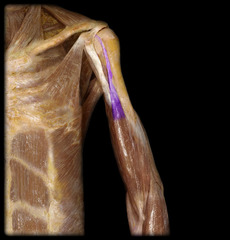
biceps brachii short head
flexion and supination
purposeful activity: washing hair

triceps brachii (medial head)
extend the elbow
purposeful movement: pushing up from a chair

triceps brachii (lateral long head)
extend the forearm and adduct the shoulder
purposeful movement: pushing up out of bed
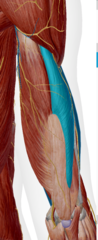
anconeus
extend the elbow
purposeful movemnt: casting a fishing line or throwing a football
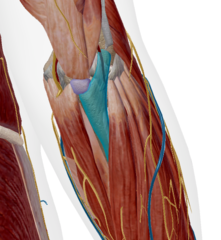
brachioradialis
flex the elbow (assist in pronation and supination) - most effective in the thumbs up neutral position
purposeful movement: hammering a nail

brachialis
flex elbow
purposeful movement: brushing teeth

pronator teres
pronate the arm and assist in flexion
purposeful movement: pouring coffee or knitting

supinator
supinate the forearm
purposeful movement: using screwdriver or turning doorknob

annular ligament

ulnar collateral ligament (medial collateral ligamenmt)

radial collateral ligament (lateral collateral ligament)

musculocutaneous nerve
supplies coracobrachialis, biceps brachii, and brachialis
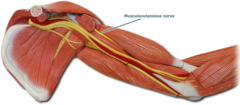
ulnar nerve

radial nerve

median nerve

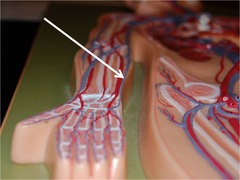
brachial artery

radial artery

ulnar artery
medial epicondyle

lateral epicondyle

supracondylar ridges

cubital tunel (passage for ulnar nerve)

olecranon process

radial head

ulnar head

ulnar styloid

radial styloid

distal radioulnar joint

listers tubercle
pulley for EPL

Lateral Epicondyle
extensor origin

Medial epicondyle
flexor origin

What are the main objectives of studying the elbow and forearm anatomy?
To define and explore musculoskeletal and neurological structures, biomechanics, osteokinematics, and arthrokinematics of the elbow.
How do the elbow and forearm facilitate occupational performance?
They support motor performance skills, functional purposes, and specific activities of daily living (ADLs) and instrumental activities of daily living (IADLs).
What is the significance of biomechanics in occupational therapy (OT) practice?
Biomechanics relates to how the elbow and forearm function, impacting occupational performance and therapy interventions.
What are osteokinematics and arthrokinematics?
Osteokinematics refers to the movement of bones around joints, while arthrokinematics refers to the movement of joint surfaces.
What impact can limitations of the elbow and forearm have on occupational performance?
Limitations can hinder motor skills necessary for ADLs and IADLs, affecting overall functional independence.
What are motor performance skills in the context of occupational therapy?
Motor performance skills are the abilities required to perform tasks that involve movement and coordination, essential for effective occupational performance.
What are the three main bones that make up the elbow?
Distal Humerus, Proximal Ulna, Proximal Radius
What ligaments provide primary support to the elbow joint?
Joint Capsule, Medial (Ulnar) Collateral Ligament (MCL), Lateral Collateral Ligament (LCL)

What is the anatomical significance of the distal humerus?
It widens from the shaft and curves anteriorly to enhance flexion, providing attachment sites for muscles that flex and extend the wrist and hand.
What common condition is associated with cumulative trauma disorders (CTDs) at the elbow?
Epicondylitis or epicondylosis (tennis/golfer's elbow) and Cubital tunnel syndrome.

What is the shape of the proximal ulna and its significance?
Shaped like a claw, with the coronoid process and olecranon, which enhances stability by 'grabbing' the distal humerus.

What is the role of the radial notch in the proximal ulna?
It allows articulation with the radial head, forming the proximal radio-ulnar joint.

What is the clinical application of a fall on an outstretched hand (FOOSH)?
It can lead to proximal radius injuries, such as radial head fractures and dislocations.

What are the three separate articulations of the elbow?
Humeroulnar, Humeroradial, and Superior Radioulnar.

What is the carrying angle of the elbow?
The angle formed by the medial angulation of the trochlea, causing lateral deviation of the ulna relative to the humerus.

What is cubitus varus and cubitus valgus?
Cubitus Varus is increased medial angulation; Cubitus Valgus is increased lateral angulation of the elbow.

What is the function of the annular ligament?
It holds the radius to the ulna and prevents lateral subluxation and radial head dislocation.

What is the primary motion allowed by the superior radioulnar joint?
Forearm rotation (pronation and supination).

What are the primary flexors of the elbow?
Biceps Brachii, Brachialis, Brachioradialis, and Pronator Teres.

What are the primary extensors of the elbow?
Triceps Brachii and Anconeus.

How does the biceps brachii function during elbow flexion?
It is a powerful flexor and supinator when the elbow is flexed.

What is the significance of the interosseous membrane?
It binds the radius and ulna and helps distribute forces from the wrist to the ulna.

What is the typical range of motion for elbow flexion?
0º (extension) to 135-140º (flexion).

What type of joint is the proximal radioulnar joint?
A pivot joint that allows for rotation of the forearm.

What does the term 'active insufficiency' refer to in the context of the biceps brachii?
When the shoulder and elbow are flexed, the biceps is shortened and unable to produce much flexion force.

What is the role of the medial and lateral collateral ligaments?
They resist varus and valgus forces, contributing to elbow stability.

What is the clinical relevance of elbow flexion contractures?
They can limit the range of motion and functional use of the elbow.

What is the passive end-feel of a joint?
It can reveal underlying limitations, such as hard (bony block), firm (ligament tightness), or soft (muscular tightness).
What is the significance of the trochlear notch of the ulna?
It surrounds the trochlea of the humerus, forming a hinge joint for flexion and extension.
What happens to the articular surface contact as the elbow flexes?
Articular surface contact increases as the elbow flexes.
What is the primary role of the biceps brachii during shoulder flexion?
It contributes to shoulder flexion while also being a powerful supinator.
What is capsular tightness?
A condition characterized by a firm end-feel with elbow and shoulder in any position.
How does biceps involvement affect elbow extension?
If the biceps limit extension, the contracture decreases with shoulder flexion and increases with shoulder extension due to muscle length changes.
What is 'Popeye's Sign'?
An abnormal protrusion of the biceps due to muscle retraction after a biceps tendon rupture.
What is the primary function of the brachialis muscle?
It is the 'workhorse of elbow flexion' and solely responsible for elbow flexion.
Which muscle provides the strongest flexion moment with the forearm in neutral?
Brachioradialis.
How does the pronator teres contribute to pronation?
It contributes less to pronation with the elbow flexed and more when the elbow is extended.
What are the primary contributors to elbow flexion?
Brachialis and biceps.
What is the peak strength position for elbow flexion?
The mid-range of elbow flexion, specifically at 90º flexion for manual muscle testing (MMT).
What are the three heads of the triceps brachii responsible for?
They primarily function as elbow extensors and assist in the extension of the humerus.
What is a clinical application of spinal cord injury at the C6 level?
Preservation of elbow flexion but loss of active elbow extension, allowing for weight-bearing through a locked extended elbow.
What is the role of the anconeous muscle?
It assists in elbow extension and may laterally deviate the ulna with forearm pronation.
What is the primary action of the supinator muscle?
It is the primary supinator of the forearm, especially when the elbow is extended.
What is the importance of scapular depression transfer?
It prevents elbow flexion contractures, which can hinder hyperextension of the elbow and weight-bearing activities.
What happens to muscle contributions during elbow flexion based on position?
In a pronated position, the brachialis is most active; in neutral, the brachioradialis; and in a supinated position, the biceps are most active.
What is the effect of elbow flexion contractures?
They can limit the ability to perform weight-bearing activities and hinder functional movement.
How does the biceps tendon rupture affect therapy?
Therapy focuses on strengthening surrounding elbow flexors, but surgical repair is required to regain biceps function.
What are the primary movements of the elbow and forearm?
Flexion and extension, as well as pronation and supination.
What is the structural classification of the humeroulnar joint?
Hinge joint.
What is the functional classification of the humeroulnar joint?
Uniaxial.
What does the term 'cubitus valgus' refer to?
Angulation of the elbow positioning the forearm farther away from the body (lateral).
What does the term 'cubitus varus' refer to?
Angulation of the elbow positioning the forearm closer to the body (medial).
What is the role of the annular ligament?
Holds the radial head in the radial notch of the ulna and prevents inferior displacement.
What is the function of the interosseous membrane?
Protects the humeroradial joint from excessive compression and transmits forces across to the ulna.
What is the primary function of elbow flexion?
Necessary for self-care tasks such as hygiene, self-feeding, and bathing.
What is the primary function of elbow extension?
Involved in weight-bearing activities, such as pushing down on armrests to stand up.
What is the structural classification of the humeroradial joint?
Modified hinge joint.
What is the functional classification of the proximal radioulnar joint?
Uniaxial.
What movements are allowed by the proximal radioulnar joint?
Pronation and supination.
What is the role of the ulnar collateral ligament?
Prevents excessive valgus (lateral angulation) at the elbow.
What is the role of the radial collateral ligament?
Prevents varus (medial angulation) at the elbow.
What are the main muscles involved in elbow flexion?
Biceps brachii, brachialis, and brachioradialis.
What are the main muscles involved in elbow extension?
Triceps brachii and anconeus.
What is cubital tunnel syndrome?
A condition caused by compression of the ulnar nerve at the elbow.
What is lateral epicondylosis?
A condition characterized by pain on the outer part of the elbow, often due to overuse.