Experiment 24
 Call Kai
 Learn
 Practice Test
 Spaced Repetition
 Match
 Flashcards
 Knowt Play
1/9

There's no tags or description
Looks like no tags are added yet.
10 Terms
What is the purpose of deionized water
deionized water is used to ensure the total diluted volume of the reaction remains constant (10 mL) across all kinetic trials while the concentrations of specific reactants are varied
what is the purpose of the buffer solution
maintains a constant hydronium ion concentration at a pH of approximately 5. This ensures changes in acidity do not affect the reaction rate during the reaction.
what is the function of the sodium thiosulfate in studying the kinetics of the hydrogen peroxide-iodide reaction?
Sodium thiosulfate removes I₃⁻ as soon as it’s formed, preventing a back reaction and maintaining a constant iodide ion concentration. once the thiosulfate is consumed, the I3- can react with starch to produce the dark blue color
calculate the moles of S₂O3-2 that are consumed during the course of the reaction in Trial 1. Calculate the Moles of I3- produced.
mole = molarity x volume
0.02 mol/L x 0.0010 L = 2.0 × 10⁻⁵ moles S₂O3-2
According to equation 24.11, the moles of I3- produced equals one-half the moles of S₂O3-2
.5 (2.0 × 10⁻⁵) = 1.0 ×10⁻⁵ I3-
Initial molar concentration of I-
Formula: M1V1=M2V2 where V2 is the total volume of 10 mL).
0.3 M x 1.0 mL / 10.0 mL = 0.03 M
Initial molar concentration of H2O2
Formula: M1V1=M2V2 where V2 is the total volume of 10 mL).
0.1 M x 3.0 mL / 10.0 mL = 0.03 M
The order of the reaction with respect to H₂O2 is determined graphically in this experiment.
What are the labels for the x-axis and y-axis, respectively
Y AXIS: log (Δ mol I3- / Δt)
X AXIS: log (Δ H2O2)0
How is the value for the order of the reaction with respect to H₂O, determined from the graphical data
Determining the order (q): The order of the reaction with respect to hydrogen peroxide is determined by calculating the slope of the straight line produced by the graph
Explain how the rate constant, k', is determined for the rate law in the experiment.
K’ is determined by substituting the orders p and q, the initial concentrations of the reactants, and the measured reaction rate for each trial into the rate law equation: Rate = k [I-]p [H2O2]q
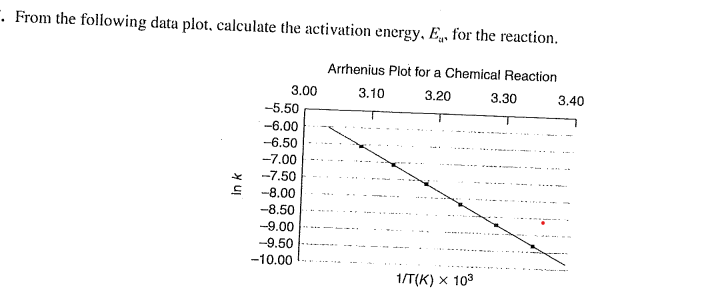
slope = -Ea/R , -Ea = slope x R
use the equation y₂-y₁ / x₂-x₁. to find slope
multiply slope by R (8.314)
should be about 83.1 Kj/mol