Skin and Soft Tissue Infections (SSTIs)
 Call Kai
 Learn
Learn Practice Test
 Spaced Repetition
 Match
Match Flashcards
 Knowt Play
1/88

There's no tags or description
Looks like no tags are added yet.
Name | Mastery | Learn | Test | Matching | Spaced | Call with Kai | Chat |
|---|
No analytics yet
Send a link to your students to track their progress
89 Terms
what are bacterial skin infections classified as?
Primary and secondary
What is primary
areas of previously healthy skin
often caused by a single pathogen
Secondary
areas of damaged skin
often polymicrobial (many pathogens)
what is Soft tissues
tissues that connect, support, or surround other structures and organs of the body
what are examples of soft tissue
Fat
Muscle
Fascia — connective tissue surrounding/separating muscles
Blood vessels
Nerves
Joint tissues
what are SSTI classified (soft tissue infections) as
uncomplicated and
complicated
Uncomplicated vs complicated SSTI
Uncomplicated SSTI | Complicated SSTI |
|---|---|
More superficial | Extends into deeper tissues |
Usually skin/subcutaneous tissue | May involve fascia or muscle |
Often treated medically | May require surgery + antibiotics |
if bacteria get deep into tissue and some tissue becomes badly damaged, surgical intervention may be needed to remove infected/damaged tissue.
Who is more at risk of SSTIs
Occurs frequently in patients with wounds or compromised immune functions (eg. diabetes, HIV infection)
what is purulent vs non-purulent for SSTis?
Purulent = pus is present.
So:
Purulent SSTI → pus
Non-purulent SSTI → no pus
what is a Abscess?
painful collection of pus, usually caused by a bacterial
infection
what is necrotizing fasciitis?
Necrotizing = causing tissue death
Fasciitis = inflammation/infection involving fascia
why is necrotizing fasciitis considered very serous?
necrotizing fasciitis (NF) is a serious infection where infection spreads through deeper tissues, particularly the fascia, and causes tissue death (necrosis).
This distinction is important because suspected NF requires urgent medical and surgical management, rather than being treated like a routine superficial SSTI.
what is the most common type of infection seen in community and hospital settings?
SSTIs
Most are treated in an outpatient setting, making it difficult to accurately quantify community-acquired SSTIs
Most common among those 70 years of age and older
what is Community-acquired MRSA?
MRSA = methicillin-resistant Staphylococcus aureus.
It's a strain of S. aureus that is resistant to certain commonly used antibiotics, so knowing whether MRSA might be involved can affect which antibiotic is chosen.
what type of bacteria mainly causes SSTIs?
Gram-positive organisms present on the skin surface
Approximately 30% to 35% of
healthy individuals are
reported to be colonized
with _____ n the skin or
in the anterior nares
S. aureus
where can Acinetobacter be found?
Acinetobacter species, can be found in moist intertriginous areas (eg. groin, toes, axilla)
what two most frequent organism causing SSTIs?
S. aureus and S. pyogenes
what are some organisms found of your normal skin flora?

gram positive vs gram negative distinction
Gram-positive:THICK peptidoglycan → outside
Gram-negative:thin peptidoglycan → OUTER membrane (with LPS) → extra barrier against some antibiotics
LPS = lipopolysaccharide provides Structural support and immune system recognizes LPS as a sign of bacteria → activates macrophages and other immune cell
5 Risk factors for developing SSTIs
Damage to the epidermal layer allowing for bacterial penetration
High concentrations of bacteria > 105 microorganisms
Excessive moisture of the skin
Inadequate blood supply
Availability of bacterial nutrients
what are Other risk factors
are co-morbidities: obesity, diabetes, disabilities limiting movement, heart problems
what is Folliculitis?
Is inflammation of the hair follicle
• superficial infection with pus present only in the epidermis
what is Furuncle
(aka boil) is a walled-off mass of purulent material arising from a hair follicle
• involve deeper areas of skin (subcutaneous tissue)
what is Abscess
is a painful collection of pus, usually caused by bacterial infection (red and swollen)
what is Carbuncles
are a collection of furuncles that coalesce to form a single inflamed area
• form deep masses that open and drain through sinus
tracts
which bacterium is the most common cause of Folliculitis,
furuncles, and carbuncles
S. aureus
where is P. aeruginosa usually found
common in unsanitized hot tub/ pool outbreaks ( ↓ [chlorine])
Treatments for Folliculitis, Furuncles and Carbuncles
Many follicular infections resolve spontaneously
without medical or surgical intervention
if they need medical treatment what do you treat with?

Primary SSTIs organisms
Infection | Main organism(s) |
|---|---|
Erysipelas | Streptococcus pyogenes (Group A Strep/GABHS) |
Impetigo | S. aureus, sometimes Group A Strep |
Lymphangitis | Group A Strep, sometimes S. aureus |
Cellulitis | Group A Strep + S. aureus |
What is cellulitis?
is an acute SSTI that begins under
the skin in the epidermis/ dermis
and then spreads to superficial
fascia/ subcutaneous layers = the
connective tissues
Cellulitis = bacterial infection that spreads through the deeper layers of the skin/connective tissue.
what is the sequence for Cellulitis infection
Break in skin → bacteria enter → infection begins in epidermis/dermis → spreads into subcutaneous/connective tissue
what are Typical signs of cellulitis
Erythema = redness
Edema = swelling
Hot
Tender/painful
Poorly defined margins = you can't clearly see exactly where the redness stops
Can be non-purulent (no pus) or purulent (pus/abscess)
what percentage of bloodwork of cellulitis patients have bacteria?
t 30% of blood work from cellulitis patients has bacteremia,
what is Lymphangitis
inflammation/infection involving the lymphatic vessels. cutaneous + subcutaneous
how can Lymphangitis develop?
It can develop from another skin infection such as cellulitis:
Skin infection/cellulitis → infection reaches lymphatic vessels → lymphangitis
what are symptoms of lymphangitis?
Symptoms: subcutaneous red line(s) in skin extending from site of
injury/ infection → serious and rapid

what is Erysipelas
is an acute distinct form of cellulitis involving superficial layers of the skin and cutaneous lymphatics; blockage of dermal lymphatics
• common name “St. Anthony’s fire”
what are symptoms of Erysipelas
skin rash, elevated lesion, erythema (redness), edema (swelling), pain, tenderness, and fever.
who is Erysipelas most common in?
Erysipelas is common in infants, young children, the elderly, and patients with nephrotic syndrome (kidney damage)
what is Impetigo
is a superficial epidermal skin infection that is seen most commonly in children
superficial = closer to the surface of the skin
difference between primary and secondary ssti?
Primary SSTI → infection develops in previously healthy skin.
Secondary SSTI → infection occurs where the skin was already damaged.
Secondary SSTIs ex pf bacteria
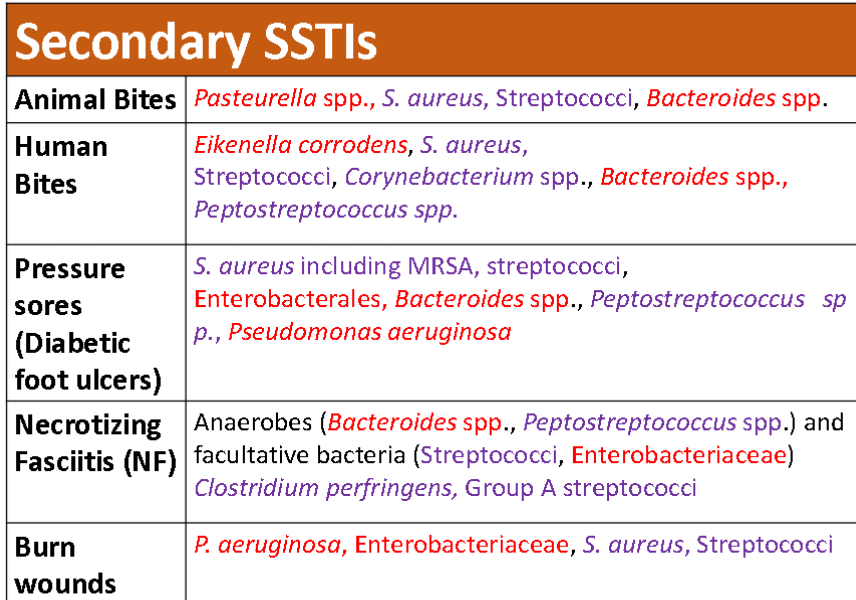
what is a Pressure sores
A pressure sore is also called a bed sore or decubitus ulcer.
It develops when an area of the body experiences prolonged pressure, especially over a bony area and joints.
Includes diabetic foot infections (DFIs)
explain how a pressure would occur?
Long-term pressure → reduced blood flow to tissue → tissue gets damaged → sore develops → bacteria can infect damaged area
who are pressure sores common in?
common among chronically debilitated persons, diabetics, and the elderly (>70 yr olds
what are common areas pressure sores are developed (5)
Sacrum/buttocks
Heels
Elbows
Back/shoulder blades
Back of the head
explain how Monomicrobial vs polymicrobial relates to pressure sores
Mild pressure sore → often monomicrobial
→ one bacterial species
Severe/deep pressure sore → usually polymicrobial
→ multiple bacterial species ( up to 60% of hospitalized patients)
what does Untreated sores and DFIs increase the risk of developing what?
Osteomyelitis
what is Osteomyelitis
Osteomyelitis = infection of the bone.
As a pressure sore becomes deeper:
Skin → subcutaneous tissue → muscle/fascia → bone
what are Pressure sore stages
The stage tells you how deep the damage/infection goes. As the stage number increases, it goes deeper.
how many stages are their?
4 stages
name all the stages and what part of skin each contains
Stage 1 → epidermis + dermis
↓
Stage 2 → subcutaneous tissue + fat
↓
Stage 3 → muscle + fascia
↓
Stage 4 → bone
at what stage would you find a higher concentration of microbes?
Stage 1 → often monomicrobial = one type of bacteria
Stage 4 → often polymicrobial = multiple types of bacteria
how would you treat a mild case of pressure sore?
Sore wound cleansing (+/- debridement)
what about Moderate
Deep culture biopsy/ needle aspiration at wound base for AST
and antibiotics
what about severe case?
Bone culture biopsy from wound base for AST
and antibiotics
what is Necrotizing fasciitis (NF)
This is a rare but severe infection that spreads through deep soft tissues, including fat, fascia and potentially muscle. It causes necrosis, meaning tissue death due to loss of blood supply
what are two types of NF?
Fast + rare monomicrobial
Slow + common polymicrobial
what type of microbes are found for fast
Clostridium perfringens, MRSA, Group A streptococci (S. pyogenes)
what type of microbes are found in slow stage?
just anaerobes
Different terms are used to classify NF types
based on what? (4)
• Co-morbidities
• skin appearance and etiologic agent
• gas production; Clostridial myonecrosis (gas
gangrene
• muscle involvement and systemic toxicity
why is testing done for NF?
because it is Hard to distinguish cellulitis and NF in their early stages
how can you test for NF?
2 ways through
tissue samples
blood samples
what can you do with tissue samples?
Histology → examine the tissue for damage/infection
Culture → determine which bacteria are present
AST → determine which antibiotics the bacteria are susceptible to
what can you do with a blood sample?
CBC → looks at blood cells, including WBCs
Chemistry profile → assesses things like electrolytes and organ function
Blood culture → checks whether bacteria are present in the bloodstream
how should you Treating NF?
don't wait for the culture results before starting treatment. immediately give combination broad-spectrum IV antibiotics.
which antibiotics should you give?
Piperacillin–tazobactam + vancomycin or β-lactam (penicillin) + lincosamide (clindamycin)
why is immediate treatment needed for NF?
>14 hours after NF diagnosis see an increase patient mortality;
increased risk of death in patients with septic shock
why are bite wounds so infectious
Most bite infections are polymicrobial = multiple species of bacteria are involved.
an average 3 to 9 bacterial isolates per culture → oral microflora of biter
what are the most common bites?
dog teeth
cat teeth
human teeth
why are dog bites dangerous
Dog teeth aren't as sharp.
can exert a pressure of 200 - 450 lb/in2 (~1,400 to 3,100 kPa)
Therefore → more likely to cause crush injuries.
why are Cat bites dangerous
Teeth are sharp and thin.
Can penetrate deeply into joints and bone.
Therefore → greater risk of septic arthritis (joint infection) and osteomyelitis (bone infection).
why are Human bites dangerous?
Generally very prone to infection than animal bites because of clenched-fist injuries—when someone's fist hits another person's teeth and the skin is broken.
how should you treat all bite wounds?
irrigated thoroughly with a copious volume of sterile water or saline and soap or antiseptic to reduce bacteria in the wound
what about more extensive bites?
More extensive injuries may require debridement, meaning removal of damaged/dead tissue.
If you see:
Pus + redness + swelling → drainage + broad-spectrum antibiotics
Broad-spectrum makes sense because, as we said above, bite infections are often polymicrobial, so you may need coverage against multiple types of bacteria.
why does it matter if the biter is immunized
information about the person/animal responsible for the bite can help determine whether the patient needs additional preventive measures such as immunization or antiviral/antiretroviral management.
why type of therapy for bites is considered controversial?
prophylactic antimicrobial therapy
Why are burns prone to infection?
Burns damage the body's mechanical barriers, neutrophil
function and immune responses
impair neutrophil and immune function and cause fluid/electrolyte imbalances.
are burn wounds sterile when they first occur?
wounds are sterile immediately after the burn is inflicted, but become polymicrobial within hours
what factors determines severity of the burn
Size of burn surface - Superficial burns <30% of total body area → treatable with topical antimicrobials
Depth of the burn
Age and pre-existing conditions of the patient
what is echnar and how can it impact the burn>
Eschar = dead/non-viable skin tissue sitting on the surface of a deep burn
Bacteria can grow around/in this damaged tissue and potentially spread deeper, leading to things like lymphangitis or bacteremia
how does echnar differ between second and third degree burns
1st to 3rd degree burns have similar stages as pressure sores but
with increased eschar in 2nd degree (deep) to 3rd degree burns
why does age matter?
• Young children < 5 yrs are at risk due to immunological status and risk of re-infection (keeping the area clean)
• older > 55 patients are most at risk due to immunological status and co-morbidities (diabetes, heart disease, etc.)
how should you treat first and second degree burns
1st to 2nd (superficial) degree: superficial/ cutaneous layer damage
• Topical antibiotic (1st) or parenteral antiseptic therapy (2nd)
• Frequent changes of dressings
how should you treat 2nd (deep) to 3rd degree subcutaneous → muscle/ bone
Oral or IV antibiotic treatment of 3 most common infections
Wound debridement +/- purulence abscess drainage
Frequent dressing changes > 2 times daily
Surgical skin grafts
name the oral or iv antiobiotics used?
• Streptococci: Penicillins, Erythromycin and Vancomycin
• Staphylococci: flucloxacillin or a glycopeptide (if MRSA suspected)
• P. aeruginosa: aminoglycoside (tobramycin) + extended spectrum β- lactam (ceftazidime/ imipenem