PK/PD and ADMET
 Call Kai
 Learn
 Practice Test
 Spaced Repetition
 Match
 Flashcards
 Knowt Play
1/36

There's no tags or description
Looks like no tags are added yet.
37 Terms
PK vs PD
PK - effect of host on drug
PD - effect of drug on pathogen
interplay between what factors PH and PD
Host - abx: PK, toxicodynamics
abx - pathogen: resistance, PD
pathogen - host: immune response, infectious disease
why is PK/PD important? (2)
to make sure the abx do work at the location where it is supposed to - avoid relapses, avoid resistance development
can help to give the best dosing regimen - ie the factors that can be influenced by the clinician
diff types of administration (5)
inhaled, oral, intramuscular, topical, intravenous
General principles of PK descr (4)
AUC - area under curve, function of how high the [] of the drug gets and how fast it gets removed
Cmax - highest [] of the drug in blood
t1/2 (half life) - time at which drug has lost half of its max []
Cmin - lowest [] of drug in blood

what is this a graph of
pharmacokinetics
what is AUC a result of
ADME
ADMET long
absorption, distribution, metabolism, excretion, toxicity
Absorption descr (+ 3 qs w/ it)
process where compounds enter the blood flow from the administration side - what is the [] of drugs in blood plasma? Is Cmax diff for different administration routes (oral vs IV)? Some drugs not well absorbed by gastrointestinal tract so should adjust accordingly
Metabolism descr
chemical breakdown of compounds in metabolites
oral vs IV absorption
Oral - slow rise, slow fall
IV - quick rise, Cmax larger but T1/2 smaller
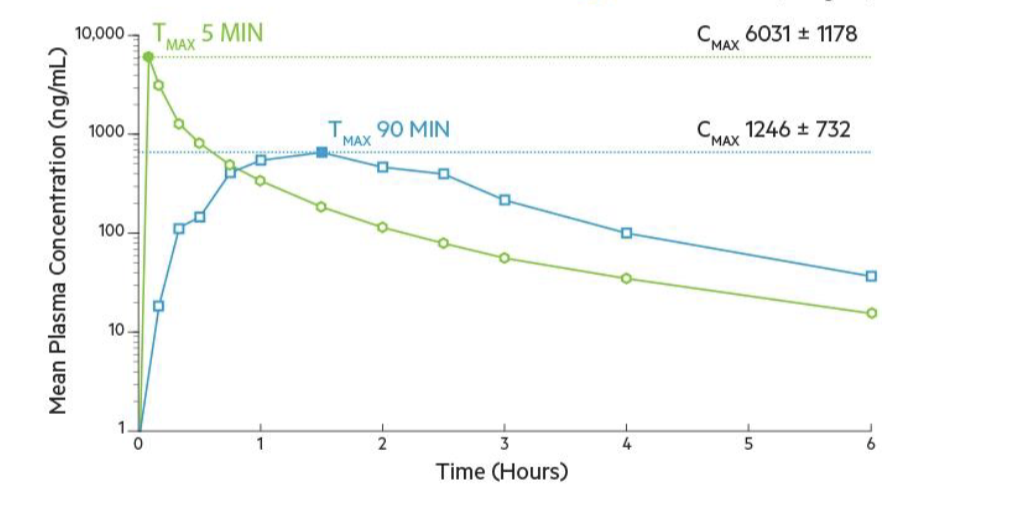
which is which?
green - IV
blue - oral
4 major compartments of the body
blood, extracellular fluid, intracellular fluid, fat
Distribution descr
drug associates w/ binding moleculea (eg proteins like albumin)- sequesters drug in compartments, increases storage capacity; equilibrium between bound and unbound drugs
what do unbound drugs do
can move into new compartment - maintains equilibrium
what is balance of drugs in body determined by + descr
Kc - equilibrium constant, dependent on permeability of barriers (cell membrane) and binding capacity

what case is this?
drug evenly distributed - uncommon

label bottom 3
1 - drug confined to circulation (very large drug molecules)
2 - drug excluded by cell membranes (very polar drug molecules)
3 - drug enriched in fat (lipophilic drugs)
Metabolism descr
most often in the liver but also in lungs or gut
fact the metabolized by liver important for PK - orally given drugs metabolized by liver before they reach systemic circulation - influences PK (first pass metabolism)
metabolis in liver more detail
first step - by Cyp 450- oxidases - can lead to drug inactivation or activation
(other phase I enzymes like esterases, hydrolases and dehydrogenases also possible)
then phase II conjugating enzymes eg GST
result modifications of metabolism phase I
drug becomes water soluble, drug can be modified by other enzymes (phase 2)
eg of drug metabolism
phenytoin - first highly lipophilic then after phase I slightly soluble in water and after phase 2 very soluble in water
3 ways of excretion
liver (into bile), kindeys, sweat/tears/milk
excretion via the kidney (3)
filtration - only free drug filtered, # determined by renal blood flow/glomerular filtration rate/plasma protein binding
secretion - saturable mechanisms for organic anions and organic cations, overlapping substrate specificity, important excretion mechanism for highly protein bound drugs
reabsorption - lipophilic drugs, modulated by urine pH & drug pKa
therepeutic index
between therapeutic effect and toxic effect
important things for PD
Cmax/MIC - how high peak [] is above the MIC, for drugs that kill better at high [] (eg aminoglycosides)
AUC/MIC - total drug exposure relative to MIC - eg for vancomycin and fluoroquinolones, also account for post antibiotic effect - suppresion after AB is removed
time ~ conc > MIC - how long drug [] is above the MIC - eg for time dependent drugs like beta lactams - continuous infusion
safety index
TI = TD50/ED50
what can you tell with PD
what is the effect of the drug on the microbe, crucial relationship w/ MIC, other factors?
are all abx [] dependent
no! eg ticarcillin is not
persistence effect
post abx effect - eg ticeracillin has direct regrowth w/ similar kinetics after dilution BUT
ciprofloxacin - delayed outgrowth after dilution
3 patterns of antimicrobial activity
PD property: []-dependent killing, prologued persistence - AUC24/MC, Cmax/MIC - goal is maximize drug []
time dependent killing, minimal persistence - T>MIC - goal is maximize duration of drug exposure
time dependent killing, moderate to prologued persistence - AUC24/MIC - goal is maximize amount of drug

what does this show
diff strategies required based on the drug and its properties
time dependent killing - eg and what application best
beta lactams - continuous application best for therapy (if MIC is known)
special conditions - location of infection (4)
bladder
lung - penetration problematic, inhalation of drugs can be advantageous
meninges
granulomas
2 abx w/ unusual PK - how used to our advantage
eg nitrofurantoin - v quickly cleared by your kidneys - 20 min half life - used for UTIs
rifaximin - derivative of rifampicin, oral abx which cannot be absorbed - used for e coli (travelers diarrhea)
special conditions - special patients (5)
disturbed blood circulation eg diabetic food, disturbed renal function, obese patients, children, pregnant women
PK/PD conclusions (3)
PK characteristics (ADME) important for [] of drug in tissue
PD - 3 diff types of behavior for diff abx
diff types request diff strategies of administration