Portage Learning Medical Terminology Module 2
 Call Kai
 Learn
 Practice Test
 Spaced Repetition
 Match
 Flashcards
 Knowt Play
1/102

There's no tags or description
Looks like no tags are added yet.
103 Terms
Homeostasis
state of equilibrium that is maintained in the body's internal environment to support and sustain life
Anatomical terminology
terms that are used to describe the human body
Anatomy
created from two Greek words: ana meaning "apart" and tome meaning "to cut"
Epithelial tissue
outer surfaces of the body and lines body cavities, as well as the tubes that lead to the exterior of the body
Connective tissue
A body tissue that provides support for the body and connects all of its parts
Muscle tissue
A body tissue that contracts or shortens, making body parts move.
Nervous tissue
A body tissue that carries electrical messages back and forth between the brain and every other part of the body.
Organs
structures in the body that perform specific purposes
Systems
groups of different organs functioning together for a common purpose
integumentary system functions
Protective membrane, temperature regulator and sensory receptor
skeletal system functions
Shape, support, protection and storage for minerals; movement possible through joints
Muscular system functions
Produces movement and heat and maintains posture
Nervous system functions
Transmits impulses, responds to changes, exercises control over all body parts
Endocrine system functions
Glands produce hormones that control various body parts
cardiovascular system functions
Transports oxygen and CO2, delivers nutrients and hormones and removes waste
Blood and lymphatic system functions
Transports oxygen, CO2, chemicals and cells that protect the body from foreign substances; stimulates immune response
respiratory system functions
Furnishes oxygen for individual tissues' cells and removes their CO2
digestive system functions
Absorption and elimination
reproductive system functions
Responsible for sexual characteristics
urinary system functions
Produces, transports and eliminates urine; kidneys help maintain levels/balances in the body
Anatomical position
position in which the body is standing upright, head facing forward, and arms extended by the side of the body with the palms oriented to the front
body planes
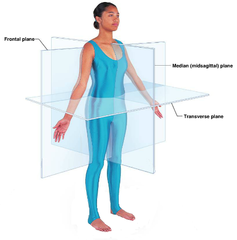
imaginary lines drawn through the body at various parts to separate the body into sections
sagittal plane
divides the body or structure vertically into right and left sections

midsagittal plane
divides the body or structure into equal right and left halves at the midline

transverse or horizontal plane
divides the body or structure into superior and inferior sections

coronal or frontal plane
divides the body into anterior and posterior sections. It is at a right angle to the midsagittal plane

superior combining form
none
inferior combining form
infer/o
Anterior combining form
anter/o
Posterior combining form
poster/o
cephalic combining term
cephal/o
Caudal combining form
caud/o
medial combining term
medi/o
lateral combining form
later/o
proximal combining form
proxim/o
distal combining term
dist/o
deep combining term
none
superficial combining term
none
superior
Above, in an upward direction, toward the head
inferior
Below, in a downward direction; more toward the feet
Anterior
In front of, before, the front side of the body
Posterior
Toward the back, the backside of the body
cephalic
Pertaining to the head, superior in position
caudal
Pertaining to the tail, inferior in position
medial
Nearest to the midline or middle
Lateral
To the side, away from the middle
Proximal
Nearest to the point of attachment, near the point of origin
Distal
Away from the point of attachment, far from the point of origin
Deep
Further below the surface
Superficial
Nearer the surface
cranial cavity
contains the brain. The brain is protected by a membrane sac called the meninges. Additionally, it is protected by the skull.
spinal cavity
contains the spinal cord. It is protected by the cervical, thoracic, and lumbar vertebrae and is also covered by the meninges.
thoracic cavity
heart, lungs, esophagus, trachea, aorta, and thymus gland. It is protected by the ribs and is separated from the abdominopelvic cavity by the diaphragm.
mediastinum
central region of the thoracic cavity, and it contains the heart, trachea, esophagus, aorta, and thymus gland.
pleural cavities
they are located lateral to the mediastinum on either side. Each pleural cavity contains a lung and is covered by a membrane called the pleura.
abdominopelvic cavity
generally divided into the superior section of the abdominal cavity and the inferior section of the pelvic cavity. However, there is not a physical structure that divides the two. The abdominopelvic cavity is covered by a membrane called the peritoneum
abdominal cavity
stomach, liver, gallbladder, spleen, pancreas, small intestine, and most of the large intestine
pelvic cavity
contains the urinary bladder, ureters, urethra, and the last section of the large intestine in both sexes. The pelvic cavity also contains the reproductive organs. In females, these are the vagina, uterus, ovaries, and fallopian tubes. In males, these are the prostate gland, seminal vesicles, bulbourethral gland, and the vas deferens.
Right hypochondriac
(Hypo- = below; chondr/o = cartilage; -iac = pertaining to): The right lateral side of the upper row under the ribs that connect to the sternum via cartilage.

Epigastric
(epi- = above; gastro/o = stomach; -ic = pertaining to): The middle area of the upper row that is above the stomach.

Left hypochondriac
The left lateral side of the upper row.

Right lumbar
(Lumb/o = low back; -ar = pertaining to): Right lateral side of the middle row, near the waist.

Umbilical region
Middle area of the middle row containing the umbilicus.

Left lumbar
Left lateral side of the middle row.

Right iliac
(Ili/o = ilium; -ac = pertaining to): Right lateral side of the lower row near the groin.

Hypogastric
(Hypo- = below; gastr/o = stomach; -ic = pertaining to): Middle area of the lower row.

Left iliac
Left lateral side of the lower row.
Right upper quadrant
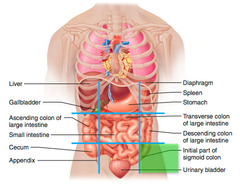
This quadrant contains the majority of the liver, the right kidney, a portion of the large intestine, a small portion of the pancreas, gallbladder, and a section of the small intestine.

Right lower quadrant
This quadrant contains portions of the large intestine and small intestine, the right ureter, appendix, and in females, the right ovary and the right fallopian tube.

Left upper quadrant
This quadrant contains a small portion of the liver, spleen, left kidney, stomach, the majority of the pancreas, and portions of the small and large intestines.

Left lower quadrant
This quadrant contains portions of the small and large intestines, left ureter, and in females, the left ovary and left uterine tube.

Abdomin/o + -al
Pertaining to the abdomen
Ante- + cubit/o + -al
pertaining to the front of the elbow
Axillary
pertaining to the armpit
Brachi/o + -al
Pertaining to the arm
Cervic/o + -al
Pertaining to the neck
Crani/o + -al
Pertaining to the skull
Femor/o + -al
Pertaining to the femur/thigh
Genit/o + -al
Pertaining to the genitals
Glute/o + -al
Pertaining to the buttocks
Inguin/o + -al
Pertaining to the groin
Lower extremity
The entire leg
Nas/o + -al
Pertaining to the nose
Orbit/o + -al
Pertaining to the eye socket
Or/o + -al
Pertaining to the mouth
Ot/o + -ic
Pertaining to the ear
Palmar
The palm of the hand
Patell/o + -ar
Pertaining to the kneecap
Pelv/o + -ic
Pertaining to the pelvis
Plantar
The sole of the foot
Popliteal
The area behind the knee
Scapula/o + -ar
Pertaining to the shoulder blade
Stern/o + -al
Pertaining to the sternum
Thorac/o + -ic
Pertaining to the chest/lungs
Trunk
The torso; Note: this does not include the arms or legs
Umbilical
The region around the navel
Upper extremity
The entire arm
Vertebr/o + -al
Pertaining to the spine
Prone
the body being positioned horizontally and face down, with the back oriented superiorly.

Supine
the body being positioned horizontally and face up, with the back oriented inferiorly.
