Chemistry - Atomic structure

0.0(0)
Studied by 0 people
call kaiCall Kai
learnLearn
examPractice Test
spaced repetitionSpaced Repetition
heart puzzleMatch
flashcardsFlashcards
GameKnowt Play
Card Sorting

1/8

encourage image

There's no tags or description

Looks like no tags are added yet.

9 Terms

1
New cards

What is the mass number of an element?

Sum of protons + neutrons

2
New cards

What is the atomic number?

Number of protons and electrons

Protons = electrons

3
New cards

What is the definition of an isotope?

Isotopes - atoms of the same element with the same number of protons but different number of neutrons

4
New cards

What is the definition of the relative atomic mass (Ar)?

Relative atomic mass (Ar) of an element - the weighted average mass of its isotopes compared to 1/12th of the mass of a carbon-12 atom

5
New cards

How do you calculate the relative atomic mass of an element?

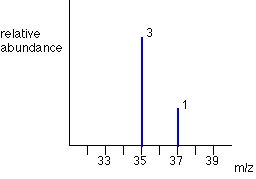
Example - Chlorine gas contains a mixture of 75% of 35Cl and 25% of 37Cl

  • Multiply the masses of each isotope by their percentage abundance

  • Add them together to calculate an Ar

[35 x (75/100)] + [37 x (25/100)] = 35.5

Ar of chlorine = 35.5

6
New cards

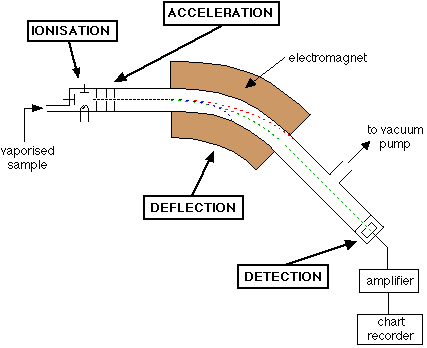
What happens in a Time of Flight (TOF) mass spectrometer? (7)

  1. Ionisation: The sample is ionised by either electron impact by electron gun (electrons removed to form positive ions) or electrospray ionisation using a high voltage (particles gain a proton, H⁺)

  2. Acceleration: Positive ions are accelerated by an electric field so they all have the same kinetic energy

  3. Ion drift: Ions travel through a field-free region; lighter ions travel faster and reach the detector before heavier ions

  4. Detection: Ions gain electrons at the detector, producing a current proportional to their abundance

  5. Data analysis: Flight times are converted into a mass spectrum showing relative abundance vs mass-to-charge ratio (m/z)

  6. The base peak is the tallest peak and represents the most abundant ion

  7. For ions with the same charge, a lower m/z reaches the detector first, while a higher m/z arrives later

<ol><li><p><strong>Ionisation: </strong>The sample is <mark data-color="yellow" style="background-color: yellow; color: inherit;">ionised</mark> by either <strong><mark data-color="purple" style="background-color: purple; color: inherit;">electron impact</mark></strong> by electron gun (electrons removed to form positive ions) or <strong><mark data-color="red" style="background-color: red; color: inherit;">electrospray ionisation</mark></strong> using a high voltage (particles gain a proton, H⁺)</p></li><li><p><strong>Acceleration:</strong> <mark data-color="yellow" style="background-color: yellow; color: inherit;">Positive ions are accelerated</mark> by an <strong><mark data-color="red" style="background-color: red; color: inherit;">electric field</mark></strong> so they all have the <mark data-color="purple" style="background-color: purple; color: inherit;">same kinetic energy</mark></p></li><li><p><strong>Ion drift:</strong> Ions travel through a field-free region; <mark data-color="yellow" style="background-color: yellow; color: inherit;">lighter ions travel faster</mark> and <mark data-color="purple" style="background-color: purple; color: inherit;">reach the detector before heavier ions</mark></p></li><li><p><strong>Detection:</strong> <mark data-color="yellow" style="background-color: yellow; color: inherit;">Ions gain electrons</mark> at the detector, <mark data-color="purple" style="background-color: purple; color: inherit;">producing a current</mark> <strong>proportional to their abundance</strong></p></li><li><p><strong>Data analysis:</strong> <mark data-color="yellow" style="background-color: yellow; color: inherit;">Flight times are converted into a mass spectrum</mark> showing <mark data-color="red" style="background-color: red; color: inherit;">relative abundance vs mass-to-charge ratio </mark><strong><mark data-color="red" style="background-color: red; color: inherit;">(m/z)</mark></strong></p></li><li><p>The <mark data-color="yellow" style="background-color: yellow; color: inherit;">base peak</mark> is the<strong> tallest peak</strong> and represents the <strong><mark data-color="red" style="background-color: red; color: inherit;">most abundant ion</mark></strong></p></li><li><p>For ions with the <mark data-color="yellow" style="background-color: yellow; color: inherit;">same charge</mark>, <strong><mark data-color="purple" style="background-color: purple; color: inherit;">a lower m/z </mark></strong><mark data-color="purple" style="background-color: purple; color: inherit;">reaches the detector first</mark>, while a <strong>higher m/z </strong>arrives later</p></li></ol><p></p>
7
New cards

How do you calculate Ar from a mass spectrum?

  • Identify the m/z value of each isotope and its relative abundance

  • Calculate the weighted mean using:

    Ar = Σ(isotopic mass × relative abundance) ÷ Σ(relative abundance)


  1. Multiply each isotope's m/z value by its relative abundance

  2. Add the values together and divide by the total abundance to calculate Ar

  3. Example: Cl has isotopes ³⁵Cl (75%) and ³⁷Cl (25%)
    Ar = ((35 × 75) + (37 × 25)) ÷ 100 = 35.5

<ul><li><p>Identify the m/z value of each isotope and its relative abundance</p></li><li><p>Calculate the weighted mean using:</p><p>A<sub>r</sub> = Σ(isotopic mass × relative abundance) ÷ Σ(relative abundance)</p></li></ul><p></p><ol><li><p>Multiply each isotope's m/z value by its relative abundance</p></li><li><p>Add the values together and divide by the total abundance to calculate A<sub>r</sub></p></li><li><p>Example: Cl has isotopes ³⁵Cl (75%) and ³⁷Cl (25%)<br>A<sub>r</sub> = ((35 × 75) + (37 × 25)) ÷ 100 = 35.5</p></li></ol><p></p>
8
New cards

Describe the structure of the principal energy levels

Principal energy levels (shells) - the main energy levels occupied by electrons around the nucleus

  • The principal energy levels are numbered 1, 2, 3, 4... (or n = 1, 2, 3, 4...)

  • Electrons in higher principal energy levels are on average further from the nucleus and have more energy

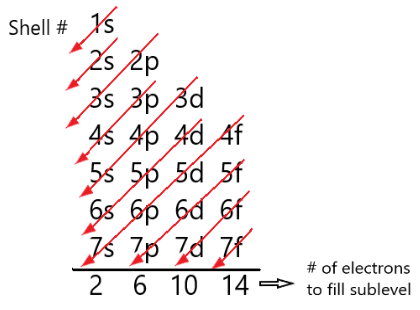
  • Each principal energy level contains one or more sub-shells (s, p, d and f)

  • The maximum number of electrons in a principal energy level is given by 2n²

  • Examples: 1st energy level = 2 electrons, 2nd = 8 electrons, 3rd = 18 electrons, 4th = 32 electrons

  • Electrons occupy the lowest available energy level first before filling higher energy levels

<p>Principal energy levels (shells) - the main energy levels occupied by electrons around the nucleus</p><ul><li><p>The principal energy levels are numbered 1, 2, 3, 4... (or n = 1, 2, 3, 4...)</p></li><li><p>Electrons in <strong>higher principal energy</strong> levels are on average <strong>further from the nucleus</strong> and <strong>have more energy</strong></p></li><li><p>Each principal energy level contains one or more <strong>sub-shells</strong> (s, p, d and f)</p></li><li><p>The maximum number of electrons in a principal energy level is given by 2n²</p></li><li><p>Examples: 1st energy level = 2 electrons, 2nd = 8 electrons, 3rd = 18 electrons, 4th = 32 electrons</p></li><li><p>Electrons occupy the lowest available energy level first before filling higher energy levels</p></li></ul><p></p>
9
New cards

What are orbitals?

Orbital - a region of space around the nucleus where there is a high probability of finding an electron

  • Each orbital can hold a maximum of 2 electrons with opposite spins

  • Orbitals are grouped into sub-shells (s, p, d and f)

s orbital - spherical with 1 s orbital per s sub-shell, 1s merges with 2s and can hold 2 electrons

p sub-shell - dumb-bell shaped and are perpendicular to eachother along the axes (x, y and z), contains 3 p orbitals and can hold up to 6 electrons

d sub-shell - contains 5 orbitals and can hold up to 10 electrons

f sub-shell - contains 7 orbitals and can hold up to 14 electrons

  • Electrons occupy the lowest energy orbitals first before filling higher-energy orbitals


<p>Orbital - a region of space around the nucleus where there is a high probability of finding an electron</p><ul><li><p>Each orbital can hold a <strong>maximum of 2 electrons </strong>with opposite spins</p></li><li><p>Orbitals are grouped into sub-shells (s, p, d and f)</p></li></ul><p>s orbital - spherical with 1 s orbital per s sub-shell, 1s merges with 2s and can hold 2 electrons</p><p>p sub-shell - dumb-bell shaped and are perpendicular to eachother along the axes (x, y and z), contains 3 p orbitals and can hold up to 6 electrons</p><p>d sub-shell - contains 5 orbitals and can hold up to 10 electrons</p><p>f sub-shell - contains 7 orbitals and can hold up to 14 electrons</p><ul><li><p>Electrons occupy the lowest energy orbitals first before filling higher-energy orbitals</p></li></ul><p></p>



