APHG Unit 2 (tprosk)
 Call Kai
 Learn
Learn Practice Test
 Spaced Repetition
 Match
Match Flashcards
 Knowt Play
1/82

There's no tags or description
Looks like no tags are added yet.
Name | Mastery | Learn | Test | Matching | Spaced | Call with Kai | Chat |
|---|
No analytics yet
Send a link to your students to track their progress
83 Terms
World Population clusters
From largest to smallest; East Asia (China, Japan), South Asia (Bangladesh, India), Europe and Southeast Asia (Indonesia, Philippines, Thailand, Vietnam)

Agricultural Density
The ratio of the number of farmers to the total amount of land suitable for agriculture

Arithmetic Density
The total number of people divided by the total land area.

Physiological Density
The number of people per unit of area of arable land, which is land suitable for agriculture.

Carrying Capacity
Largest number of individuals of a population that a environment can support

Census
the official count of a population

Demography
The scientific study of population characteristics.

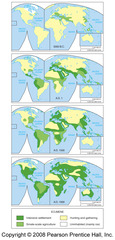
Ecumene
The portion of Earth's surface occupied by permanent human settlement.
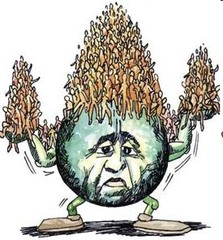
Overpopulation
a situation in which the number of people in an area exceeds the capacity of the environment to support life at a decent standard of living
Fertility
the incidence of childbearing in a country's population

Mortality
The death rate within a population.

Migration
Form of relocation diffusion involving permanent move to a new location.

Crude Birth Rate (CBR)
The total number of live births in a year for every 1,000 people alive in the society.

Example of a high crude birth rate
Uganda, 43 births per 1000 people per year

Example of a low crude birth rate
Japan, 7 births per 1000 people per year
US Crude birth rate
12.5 births per 1000 people per year
Crude Death Rate (CDR)
The total number of deaths in a year for every 1,000 people alive in the society.

Rate of Natural Increase (NIR)
the percentage by which a population grows in a year. (Excludes migration)
CBR-CDR= NIR

World-wide Natural Increase Rate today (2020)
1.2%
Highest world-wide natural increase rate in history
2.2% in 1963
"Rule of 70"
An equation to calculate doubling time: 70 / natural increase rate = doubling time. (Ex: if NIR is 2% then doubling time is 70/2= 30 years.)
Natural Increase rate in the US today (2020)
0.5%
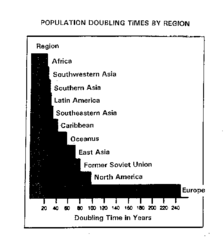
Doubling Time
The number of years needed to double a population, assuming a constant rate of natural increase.
Population Pyramid
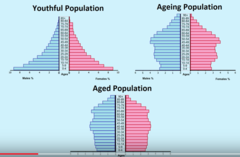
A bar graph representing the distribution of population by age and sex.

Maternal Mortality Rate
annual number of deaths of women from pregnancy-related causes per 100,000 live births

Sex ratio
the ratio of males to females in a population

Total Fertility Rate (TFR)
an estimate of the average number of children that each woman in a population will bear throughout her childbearing years

Average Total Fertility Rate in the world today (2020)
2.5
Total Fertility Rate in sub-Saharan Africa today
4.5
Total fertility rate in the US today
1.7
Total fertility rate need to sustain zero population growth
2.1
Dependency Ratio
The number of people under age 15 and over age 64 compared to the number of people active in the labor force

Graying population
a demographic pattern in which the percentage of a country's population older than sixty-five increases

Consequences of a Graying Population
fewer people in the work force and more retired people dependent on the medical and social services of the nation
Anti-Natalist Policies
government policies to reduce the rate of natural increase

Demographic Transition Model (DTM)
The process of change in a society's population from a condition of high crude birth and death rates and low rate of natural increase to a condition of low crude birth and death rates, low rate of natural increase, and a higher total population.

Industrial Revolution
A period of rapid growth in the use of machines in manufacturing and production that began in the mid-1700s

Medical Revolution
the leap of medical knowledge in stage 2 of the demographic transition

Pro-Natalist Policies
Government policies to increase the rate of natural increase

Zero Population Growth (ZPG)
a condition for individual countries when births plus immigration equals deaths plus emigration

stage 1 of demographic transition
Low growth; Very high birth and death rates = 0 NIR; Hunting & gathering, agricultural societies.

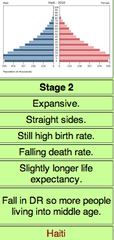
Stage 2 of demographic transition
improvements in healthcare, nutrition, sanitation, and wages cause death rates to drop
stage 3 of demographic transition
fertility rates drop and cause a more even distribution of the population according to age and sex
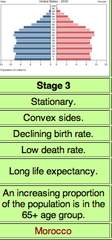
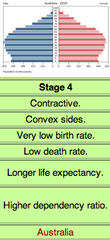
stage 4 of demographic transition
an industrialized society; birth and death rates are both low
Declining Birth Rate
Medicine and contraceptive methods improve during this time so women can choose to have less children.
Thomas Malthus
Eighteenth-century English intellectual who warned that population growth threatened future generations because, in his view, population growth would always outstrip increases in agricultural production.

Neo-Malthusian
theory that builds upon Malthus' thoughts on overpopulation. Takes into count two factors that Malthus did not: population growth in LDC's, and outstripping of resources other than food

Causes of CBR decline
increased education, access to contraception, urbanization
Epidemiologic Transition
The process of change in the different causes of death in each stage of the demographic transition

Epidemiology
Branch of medical science concerned with the incidence, distribution, and control of diseases that affect large numbers of people.

Infant Mortality Rate (IMR)
The total number of deaths in a year among infants under 1 year old for every 1,000 live births in a society.

Life Expectancy
The average number of years an individual can be expected to live, given current social, economic, and medical conditions in a particular society

Pandemic
Disease that occurs over a wide geographic area and affects a very high proportion of the population.

mobility
All types of movement from one location to another.

Circulation
Short-term, repetitive, or cyclical movements of people that recur on a regular basis.

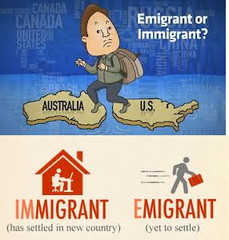
Emigration
movement of individuals out of an area

Forced Migration
Human migration flows in which the movers have no choice but to relocate.

Immigration
Movement of individuals into a population

Internal Migration
Permanent movement within a particular country.

International Migration
Permanent movement from one country to another.

Interregional Migration
Permanent movement from one region of a country to another.

Intraregional migration
Permanent movement within one region of a country.

Migration
Form of relocation diffusion involving permanent move to a new location.

Migration Transition
Change in the migration pattern in a society that results from industrialization, population growth, and other social and economic changes that also produce the demographic transition.

Net Migration
the difference between the number of immigrants and the number of emigrants (determines whether migration raises or lowers your population)
Ravenstein's Law
11 principles that describe most common patterns in migration. For example: 1) Most migrants move only a short distance. 2) females are more migratory than males within the areas of their birth, but males more frequently venture beyond; 3) most migrants are young adults; families rarely migrate out of their country of birth

Voluntary Migration
movement in which people relocate in response to perceived opportunity; not forced.

Counterurbanization
Net migration from urban to rural areas in more developed countries.

Asylum Seeker
a person who has left their home country as a political refugee and is seeking asylum in another.

Floodplain
an area along a river that forms from sediments deposited when the river overflows its banks

Guest Worker
a foreign laborer living and working temporarily in another country

Internally Displaced Person (IDP)
someone who is forced to flee his or her home but who remains within his or her country's borders

Pull Factor
A factor that draws or attracts people to another location

Push Factor
negative home conditions that encourage the decision to migrate

Refugee
A person who has been forced to leave their country in order to escape war, persecution, or natural disaster

Step Migration
Migration to a distant destination that occurs in stages, for example, from farm to nearby village and later to a town and city
Brain Drain
the emigration of highly trained or intelligent people from a particular country.

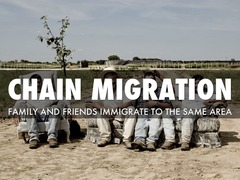
Chain Migration
migration of people to a specific location because relatives or members of the same nationality previously migrated there
Intervening Obstacle
An environmental or cultural feature of the landscape that hinders migration.

Quotas
In reference to migration, laws that place maximum limits on the number of people who can immigrate to a country each year.

Remittances
Money migrants send back to family and friends in their home countries, often in cash, forming an important part of the economy in many poorer countries

Unauthorized Immigration
People who enter a country without proper documents to do so

Transhumance
A seasonal periodic movement of herders and their livestock between highland and lowland pastures
