Advanced medical care unit 4
 Call Kai
 Learn
 Practice Test
 Spaced Repetition
 Match
 Flashcards
 Knowt Play
1/149

There's no tags or description
Looks like no tags are added yet.
150 Terms
How do endocrine glands release hormones?
They secrete hormones into the bloodstream.
What is a target organ?
A tissue or organ affected by a particular hormone.
Where is the pituitary gland located?
At the base of the brain, below the hypothalamus.
What is another name for the anterior pituitary?
Adenohypophysis.
What does thyroid-stimulating hormone do?
It promotes thyroid gland growth and secretion.
What does adrenocorticotropic hormone stimulate?
Growth and secretion of the adrenal cortex.
What does follicle-stimulating hormone promote?
Estrogen secretion and egg and sperm development.
What does luteinizing hormone promote?
Ovulation and maintenance of pregnancy.
What does growth hormone do?
It accelerates body growth.
Where are posterior pituitary hormones produced?
In the hypothalamus.
What is the kidney effect of antidiuretic hormone?
It promotes water reabsorption.
What does oxytocin stimulate during birth?
Uterine contractions.
What is the function of thyroid hormones T3 and T4?
They regulate metabolism.
What effect does calcitonin have on calcium?
It promotes calcium absorption from blood into bones.
What effect does parathyroid hormone have on blood calcium?
It increases blood calcium levels.
What does aldosterone regulate?
Sodium and potassium.
What is a metabolic function of glucocorticoids?
They regulate carbohydrate, fat, and protein metabolism.
What response does epinephrine stimulate?
The sympathetic fight-or-flight response.
What is the effect of insulin on blood glucose?
It lowers blood glucose by promoting cellular uptake or storage.
What is the effect of glucagon on blood glucose?
It raises blood glucose by breaking down glycogen.
What is thymosin's immune function?
It promotes T-lymphocyte maturation.
What hormone helps maintain the sleep-wake cycle?
Melatonin.
What hormone helps maintain pregnancy?
Progesterone.
What causes hypothyroidism?
Insufficient thyroid hormone.
What is the standard initial hypothyroidism screening test?
Total T4.
What results strongly suggest hypothyroidism?
High TSH combined with low T4.
What is the treatment of choice for feline hyperthyroidism?
Radioactive iodine-131.
What mechanisms can cause diabetes mellitus?
Insufficient insulin production or resistance to insulin.
What diabetic posture can occur in cats?
Plantigrade posture, with walking on the hocks.
What breath odor can accompany diabetic ketoacidosis?
A fruity acetone odor.
At what blood glucose level does glucose enter urine?
At the renal threshold of 180 mg/dL.
What diet is recommended for diabetic patients?
A high-protein, low-carbohydrate diet.
When is insulin given to diabetic patients?
Every 12 hours, after a meal.
How is an initial glucose curve performed?
Collect five blood samples at two-hour intervals.
What does fructosamine monitoring assess?
Average blood glucose over approximately two weeks.
What is another name for insulin shock?
Insulin overdose.
What routines help prevent insulin shock?
Consistent feeding and exercise routines.
What type of tumor causes insulinoma?
A functional pancreatic beta-cell tumor.
What blood glucose range is listed for insulinoma?
15-75 mg/dL.
What glucose level accompanies insulinoma symptoms in Whipple's triad?
Less than 50 mg/dL.
How frequently should insulinoma patients be fed?
At least four to six meals per day.
What is the reported survival with insulinoma treatment?
12-24 months.
What is another name for hypoadrenocorticism?
Addison's disease.
What causes secondary Addison's disease?
A lack of ACTH.
What adrenal changes occur in primary Addison's disease?
Cortical atrophy reduces glucocorticoid and mineralocorticoid production.
What serum chemistry changes are listed for Addison's disease?
Increased BUN, creatinine and calcium; decreased glucose and albumin.
When are canine ACTH stimulation samples collected?
At baseline and 60 minutes.
When are feline ACTH stimulation samples collected?
At baseline, 30 minutes and 60 minutes.
What medication is listed for an acute Addisonian crisis?
Intravenous dexamethasone, alongside normal saline.
What is another name for hyperadrenocorticism?
Cushing's disease.
What hormone is hypersecreted in Cushing's disease?
Cortisol.
What skin change commonly accompanies Cushing's disease?
Bilateral symmetrical alopecia.
When is cortisol retested in the dexamethasone suppression test?
Four and eight hours after dexamethasone administration.
Which drug is considered safer than mitotane for Cushing's?
Trilostane.
What hormone is excessively secreted in primary hyperparathyroidism?
Parathyroid hormone.
Which breed is overrepresented in primary hyperparathyroidism?
Keeshonds.
What serum calcium level supports primary hyperparathyroidism?
Over 12 mg/dL.
What supplementation treats hypocalcemia or hypoparathyroidism?
Calcium and vitamin D.
What is another name for puerperal tetany?
Eclampsia.
What treatment is listed for suspected eclampsia?
Slow intravenous administration of 10% calcium gluconate.
What is the prognosis for promptly treated eclampsia?
Good.
Why are the testes located outside the body?
A lower temperature is needed for sperm development.
What do the testes produce?
Spermatozoa and testosterone.
What is the function of the epididymis?
It stores semen and provides a passageway for sperm.
What carries sperm from the epididymis toward the urethra?
The ductus deferens.
Which accessory sex gland do dogs possess?
The prostate gland.
What stimulates testosterone secretion from the testes?
Luteinizing hormone.
What do the ovaries produce?
Estrogen, progesterone, and ova.
Where does fertilization usually occur?
In the uterine tubes.
What catches the ovum after it leaves the ovary?
The infundibulum.
Where does the developing embryo reside?
In the uterus.
What is the muscular middle layer of the uterus?
The myometrium.
What seals the cervix during pregnancy?
A mucus plug.
What is the predominant hormone in the follicular phase?
Estrogen.
What is the predominant hormone in the luteal phase?
Progesterone.
How long does proestrus last in dogs?
Nine days.
When is the female receptive to the male?
During estrus.
What structure forms during metestrus?
The corpus luteum.
What happens to progesterone when the corpus luteum regresses?
Its level drops rapidly.
What hormone stimulates milk letdown?
Oxytocin.
What hormone stimulates milk production?
Prolactin.
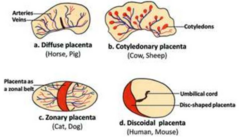
Which species have a diffuse placenta?
Horses and pigs.
What structures form a placentome?
A fetal cotyledon and a maternal caruncle.
Which species have a zonary placenta?
Dogs and cats.
What is the gestation period for dogs and cats?
Approximately 63 days.
When can canine and feline fetuses be palpated?
Around 21-30 days of gestation.
When is fetal bone ossification visible on radiographs in dogs?
At approximately 43 days of gestation.
What characterizes stage 1 of labor?
Nesting and uterine contractions without an abdominal component.
What temperature drop precedes stage 2 of labor?
A drop to 99°F, approximately 24 hours beforehand.
How long does stage 2 usually take per puppy or kitten?
Approximately 20-60 minutes.
What characterizes a breech presentation?
The buttocks emerge first, with hind limbs folded inward.
When do continuous contractions indicate dystocia?
After 30 minutes without progress.
When do infrequent contractions indicate dystocia?
After two hours without progress.
What does a stuck puppy or kitten require?
Immediate medical attention.
Where does blackish-green birth discharge originate?
Placental attachment sites.
What should be completed before cesarean induction?
IV catheter placement and initial surgical site preparation.
How do anesthetics affect fetuses during cesarean delivery?
All anesthetics and analgesics enter fetal circulation.
Which drug can induce cesarean anesthesia?
Propofol.
How is the uterus closed if not spayed?
With two layers of sutures.
Why use intradermal sutures after cesarean delivery?
Hidden sutures reduce irritation from puppies or kittens.