Diagram of CCEA A2 2 CHEMISTRY- Electrode Potentials
 Call Kai
 Learn
 Practice Test
 Spaced Repetition
 Match
 Flashcards
 Knowt Play
1/48

There's no tags or description
Looks like no tags are added yet.
49 Terms
Standard electrode potential
The potential difference measured when a half-cell is connected to the standard hydrogen electrode under standard conditions.
oxidation number of oxygen
-2
oxidation number of hydrogen
+1
oxidation number of fluorine
-1
oxidising agent
the substance that is reduced ie. gains electrons
reducing agent
the substance that is oxidised ie. loses electrons
what does standard electrode potential measure?
tendency to be oxidising reagents or the tendency to accept electrons
standard conditions for standard electrode potential (temperature, pressure and concentration)
temp 298k
gases at 100kPa pressure
concentration of ions 1mol dm-3
equation for equilibrium when a metal is in a solution of its own ions
M^n+ (aq) + ne- -> M(S)
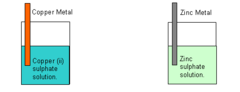
When is a platinum electrode used?
If there is no solid state to act as the electrode
equilibrium equations for 2 half cells Zn and Cu
Zn2+ (aq) +2e- -> Zn (S)
Cu2+ (aq) + 2e- -> Cu (s)

what side is oxidation on in the cell ?
oxidation is left (OILRIG)
label
Voltmeter
label (remember CPR)
anode (oxidation)
label (remember CPR)
cathode(reduction)
label
direction of electron flow
label the solution
Cu2SO4
Label the solution
ZnSO4
Cell notation
Zn(s) | Zn2+ (aq) || Cu2+ (aq) | Cu (s)
What is a hydrogen electrode?
a standard reference used for measuring electrode potentials, assigned an electrode potential of 0.00V

structure of hydrogen half cell
-hydrogen gas at 100kPa
- Platinum electrode
- 298K temp
- 1 mol dm-3 H+ in solution
- connects to half cell via salt bridge
how is standard electrode potential measured with a hydrogen electrode?
the voltage measured by the voltmeter is the Standard electrode potential
purpose of salt bridge
completes the circuit, the ions in the salt conduct the electricity, maintains a balance of cations and anions
purpose of the wire in electrochemical cell
connects the two metals and allows electron flow in the external circuit

label
wire
EMF (electromotive force)
The potential difference measured when two half-cells are connected
How is a salt bridge made?
filter paper is soaked in saturated potassium nitrate solution

method for determining the electrode potentials of a series of cells
- set up a half-cell with a metal dipping into a 1M solution of its ions
- use a salt bridge to connect the two beakers
- record the voltage
why is KNO3 used more often than KCl for the salt bridge?
the Chloride ions can sometimes form complexes with the ions in solution
EMF equation
E^Ө RHS - E^Ө LHS
which EӨ value will go on the right of the cell?
the one with the greater positive value as it is the reduction one
overall ionic equation for Zn and Cu cell
Zn + Cu2+ -> Zn2+ + Cu
how is emf used to predict feasibility of a redox reaction?
a positive emf indicates a feasible reaction
cell notation for Fe3+ , Fe2+ and Cl2 Cl- half cells (pt electrode)
Pt(S) | Fe2+ (aq) , Fe3+ (aq) || Cl2 (g) | Cl (aq) | Pt (s)s
how to predict what Zn2+/Zn will react with using its standard electrode potential
will react with anything with a more positive electrode potential
explain the limitations of prediction in terms of concentration
non-standard conditions alter electrode potential: increasing concentration of ions in solution moves equilibrium to RHS, electrons are removed from the equilibrium causing the electrode potential to become less negative
why can prediction of rate not be made using Electrode potential values?
predictions can be made about the equilibrium position but not about the rate of reaction- this could be extremely slow due to a high activation energy
Non-rechargeable cells (primary cells)
the chemical reaction takes place providing electrical energy and its not reversible so the cell can not be recharged
rechargeable cells
chemical reaction takes place providing electrical energy, the reaction can be reversed during recharging
Examples of a rechargeable cell
lithium ion cell, nickel-cadmium cells, lead-acid cells
why are lithium ion cells used in portable devices?
lightweight, rechargeable, can be made in different shapes
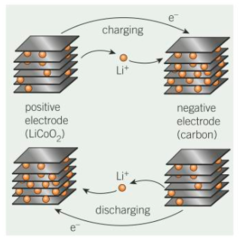
how to write the recharging equation
reverse the overall equation
example of non-rechargeable cells
zinc-carbon cell

cell notation for lithium ion cell
Li | Li+ || Li+, CoO2 | LiCoO2 | Pt
fuel cell
a fuel cell uses energy from the reaction of a fuel with oxygen to create a voltage
half equation for reaction at anode and cathode and overall equation during discharge in alkaline hydrogen-oxygen fuel cell
anode: H2 + 2OH- -> 2H2O + 2e-
cathode: O2 + 2H2O + 4e- -> 4OH-
overall: 2H2 + O2 -> 2H2O
Limitations of hydrogen fuel cells
- storage of flammable hydrogen
- limited lifetime
Advantages of fuel cells
- renewable source of energy
- non polluting
environmental issues associated with cells
- non-renewable cells are wasteful
- rechargeable cells have limited lifetime