The Chemical Industry
 Call Kai
 Learn
 Practice Test
 Spaced Repetition
 Match
 Flashcards
 Knowt Play
1/8

There's no tags or description
Looks like no tags are added yet.
9 Terms
dot and cross diagram of ammonium
dative covalent bond bc ammonia has a lone pair

what is the nitrogen cycle and why is it useful
nitrogen is very unreactive so it can’t be used directly by plants to make proteins

nitrogen oxide, nitrogen dioxide and dinitrogen oxide: appearance and where it comes from
NO- colourless, turns to brown NO2 in air, from combustion in engines, thunderstorms and denitrifying bacteria
NO2- brown gas, from oxidation of NO in atmosphere
N2O- colourless gas, formed by denitrifying bacteria
test for nitrate (V) ions, and ammonium ions
nitrate(V): warm with Devarda’s alloy and NaOH, test gas w damp red litmus, if it turns blue it is present
ammonium: warm w NaOH, if damp red litmus paper turns blue it is present
this is because both processes release ammonia which is basic so turns litmus paper blue
rate of reaction vs product yeild
product yeild depends on Kc/equilibrium, but rate of reaction is always increased by increasing temperature and pressure- energy/cost/safety issues. May have to compromise between product yeild and rate of reaction
rate equation
shows how fast reactants are converted into products. This depends on conc of reactants, and rate constant. Units are mol dm-3 s-1
A+B→C+D
rate equation= k[A]m + [B]n
m and n = order 0,1, or 2, overall order= m + n
k- rate constant: this is constant when the temperature is constant. its units vary
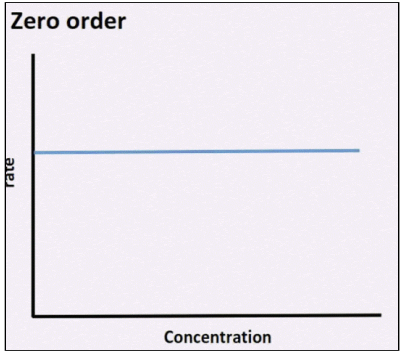
zero order
conc of this species has no effect on rate
horizontal line
rate = k
first order
conc of the species is directly proportional to rate
doubling conc doubles rate
rate = k[A]
