chronic diarrhoea sdl
 Call Kai
 Learn
 Practice Test
 Spaced Repetition
 Match
 Flashcards
 Knowt Play
1/19

There's no tags or description
Looks like no tags are added yet.
20 Terms
When would we define diarrhoea as acute and when would it be classed as chronic?
chronic is over 2 weeks
What are the features of small intestinal diarrhoea?
-abdominal pain
-weight loss
-large amount
-normal to increased frequency
-borborygmi
-melena
What are the features of large intestinal diarrhoea?
-increased frequency
-small amounts
-blood/mucus
-mild borborygmi
-urgency
-start soft → runny
What factors might influence the development of a chronic enteropathy (and therefore chronic diarrhoea)?
effective treatment
gut support
microbiome
what is the difference between primary and secondary GI disease
Primary: pathology of intestines (IBD, lymphoma, parasites, food intolerance, EPI, infections).
Secondary: systemic cause → diarrhoea (liver disease, renal disease, pancreatic insufficiency, hyperthyroidism, Addison’s disease).
Your first consult of today is Barney. He is a 12-year-old Persian-X, who has presented for an approximately 4-month history of diarrhoea.
Barney has been with his current owners for 4 years; he was rehomed privately from a friend who was emigrating.
Barney has only ever been seen at the practice for his routine vaccinations once a year, and no health issues have been identified previously.
The owner has two other cats.
What further information do you need from the history in this case?
what does the diarrhoea look like
does he usually go outside
is there urgency or more frequency?
other cats affected
flea and worm utd?
what is diet like? any changes?
Drinking? urinating? eating?
vomiting?
Barney defecates in the litter tray once a day, though he does also have outside access. The stools vary in quality, but are score 4 on a ‘good day’, and score 6-7 on a ‘bad day’.
Amount of faeces is relatively large each time, and it varies from a normal brown colour, to occasionally being a lighter yellow/brown. The owner has not seen Barney straining.
He vomits occasionally (around 2x a month). Normally bile/froth rather than food.
He is wormed every 3 months with a milbemycin/praziquantel product. He isn’t a ‘big hunter’ but does bring in the occasional baby mouse.
Neither of the other cats in the household are affected.
His appetite varies – he can sometimes be fussy which owners report is normal for him. He is fed a mixture of ‘Go Cat’ dry biscuits and a variety of different wet pouches.
Owners also report hearing his tummy gurgle and that he can have some flatulence.
Clinical Examination
BAR, mucus membranes pink and moist, crt 1s. Mild tartar on teeth.
HR 160bpm, RR 34bpm, no heart murmur, chest clear on auscultation.
T 38.8°C with loose, brown faeces present on thermometer, and some dried faeces in coat around back end.
BCS 4/9 (weight previously 4.4kg at vaccine appointment 4 months ago, now 4.2kg).
Abdominal palpation comfortable, and NAD other than gassy/liquid feeling intestinal contents.
Based on history and clinical examination findings, create a problem list for Barney.
Is this small or large intestinal diarrhoea?
d+ over last 4 months
weight loss
occasional vomiting
gassy
small intestinal
-pale/yellow
-weightloss
-large amount
-flatulance
-vomiting
Due the fact Barney is otherwise well in himself, his owners decline investigation at this point.
What initial medications and/or management will you suggest to the owners at this point?
probiotic → pro kolin
gi diet
fenbendazole to cover giardia
When would you recommend rechecking this patient if he is not improving? What expectations would you set for what might happen in the next appointment?
2 weeks recheck
start with Heam (check for anaemia and infection/inflam status) and biochem plus T4= check thyroid, kidneys and for lymphoma

One month later…
Barney represents at the clinic, with no improvement in his diarrhoea after a diet trial on Purina HA food (a hydrolysed protein diet). He is not eating much now and the owners report he is quite lethargic.
His owners have noticed weight loss, and his BCS is now 3/9, with his weight now 3.9kg (last visit 4.2kg).
On examination today, he is still BAR, with a CRT of 2 seconds. MMs are maybe slightly pale, and he looks generally ‘unkempt’.
HR – 148 RR – 30 T – 38.2c
Abdominal palpation is still comfortable, but intestines possibly feel slightly thickened/‘ropey’.
As discussed at your previous visit, you decide to firstly take a blood sample for Haematology and Biochemistry, as well as a Total T4.
total t4= normal
Interpret the blood results above, thinking about the following points:
- Has a diagnosis been reached?
- How would you communicate the findings to the owner?
- What are your main concerns regarding the findings?
diabetes mellitus? → high glucose
CKD → azotaemia
get a urine sample to assess both of these
mild non-regen anaemia
T4 normal
IBD or lymphoma → We need imaging and further tests
faecal analysis to rule out giardia → eosinophils high
abdo us?
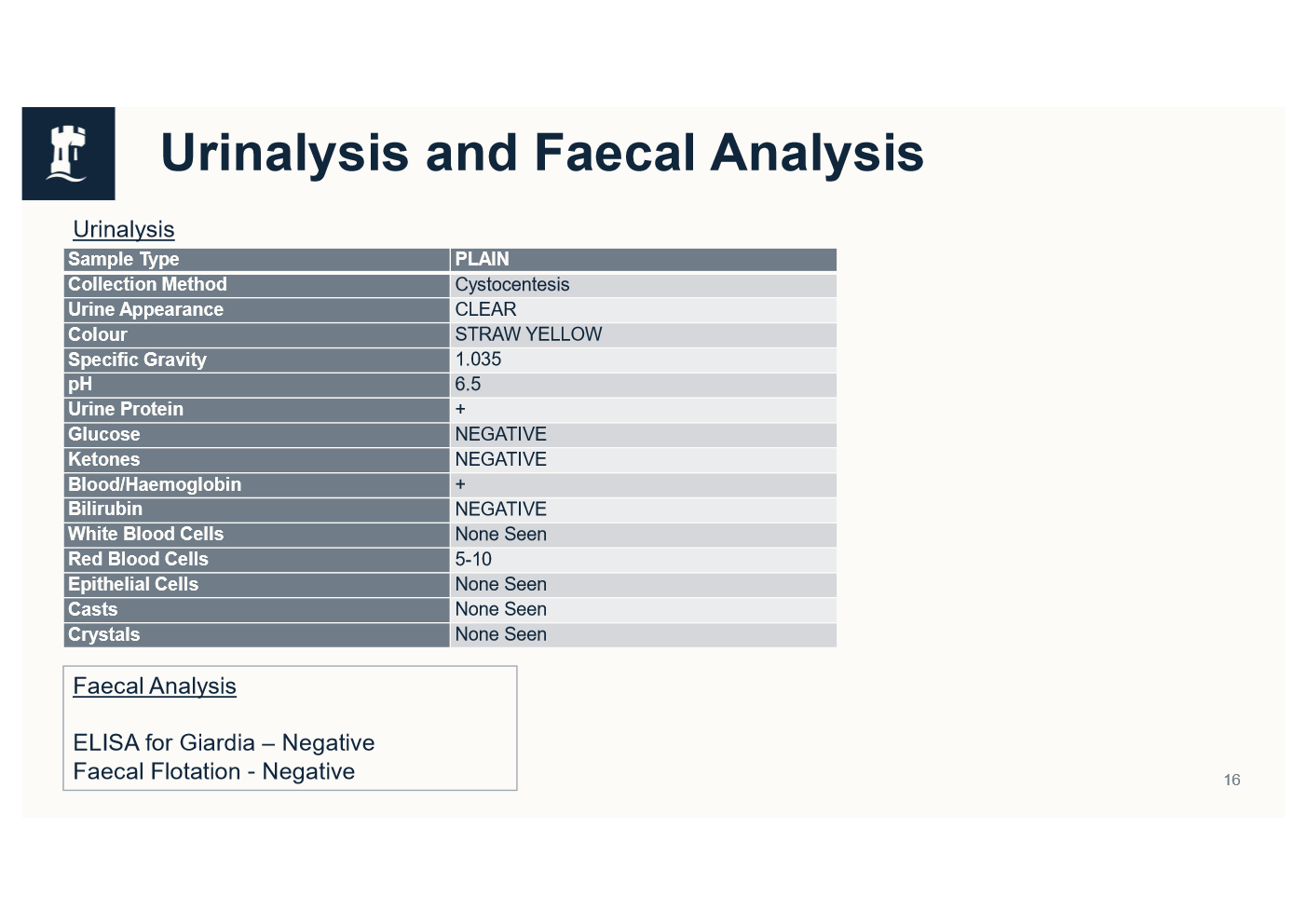
urinarysis and faecal analysis
On abdominal ultrasound, you see a generalised thickening of the small intestine, and enlargement of the mesenteric lymph nodes. Other organs appear normal.

What are your differentials based on the above findings?
What further diagnostic test is required to reach a diagnosis in this case?
IBD
lymphoma
LN aspirate
intestinal biopsy
You discuss with the owners, and advise them that to differentiate between IBD and lymphoma, and to reach a definitive diagnosis, an intestinal biopsy would need to be taken.
how can this be done
This biopsy could be taken during a laparotomy, or endoscopically.
pros and cons of endoscopic biopsy
Pros:
Minimally invasive
Quick recovery
Can sample upper GI ± colon
Lower cost than surgical
Cons:
Only mucosal samples
Cannot reach jejunum (common site of feline disease)
Cannot sample full-thickness → may miss lymphoma
Cannot biopsy lymph nodes
pros and cons of surgical biopsy
Pros:
Full-thickness samples (gold standard)
Can biopsy jejunum + ileum + lymph nodes
Highest diagnostic accuracy
Cons:
More expensive
More invasive
Longer recovery
Requires GA and hospitalisation
The owners elect not to pursue further investigations in this case, as they do not wish to put Barney through invasive procedures.
What is your treatment plan for Barney?
steroids
prednisolone, taper down to try and achieve lowest dose possible with no clinical signs
easily digestible food
Strict hydrolysed or novel protein diet
Cobalamin supplementation (if low B12 suspected)
lymphoma responds well to chemo
Chlorambucil (for suspected small-cell lymphoma or steroid-refractory IBD)
± Cyclosporine
Had the owners opted for biopsies, and a diagnosis of lymphoma was made, what other options are there available for treatment/management?
Small-cell lymphoma
Chlorambucil + prednisolone
Very good prognosis (often years)
Large-cell lymphoma
Multi-agent CHOP chemotherapy
Prognosis guarded (months)
Palliative care
Prednisolone alone
Appetite stimulants
Quality-of-life management
Harley, a 5-year-old, male neutered, Labrador, also presents to you for diarrhoea. He started with diarrhoea 8-10 months ago. At first this was intermittent but is now more frequent. He has a ravenous appetite. He is prone to scavenging and also displays coprophagia as well as pica at times. He vomits occasionally (1-2 times a month).
He passes large volumes of steatorrhoeic foul smelling diarrhoea 2-3 times a day. There is no dyschezia, haematochezia or urgency. The owners have not seen any mucus. He frequently has boroborygmi and flatulence.
How would you categorise Harley’s diarrhoea?

small intestinal, chronic
Clinical Exam
BCS 2/9, generalised muscle wasting and dry seborrheic coat.
T – 38.2°,C P – 100bpm, RR - 28,
no evidence of dehydration, mucous membranes pink, CRT – 1 second. Abdominal palpation suggests soft intestinal contents. No abnormalities detected and very easy to palpate due to poor body condition.
Harley’s owners have tried various diets over the past few months, some have made no difference at all, and some have made a small improvement in faecal consistency, but none have ‘fixed’ the problem. He is up to date with flea and worming (given Bravecto every 3 months, and Milbemax monthly).
You decide to run some blood and urine tests in house to investigate, as you are worried about the chronic nature of the diarrhoea and the poor body condition of Harley.
Think about which specific tests you may like to run and why?
heam- inflammation, infection, aneamia
biochem- renal and hepatic health, electrolyte balance
feacal sample - giardia
Cobalamin & folate
TLI (trypsin-like immunoreactivity)

Can you explain the blood results? Think about what each test is for and what they show individually as well as together.
What is your diagnosis?
low WBC and low lypmocytes- suggest infection, auto immune or nutrition deficiency
AAT and ALP high - hepatic disease/inflammation
low cholestrol and low calcium - malabsorption or neoplasia
would expect hyperca with neoplasia tho
low B12 - malabsorption
high folate - low B12 induced
TLI low - low pancreatic enzymes - EPI
EPI explains all the results
Come up with a management plan for Harley:
How will you monitor his progress?
How long will you treat him for?
What is the likely prognosis?
-supplement pancreatic enzymes
-or if cannot afford give pig pancreas from butchers
Cobalamin injections (weekly for 6 weeks, then monthly)
Highly digestible, low-fat diet
-Recheck cobalamin in 4–6 months
Excellent with treatment
Most dogs gain weight quickly
If owners compliant → near-normal life expectancy