Nuclear Chemistry
 Call Kai
 Learn
 Practice Test
 Spaced Repetition
 Match
 Flashcards
 Knowt Play
1/31

Earn XP
32 Terms
Nuclear Equations
a representation of balanced particles and energy.
Alpha Decay
the nuclear atom releases α-particle.
Beta Decay
the nuclear atom releases β−-particle
Gamma Decay
release of a high-energy photon and tends to accompany other types of decay.
Electron Capture
the nucleus of an atom captures electron from the first shell in the atom.
Positron Emission
the nuclear atom releases β+-particle
Radioactivity
the process in which unstable nuclei lose energy by emitting radiation due to imbalance of protons and electrons.
Radioactive Decay
a sequence of nuclear reactions which result in the formation of a stable isotope.
Radioactive Decay follows first-order kinetics for which the rate of decay is:
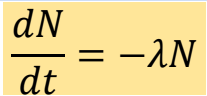
The activity of a radioactive isotope is the absolute rate of decay:

Use of Half-Life
The half-lives of radioactive isotopes have been used as “atomic clocks” to determine the ages of certain objects by radioactive dating.
Nuclear Stability
the tendency of an atomic nucleus to remain intact without undergoing radioactive decay.
Nuclear Binding Energy
the energy required to break up a nucleus into its component protons and neutrons.
Nucleons
protons & neutrons in a nucleus
Nuclear Transmutation
The conversion of one chemical element or isotope into another through a nuclear reaction.
Natural Transmutation
the spontaneous transformation of one chemical element into another, or into a different isotope of the same element, due to radioactive decay.
Artificial Transmutation
the process of changing an element's nucleus into a different element by bombarding it with particles, such as alpha particles or neutrons.
Nuclear Fission
The splitting of a heavy atomic nucleus into two (or more) smaller nuclei, along with the release of a large amount of energy.
Nuclear Fusion
The combining of two light atomic nuclei to form a heavier nucleus, releasing enormous energy.
Nuclear Fuels
refers the substances being utilized by nuclear power plants for energy generation.
Containment Building
a strongly reinforced concrete building at which the nuclear reactor core is housed.
Moderator
a working fluid (usually water) or even that slows down high-velocity neutrons which reduces the likelihood of fission.
Fuel Element
a long metal rod containment for uranium pellet fuel.
Control Element
a metal rod (made of B, Cd, Ag, Hf or In) that is capable of absorbing neutrons during the nuclear fission process without decaying.
Steam Generator
an equipment used to convert liquid water to superheated by the heat coming from the nuclear fission process happening in the nuclear reactor
Turbine
an equipment that is utilized to extract thermal energy from superheated steam which produces a mechanical work on a rotating shaft.
Electrical Generator
a power converter that transforms the mechanical power from the turbine shaft into electrical power.
Condenser
an equipment used to transfer heat from a working fluid (water) which transforms the superheated steam back to liquid water which can be reused for steam production.
Cooling Tower
a heat exchanging equipment that used to cool down water by contact with air to reduce the water temperature. A small volume of water is evaporated then the remaining water is recirculated.