Kidney and Ureter Anatomy PART ONE
 Call Kai
 Learn
 Practice Test
 Spaced Repetition
 Match
 Flashcards
 Knowt Play
1/48

There's no tags or description
Looks like no tags are added yet.
49 Terms
What are the components of the urinary system?
Kidneys filter blood and produce urine, ureters transport urine from the kidneys to the bladder, bladder stores urine until ready to void, urethra carries urine out to the body.
What is the functional unit of the kidney? How many are in each kidney?
Nephron; 1-1.5 million
Nephron Anatomy
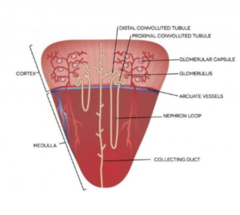
Which structures are found in the renal cortex?
The glomerulus, bowman's capsule, and the proximal and distal convoluted tubules
Which structures can be found in the renal medulla?
The loop of henle and the collecting ducts
What are nephrons responsible for?
Filtering blood (in the glomerulus), reabsorbing nutrients water and electrolytes, secreting waste products and excess ions, and producing filtrate that is produced into urine and drains through the collecting ducts to the renal papillae to the calyces to the renal pelvis.
More Nephron Anatomy

Together, how much do the kidneys filter?
45-50 gallons of plasma-derived filtrate every day
Where are the kidneys located? Make sure to mention where in regards to the vertebrae.
Located in the retroperitoneal space on either side of the vertebral column (T12-L3)
Which kidney is slightly lower and why?
The right kidney due to the liver.
Kidney anatomy

What is the renal capsule?
The innermost layer directly covering the kidney. Thin, tough, fibrous membrane that protects the kidney from trauma and infection. Lies immediately to the renal cortex.
What is the Gerota's Fascia (also called renal fascia)?
The outer fibrous layer that surrounds the kidney AND the adrenal gland. Anchors the kidney to surrounding structures and helps maintain itsposition.
What is the perineal fat? What is its function?
Protective adipose tissue that surrounds and cushions the kidney and adrenal gland. Protects the kidney from trauma, insulates against temperature changes, and supports/helps anchor the kidney in place.
More Kidney Anatomy

Where does the initial filtration of blood and reabsorption of essential substances occur?
The renal cortex
Where are the renal pyramids, loop of henle, and collecting ducts located? What happens here?
Renal medulla. Established and maintains the concentration gradient that allows urine concentration.
Which structure transports urine from the nephrons to the calyces?
The renal pyramids
What structure collects urine from the renal papillae? Which structure is formed by the convergence of those structures? Function?
Minor calyces; major calyces
Function: Funnel urine toward the renal pelvis
What is the funnel shaped reservoir that collects urine from the major calyces? It narrows to become the .....
The renal pelvis, which narrows to become the ureter
Before entering the kidney, the renal artery divides into __________
Segmental arteries
What do segmental arteries further branch into?
Interlobar arteries, arcuate arteries, and interlobular arteries.
Label the segmental arteries, interlobular arteries, arcuate arteries, and interlobular arteries of the kidneys.

Know the blood flow to and from the kidney, starting at the aorta and ending at the inferior vena cava.
Aorta
Segmental arteries
Interlobar arteries
Arcuate arteries
Cortical radiate arteries
Afferent arteriole
Glomerulus
Efferent arteriole
Peritubular capillaries/vasa recta
Cortical radiate veins
Arcuate veins
Interlobar veins
Renal vein
IVC
The kidneys receive _______% of cardiac output
20-25%
What are the two common causes of narrowed renal arteries and reduced blood flow, which leads to hypertension and kidney damage?
Atherosclerosis and fibromuscular dysplasia.
What is atherosclerosis?
The build-up of plaque along the inner walls of the arteries supplying blood to the kidney.
What is fibromuscular dysplasia?
A non-atherosclerotic, non-inflammatory vascular disease that causes abnormal cell growth within the arterial wall.
Glomerulus? Located where?
A tiny ball of capillaries located in the renal cortex, inside the Bowman's capsule.
What is the function of the glomerulus?
Filters blood plasma.
What is the glomerulus driven by?
Driven by hydrostatic pressure from the afferent arteriole.
In the glomerulus, high pressure forces water and small solutes (electrolytes, amino acids, and urea) out of the blood into....
the Bowman's capsule
Large molecules remain.....
In the blood
The resulting fluid from glomerular filtration is called...
Glomerular filtrate
Where does the majority of reabsorption occur?
In the proximal convoluted tubule (65-70% reabsorbed here)
The loop of henle works via a ...
concentration gradient
What happens in the descending limb of the loop of henle?
Water leaves filtrate (it is permeable) and then the filtrate becomes concentrated.
What happens in the ascending limb of the loop of henle?
Impermeable to water, so it actively pumps out sodium and chloride. the filtrate becomes dilute here.
Where is the distal convoluted tubule located? Also think in relation to the loop of henle.
Located in the renal cortex like the PCT, but located after the loop of henle.
What is additionally reabsorbed in the distal convoluted tubule?
Sodium and chloride, and calcium
What enters the collecting duct?
Filtrate
What controls water permeability?
Antidiuretic hormone (ADH)
What goes back into the blood (reabsorption)?
Water (about 99% of filtered water)
Electrolytes (Sodium, chloride, bicarbonate, and potassium)
Nutrients (Glucose, amino acids)
Hormone-regulated ions (Calcium, magnesium)
What stays in the urine?
Nitrogenous wastes: urea, creatinine, and uric acid
also excess salts like sodium, potassium, and chloride if levels are high
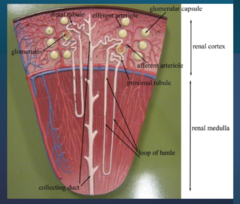
Anatomy to look over
What are the three layers of the ureters? Describe their characteristics
Mucosa (transitional epithelium for stretching), muscular (smooth muscle layers), and adventitia (outer connective tissue layer)
What is the mechanism for the ureters?
Peristalsis: rhythmic contractions of smooth muscle that propel urine downward
Gravity also assists, but peristalsis is essential even when laying down.
What is important to note about the structure of the ureters' entry?
Valve-like entry that prevents backflow
What are common sites for kidney stones, aka ureteral constriction points? Which conditions are associated with these? (3 each)
1. Ureteropelvic junction (UPJ)
2. Crossing over the iliac vessels
3. Ureterovesical junction (UVJ)
*Ureteral obstruction
*Vesicoureteral reflux
*Ureteral injury during surgery