Week 12 MolBio flashcards
 Call Kai
 Learn
 Practice Test
 Spaced Repetition
 Match
 Flashcards
 Knowt Play
1/31

There's no tags or description
Looks like no tags are added yet.
32 Terms
Notes about Genetic Code
Triplets of four nucleotide bases in an mRNA code for 20 amino acids
4³= 64 combinations
The code is mutation resistant
One start codon and three stop codons
Notes about Codons
Similar amino acids = similar codons
Hydrophobic: mostly a pyrimidine (C or U) in position 2
Polar and Charged mostly a purine (A or G) in position 2
Each organism has its own codon bias
For codons making the same amino acid, the difference is usually in base 3
Types of DNA Mutations
Point Mutation = Substitiution
silent = same amino acid
missense = different amino acid
nonsense = premature stop codon
Frameshift Mutation = Insertion (only 1-2 bases added, changing the DNA reading frame)
Frameshift Mutation = Deletion (only 1-2 bases removed, changing the DNA reading frame)
tRNA structure
Highly conserved bases are shown in pink
Invariable CCA arm at 3’ end
5’ end often has a phosphorylated G
Contains ~10 unusual or modified bases

tRNA secondary and tertiary structures

How many types of amino-acyl tRNA synthetases (aatRNAses)?
Class I: found in monomeric form
Class II: found in dimeric form

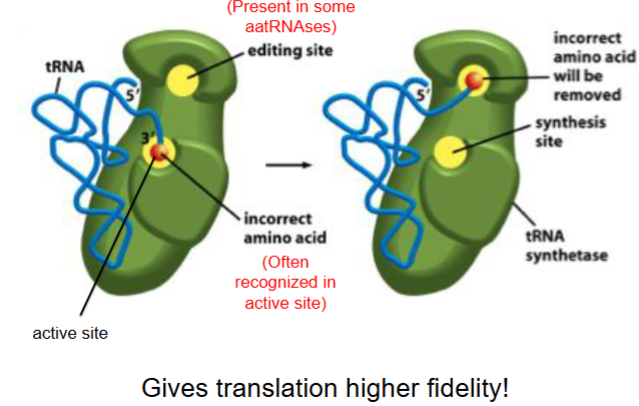
Amino-acyl tRNA synthetases (aatRNAses) charge tRNAs pt. 1

Amino-acyl tRNA synthetases (aatRNAses) charge tRNAs pt. 2

Basic elements of tRNAs

Some aa-tRNAses use an editing site as a proofreading strategy
Codon-Anticodon pairing
I = Inosine

Notes on Ribosomes
65% RNA, 35% protein
2 subunits: small and large
Prokaryotes: 30S + 50S → 70S
Eukaryotes: 40S + 60S → 80S
3 ribosomal RNAs in prokaryotes
Found in small subunit: 16S
Found in large subunit: 23S, 5S
~50 different ribosomal proteins: rich in lysine, arginine, and aromatic amino acids.
Prokaryotic 70S Ribosome
Makes up 20% of dry mass in cells
Composed of 50 proteins and 3 rRNAs
2.5 MegaDaltons in size
Prokaryotic Ribosome subunits
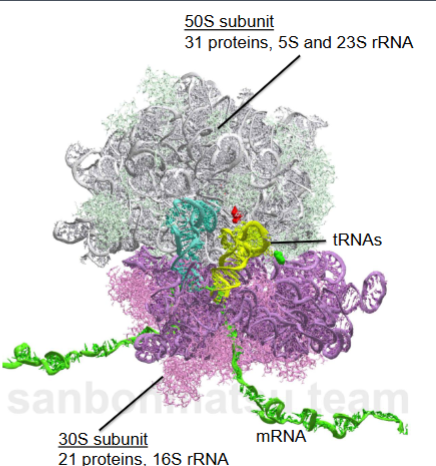
what changes in rRNA in different organisms?
Primary sequence differs organism to organism, but secondary and tertiary structure are conserved.

Notes on Secondary and tertiary structure of 23S and 5S rRNA (50S subunit)
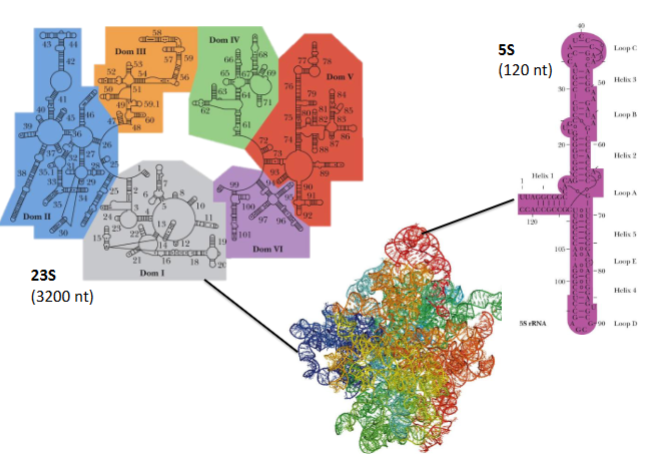
rRNA and ribosomes and proteins
rRNA mostly determines 3D shape of ribosome, proteins stabilize
Ribosomal proteins:
50 distinct proteins in 70S ribosome
Vary in size 6-75: KDa
Rich in lysine, arginine, and aromatic amino acids
The ribosome is a ribozyme

Ribosomal Functional Sites

The 70S ribosome has three distinct binding sites for tRNAs

Initiator tRNA for Prokaryotic translation

The Shine-Dalgarno sequence binds to 16S rRNA of the 30S subunit

Initiation of Prokaryotic Translation
Assembly of the 70S initiation complex

Elongation of Prokaryotic Translation Pt.1
EF-Tu: GTPase enzyme “Delivers” charged tRNA to ribosome at A site. Delivery is GTP-dependent

Elongation of Prokaryotic Translation Pt.2
Correct codon:anticodon pairing must take place before EF-Tu hydrolyzes GTP

Elongation of Prokaryotic Translation Pt.3
Peptide Bond formation

Elongation of Prokaryotic Translation Pt.4

Termination Notes
EF-G resembles EF-Tu-tRNA, binds to same location on ribosome
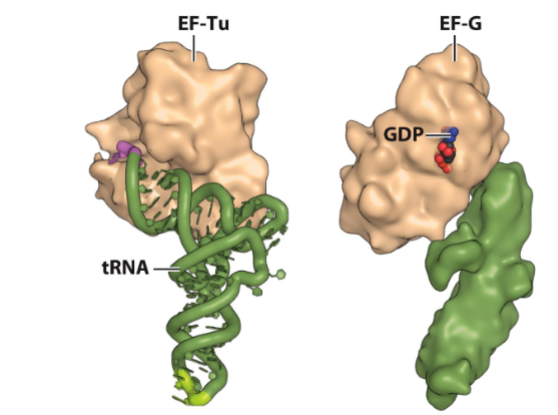
Termination of Prokaryotic Translation Pt.3
requires release factor (RF), EF-G, and Ribosome Recycling Factor (RRF)

few common post-translational modifications
amino and carboxy-terminal modifications (ie cleavage of N- terminal N-formyl Methionine)
Glycosylation
Proteolytic cleavage
Addition of co-factors, prosthetic groups
Antibiotics target all stages of protein synthesis in prokaryotes

Inhibitors of Protein Synthesis

Puromycin
