Unit 7 Monopoly
0.0(0)
Studied by 1 person Call Kai
 Learn
Learn Practice Test
 Spaced Repetition
 Match
Match Flashcards
 Knowt Play
Card Sorting
1/23

Earn XP
Description and Tags
Last updated 7:54 PM on 12/10/22
Name | Mastery | Learn | Test | Matching | Spaced | Call with Kai | Chat |
|---|
No analytics yet
Send a link to your students to track their progress
24 Terms
1
New cards
What are 4 barriers to entry that are conducive for the creation of monopolies?
Control of scarce resources
Large increasing returns to scale (natural monopoly)
Technological superiority
Patents and copyrights
Large increasing returns to scale (natural monopoly)
Technological superiority
Patents and copyrights
2
New cards
What are the relationships between MR, AR and D
AR = D but not MR which is the case with perfect competition
3
New cards
What is the price effect and how is this shown on the curve for total revenue?
To sell the last unit, the monopolist must cut the price of all units, decreasing total revenue
The TR curve is n shaped and decreases when the price effect > the quantity effect
The TR curve is n shaped and decreases when the price effect > the quantity effect
4
New cards
What is the quantity effect and how is this shown on the curve for total revenue?
More units sold increases total revenue
The TR curve is n shaped and initially increases as the quantity effect > the price effect
The TR curve is n shaped and initially increases as the quantity effect > the price effect
5
New cards
Graph for a monopoly showing profit and deadweight loss?
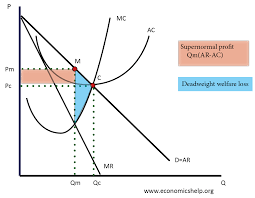
6
New cards
Where are producer and producer surplus shown on a monopoly diagram?
Consumer surplus is the area above price and under the demand curve
Producer surplus us the area under the price and above the MC curve
Producer surplus us the area under the price and above the MC curve
7
New cards
What are the profit maximising price and quantity for monopoly?
Quantity- where MC = MR
Price- the corresponding point on the demand curve
Price- the corresponding point on the demand curve
8
New cards
Define minimum efficient scale
The scale of production beyond which no significant economies of scale can be achieved- dependent on the level of fixed and variable factor inputs, market share, and market contestability
9
New cards
What does low MES mean and what does the graph look like
When a firm has little market share, the market is contestable and the firm cannot benefit significantly from large
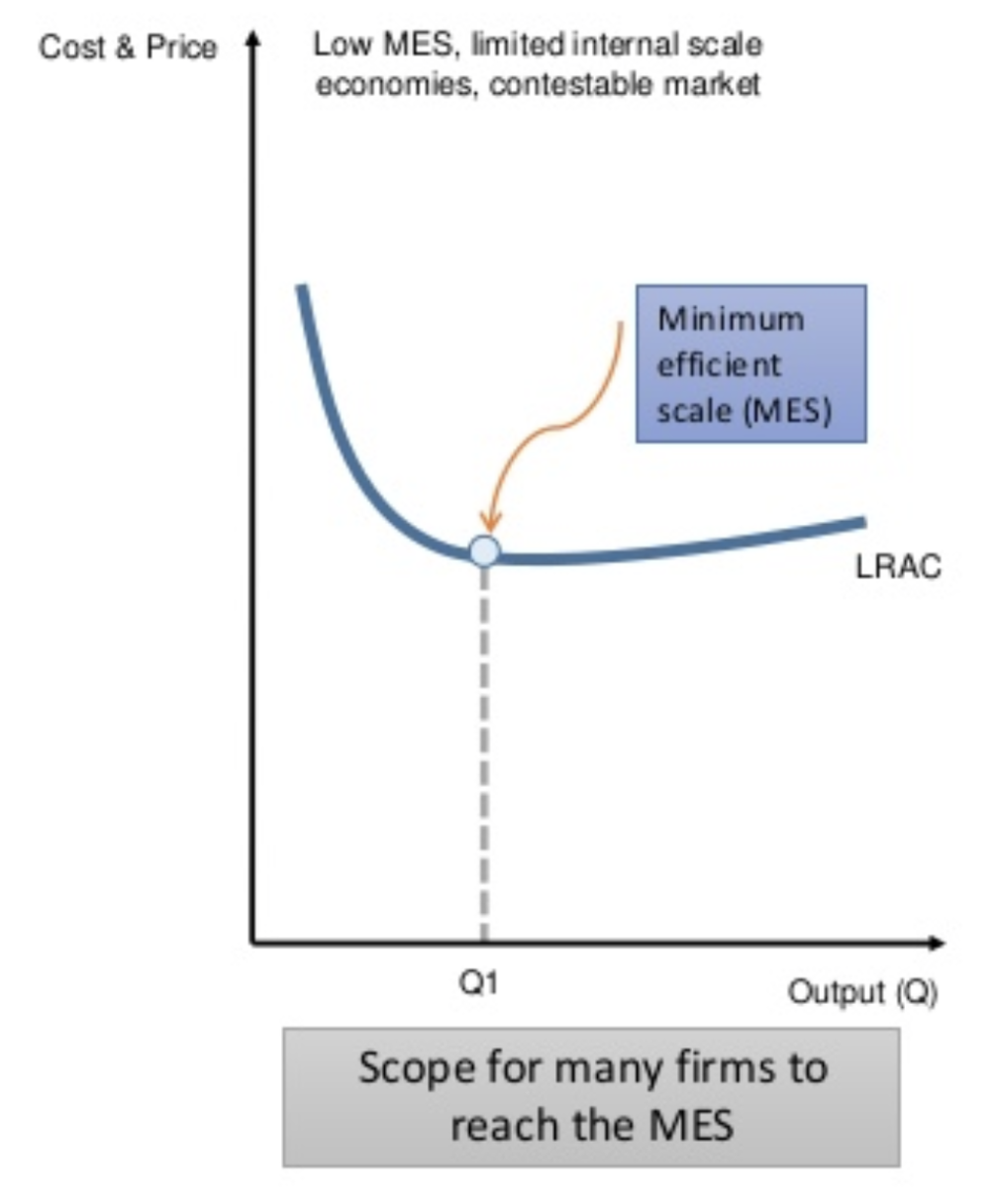
10
New cards
What does high MES mean and what does the graph look like
High minimum efficient scale: production costs will fall throughout the entire range of output hence MES will continue to increase as output increases, occurring in concentrated markets
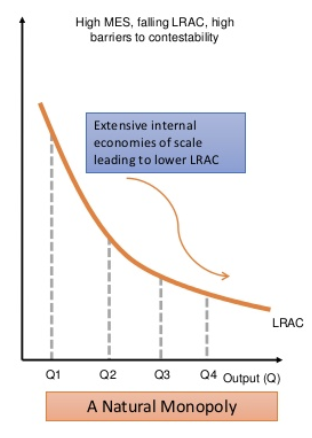
11
New cards
What is price discrimination and perfect price discrimination?
Charging different prices to different consumers for the same good on the basis of their elasticity of demand
Perfect means each customer gets an individual price
Perfect means each customer gets an individual price
12
New cards
What are 3 firms price discriminate?
Advance purchase restrictions i.e. the earlier you buy the lower the price, such as with airlines
Volume discounts
Two-part tariffs where the customer pays a flat fee upfront then a per-unit fee on each item purchased
Volume discounts
Two-part tariffs where the customer pays a flat fee upfront then a per-unit fee on each item purchased
13
New cards
Graphs comparing consumer surplus and welfare in monopoly vs perfect competition
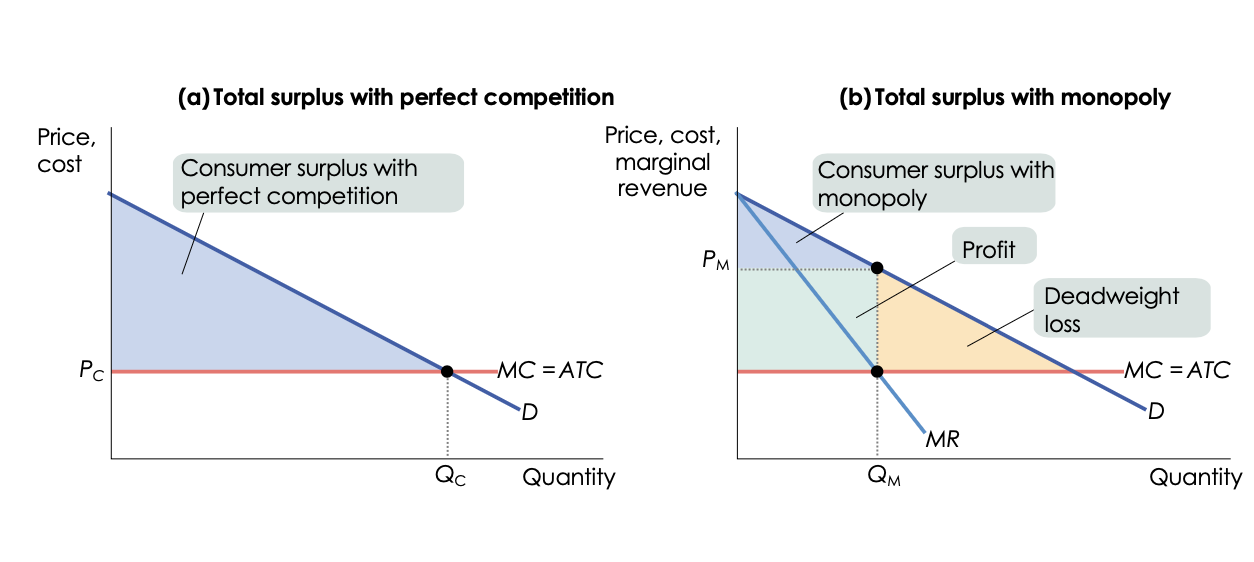
14
New cards
How is price discrimination, where 3 prices are charged, shown on a diagram?
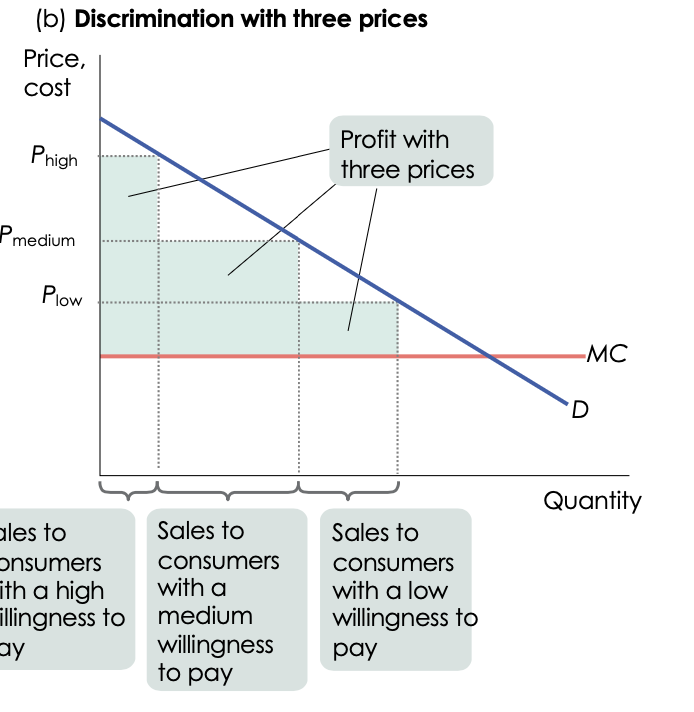
15
New cards
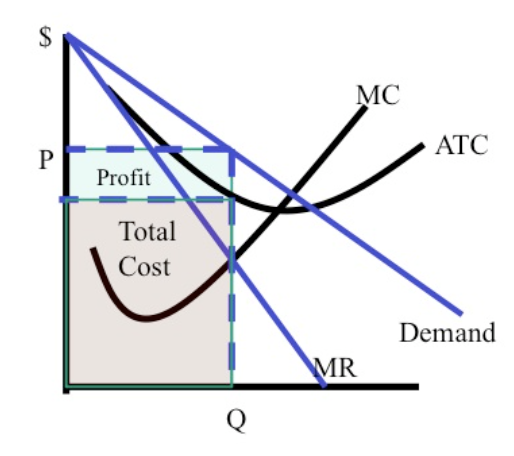
How do you find total cost on a diagram?
Profit maximising Q-point on ATC curve-corresponding price-0
16
New cards
How does a monopolist respond to a decrease in demand?
Decrease price, decrease output
17
New cards
How does a monopolist respond to an increase/decrease in marginal cost?
Increase: increase price, decrease output
Decrease: decrease price, increase output
Decrease: decrease price, increase output
18
New cards
What happens if the ATC curve > demand?
The firm shuts down
19
New cards
How do you find cost per unit on a diagram?
Find the profit maximising quantity then the corresponding price from the ATC curve
20
New cards
How do you find price per unit on a diagram?
Find the profit maximising quantity then the corresponding price from the demand curve
21
New cards
How do you find profit per unit on a monopoly diagram?
Price per unit - cost per unit
Price from demand curve - price from ATC curve
Price from demand curve - price from ATC curve
22
New cards
How does deadweight loss change with price discrimination vs a single price monopolist
A single-price monopolist produces more deadweight loss
23
New cards
In perfect price discrimination, what output will the monopolist produce at>
Quantity where MC = D
24
New cards
In the short run, a monopoly will stop producing if:
AVC > P