Pathophysiology Test 3 Lecture 6: Heart II
 Call Kai
 Learn
 Practice Test
 Spaced Repetition
 Match
 Flashcards
 Knowt Play
1/67

There's no tags or description
Looks like no tags are added yet.
68 Terms
What is congenital heart disease?
defects of cardiac chambers or the great vessels (pulmonary artery or aorta)
What does congenital heart disease result in?
shunting of blood between the right and left-sided circulation or cause blood outflow obstructions
What causes congenital heart disease?
environmental (toxic or infectious) and genetic causes both contribute
Malformations associated with what shunts are the most common?
left-to-right shunts
What are the left-to-right shunt malformations?
atrial septal defects (ASDs), ventral septal defects (VSDs), and patent ductus arteriosus (PDA)
What do left-to-right shunts cause?
right-sided volume overload that causes pulmonary hypertension and cyanosis
What are malformations associated with right-to-left shunts?
tetralogy of Fallot and transposition of the great arteries
Right to left shunts (lesions) cause early-onset cyanosis that are associated with what?
polycythemia, osteoarthropathy, and paradoxical embolization
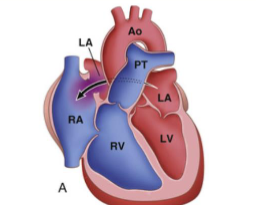
What is this
ASD

What is this?
VSD

What is this???
PDA
What four things characterize the tetralogy of fallot?
1. a ventricular septal defect
2. right ventricular outflow tract obstruction
3. overriding of the VSD by the aorta (aorta receives blood from both ventricles)
4. Right ventricular hypertrophy
What does the tetralogy of fallot cause?
cyanotic congenital heart defect (blue-baby syndrome)
What is the transposition of the great arteries (TGA)?
the aorta originates from the right ventricle and the pulmonary artery originates from the left ventricle; separates the pulmonary and systemic circulations
What is the result of TGA?
an extremely hypoxic neonate, lethal without intervention
Nearly all infants with TGA have what?
an ASD
What do right-to-left shunts cause?
early-onset cyanosis and polycythemia
What is an atrial septal defect (ASD)?
Abnormal opening between the left and right atrium (causing oxygenated blood to enter RA)
What are symptoms of ASD?
heart failure, paradoxical embolism, pulmonary arterial hypertension
What is a ventricular septal defect (VSD)?
Abnormal opening between the ventricles; left-to-right shunt
What is the most common congenital cardiac anomaly at birth?
VSD
Large VSDs result in early symptoms of what?
congenital heart failure
What are symptoms of large VSDs?
-higher left ventricle pressure causes left-to-right shunt
-thickening of pulmonary arteries
-increased pulmonary vascular resistance
-right ventricular hypertrophy and right-sided HF
What is patent ductus arteriosus (PDA)?
PDA is failure of the fetal ductus arterioles (artery connecting the pulmonary trunk to the aorta to close (and form ligamentum arteriosus) within the first weeks of life.
Large PDA contributes to what?
early symptoms of congestive heart failure
What is a treatment for PDA?
indomethacin; a prostaglandin inhibitor that constricts ductus
Where does oxygenated blood travel in fetal circulation?
oxygenated blood travels from placenta -> right atrium; bypasses right ventricle via foramen ovale to enter left atrium -> blood pumped out of left ventricle to aorta
Where does deoxygenated blood travel in fetal circulation?
deoxygenated blood returning from the head and neck flows straight down into the right ventricle; then pumped into pulmonary trunk where majority enters ductus arteriosus to bypass the pulmonary circulation
At birth, the foramen ovale closes and forms what?
the fossa ovalis
At birth, the ductus arteriosus contracts and eventually obliterates leaving what structure?
ligamentum arteriosus
What happens if the foramen ovale fails to close after birth?
patent foramen ovale
What is patent foramen ovale?
valve remains open to some degree but generally causes no significant problem

What could potentially be a problem with patent foramen ovale?
if patient develops a thrombus and it reaches the right atrium and then enters left atrium via foramen ovale, could get pumped to the brain and cause a stroke
what is coarctation of the aorta?
narrowing or constriction of the aorta; common form of obstructive congenital heart disease
What is coarctation of the aorta associated with?
turner's syndrome (XO genotype)
What are symptoms of severe coarctation?
patient present with symptoms of heart failure; if PDA is present, differential cyanosis accompanies condition
What are symptoms of mild coarctation (without PDA)?
patient is asymptomatic until adulthood
what is coarctation of the aorta (without PDA)?
limits blood supply to the lower body because of constriction; increased blood flow through the subclavian artery; decreased blood flow to lower body; enlargement of intercostal arteries due to increased blood flow
What is the treatment for a coarctation of the Aorta?
Surgical excision of narrowed segment: balloon dilation using cardiac catheterization
What are the valvular diseases?
aortic and mitral stenosis
What is aortic stenosis?
narrowing of the aortic valve opening; restricts blood flow from the left ventricle to the aorta and results in left ventricular hypertrophy
What is mitral stenosis?
narrowing of the mitral valve that results in mitral regurgitation; blood flows backwards into the left atrium
What does chronic mitral regurgitation lead to?
the enlargement of the left atrium, and to left ventricular enlargement and hypertrophy due to chronic elevated volume
What is cardiomyopathy?
disease of the myocardium not caused by other cardiovascular disorders
What does cardiomyopathy often cause?
heart failure
What is the most common form of cardiomyopathy?
dilated cardiomyopathy (DCM)
What are the two types of dilated cardiomyopathy (DCM)?
primary (idiopathic) and secondary (alcoholism)
What is hypertrophic cardiomyopathy?
associated with sudden death in athletes
What is the coronary circulation?
the functional blood supply to the heart muscle itself
What is acute coronary syndrome?
any of the three manifestations of ischemic heart disease
What are the three manifestations of ischemic heart disease?
unstable angina, myocardial infarction, and sudden cardiac death
What is unstable angina?
increasingly frequent chest pain associated with plaque disruption and superimposed thrombus; leads to MI
What is myocardial infarction (MI)?
necrosis of the heart muscle resulting from ischemia
What is the major cause of myocardial infarctions?
acute thrombosis within coronary arteries
What are the two types of myocardial infarctions?
Subendocardial infarction and
Transmural infarction
What is subendocardial infarction?
involves the innermost layers of the myocardium
What is a transmural infarction?
spans the entire thickness of the myocardium
What is the therapeutic goal in acute MI?
reperfusion (restoration of blood flow to ischemic myocardium) as quickly as possible
What factors are related to the amount of tissue affected by an infarct?
-mass of myocardium perfused
-magnitude and duration of impaired coronary blood flow
-degree of tissue response that modifies the ischemic process
What is sudden cardiac death?
occurs due to tissue damage from MI, but most commonly from lethal arrythmia without myocyte necrosis
What are some biomarkers of myocardial injury?
checking for troponin I or troponin T, creatine kinase (outdated method)
More than 90% of acute coronary syndromes result from what?
disruption of atherosclerotic plaque and formation of an intracoronary thrombus
What is the node layout of the heart?
SA node in right atrium -> AV bundle -> bundle branches -> subendocardial conducting network
Where do sympathetic nerves travel in the heart (nodes)?
SA and AV nodes as well as the ventricular myocardium
Where do parasympathetic nerves travel in the heart (nodes)?
mainly to the SA and AV nodes
What are arrythmias?
irregular heartbeat
What causes arrythmias?
ischemic or structural changes in the conduction system or by myocyte electrical instability; mutations in ion channels that cause aberrant repolarization or depolarization
What causes sudden cardiac death?
coronary artery disease leading to ischemia