OCR A Level Geography Migration (copy)
0.0(0)
Studied by 1 person Call Kai
 Learn
 Practice Test
 Spaced Repetition
 Match
 Flashcards
 Knowt Play
Card Sorting
1/121

122 Terms
1
New cards
Economic migrant
-A person who moves from another country, region or place, involving a permanent or semi-permanent change of residence, to improve their standard of living or job opportunities
- often send money back home known as migrant remittances
- often send money back home known as migrant remittances
2
New cards
Migration
A movement from one country or region to another
3
New cards
Emigration
out-migration of people from a country, which involves permanent change of residence.
4
New cards
Immigration
Migration of individuals into a country that involves a permanent change of residence
5
New cards
Migrant remittances
Money transferred from one country to another, sent home by migrants to their family, friends and community.
6
New cards
Asylum seekers
A person who seeks entry to another country by claiming to be a refugee.
7
New cards
Refugee
A person who has moved outside the country of his/her nationality because of genuine fear of persecution or death.
8
New cards
Factors that impact migration
- demographic
- economic
- social
- cultural
- environmental
-political
- economic
- social
- cultural
- environmental
-political
9
New cards
In 2015 how much of the worlds population was living outside their country of orgin
3.3%
10
New cards
Important issues associated with migration
Migration policies
Border control
Migrant safety
Border control
Migrant safety
11
New cards
Why is migration dynamic
- flows of people are constantly changing in number, direction of movement and in demographic and economic composition between countries, regions and continents
12
New cards
Advanced Countries (ACs)
Countries that share a number of important economic characteristics, including well-developed financial markets, high degrees of financial intermediation and diversified economic structures with rapidly growing service sectors.
13
New cards
Diaspora
The spread of an ethnic or national group from their homeland, e.g. Jews from Israel or Kurds from Kurdistan.
14
New cards
Emerging and developing countries (EDCs)
Countries that do not share all the economic development characteristics required to be advanced, and also are not eligible for the Poverty Reduction and Growth Trust, identified by the IMF.
15
New cards
Foreign Direct Investment (FDI)
Inward investment by a foreign country (usually a large TNC) in a country.
16
New cards
Interdependence
Interrelationships between ACs, EDCs and LIDCs through trade, FDI, foreign aid and migration.
17
New cards
International migrant stock
The number of people born in a country that is different to where they live now.This also includes refugees.
18
New cards
Why are migration figures estimates
Many migrations are undocumented and illegal
So hard to obtain accurate, reliable and comparable statistics
So hard to obtain accurate, reliable and comparable statistics
19
New cards
What is UN definition of long term migrants
Person who moves to a country different to their usual residence for at least 1 year
20
New cards
What is UN definition is short term migrants
Person who moves to a country different to their usual residence for at least 3 months but less than 1 year
21
New cards
Low-income developing country (LIDCs)
Countries that are eligible for financial support from the IMF through the Poverty Reduction and Growth Trust.
22
New cards
Net Migration
Difference between the number of people moving permanently into an area and out of that area.
( difference between number of immigrants and emigrants for that particular country)
( difference between number of immigrants and emigrants for that particular country)
23
New cards
Uk net migration 2014
318,000
24
New cards
EU countries with largest net migration gain in 2013
Italy = 1.2 million
Germany = 450,000
Germany = 450,000
25
New cards
EU countries with largest net migration LOSS
Spain = 260,000
Greece = 50,000
Greece = 50,000
26
New cards
Where do majority of Uk immigrants come from
Poland
India
Pakistan
India
Pakistan
27
New cards
Which countries holds the largest proportion of UK emigrants
Australia
USA
Canada
USA
Canada
28
New cards
How many Uk born citizens lived abroad in 2013
5.1 million
29
New cards
Reasons for emigration from Uk
Employment opportunities
Retirement
Joining family overseas
Retirement
Joining family overseas
30
New cards
How many foreign born people were living in Uk in 2013
7.8 million
31
New cards
Where are the majority of immigrants found in Uk
London - 36%
32
New cards
% of immigrants that moved to Uk in 2014 looking for work
16%
33
New cards
Difference between intra regional migration and inter regional migration
Intra = movement within a country
Inter= moving to a different country
Inter= moving to a different country
34
New cards
Pull Factors
Positive attributes of a place or destination which attract migrants.
35
New cards
Push Factors
Negative attributes of a migrant's place of origin which force a migrant to leave.
36
New cards
Demographic change
Change in the characteristics of a population.
37
New cards
Ethnic composition
The relative size and distribution of different cultures within a given population or community
38
New cards
Destination country
The country that is moved to
39
New cards
Migrant flows
Patterns of migration
40
New cards
Family reunification
Moving to join family overseas
41
New cards
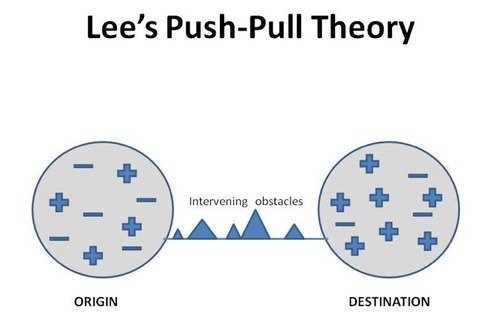
Lee migration model
Explains how the flow of migration between host and donor countries isn't just influenced by push and pull factors but also intervening obstacles
42
New cards
Intervening obstacles
Factors that affect the ease of migration.
- physical features ; oceans, rivers, mountains
- climatic factors
-health
- transport
- cultural factors; language
- physical features ; oceans, rivers, mountains
- climatic factors
-health
- transport
- cultural factors; language
43
New cards
Intra-regional migrant flows
Migration within a region, such as the EU.
44
New cards
Inter-regional migrant flows
Migration between different regions - often defined as movement across continents.
45
New cards
Example of Intra-Regional Migration
International migration between EU Countries
46
New cards
How many people in 2012 migrated from Eu country to another Eu country
1.7million
47
New cards
How many immigrants came to Uk from other EU states in 2013
190,000
48
New cards
Factors influencing intra regional migration within the EU
-Schengen Argument = allows freedom of movement within the EU Across international borders
- more countries joining EU with high proption of working age looking to seek higher wage within EU
- education, retirement, joining family
- more countries joining EU with high proption of working age looking to seek higher wage within EU
- education, retirement, joining family
49
New cards
ASEAN
An association of nations dedicated to economic and political cooperation in southeastern Asia.
50
New cards
Bilateral Migration
Flows of migrants between 2 countries.
51
New cards
Brain Drain
Large scale emigration by talented people (doctors, researchers, scientists, and other professionals) migrating to countries where they can make better use of their skills.
52
New cards
Migrant Remittances
Money transferred from one country to another, sent home by migrants to their family, friends and community.
53
New cards
What is socio-economic development
Process of social and economic development in society
54
New cards
how is socio-economic status measured?
GDP
LIFE EXPECTANCY
LITERACY RATE
LEVEL OF EMPLOYMENT
LIFE EXPECTANCY
LITERACY RATE
LEVEL OF EMPLOYMENT
55
New cards
How does migration influence development
- it can increase stability, economic growth and socio-economic change
- it can cause inequalities in the level of development which can influence direction/scale of global migrant flows
- it can cause inequalities in the level of development which can influence direction/scale of global migrant flows
56
New cards
What is development measure by
HDI (human development index)
57
New cards
How is HDI measured?
Education
GDP per capita
Social/ economic factors for life expectancy
GDP per capita
Social/ economic factors for life expectancy
58
New cards
How can migrant remittances contribute to development
Reduce extreme poverty
Find education and healthcare
Help families invest in land, livestock and equipment
Find education and healthcare
Help families invest in land, livestock and equipment
59
New cards
How does migrant remittances as a % of GDP differ from advanced countries to LIDCs and EDCs
Advanced countries have a higher HDI and a lower % of remittances that contributes to GDP
LIDCs = low HDI and high % of remittances contribute to GDP
LIDCs = low HDI and high % of remittances contribute to GDP
60
New cards
Why do not all poor countries receive large migrant remittances
- restrictive immigration policies in developed countries
- cost of travel
- cost of travel
61
New cards
Significance of migrant remittances
Reduce extreme poverty
Improve human development
Fund education/healthcare
Help families invest in land, livestock and equipment
Can lead to a multiplier effect ( more people from host country have the money to be able to become migrants)
Improve human development
Fund education/healthcare
Help families invest in land, livestock and equipment
Can lead to a multiplier effect ( more people from host country have the money to be able to become migrants)
62
New cards
How can global migration benefit a country
Encourages;
Stability
Growth
Development
Stability
Growth
Development
63
New cards
How is stability, growth and development in country achieved by global migration
Through flows of people, money, ideas and technology
64
New cards
What are social remittances
Social remittances are ideas, values, knowledge, behaviour and skills that migrants bring home with them or that they send home from abroad via technology
These can promote development in home countries,
These can promote development in home countries,
65
New cards
Importance of technology
Used by international humanitarian organisations to respond to crises through data from many sources to enable crisis mapping
66
New cards
Example of international humanitarian organisation
NGOs, UN
67
New cards
What is a NGO?
a non-profit organization that operates independently of any government, typically one whose purpose is to address a social or political issue.
68
New cards
What is crisis mapping
Gathering of info from many sources ( phone, media reports, satelittle imagery, credit card transactions) to help those in crisis
69
New cards
What is a key factor of development
Migration
70
New cards
What is an IDP?
internally displaced person
71
New cards
How can global migration promote stability within countries
- young migrants can balance age structure and population growth in ageing population
- peace building and conflict resolutions= returning migrants gained new ideas/ values (e.g equality)
- migrant remittances = economic stability of recipient county
- peace building and conflict resolutions= returning migrants gained new ideas/ values (e.g equality)
- migrant remittances = economic stability of recipient county
72
New cards
How can global migration promote economic growth within countries
- working migrants can increase GDP/ tax base of host nation
- migrants can contribute to local economies= and stimulate opening of new markets ( food, clothing)
- migrant remittances = many benefits for home country
- migrants can fill skills gaps and shortages in the labour market
- migrants can contribute to local economies= and stimulate opening of new markets ( food, clothing)
- migrant remittances = many benefits for home country
- migrants can fill skills gaps and shortages in the labour market
73
New cards
How global migration can promote development between countries
- skills/knowledge from returning migrants benefits country of origin
- migrants can create networks between more diaspora associations including professionals, business, social and religious= gain financial resources, values and ideas, wider range of skills
- UN migration and development projects between partner countries are involving families, local communities, public and private sectors to help development
74
New cards
What are diaspora associations
Community of people that are not in country of origin but maintain heritage in new land
75
New cards
Negative of global migration
Causes inequalities
Conflicts
Injustices
Conflicts
Injustices
76
New cards
How can global migration lead to inequalities, conflicts and injustices
Due to unequal flows of people, money, ideas and technology
77
New cards
How can global migration cause inequalites for people and places
- some families receive migrant remittances while others don't
- low birth rates in country of origin and high birth rates at host = redistribution of population of reproductive age
- origin loses high proportion of young, vibrant and fittest element of labour forces = downward economic spiral
- educated people migrate = leads to brain drain and loss of Human Resources in country of origin
78
New cards
How does global migration lead to conflicts
- people of diff culture/ ethnicity have trouble integrating which can creates tensions
- more immigrant can put pressure on services ( education,health, housing)
- conflicts between border control authorities, traffickers and illegal immigrants
- more immigrant can put pressure on services ( education,health, housing)
- conflicts between border control authorities, traffickers and illegal immigrants
79
New cards
How does global migration lead to injustices
- migrants vulnerable to violation of human rights
-asylum seekers treated poorly
- risk of refugees sent home to country of origin to a dangerous situation
-asylum seekers treated poorly
- risk of refugees sent home to country of origin to a dangerous situation
80
New cards
Example of a violation of human rights
Human trafficking
Forced labour
Exploitation of women/ children
Forced labour
Exploitation of women/ children
81
New cards
How are asylum seekers treated poorly
- not allowed to work for duration of application
-some held in detention centres
- receive poor financial resources for food etc
-some held in detention centres
- receive poor financial resources for food etc
82
New cards
social challenges experienced by female migrants
-racism
-trafficking and violence
-segregation
-hostility
-exploitation
-trafficking and violence
-segregation
-hostility
-exploitation
83
New cards
economic challenges faced by female migrants
-low skilled
-no work permit
-reliance on others
-no work permit
-reliance on others
84
New cards
political challenges faced by female migrants
-no voice
-discrimination
-discrimination
85
New cards
How can increased international migration lead to increased social- economic inequalities
- LIDCs and MIDCs= lack human/ computer skills to downloads maps and satellite imagery
- due to poor socio-economic development and ICT infrastructure
- majority of high skilled migrate to developed countries so poor country has no human skills to develop infrastructure
- due to poor socio-economic development and ICT infrastructure
- majority of high skilled migrate to developed countries so poor country has no human skills to develop infrastructure
86
New cards
Brazil backgorund information
- population density is all coastal and there is trouble getting people inland
- population of 211 million
- industry is 5% primary, 25% secondary and 70% theriary
- 8th largest GDP in the world#
- lots of diasporas with lots of immigrants
-boarders all but 3 countries in South America
- population of 211 million
- industry is 5% primary, 25% secondary and 70% theriary
- 8th largest GDP in the world#
- lots of diasporas with lots of immigrants
-boarders all but 3 countries in South America
87
New cards
Brazil main flows of migration
- There is significant rural to urban migration approx 100,000/year
- lots of high skilled Brazilians looking for better employment in Japan (200,000) and USA (700,000)
- since 2000 immigration has slowed down with increased international migration and increased emigration
- In the 19th century there was an influx due to agriculture conditions and potential for industry as it became a EDC
88
New cards
Brazil interdependence with USA
- Lots of low skilled Brazilians working in USA due to minimum wage leading to remittances and increased knowledge and idea
- also high skilled Brazilians working in the services sector in USA
- they have made trade agreements that allow positive relationships such as USAID
- also high skilled Brazilians working in the services sector in USA
- they have made trade agreements that allow positive relationships such as USAID
89
New cards
Brazil interdependence with Portugal
- Brazil is a former colony of portugal and gives special passage to migrants
- shared language helping with employment and trade
- well developed Diasporas in each country
- shared language helping with employment and trade
- well developed Diasporas in each country
90
New cards
Brazil interdependence with Haiti
- Brazil council worked in Haiti to rebuild it after 2012 and administered aid
- Haiti migrant to Brazil for low skilled work such as for large events such as Olympic games in 2016
- Haiti migrant to Brazil for low skilled work such as for large events such as Olympic games in 2016
91
New cards
Impact of migration on Brazil
Economic:
- It has lead to a growth in all industries
- arrival of skilled migrants improved skilled labour and attracted 10% more foreign investment
- emigration allowed $2.4 billion/year in remittances
Political:
- Stable trade links (G20, BRICS)
- bilateral flows
- receiver of environmental and social migrants
Social:
- immigration of significant diasporas e.g Confererados, German culture in southern states and this can be negative or positive e.g illegal immigrants from Venice Walia create social tensions
- Inequalities in the labour market (ethnicity and language) and an increase in inequality on rural areas and favelas
92
New cards
Number of migrants living in the USA in 2013
41.3 million. 13% of the total population.
93
New cards
Why move to the USA
Possibility of a green card, high wages for remittances healthcare and education.
94
New cards
USA net migration.
Net migration gain.
95
New cards
Number of different nationalities living in the USA
78 different nationalities-2013
96
New cards
USA Migration policy
Allow 675,000 permanent migrants. Based on different categories.
480,000 for reunification of families
140,000 for migrants with skills.
other quotas for diversification and protecting refugees.
480,000 for reunification of families
140,000 for migrants with skills.
other quotas for diversification and protecting refugees.
97
New cards
Number of Mexicans living in the USA
2013-11.5 million Mexicans.
98
New cards
Amount of money sent back to Mexico as remittances from USA
22 billion dollars. 2% of Mexico's GDP.
99
New cards
Opportunities created by migration in USA
Young migrants decrease the age of the population and increase taxation revenue
new cultural traditions e.g. food, music,
teaching Spanish at schools- widens skill set and eases language barrier
migrants take low paying jobs
most immigrants are of working age so are of social/economic benefit
immigration policy attracts highly skilled and well qualified workers
new cultural traditions e.g. food, music,
teaching Spanish at schools- widens skill set and eases language barrier
migrants take low paying jobs
most immigrants are of working age so are of social/economic benefit
immigration policy attracts highly skilled and well qualified workers
100
New cards
Challenges caused by migration in USA
11.5 million illegal immigrants in the USA with 6 million Mexicans
Minimal integration into society
as unemployment rises, Americans want lower paying jobs but they are taken- social tension
Human trafficking
language barrier
concerns its increasing crime rates
money sent as remittences instead of being spent in us
Minimal integration into society
as unemployment rises, Americans want lower paying jobs but they are taken- social tension
Human trafficking
language barrier
concerns its increasing crime rates
money sent as remittences instead of being spent in us