Research skills A- Qual
 Call Kai
 Learn
 Practice Test
 Spaced Repetition
 Match
 Flashcards
 Knowt Play
1/74

There's no tags or description
Looks like no tags are added yet.
75 Terms
Wilhelm Wundt- key info
Wilhelm Wundt (1832-1920) was a German psychologist who established the first experimental psychology lab in 1879 in Leipzig, marking the formal beginning of psychology as a scientific discipline. He is often referred to as the "father of modern psychology" and emphasized the importance of introspection in studying conscious experience.
Lawrence Kohlberg- key info
Lawrence Kohlberg (1927-1987) was an American psychologist best known for his theory of stages of moral development, which outlines how individuals progress in their understanding of morality through a series of developmental stages. His work expanded on the ideas of Jean Piaget to include the influence of social and cultural factors on moral reasoning.
Kohlberg research
Sample- 72 Chicago boys, aged 10-16, 58 followed for 3 years intervals for 20 years. Everyone given 2 hour interview- 10 dilemmas- he cared about the reasons they gave for their decisions not the actual decision
Heinz research
Wife dying- he couldn’t afford drug so he broke in to steal it
Abraham Maslow- key info
American (1908-1970) known for creating his hierarchy of needs. Defined self-actualization as achieving the fullest use of one’s talents. Hesitated to publish work as he viewed it as purely personal inquiry rather than scientific work
John Flanaghan- key info
American (1906-1996)
Devised the Critical incident Technique (CIT)
First qualitative research method
CIT- research method that relies on a set of procedures rto collect, analyse and classify observations of human behaviour
CIT- Obtained from groups of individuals through written means or interviews
Offers application of qualitative methods to real life situations
Used in the development of ethical principles and standards for psychologists
Rise of qualitative methods during 1960s to 80s
Late 1960s to 1980s- Sociologists
Amedeo P. Giorgi is an American psychologist known for his contributions to phenomenology and humanistic psychology - developed usable qualitative methods for psychology
Discourse Analysis was developed through work of Potter + Wetherell
Narrative inquiry in psychology was advanced by Polkinghorne
Key events in qual from 2006
Qualitative methods in Psychology formed
Qualitative methods section of BPS established- 1000 members
Attempt to establish a Division for Qualitative industry for the American Psychological society failed in 2008 (succeeded in 2013)
ESRC require that doctoral students in psychology are trained in both quantitative and qualitative RM
Ontology
what is real? What sort of things exist?
It is concerned with the nature of the world
BUT the nature of our world is changing- New discoveries and new technology
Epistemology
The study of knowledge, e.g. how do we know?
Objectivism
Stable 'laws' that exist- reality that exists independently of consciousness. Reality is an absolute
Positivism
Reality consist of what is available to the senses, Inquiry should be based upon scientific observation, Objective, value-free discovery, Dominant approach in Psychology
Interpretivism
Subjective meaning, Humans generate knowledge and meaning from their interactions with the world, Knowledge is interpretation- importance of the researcher's perspective and interpretative nature of social reality
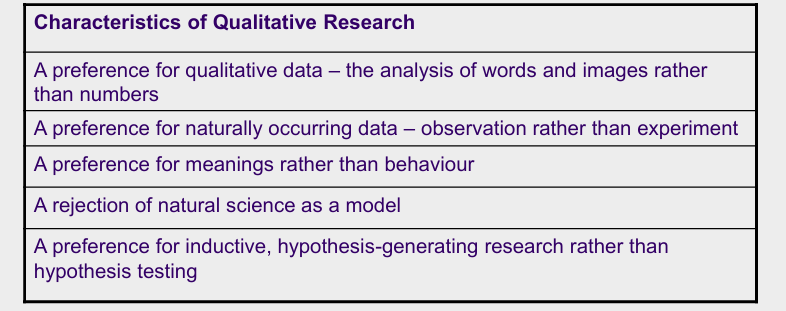
Characteristics of qual research
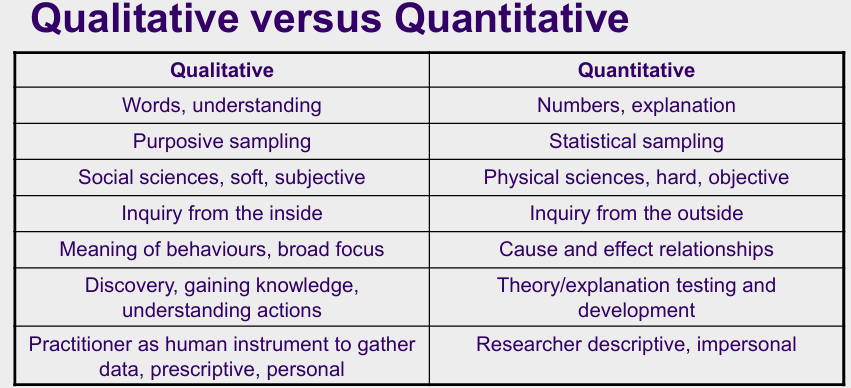
Qual vs Quant
Qualitative methods cannot answer questions such as:
How many? What are the causes? What is the strength of the relationship between variables?
Qualitative methods can answer questions such as:
What is the experience of identifying as LGBTQ in the foster care system?
Qualitative research questions often contain words like lived experience, personal experience, understanding, meaning, and stories
Critique of the scientific method (positivism)
Quantitative research involves designs that disengage researcher from participants (little or no contact with people or field settings)
-excludes outliers
If we are always testing someone else's theory, how do we generate new theories?
The pursuit of 'measurable' phenomena means that difficult concepts such as criminality or intelligence are treated unproblematically
Generalisability vs Transferability
G- The extent to which we can generalise the findings of a study to the entire population
T- The extent to which we can transfer the findings
Transferability in qual
Qual studies typically recruit smaller samples of participants
– Cannot generalise to wider population
• Qualitative researchers aim to expand our understanding of a phenomenon, and this information can be ‘transferred’ to a similar population
When should we use qual methods
Qual research is considered exploratory
Used when we don't know what to expect (no hypothesis)
But qual research can also be used to enhance our understanding of a relationship found in quantitative research
What should the research question do
The research question should identify the phenomenon you are studying, your chosen population, and what you want to find out about them
How do we choose a research topic
•Through literature (e.g., books, academic and professional journals)
•Through a place of work / directed by a senior / assignment
•Should (ideally) be a topic that interests you!
–Useful for personal development / demonstrate personal skills
Generating research ideas

Deductive and inductive literature reviews
•Deductive:
–Provide source of focus. Examine research at the outset of the study. Aims, objectives, hypothesis
•Inductive:
–Begin with collection and analysis of data. Process leads to questions then addressed in literature
Literature reviews: Qual vs Quant
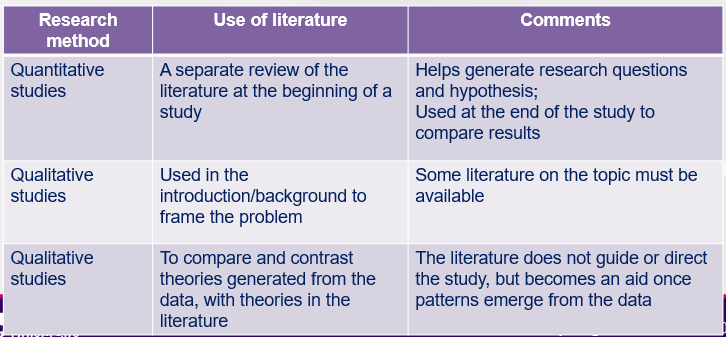
Literature reviews- two arguments among qual researchers
•Reviewing literature curtails the inductive analysis and thus should be avoided at the outset.
Review of literature is important early in the qualitative research process and serves various functions.
Sources: Things to remember
•All sources should be evaluated, analysed, and critiqued.
–Determine credentials, education, experience, and bias.
•Peer review journals have been reviewed by experts in the field and evaluated on the quality of the research.
–Journals will indicate if they’re peer reviewed or not.
•Always be aware of your own personal bias (e.g., political opinion).
•Some sources are primary (e.g., the researcher, writer, film maker) and other sources are secondary (e.g., when info is analysed by others).
–Don’t assume that primary is more valid (e.g., personal diaries are full of ‘bias’ whereas academic critique of information can be robust)
Making critical judgements

Sampling techniques in research
•Convenience sampling
–Involves the sample being drawn from a part of the population that is close to hand
•Purposive sampling
–A sample is built up that enables the researcher to meet the needs of the project
•Snowball sampling
–Existing participants recruit further participants from among their acquaintances
Purposive sampling in qual research
•Identification and selection of individuals/groups of individuals that are well informed in the phenomenon of interest
•Recruiting individuals with characteristics that meet the requirements of the study
•Often focuses on ‘data saturation’ – continue to recruit until nothing new is being identified in the data
Research ethics
Philosophical term derived from the Greek word ethos (character)
Appropriateness of researcher's behaviour in relation to those participating or affected by the research
Ethical issues can arise at any stage of a research project
Some ethical considerations can appear simple- more common sense
There can be complex ethical dilemmas to consider
Example of an unethical study
Milgram study – obedience to authority: impact of perceived electric shocks on memory retention
When should ethics be applied in research
Ethics should be applied during all stages of research:
Before
At the beginning
During
After
Adherence to ethical guidelines assists a researcher to conduct research in a responsible and morally defensible way
Ethical issues in qual
Power imbalance
Present illustrative quotes- confidentiality
Go into great detail about human experience
The four component model- ethics
Ethical sensitivity- interpreting the situation, and identifying the presence of an ethical issue
Ethical reasoning- formulating the morally ideal course of action by identifying the relevant ethical issues and using these principles to consider appropriate actions.
Ethical motivation- deciding what one wishes and intends to do
Ethical implementation- Executing and implementing what one intends to do
Ethical sensitivity
Means being sensitive to what ethical issues are raised by a course of action
Ethical sensitivity can vary considerably
Herbert et al. (1990) asked medical students to identify ethical issues from a vignette and found high levels of variability in the number of issues identified by different students
- Enhancing a capacity for ethical sensitivity is an important educational objective.
Ethical reasoning
• Ethical reasoning is the capacity to consciously articulate the rationale for taking a particular course of action
• Ethical reasoning is often subject to our cognitive biases.
• Being aware of our biases is important when trying to think through ethical dilemmas.
Ethical motivation
Whilst it's important to be able to identify a problem, ethical motivation refers to the motivation to act ethically
Ethical motivation is linked to our values
The bystander effect- this is the name given to the tendency for people to fail to act when they assume that others are in a position to take action (Levine & Crowther, 2008) and again would be likely to come into play in a team situation as, for example, in many healthcare systems
Ethical implementation
refers to put into place an ethical plan
E.G
What would you do if you were aware of a peer who had fabricated data? What might affect how you act?
4 BPS code of ethics
Respect
Competence
Responsibility
Integrity
Respect
Psychologists value the dignity and worth of all persons, with sensitivity to the dynamics of perceived authority or influence over people and with regard to people's rights
Should consider:
(i) Privacy and confidentiality;
(ii) Respect;
(iii) Communities and shared values within them;
(iv) Impacts on the broader environment – living or otherwise;
(v) Issues of power;
(vi) Consent;
(vii) Self-determination;
(viii) The importance of compassionate care, including empathy, sympathy, generosity, openness, distress tolerance, commitment and courage
Competence
Psychologists value the continuing development and maintenance of high standards of competence in their professional work and the importance of working within the recognised limits of their knowledge, skill, training, education and experience. In applying these values, Psychologists should consider:
(i) Possession or otherwise of appropriate skills and care needed to serve persons and peoples; (ii) The limits of their competence and the potential need to refer on to another professional; (iii) Advances in the evidence base;
(iv) The need to maintain technical and practical skills;
(v) Matters of professional ethics and decision-making;
(vi) Any limitations to their competence to practise taking mitigating actions as necessary;
(vii) Caution in making knowledge claims.
Responsibility
Psychologists value their responsibilities to persons and peoples, to the general public, and the profession and science of Psychology, including the avoidance of harm and the prevention of misuse or abuse of their contribution to society
Should consider:
(i) Professional accountability;
(ii) Responsible use of their knowledge and skills;
(iii) Respect for the welfare of human, non-humans and the living world;
(iv) Potentially competing duties.
Integrity
Psychologists value honesty, probity, accuracy, clarity and fairness in their interactions with all persons and peoples, and seek to promote integrity in all facets of their scientific and professional endeavours
Should consider:
(i) Honesty, openness and candour;
(ii) Accurate unbiased representation;
(iii) Fairness;
(iv) Avoidance of exploitation and conflicts of interest (including self-interest);
(v) Maintaining personal and professional boundaries;
(vi) Addressing misconduct.
Code of Human research ethics
The BPS Code of Human Research Ethics lays out a set of general principles that are applicable to all research contexts and which are intended to cover all research with human participants
Key areas relevant to qualitative research:
Respect for the autonomy, privacy and dignity of individuals, groups and communities.
Scientific integrity.
Social responsibility.
Maximising benefit and minimising harm
Some ethical things need to consider
• valid consent, confidentiality, anonymity, fair treatment and due process
• respect for individual, cultural and role differences
• explain the nature of the research and avoid any unfair, prejudiced or discriminatory practice
• respect the privacy of individuals and ensure that individuals are not personally identifiable
• Respect confidentiality
Scientific integrity
Research should be designed, reviewed and conducted in a way that ensures its quality, integrity and contribution to the development of knowledge
Psychologists should be committed to and accountable for ensuring that the scientific and scholarly of their research and sufficiently high
The scientific design of the research should consider potential risks of harm
Plagiarism- definition and importance
Act of passing of someone else's ideas, thoughts, pictures, theories, words or stories as your own
Plagiarism brings into question a researcher/group's integrity
Plagiarism it is not tolerated by scientific community
Beneficence definition
Concept in research ethics that states that researchers should have the welfare of the research ppt as a goal of any research study
Resolving ethical issues
• Ethical issues are present in any kind of research
• Identify the issues present in your research
• Consult the BPS documentation and apply the information to your issues
• Consider alternative actions to ensure your research conforms to the general principles in the BPS Codes
• Implement these actions
• Continue to review your actions as the research progresses.
Importance of research ethics
• Promotes the aims of research
– (knowledge, truth, and avoidance of error)
• Promotes the values that are essential to collaborative work
– (trust, accountability, mutual respect, and fairness)
• Ensure that researchers can be held accountable to the public
• Build public support for research
– (as people more likely to fund research projects if they trust the quality and integrity of research)
• Promotes moral and social values
– social responsibility, human rights, animal welfare etc
Structured interviews
•Example: IPAQ – short form (telephone administered)
•Often collected for quantitative data
•Standardised questions
Semi-structured interviews
•Most widely used data collection method in qualitative research
•Requires careful planning and preparation
–Who to interview? Why?
–Recording and transcribing
•Face to face / telephone / online
•Researcher facilitates/drives the interview
–Use of prompts/questions as triggers
•Important to build a rapport with participant
The interview schedule
Can take different forms
•A series of headings (generally for more experienced researchers)
•Used to guide the conversation
–Start with broader questions and then add more focused questions to aid discussion
•A few carefully worded questions
–Open ended
–Avoid leading questions
–Not ambiguous
Things to do during an interview
•Build rapport and trust with participant
•Use prompts and expand on points made
•Pilot the interview and schedule
•Be mindful of the language you use
•Maintain control of the interview
•Follow a sequence of questions
Things to remember during interview
•Don’t rush or interrupt the participant
–Silence is powerful!
•Keep your personal opinions and experiences to yourself
•Don’t forget earlier responses
–Learn note taking, share this with participants
•Don’t ask leading questions
The problems with interviews
•They only account for the perspective of the participants
•Do not allow for in situ understanding of phenomena
•Quality dependent on skills of interviewer
•Focus on words / textual accounts – ignore data captured by the other senses (Seeing, hearing, feeling and smelling)
Observations- will get other perspectives, e.g researcher’s perspective
Focus groups
•An alternative to semi-structured, 1:1 interviews
Originally called ‘focused interviews’
What are focus groups
•Groups of people are asked their opinions on a particular topic
•A group interview which capitalises on the communication of participants to generate data
–Interactive interview
•The interaction between participants is key for focus group research
Focus groups: methodology
•Around 4-8 participants in each group
–Homogenous / heterogeneous
–Pre-existing / new
•Interviewer sets ground rules at the start
–Confidentiality
–Respect
–Group dynamics
•Researcher acts as moderator – pose questions, ensure discussion keeps flowing
•Researcher doesn’t direct questions at each participant in turn – facilitates group discussion
Participant observation
•Tool used for collecting data about people, processes and cultures.
•Process by which researchers take part in daily activities, rituals, interactions and events of a group of people to learn the explicit aspects of their life, routings and culture (Musante & DeWalt, 2010)
•Data collected in naturalistic settings
•Observational data = field notes
Types of observations
•The complete participant
–Group membership, covert
•The participant as observer
–Group membership, overt
•The observer as participant
–‘shadowing’, overt
•The complete observer
–‘fly on the wall’, covert or overt
Diary entries
•Often used when observations aren’t possible
•Written or audio recorded
•Lengthy or small snippets
•Data collected over time
•Capture what's important for the participant
–View from within
Pros and cons of diary entries
•Less reliant on memory recall
–Real time account
•Participants can be provided with specific info on what to note in their entries
•More reliant on participant engagement
–Sending reminders
•Might be less inclined to record details that are personal•Less reliant on memory recall
–Real time account
•Participants can be provided with specific info on what to note in their entries
•More reliant on participant engagement
–Sending reminders
•Might be less inclined to record details that are personal
Poor data management (interview)
No systematic record of the interviews undertaken
Interview recordings are filed on different computers/locations
Interview recordings are not stored securely
File names for recordings are confusing and unclear
Consent forms are scattered in various places
Transcription is incomplete and/ or inaccurate
Good data management is essential
-Systematic record of participants and interviews
-Secure storage of audio and video data
-Digital file names are clear
-Research paperwork is filed systematically
-Appropriate transcription protocol.
Transcription
-Transcription is the process whereby the recordings of individual or group interviews are generally written / typed out
-A necessary step on the way to interpreting textual qualitative data
-Transcription
-Represents the audio/video data collected
-Provides the researcher with something tangible they can analyse
-Allows verification of analytic claims (Jenks, 2011).
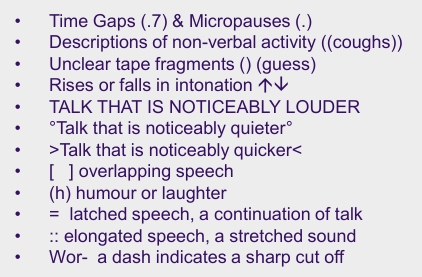
Precise transcription- Jefferson symbols
Verbatim transcription
Just writing down what is required by the research question

What’s the point of different types of transcription
-The level of transcription has an influence on the quality of data for interpretation
-Transcription takes time
-Badly recorded interviews take longer to transcribe
-The words of the interviewer should also be included
-Transcription services (very expensive and not always accurate) – quality check
-Use a transcription machine (and padel)
-Transcribe only relevant parts of the interview/ focus group
Two types of codes used
-Can be identified in one of two primary ways:
-Deductive (Top down / A priori). Driven by a specific research question
-Inductive (Bottom up / Emergent). Codes are linked to the data