Urinary/Repro - Exam 1
 Call Kai
 Learn
 Practice Test
 Spaced Repetition
 Match
 Flashcards
 Knowt Play
1/380

There's no tags or description
Looks like no tags are added yet.
381 Terms
Functions of kidney (5)
Maintians volumes/osmolality and composition of body fluids
blood pressure
Metabolism ( ammoniagengeisis, gluconeogenesis)
major endocrine orang
What hormones does the idney produce
renin, erythropoietin, vit D3, Prostaglandins, kinins, angiotensin II
Proximal convoluted tubule - epithelium and capillaries
large epithelial brush borders (increase SA and absorption)
surrounded by peritubular capillaries
Tubular Transport Maximum
the limit on the rate at which renal tubules can actively reabsorb or secreta a speciifc substance due to the saturation of carrier or channel proteins
PCT reabsorbes at a constat fraction at ___% of filtrate so this means that the GFR has a ____ impact on it’s fucntion. THis is to prevent overwhelming o f_______ and it operateds ______ of hormones or nerves
fraction at 65% of filtrate
GFR has large imapct
to prevent overwhelming of DCT
operates independent of hormones or nerves (intrinsic)
Loop of Henle is the countercurrent ______ and vasa recta is the countercurrent _________
lopp of henle - ountercurrent multipliet
vasa recta - counctercurrent exchanger
urea contributes to osmolality of interstitum with ___,
usrea diffuses out of CD into ________ (urea _____)
in the vasa recta urea is _____
with Na
ascending loop of henle (urea recycling)
urea is in and out
Counterucurrent mechaism
conetrating mechanimsms depends on ________
multiplier - depends on ________
exchanger - fucntion _______
1) maintiang a gradient of osmilality
multplier - active salt reabsorption in thick eascending limb
exchanger - keeps solutes in the interstitium to maintain gradient
How does the vasa rect keep solutes in interstitium
solutes recirculate in medulla
water tends to bypass medulla
hypertonicity maintianed
water removed from collecting ducts picked up by vasa recta adn enters general circulation
Distal Convoluted Tubule is similair to proximal onvoluted tubule except for ______, and contains 2 cells_____
no brush borders
macula densa epithelial cells (Na/Cl sensors)
juxtaglomerular cells - specilaized smooth muscle cells -rennin
Tubuloglomerular feedbakc maintains _____
load delivered to distal tubular (increase flow → decrease GFR)
Collecting ducts are like proximal convoluted tubules without _____, and extends from _____ through _____ and epties into ______
without brush boarders
extends from renal xortex through renal medullar and empties into renal pelvis
Collecting duct is permeable to water with _____ only and is a site of ____ secetion and ____ reabsorption
with ADH only
site of H+ secetion
urea reabsorption
Upper vs lower urinary tract disease (s/s, systemic illness, urine compositio)
upper - no s/s, systemic illness, changes in urine composition
Lower - no signs, may be systemically ill, changes in urination
oligo -anuric
minimal to no urine output
non-oligo-anuric
some but less than normal urine output
Polyuric
increased urine output
polakiuria
small volume of urien
stranguria
straining to urinate
Dyuria
difficulty urinating
periuria
inappropriate urination
nocturia
urination at nighti
ncontinence
unconscious urianation
Urea nitrogen - orignates from where, what causes increases, sensivitiy for kidney impairment, what cuases decreases
or - liver
increase - prerenal/renal/postrenal, gi bleed or high protein diet
sensisvitiy - poor
decreases - liver dysfunction, low protien diets
Creatinine - orignates from where, what causes increases, sensivitiy for kidney impairment, what cuases decreases
or - muscle
increases - prerneal/renal/postrenal, not muscle damage
senstivity -not great, but better than BUN
Decrease - muscle wasting, not common
SDMA - orignates from where, what causes increases, sensivitiy for kidney impairment, what cuases decreases
or - nuleated cells
increase - pre/renal/postrenal
most sensitive of the three
decrease - not common
Urea Nitrogen’s most important route of excretion
urinary tract
Increased urea nitrogen cuases
decreased urinary excretion - dehydration/hypovolemia, kidney dysfucntion, outflow obstruction
increase protein digestion or catabolism - GI hemorrhage, high protien diets, starvation
increased creatinine cuases
decreased urine excretion - dehydration/hypovolemia, kideny dysfuniton, outflow obstruction
very muscular animals
Azotemia
increased non-protein nitrogenous compounds in the blood
(increase is serum ntirogen/creatine concentration/SDMA) is reflective of GFR
How to differentiate between the different types of azotemia
urine specific gravity
Urine specific gravity - artifacts
marked glucosuria or proteinuria
Hypersthenuria
highly/adequately concentrated ruine
Idoyhrnutia
urine osmolality = plasma osmoality
tubus did not dilute or concentrate
Hyposthenuria
dilute ruine
USG adequate cut off -cats
over 1.035
USG adequae of dogs
over 1.030`
USG adequate of horses nad cattle
over 1.025
Differences in Avians and reptiles
______ is a major nitrogenous waste product in birds and terrestrial reptiles w/ blood concentrations can be increased due to _______ (2)
uric acid
due to impaired renal fucntion although dehydration can affect
why is USG less useful in avians/reptiles
inability to concentrate urine (reptiles)
mixture with feces, wide nromal ranges (birds), small sample volume
Prerenal azotemia is due to
reduced renal blood flow (hypovolemia from dehydration, shock)
decreased UN and creatine clearance
increased urea production - upper gi hemorrhage (digest blood), high protein diets, midly increased UN and normal creatine (urea production exceeds excretion)
USG variable
Prerenal azotemia USG values for cats/dogs/horses/cattle
cats - over 1.035
dogs - over 1.030
horses/cattle - over 1.025
renal azotemia - any renal disease that decreases GFR below ____ with the USG being _____
GFR below 25%
USG 1.008-1.012 but not always
Postrenal azotemia - cuases and usg/hyperkalemia
excretion challenge (blockage/rupture)
USG is variable (depends on hydration, presnce or absence of concurrent renal disease)
hyperkalemia often present - decreased K excretion through urinary tract
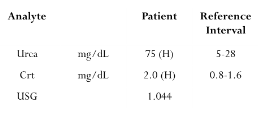
FS dog with signs of dehydraiton - what azotemia
pre-renal

12 year old FS cat with increase urination for a long timer per O - what word to describe USG, what kind of azotemia
isothenuria, renal azotemia

7 year old FS dog with polyuria - what azotemia
none but need to investiage with s/s and usg
GFR decreases are detected by what on blood work
urea nitrogen, creatinine, SDMA
dark yellow to orange or yellow green urine color means
bilirubin
white urine means
pyuria, crystalluria
red to brown urine means
RBCs, hemoglobin, myoglobin
What does increased estrogen do ti capillaries adn epithelium
incr4eased capillary permeability → diapedesis of RBCs
vagianl epithelium becomes hyperplastic → superficial epithelial cells keratinized (go from round eggs to no nucleous corn flakes)
Vaginal cytology can be used for
cheap assessment estrogen levels for hyper-estrogenism syndromes
ovarian remanets in spayed females
granulosa-thecal cell tumors
atypical cushings
exposure to exogenous estrogen creams
cna even wrok on prepuce to determine estrogen exposure
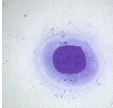
Vaginal cytology - how would you describe this cell
parabasal

Vaginal cytology - how would you describe this cell
intermediate
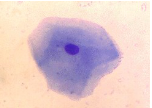
Vaginal cytology - how would you describe this cell
Superficial nucelar - cornified

Vaginal cytology - how would you describe this cell
superficial anulcear - cornified
Canine proestrus - how many days, PE, behavior, cytology
9 dyas
PE - vulvar swelling, serosanguinous vulvar discharge (originates from uterus)
behavior - attracts males but won’t stand for mating
cytology - starts under 10% but over 90% by end
Proestrus - hormones
increase in LH pulses @ end anestrus → follicular grwoth → increased plasma estrogen
estrogen peaks at end of proestrus
Estrus canine - days, PE, behavior, cycoltoy, homrones
9 days
pe - less vulvar swelling, vulvar discharge more serous
behvaior - attracts males and stands for mating
cytology over 90% cornified, most anulcear
hormones - increasing progesterone
Canine Diestrus - dyas, cells, whe do they whelp, cyctology
6- days with day 1 having a sharp decrese to less than 50% cornifeid
whelp 57 ± 2 days from d1 diestrus
cytology - some nondegenerative PMNs, no RBCs, some metestrus cell
Anestrus - days, hormones, pe, behavior, cytology
dyas - 90-150
hromones - basal progesterone and estradiol
pe - no detectable changes
bhevaior - does nto attracts males or stand to be mated
cytology - parabasal cells, some neutrophills no RBCs
canine first estrus characterisitcs
often irregular, may be split head
shouldn’t breed on first heat (lower fertitlity, increased risk dystocia
How to natrual mate a dog (protcol)
breed 1 48 hours until go out of heat
when in same area, both young and healthy, no hx of infertility
Causes of failure of natural mating
poor timing (female not actually in estrus), dominant female, in experience, size mismatch, vaginal strcitures, other abnormalie
dx and treat codntion adn AI
Breeding management protocol
vaginal cytology and serum progesterone every 48 hrs, determine date of LH peak and ovulation
breeding date based on type of semen used and number of inseminations
Testing LH
only peaks the day before ovulation so it is really hard to target
instead we use progesterone to trakc with it being around 2ng/ml at LH peak (rnage 1.5-3 ng/ml)
AL with colled semen is within _____ hours of collection and ideally do it ____, ____ hours apart on days ____________
24-48 hrs of collect and ideal breed twice 48 hours appart
days 3 and 5 post LH or days 4 and 6 post LH
Rules of 2s with ovulation timing
LH peak at 2 ng/ml, ouvulate 2 days latter, oocytes mature 2 days after that
AI with frozen semen
often only 1 insemiantion dose, especially is using sx insemiantion (day 5-6 post LH)
must do intrauterine insemination (sperm doesn’t live as long after cryopreservation, must get close to site of fertilization)

7-year-old Tibetan Spaniel, 1 normal litter three years ago, To be bred with frozen semen
when LH peak, ovulaiton, rehckec progestione, when to breed
LH peak likely - 9/9
ovulation - 9/11
rechekc progesterion - 9/12
ai frozen semen 9/13 and 9/14
9/13 ad 9/15 also a good anser
if only once then on 9/14
Pseudopregnancy - s/s
behavioral changes - nesting, aggression, variable appetite
mamamry gland development - lactation
weight gain
Pseudopregnancy - what dogs, when and how
diestrus, physiologic proess (dogs don’t ahve recongition of pregnancy)
cna also occur if spayed during late estrus/diestrus
withdrawal of progesterone
Pesudopreganncy - tx
none need and resloved with time
cold and wam compresses and food/water restrcition
IF rx managment need - megestrol acetate for 8 days only apporved tx (mibolerone for 5 days, bromocriptine or cabergoline for 5-10 days, OVH)
if you remove the ovaries then there is no _____ feedback and LH will _____
no negtive feedbacka dn LH remains high
testing for spayed or no
serum estradiol test - detectable estradiol before and after injection
anti-mullerian hormone - expensive and only at cornell and uc davis, should also test progesterone if testing for ovarian remannt
Increase urine turbidity (decreased clarity) can be caused by 6
increases cells, numerous crystals, bacteria, lipid, mucus, storage artifact
Urinary dipstick results in a health animla (pH, protein, glucose, blood, ketons, bilirubin)
pH - dogs and cats (6-7.5), horse and cows (7.5-8.5)
protein - up to trace
glucode, ketons, blood - none
Bilirubin - up to 1+
Aciduria is found in (2)
carnivores (protein breakdown), Acidosis
Alkalinuria is found in (4)
herbivores, alkalosis, urease-containing bacteria, prolonged storage at room temp
False postivies for protein on urine dipstick cna be cuased by (2) and to double check you can
alkaline urine and increased contact time with dipstick
consider USG before reacting
Cuases of Proteinuria
Prereanl - colostrum, Hgb, Mgb, bence-jones proteinuria
Renal - glomerular disease, Tubular disease
Postrenal - hemorrhage, inflammation
Urine blood (heme) will cuase urine ____ to also be postive one urine is viisibly pink to red
protein
How to tell if you have hematuria vs hemoglobinuria/myoglobinuria
Hematuria - after centrifuge, RBCs found in sediemnt but urine supernatant is clear, clear plasma
hemoglobinuria/myoglobinuria - after centrifugation - red/brown color persists throughout, red/pink plasma (hemoglobin), clear plassma (myoglobin)
Urine reflects glucose status over
past few hours (or since animal emptied its bladder)
Blood glucose value that exceeds the max tubular resorption capacity (cats and dogs)
Dogs ~180 mg/dl
cats ~ 280 mg/dl
cause of glucosuria with peristent hyperglycemia vs normalglycemia
persistent hyperglemcia - diabetes mellitus
normoglycmeia - renal tubular problem
Ketosis is due to
negative enrgy balance that can be cuased by diabetes mellitus, bovine ketosis, late pregnancy/early lacation, starvation
Bulurubinuira - 3 cuases
mild (up to 1+) heptobiliary disease, hemolysis
In vet spceis what 3 UA test are virtually worthlesss
urobilinogen, bacteria, nitrite
Typical urine sediemnt result in a healthy animal (epithelial cells, hyaline/granular casts, crystals, rbcs, wbcs, bacteria or toher infectious organism)
epithelial - varies
hyaline and granular cast - absent to very low numbers
crytstals - absent to low numbers
rbc/wbc - <5 per 40x field
bacteria/.infetious organissm - none
Squamous Epithelial cells are most common in what urine smapels
catheterized and voided samples
Transitional epithelial cells are common in what urine smaples and what do they look like
catheterization, utis and neoplaisa
vissible round nucleus

What is this on a urine sediment
Squamous epithelial cells
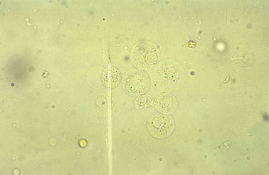
What is this on urine sediemnt
transitional epithelial cells
Casts from in _______ and may not be flushed into urine and may intermittenlty _____, absence does not rule out __________
renal tubulers, may not be flushed into urine, may intermittently shower, absence does not rule out active tubular disease
Hyaline are more abundant in animals with _____ and how quickly do cast deterioate in urine
glomerular proteinuira
cast detiorate quickly

This was found on a urine sediement what is it
casts

What is this and is it a normal finding in urine sedmeint
struvite
can be found in healthy and unhealthy dogs/cats

What is this finding on a urine sediment and it is common in
calcium carbonate
common in normal horses and rabbits