Autonomic nervous system

0.0(0)
Studied by 0 people
call kaiCall Kai
learnLearn
examPractice Test
spaced repetitionSpaced Repetition
heart puzzleMatch
flashcardsFlashcards
GameKnowt Play
Card Sorting

1/17

encourage image

There's no tags or description

Looks like no tags are added yet.

18 Terms

1
New cards

Organization of NS

  • autonomic nervous system divides into sympathetic division and parasympathetic division
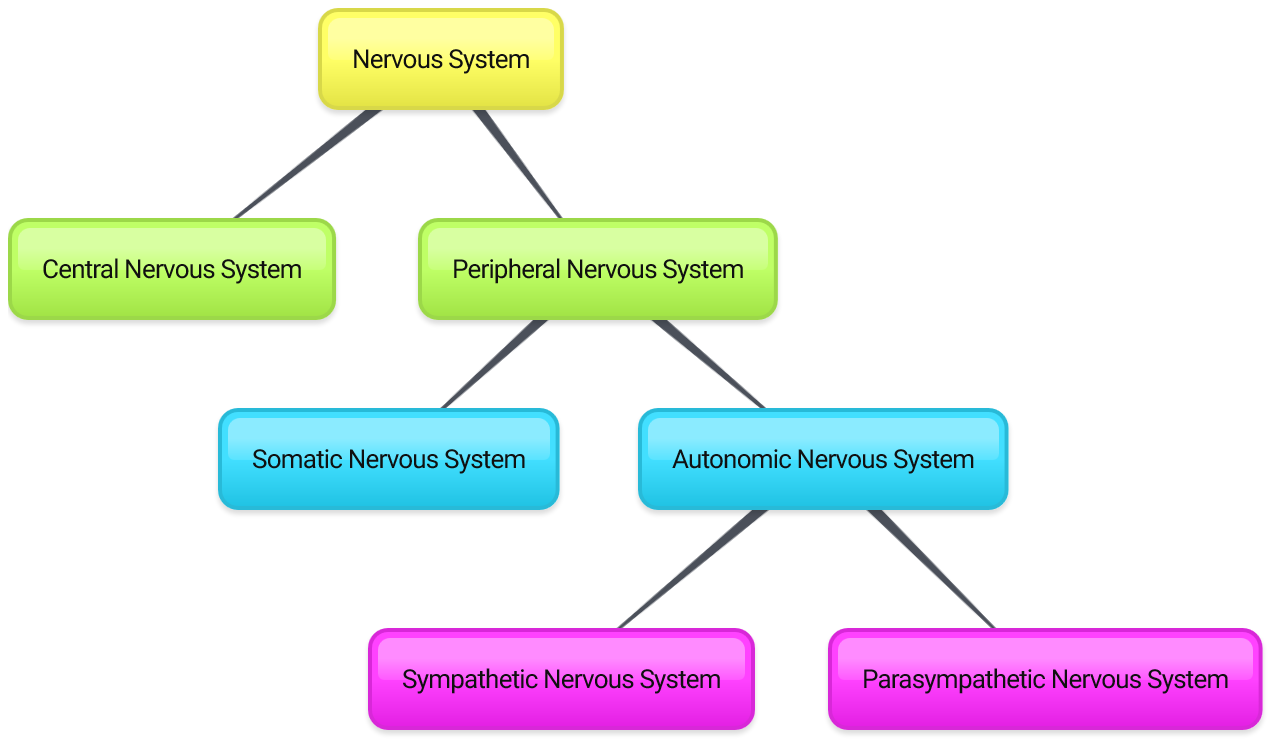

<ul><li><p>autonomic nervous system divides into sympathetic division and parasympathetic division</p></li></ul><p></p>
2
New cards

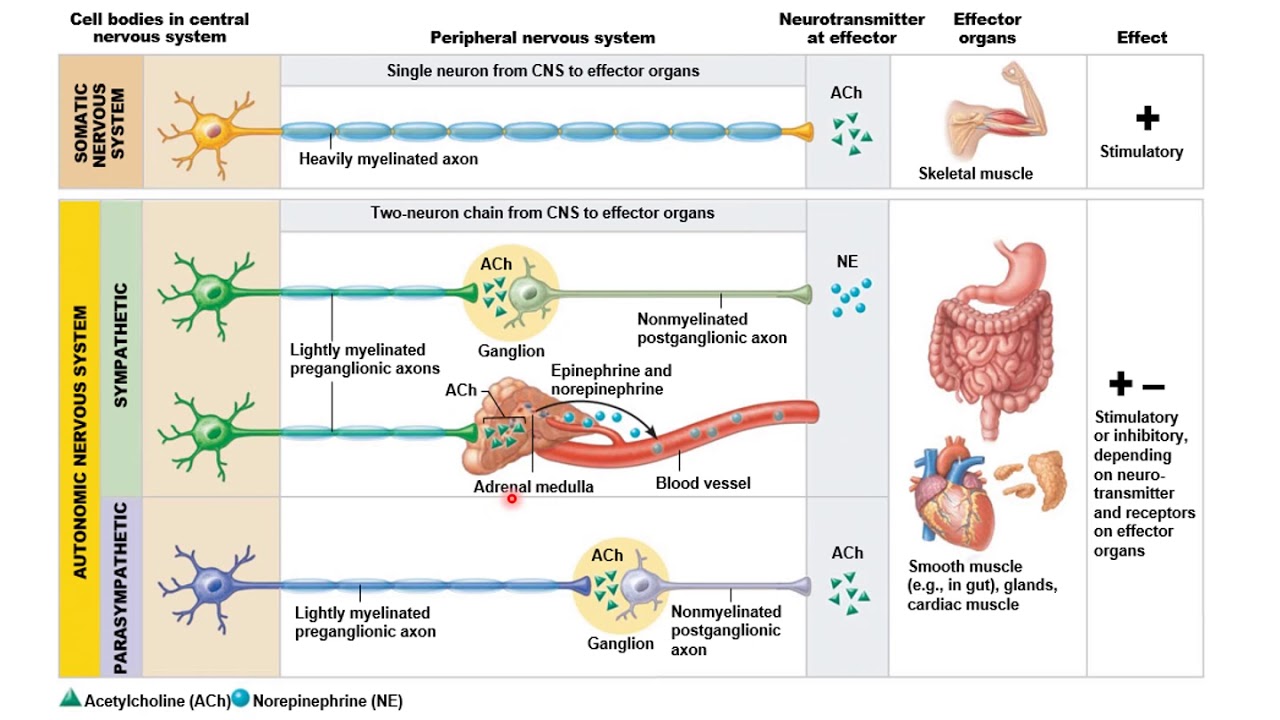
Comparison of motor neurons and effectors

1) effectors

2) number of MN

3) location of MN

4) myelination

5) neurotransmitters

6) effects of neurotransmitters
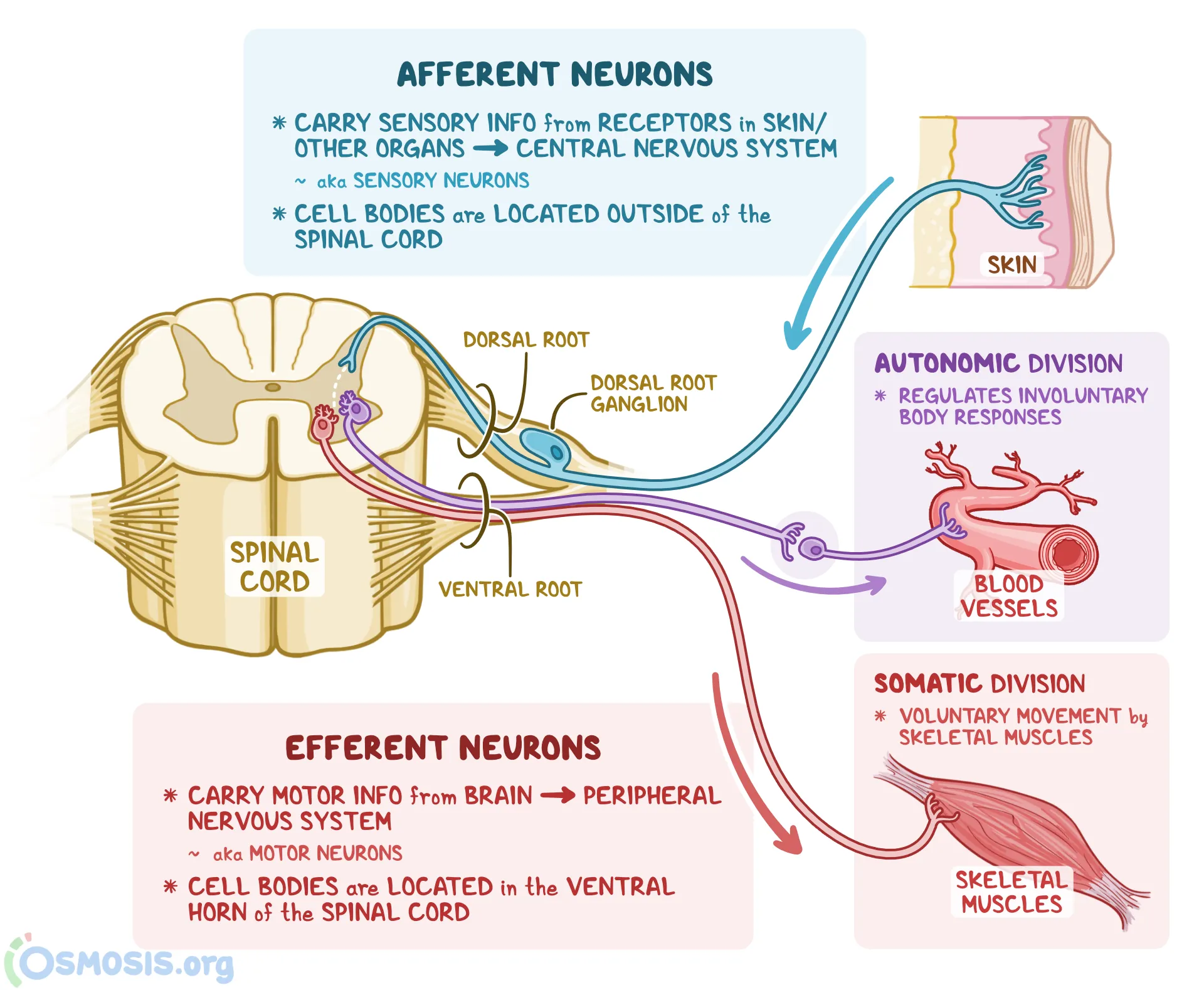

<p>1) effectors</p><p>2) number of MN</p><p>3) location of MN</p><p>4) myelination</p><p>5) neurotransmitters</p><p>6) effects of neurotransmitters </p><p></p>
3
New cards

Organization of autonomic ns

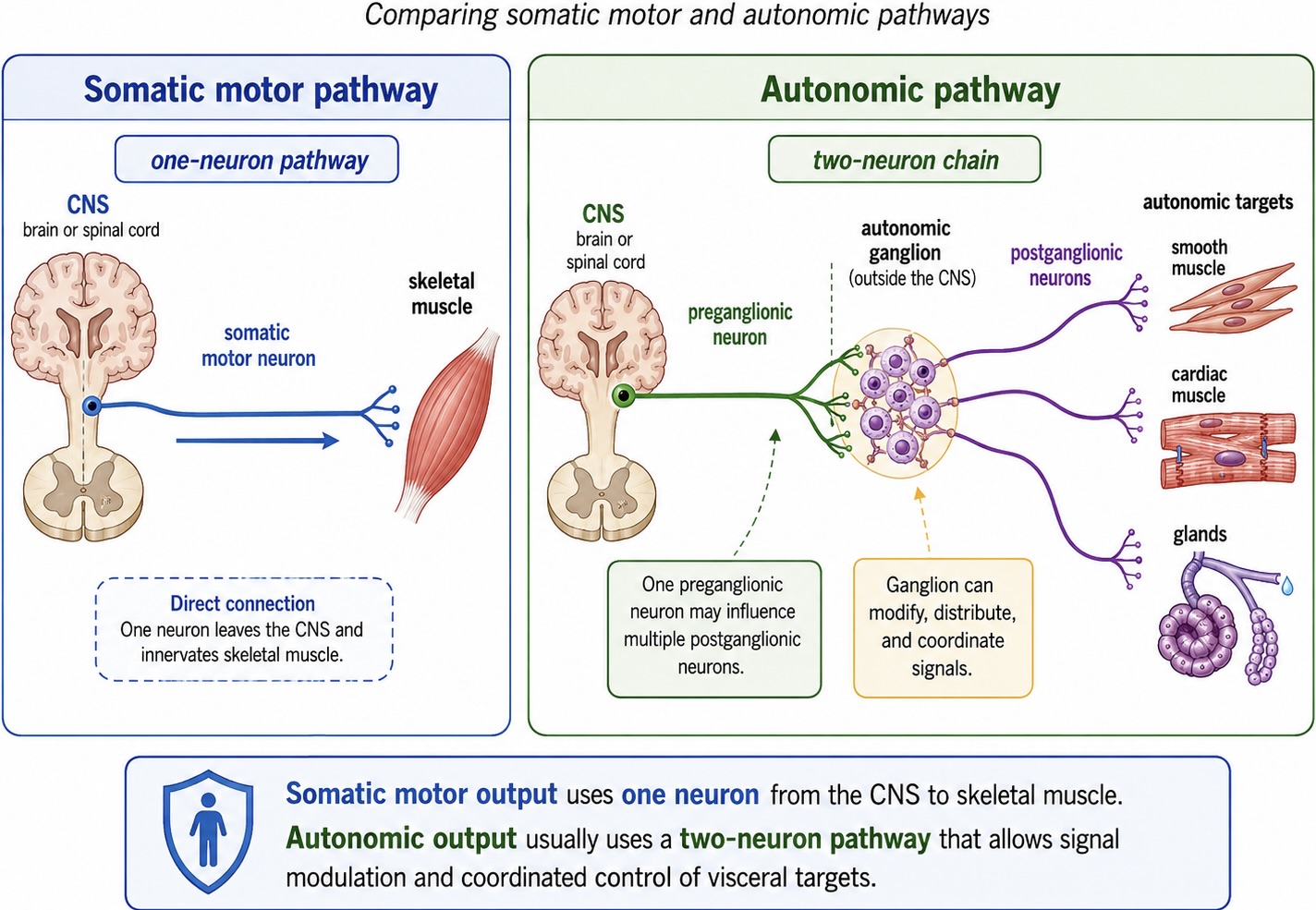
  • use two efferent (motor) neurons

    1) CNS to autonomic ganglia-pre-ganglionic motor neurons and axons

    2) autonomic ganglia to effector- post-ganglionic motor neuron and axons

  • Effectors= visceral organs, smooth muscles, cardiac muscle, glands

  • Ganglia are not DRGs, they are motor ganglia
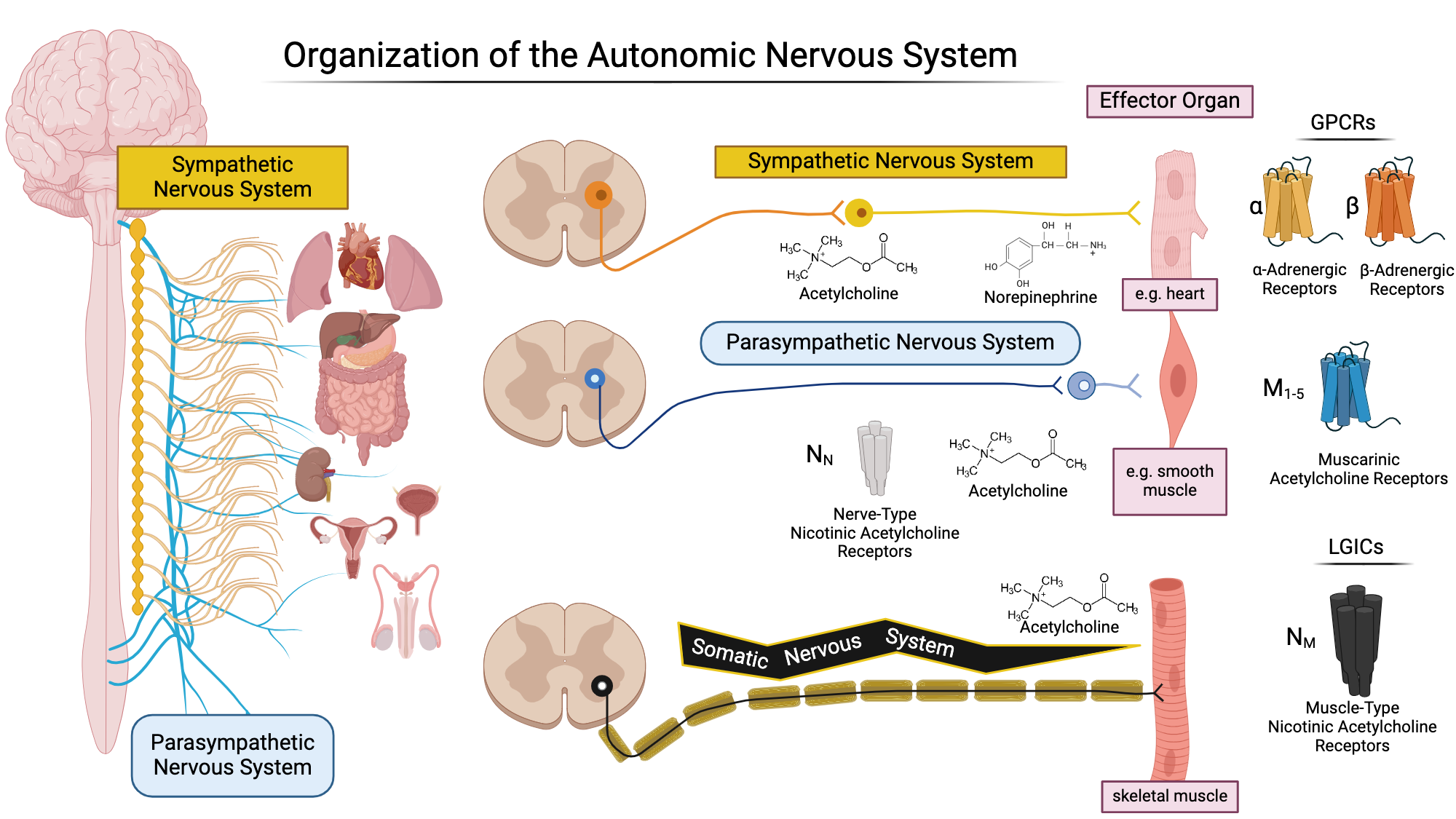

<ul><li><p>use two efferent (motor) neurons</p><p>1) CNS to autonomic ganglia-pre-ganglionic motor neurons and axons </p><p>2) autonomic ganglia to effector- post-ganglionic motor neuron and axons </p></li><li><p>Effectors= visceral organs, smooth muscles, cardiac muscle, glands </p></li><li><p>Ganglia are not DRGs, they are motor ganglia </p></li></ul><p></p>
4
New cards

Sympathetic ns

  • arouses (fight-or-flight)


<ul><li><p>arouses (fight-or-flight) </p></li></ul><p></p>
5
New cards

Parasympathetic ns

  • calms (rest and digest)


<ul><li><p>calms (rest and digest) </p></li></ul><p></p>
6
New cards

More on the parasympathetic nervous system

  • craniosacral division of ANS

  • Pre-ganglionic neurons in nuclei of the brain stem (CN lll, Vll, lX, X) or sacral spinal cord (S2-4)

  • Long pre-ganglionic axons

  • Post-ganglionic neuron is ganglia adjacent to or in target effectors (intramural ganglia)

  • Short post-ganglionic axons

  • Vagus nerve (CNX): 90% of ANS(both SNS and PsNS)


<ul><li><p>craniosacral division of ANS</p></li><li><p>Pre-ganglionic neurons in nuclei of the brain stem (CN lll, Vll, lX, X) or sacral spinal cord (S2-4)</p></li><li><p>Long pre-ganglionic axons </p></li><li><p>Post-ganglionic neuron is ganglia adjacent to or in target effectors (intramural ganglia) </p></li><li><p>Short post-ganglionic axons </p></li><li><p>Vagus nerve (CNX): 90% of ANS(both SNS and PsNS)</p></li></ul><p></p>
7
New cards

More on sympathetic nervous system

  • thoracolumbar division of ANS

  • preganglionic neuron cell bodies in lateral horn of the spinal cord (T1-L2), axons project to sympathetic chain ganglia or collateral ganglia

  • sympathetic chain ganglia (23) (paravertebral sympathetic ganglia) lie adjacent to spinal column on either side

  • collateral ganglia are proximal to target effector (only thoracic and pelvic)

  • sympathetic chain ganglia and the interconnecting nerves form the sympathetic trunk


<ul><li><p>thoracolumbar division of ANS</p></li><li><p>preganglionic neuron cell bodies in lateral horn of the spinal cord (T1-L2), axons project to sympathetic chain ganglia or collateral ganglia </p></li><li><p>sympathetic chain ganglia (23) (paravertebral sympathetic ganglia) lie adjacent to spinal column on either side</p></li><li><p>collateral ganglia are proximal to target effector (only thoracic and pelvic)</p></li><li><p>sympathetic chain ganglia and the interconnecting nerves form the sympathetic trunk</p></li></ul><p></p>
8
New cards

Innervation pattern of sympathetic ns

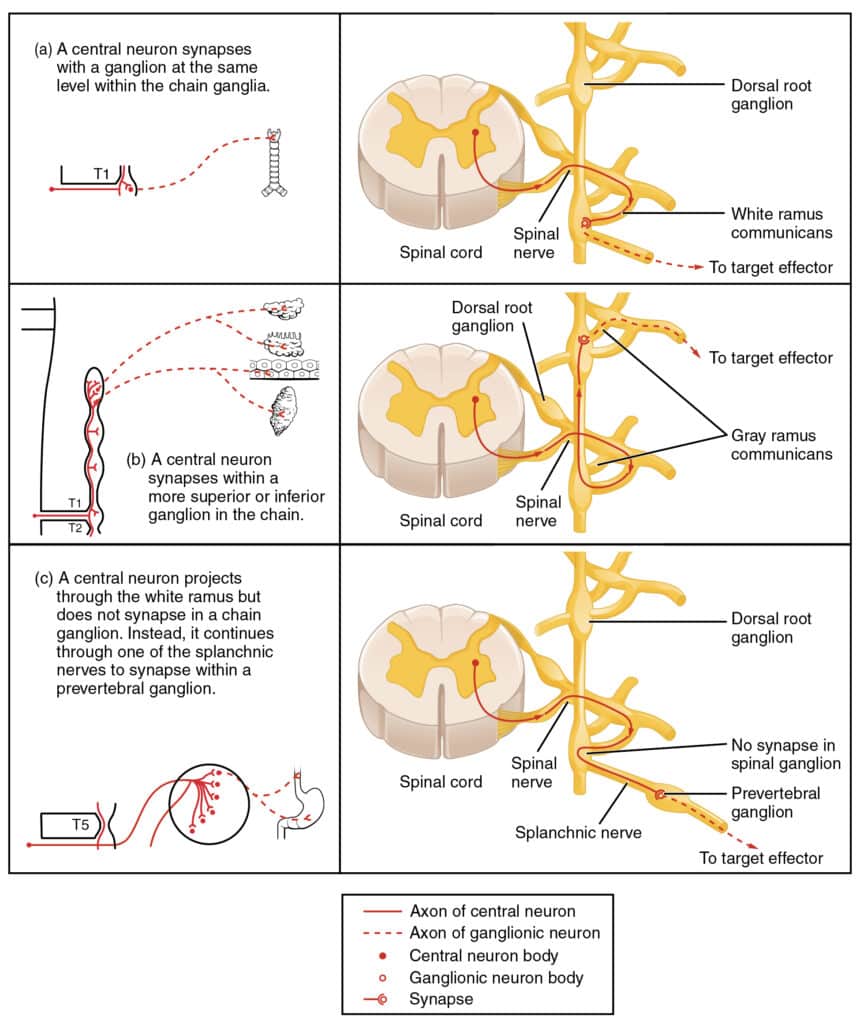
  • pre-ganglionic fibers leave the spinal cord via the ventral root and enter ventral branch of the spinal nerve

  • they then enter sympathetic chain ganglia via a white ramus

  • they synapse either in 1) that ganglion, 2) a different chain ganglion or 3) a collateral ganglion(via collateral nerve)

  • Post-ganglionic fibers from the chain ganglion rejoin spinal nerves via the gray rami(unmyelinated fibers)

  • pre-ganglionic fibers passing through chain ganglia to form splanchnic nerves

  • post-ganglionic fibers from collateral ganglia directly innervate the target effector


<ul><li><p>pre-ganglionic fibers leave the spinal cord via the ventral root and enter ventral branch of the spinal nerve</p></li><li><p>they then enter sympathetic chain ganglia via a white ramus</p></li><li><p>they synapse either in 1) that ganglion, 2) a different chain ganglion or 3) a collateral ganglion(via collateral nerve) </p></li><li><p>Post-ganglionic fibers from the chain ganglion rejoin spinal nerves via the gray rami(unmyelinated fibers)</p></li><li><p>pre-ganglionic fibers passing through chain ganglia to form splanchnic nerves </p></li><li><p>post-ganglionic fibers from collateral ganglia directly innervate the target effector </p></li></ul><p></p>
9
New cards

Sympathetic ns for the head

  • preganglionic axons arise from T1-T4

  • synapse in superior cervical ganglion

  • follow various nerves to effectors in head(smooth muscle, glands, skin)


<ul><li><p>preganglionic axons arise from T1-T4</p></li><li><p>synapse in superior cervical ganglion </p></li><li><p>follow various nerves to effectors in head(smooth muscle, glands, skin) </p></li></ul><p></p>
10
New cards

Thoracic sympathetic innervation

  • preganglionic axons arise from T1-T6

  • Mostly synapse in adjacent chain ganglia

  • some ascend to and synapse in the middle and inferior cervical ganglia


<ul><li><p>preganglionic axons arise from T1-T6</p></li><li><p>Mostly synapse in adjacent chain ganglia </p></li><li><p>some ascend to and synapse in the middle and inferior cervical ganglia </p></li></ul><p></p>
11
New cards

Abdomen sympathetic innervation

  • preganglionic axons arise from T5-L2

  • Travel through chain ganglia, form splanchnic nerves, synapse in collateral ganglia


<ul><li><p>preganglionic axons arise from T5-L2</p></li><li><p>Travel through chain ganglia, form splanchnic nerves, synapse in collateral ganglia </p></li></ul><p></p>
12
New cards

Pelvic sympathetic innervation

  • preganglionic axons arise from T10-L2

  • Descend to lumbar and sacral chain ganglia; some synapse there, others pass through to collateral ganglia
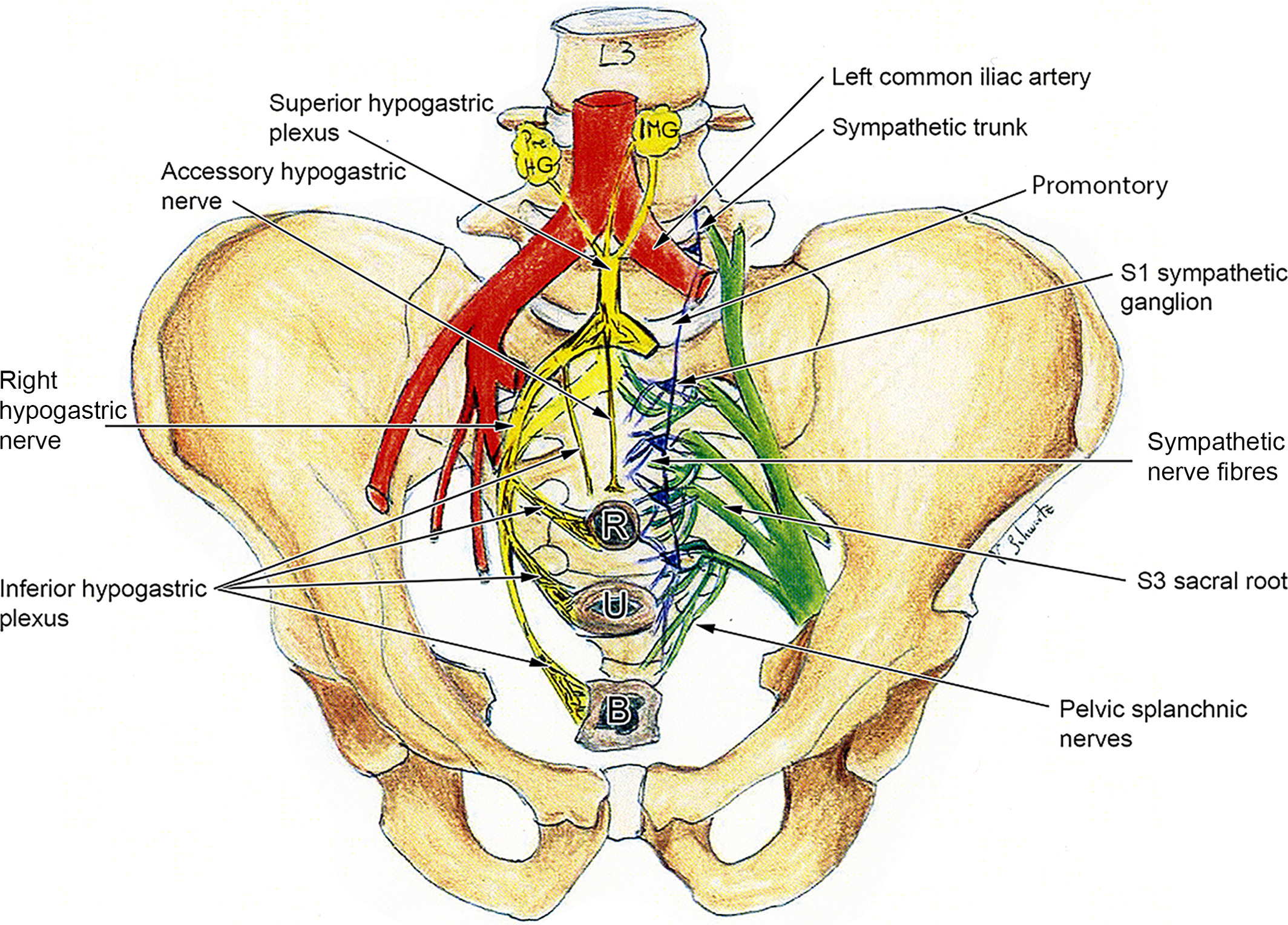

<ul><li><p>preganglionic axons arise from T10-L2</p></li><li><p>Descend to lumbar and sacral chain ganglia; some synapse there, others pass through to collateral ganglia </p></li></ul><p></p>
13
New cards

Exception to sympathetic innervation: Adrenal medulla

  • some preganglionic axons(T8-L1) pass directly into thoracic splanchnic nerves and synapse in the adrenal medulla

  • Chromaffin cells then release epinephrine and norepinephrine into the blood supply(adrenaline)

<ul><li><p>some preganglionic axons(T8-L1) pass directly into thoracic splanchnic nerves and synapse in the adrenal medulla</p></li><li><p>Chromaffin cells then release epinephrine and norepinephrine into the blood supply(adrenaline) </p></li></ul><p></p>
14
New cards

Sympathetic sensory neurons

  • somata in DRGs

  • follow same pathway from the effectors as the corresponding motor pathway

  • generally synapse on neurons in the dorsal horn(direct sensory pathways to brain and referred pain)

  • some synapse on postganglionic neurons in chain ganglia

<ul><li><p>somata in DRGs </p></li><li><p>follow same pathway from the effectors as the corresponding motor pathway </p></li><li><p>generally synapse on neurons in the dorsal horn(direct sensory pathways to brain and referred pain)</p></li><li><p>some synapse on postganglionic neurons in chain ganglia </p></li></ul><p></p>
15
New cards

ANS neurotransmitters: Acetylcholine and norepinephrine

  • the receptor in AcH, muscarinic is excitation in most cases; inhibition in cardiac muscle

  • limited sympathetic targets like sweat glands that cause activation as effect on binding

  • response to transmitter determined by receptor type


<ul><li><p>the receptor in AcH, muscarinic is excitation in most cases; inhibition in cardiac muscle </p></li><li><p>limited sympathetic targets like sweat glands that cause activation as effect on binding</p></li><li><p>response to transmitter determined by receptor type </p></li></ul><p></p>
16
New cards

Neurons of the SNS and ANS

  • somatic motor neurons use ACh, skeletal muscle has nicotinic-type receptors (ionotropic Na+ channels)

  • pre-ganglionic autonomic motor neurons also are cholinergic and synapse onto nicotinic-type receptors

  • sympathetic post-ganglionic neurons use norepinephrine, binds to adrenergic receptors on effectors, multiple types of receptors

  • parasympathetic post-ganglionic neurons are cholinergic, but effectors have muscarinic ACh receptors, metabotropic receptors of multiple types

  • some pre-ganglionic neurons synapse directly onto the adrenal medulla which release NE and E


<ul><li><p>somatic motor neurons use ACh, skeletal muscle has nicotinic-type receptors (ionotropic Na+ channels) </p></li><li><p>pre-ganglionic autonomic motor neurons also are cholinergic and synapse onto nicotinic-type receptors </p></li><li><p>sympathetic post-ganglionic neurons use norepinephrine, binds to adrenergic receptors on effectors, multiple types of receptors</p></li><li><p>parasympathetic post-ganglionic neurons are cholinergic, but effectors have muscarinic ACh receptors, metabotropic receptors of multiple types</p></li><li><p>some pre-ganglionic neurons synapse directly onto the adrenal medulla which release NE and E</p></li></ul><p></p>
17
New cards

Antagonism of autonomic systems

  • both the sympathetic and parasympathetic systems are tonically active

  • when present, the systems antagonize each other

<ul><li><p>both the sympathetic and parasympathetic systems are tonically active </p></li><li><p>when present, the systems antagonize each other </p></li></ul><p></p>
18
New cards

Control of ANS

1) Cerebral cortex(frontal lobe)

2)Limbic system(emotional input)

3)hypothalamus-the “boss”: overall integration of ANS

4)Brain stem( reticular formation)- regulates pupil size, heart, blood pressure, airflow, salivation

5)spinal cord-reflexes for urination, defecation, erection, and ejaculation


<p>1) Cerebral cortex(frontal lobe)</p><p>2)Limbic system(emotional input)</p><p>3)hypothalamus-the “boss”: overall integration of ANS</p><p>4)Brain stem( reticular formation)- regulates pupil size, heart, blood pressure, airflow, salivation </p><p>5)spinal cord-reflexes for urination, defecation, erection, and ejaculation </p><p></p>



