2.2 Demand
 Call Kai
 Learn
 Practice Test
 Spaced Repetition
 Match
 Flashcards
 Knowt Play
1/50

There's no tags or description
Looks like no tags are added yet.
51 Terms
Demand
the willingness and ability to purchase a good or service at a given price in a given time period.
Law of demand
for most products, the quantity demanded varies inversely with its price.
Individual demand
the demand for a good or service by an individual consumer.
Market demand
the total demand for a good or service, found by adding together the individual demands.
Movement along the demand curve
when the price changes, leading to a movement up (contraction) or down (expansion) the existing demand curve.
Shift of the demand curve
a complete movement of the demand curve either outward (to the right) or inward (to the left).
Price elasticity of demand
the responsiveness of quantity demanded to a change in the price of a product.
Elastic demand
when the percentage change in quantity demanded is greater than the percentage change in price.
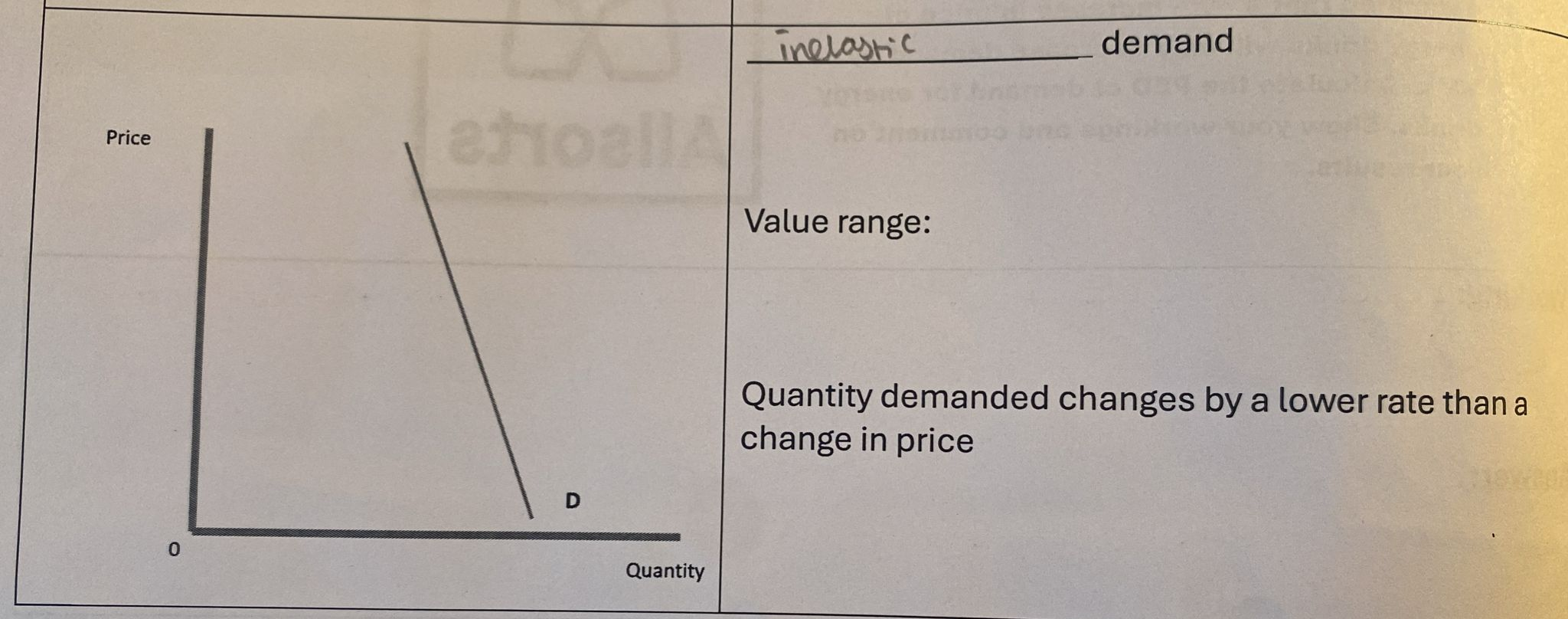
Inelastic demand
when the percentage change in quantity demanded is less than the percentage change in price.
Effective demand
demand is different to desire. effective demand is when a desire to buy a product is backed up by an ability to pay for it
Latent demand
exists when there is a willingness to buy among ppl for a good or service, but where consumers lack the purchasing power to be able to afford the product
derive demand
arises due to the demand for another product
drawing a demand curve

drawing a MOVEMENT along the demand curve

effects on consumer and producer when price INCREASE (obvious shi)
contraction in demand/ movement up
consumer- worse off as they cannot afford to by as many goods, reducing standard of living
producer- sales will contract and producer may see reduced profits and market share, esp if competitors dont raise prices
effects on consumer and producer when price DECREASE (obvious shi)
movement down curve/ expansion in demand
consumer- better off as they can afford to buy more good increasing social welfare
producer- sales will expand and profits r likely to improve. competitors may even be forced out of market if they cannot compete
Drawing shifts in the demand curve

Factors that shift demand
PASIFIC
Population
Advertising
Substitutes (price of)
Incomes/state of the economy
Fashion trends
Interest rates & govt. policies
Complement (price of)
(bonus): price expectation
population
Size: likely that demand will increase as the number of people in a country increases, i.e. healthcare.
Age, i.e. more older people = more demand for related goods and services eg wheelchair, grabbing sticks
Gender: i.e. increase in women = more demand for related goods and services eg pads #makethatshitfree
Advertising
Designed to increase the demand for a product, usually through advertising. For example, large firms spend tens of millions of pounds every year on advertising.
Substitutes (price of)
Goods and services that can be used in place of another good or service. If the price of one product rises then demand will fall as people change to buying the other one, eg PG Tips and Yorkshire tea or tea and coffee.
Incomes/ state of the economy
As incomes rise, consumers are able to buy more goods and services at every price causing an outward shift of the demand curve.
However, low quality products (inferior goods) may see a fall in demand as consumers decide to buy better quality goods eg switching from Tesco value beans to Heinz baked beans.
For example, during a financial crisis, demand falls as more people become unemployed however demand may increase for inferior goods and services.
Fashion trends
Tastes and fashions change over time and most people prefer to buy different or more advanced products therefore demand for these goods and services increase.
Interest rates/ gov policies
The Bank of England may change interest rates making cheaper or more expensive to borrow money for large purchases
The government may pass a law making a good compulsory to use e.g. booster seats, increasing demand
Complement (price of)
Goods and services that go together, eg cars and fuel. If the demand for one increases it is likely that the demand for the other will also increase.
bonus additional factor: price expectation
If people expect prices to rise, they are likely to demand more of the product now before it becomes more expensive.
summary table of the changes in demand and their effects

calculating PED
PED always has a minus sign which means that the price and demand move opposite directions (price falls, demand rises and if price rises, demand falls)

What does PED = 0 mean?
Perfectly inelastic demand. Demand does not change when price changes.

What does PED = 0 to -1 mean?
Inelastic demand. The % change in demand is less than the % change in price.
What does PED = 1 mean?
Unitary elastic demand. The % change in demand is the same as the % change in price.

What does PED = 1 to ∞ mean?
Elastic demand. The % change in demand is more than the % change in price.

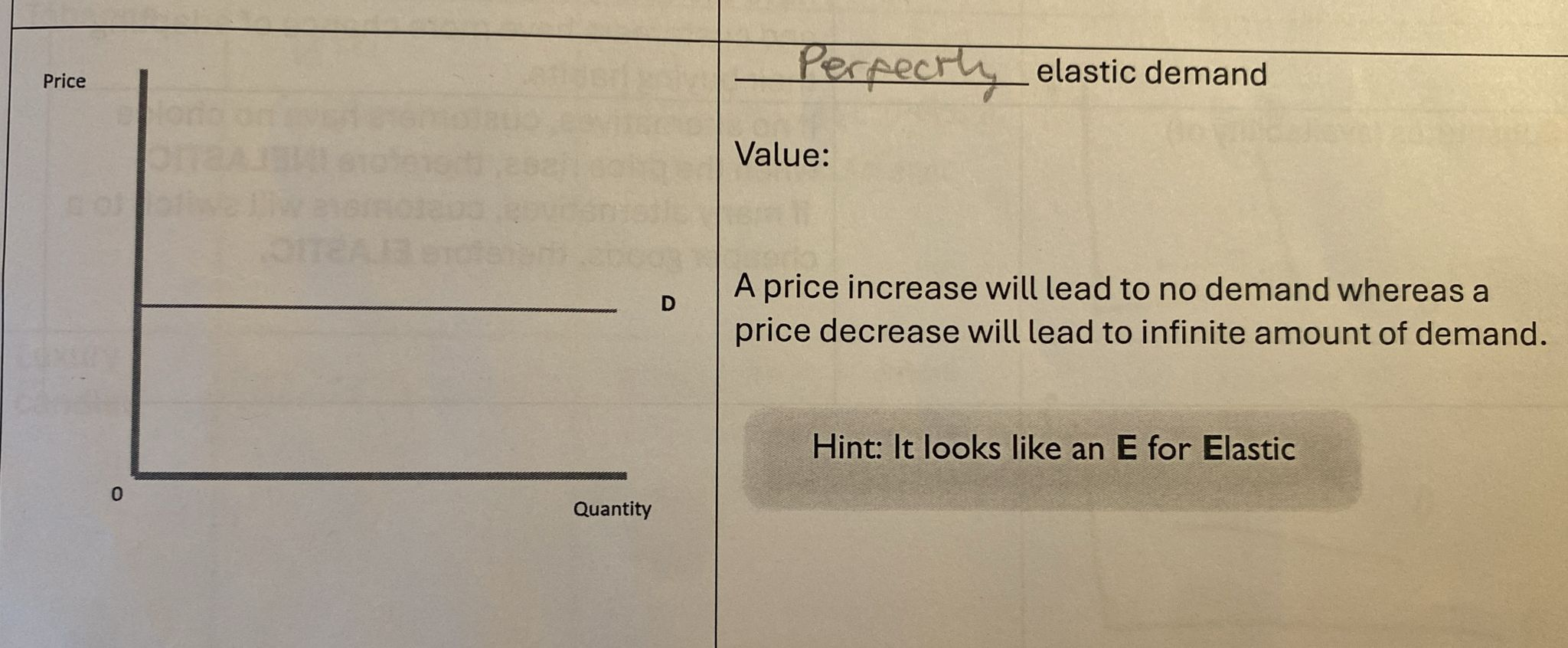
What does PED = ∞ mean?
Perfectly elastic demand. If a firm increased price, demand would fall to zero.
What mnemonic can be used to remember the determinants of PED? (whether demand is elastic or inelastic)
PLANTS
Proportion of income spent on item
Loyalty to the brand
Addictiveness
Necessity vs Luxury
Time Period
Substitutes (Availability of)
Proportion of income spent on item
If a low proportion of income is spent then a small change in price is easily afforded, making demand INELASTIC.
If a high proportion of income is spent, a price rise is difficult to afford, making demand ELASTIC.
Loyalty to the brand
Can be created through quality, advertising or other promotion. If high = INELASTIC.
Addictiveness/Habit forming
Habit makes products necessities for certain individuals INELASTIC. E.g. cigarettes and vapes or football tickets
Necessity vs Luxury
If a product is an essential, customers will still buy consistent levels even if the price rises or falls, therefore INELASTIC.
Whereas luxury goods suffer a greater fall in demand with an increase in price, as consumer can do without them, therefore ELASTIC.
Time Period
the longer the time period the higher the PED (more elastic). Given more time other firms have the ability to produce similar products and customers have more chance of adapting their buying habits.
Substitutes (availability of)
If no alternatives, customers have no choice when the price rises, therefore INELASTIC
If many alternatives, customers will switch to a cheaper goods, therefore ELASTIC.
Sales Revenue
The income generated from the scale of goods
FORMULA: selling price x quantity sold
effect on revenue when raising/lowering the selling price of a good w price elastic/ inelastic demand
RAISE:
elastic- revenue decreases
inelastic- revenue increases
LOWER:
elastic- revenue incr
inelastic- revenue decr
Why might PED be important to consumers? like why does PED matter in real life for consumers, to what they pay and do? POSSIBLE 6MARK ON MOCK
STEL stuff that explains consumer links to ped
Seasonal products
Taxes imposed by the government
Expectations of consumers
Lower prices offered by firms
Seasonal products
When buying seasonal goods, demand is more inelastic when in season e.g holiday accommodation and flights during school holidays/ice cream in summer, leads to consumers planning shopping habits accordingly, budgeting better, or buying out of season, buying while less in demand at discount
Taxes imposed by the government
Higher taxes placed on products with inelastic demand will lead to higher prices for consumers. E.g. fuel, tobacco, alcohol, ts leads to consumers to recognise the demand is price inelastic, & therefore budget for higher prices
Expectations of consumers
May expect to pay higher prices if demand is inelastic. e.g. travelling at peak times on railway as commuters who need to get to work are willing to pay more. Expecting PED to be inelastic will mean price incr come as less as a shock, therefore they can adjust their spending accordingly or start to look for alternatives.
Lower prices offered by firms
Consumers may expect to pay lower prices when demand is elastic as firms lower prices to maximise sales revenue Eg charity shop goods, clothes shops as lots of competition (and therefore substitutes). ts leads to consumers making conscious choices around their spending & making choices that therefore help them to budget
Why might PED be less important to consumers?
CHO
Consumers unaware of PED
Habit forming goods
Other factors may be more important
Consumers unaware of PED
Most consumers unaware of PED as a concept and will not realise the impact it is having on them.
Habit forming goods
Consumers unlikely to consider PED especially for addictive products e.g. tobacco and alcohol
Other factors may be more important
Quality, variety, branding, ethical and environmental factors, convenience may all be more important