adult rehab final
 Call Kai
 Learn
 Practice Test
 Spaced Repetition
 Match
 Flashcards
 Knowt Play
1/111

There's no tags or description
Looks like no tags are added yet.
112 Terms
common diagnoses
cerebrovascular accident (stroke)
transient ischemic attack (TIA)
acquired brain injury
CVA or stroke
acute neurological event of vascular origin
` ischemic: lack of blood flow
` hemorrhagic: rupture of weakened blood vessels
TIA
temporary blockage of blood flow to part of the brain that causes stroke like symptoms
` symptoms start suddenly and typically resolve within a few hours
` higher risk of a future stroke
acquired brain injury
head injury that can be traumatic or nontraumatic
brain tumor
substance abuse
environmental exposure
TBI: brain injury caused by external trauma to the head suddenly and violently hits an object or when an object pierces the skull and enters brain tissue
other brain injuries
hematoma hemorrhage: hematoma (collection of blood) hemorrhage (active bleeding), categorized by location in the brain and can have traumatic and non etiology
Brain infarction: infections can affect tissue and surrounding structures
encephalitis: type of inflammation caused by viral infection or autoimmune reaction
meningitis: inflammation of the meninges which can impact brain and spinal cord
encephalopathy: general term for altered brain function, can be caused by metabolic imbalances (liver, kidney, malnutrition) lack of oxygen, infection, sepsis. symptoms may fully resolve or lead to brain dysfunction

important considerations of brain injuries
regardless of etiology it’s important to know what area is affected (structure) to understanding potential deficits (function)
etiology is important to understand the prognosis which may help with intervention and discharge planning
its extremely important that you are familiar with the lobes of the brain and right vs left deficits
levels of brain injury: mild (GCS= 13 to `5)
must have at least 1 of the following
LOC (less than or equal to 30 min
loss of memory immediately before or after event (no greater than 24 hours before)
any alteration of mental status at the time of accident
focal neurological deficits (lasting or transient)
levels of brain injury: moderate (GCS= 9 to 12)
LOC of 20 min to 6 hours AND GCS score of 9 to 10
LOC no greater then 24 hours
abnormal brain imaging results
levels of brain injury: severe (GCS= GCS 3 to 8)
LOC or coma greater then 24 hours
abnormal brain imaging results
ranchos los amigos level (RLA) of cog function
scale used to assess clients after traumatic brain injury based on behavioral and cog abilities
scale I-X with lower scores indicating higher impairment
patients can move through a sequential pattern but the amount of time in each level and max level can vary
criteria in determining RLA level
responsive to stimuli
ability to follow commands
presence of non-purposeful behavior
cooperation
confusion
attention to environment
ability to focus
coherence of verbalization s
memory recall
orientation
judgement and reasoning
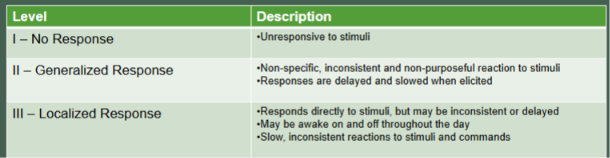
RLA levels 1 through 3
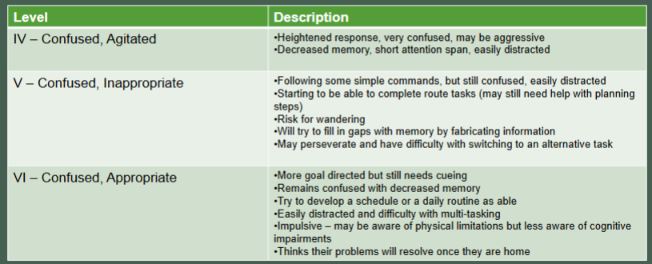
RLA levels 4 through 6
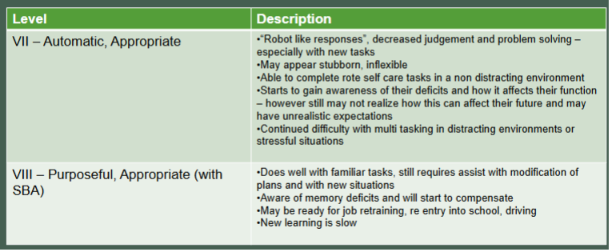
RLA levels 7 and 8
RLA levels 9 and 10

common brain injury impairments
visual deficits (double vision, visual field impairments)
perceptual deficits (visuospatial inattention, impaired depth perception)
cognitive deficits (impaired attention and memory)
sensory deficits (impaired light touch, hot/cold)
memory deficits (impaired strength, impaired tone, spasticity)
communication deficits (dysarthria, aphasia)
disorders of consciousness
ataxia
apraxia
agnosia
amnesia
behaviors and agitation impairment
DOC
often from severe TBI’s, state of reduced wakefulness and awareness due to brain damage
coma: no evidence of arousal or awareness (eyes closed, no sleep-wake cycle)
vegetative/unresponsive wakefulness: no awareness of self or environment, no sustained/reproducible/ purposeful/voluntary behavioral responses, eyes open, have a sleep wake cycle
minimally conscious state: visually tracks, non stereotypical movements, some awareness of self or environment, reproducible commands, manipulates objects, may be able to indicate yes/no responses
ataxia
uncoordinated movements which are disproportionate to strength
result from cerebellar lesions
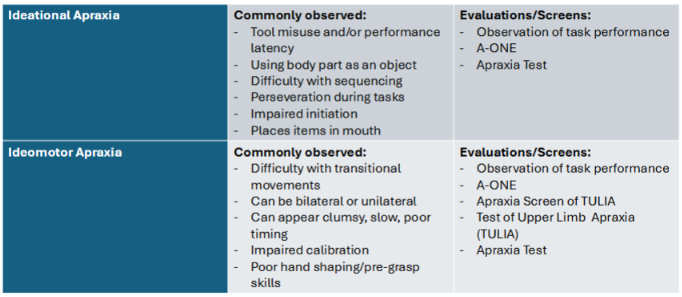
apraxia
inability to perform purposeful actions despite having normal muscle function
does not mean that weakness will not be present
result primarily from damage to left parietal lobe, can also be from lesions to intrahemispheric area, basal ganglia, thalamus
2 sub types:
ideomotor: difficulty with programming, planning, and producing motor movements (does not know how to do)
ideational: breakdown of knowledge of what needs to be done (does not know what to do)
agnosia
inability to recognize objects, persons, smells, or sounds despite normal sensory functions
- common subtypes
anosognosia: unawareness/denial of neurological deficit that’s clinically evident
visual agnosia: inability to recognize incoming visual information despite intact primary visual skills and visual anatomy
Visual agnosia: appreceptive
inability to perceive the structure or shape of an object, more severe functional deficit
visual agnosia: associative
inability to identify objects despite a relatively intact basic perception of forms and shapes
amnesia
retrograde: inability to retrieve old memories or information that was stored before the onset of the injury or trauma
anterograde amnesia: inability to form new long term or explicit memories after the event or injury occurs
Behavior and Agitation Impairments linked to BI: agitation and restlessness
pacing
extreme irritability
heightened responsiveness
severe inner tension
Behavior and Agitation Impairments linked to BI: impulsivity
tendency to act on a whim
displaying behavior with little to no forethought
reflection
consideration of long term consequences
Behavior and Agitation Impairments linked to BI: aggression
explosive verbal outbursts or physical actions directed at obhects, caregivers, or themselves
Behavior and Agitation Impairments linked to BI: disinhibition
inability to monitor or stop inappropriate behaviors which can manifest as social or verbal boundary crossing
Behavior and Agitation Impairments linked to BI: egosentrism
altered perception where the individual struggles to realize how their words and actions affect others
Behavior and Agitation Impairments linked to BI: apathy
decrease in or or lack of motivation
surgical interventions of lowering intercranial pressure

seizure
tonic-clonic/grand mal: loss of awareness muscles may stiffen and produce rhythmic jerking
absent seizure/petit mal: short, sudden lapse of consciousness, may stare into space, blink quickly, make shewing or hand movements
things to consider after TBI
arousal and responsiveness: is the client alert enough to participate
cognition: can the client attend, understand, remember, and follow directions
behavior: is the client impulsive, agitated, withdrawn, or easily overwhelmed
physical dysfunction: what assistance is needed for mobility, balance, and upper extremity use
occupational performance: what can the client currently do during meaningful activities
environment: does the setting support participation or create excessive demands
RLA guide intervention

management of behavior/agitation
use a quiet, structured environment with limited distractions
provide short, simple, one-step instructions
allow additional processing time and repeat instructions as needed
avoid arguing, confronting, or providing excessive verbal information
use repetition, familiar routines, visual cues, and consistent task setup
monitor for agitation, restlessness, fatigue, and overstimulation
stop or modify activities if client demonstrates escalating agitation or distress
allow de-escalation time if agitated by stepping back, providing physical space, and allowing individual a quiet rest period to calm down
apraxia intervention techniques

Mild TBI
brain injury caused by an external force resulting in a change in brain function
concussion
commonly used to describe mild TBIs
loss of consciousness is not required for a concussion to occur
conventional brain imaging may be normal despite clinically significant symptoms
symptoms may appear immediately or develop over hours or days
ot assessment for concussion
Focus on the relationship between symptoms, activity, and occupational performance
occupational profile: work, school, family roles, routines, and meaningful activities
cognitive functions: attention, processing speed, memory, and executive functions as indicated
functional vision and vestibular system: screening and referral when appropriate
activity tolerance: response to physical, cognitive, and environmental demands
participation: identify barriers to return to work, school, driving, and leisure
ot intervention for concussion
education about symptom monitoring and gradual return to activity
activity pacing and modification of demanding routines
graded return to work, school, and meaningful occupations
environmental modifications to manage light, noise, and visual complexity
external memory aids and organizational strategies when needed
referral or collaboration for persistent vestibular, visual, headache, or cognitive symptoms
visual agnosia
apperceptive and associative are academic categorizations
types are more specific based on deficit
each type has a different neurological underpinning
most commonly in posterior multimodal association area (occipital-parietal-temporal lobes)
visual object agnosia

prosopagnosia
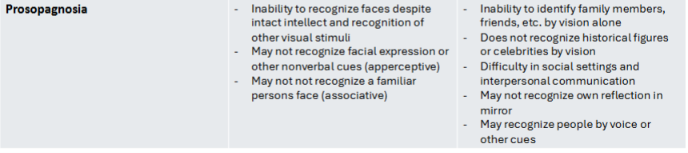
simultanagnosia

landmark agnosia
definition: inability to recognize landmarks including buildings, places, streets, distinctive monuments, etc.
observation:
difficulty wayfinding with both new and unfamiliar environments
gets lost easily

evaluation for agnosia
will differ based on the type of agnosia
common evals:
A ONE
occupational therapy adult perceptual screening test
various neuropsychological tests
Treatment for visual agnosia
primarily compensatory strategies use of adaptive devices tailored to the type
essential for interprofessional collaboration during eval and treatment planning to assist with diagnosing and carrying over strategies
spinal cord injury
involves damage to the spinal cord resulting in temporary or permanent changes in motor, sensory, and/or autonomic functions, can be categorized into 2 broad categories
2 categories of SCI
traumatic: motor vehicle collisions, falls, sports injuries, violence, and other external forces
nontraumatic: tumors, vascular events, infection, inflammatory conditions, degenerative compression, other medical causes
SCI term: functional level
lowest segment which the strength of important muscles are graded >/= 3+ and at which sensation is intact
SCI term: zone of partial preservation
dermatomes and myotomes below the neurological level that remain partially innervated
SCI term: motor level
diagnostic level that quantifies outcome expectations, identified by the lowest level of the spinal cord with normal motor functions
SCI term: sensory level
identified by the lowest segment of the spinal cord processing normal sensation to PP and LT
SCI term: neurological level of injury
lowest segment of the spinal cord with preserved bilateral normal sensory and antigravity motor function
SCI term: paraplegia
loss of or impairments of motor and/or sensory function in the thoracic, lumbar, or sacral segments of the spinal cord; results in functional impairments in the trunk, legs, and pelvic organs
SCI term: tetraplegia
loss of or impairment of motor and/or sensory function in the cervical segments of the spinal cord, results in functional impairment in the arm, trunk, legs and pelvic organs
complete spinal injury
total loss of motor and sensory function below the level of injury
incomplete spinal injury
preservation of any sensory and/or motor function below the level of injury
potential functional implications of high cervicale injury
may affect respiratory function
head and neck control
independence in most self care activities
potential functional implications of lower cervical injuries
may preserve some shoulder, elbow, wrist, or hand function
depends on the exact level and individual findings
potential functional implications of thoracic injury
arm and hand function are generally preserved
trunk control, balance, transfers, and lower body function vary
potential functional implications of lumbar injury
upper extremity generally preserved
lower extremity motor function and walking potential vary
central cord syndrome
damage to the center of the spinal cord
results in greater weakness in UE’s then LE’s
brown cord syndrome
damage to 1 side of the cord
result in ipsilateral proprioceptive and vibratory sensory loss, loss of motor control at/below lesion
contralateral loss of pain/temp
anterior cord syndrome
absent blood supply to anterior cord
results in loss of motor control at/below injury
loss of pain/temp sensation at/below injury
proprioception and light touch preserved
cauda equina syndrome
damage 2 or more lumbosacral nerve roots within spinal canal but not spinal cord
results in bowel/bladder dysfunction and flaccid paralysis
conus medullaris syndrome
damage to 2 or more lumbosacral nerve roots within spinal canal and spinal cord
results in bowel/bladder dysfunction
symmetrical motor dysfunction
transverse myelitis
inflammation of both side of 1 section of the spinal cord
results in pain in lower back, neck, and torso
muscle weakness leading to partial/complete paralysis in arms and legs
sensory changes (numbness, tingling)
Secondary conditions associated with SCI: pressure injuries/skin integrity
caused by reduced sensation, prolonged pressure, shear, friction and moisture, and/or inability to reposition
ot complications: skin inspection, seating and positioning, education on pressure relief schedule
Secondary conditions associated with SCI: autonomic dysreflexia (AD)
sudden severe overreaction of the sympathetic NS to a painful or irritating stimulus
common triggers include bladder distention, bowel problems, kinked/blocked urinary catheter, skin irritation, pressure, and constrictive clothing
ot implications: immediately stop activity, sit person up (if appropriate)
loosen restrictive clothing catheter
check catheter
monitor blood pressure
alert medical team
Secondary conditions associated with SCI: orthostatic hypotension
drop in blood pressure associated with positional changes
common signs include dizziness, lightheadedness nausea, blurred vision, weakness, and sometimes fainting
ot implications: monitor blood pressure, use gradual positional changes, use of compression stockings and abdominal binder (as appropriate)
Secondary conditions associated with SCI: heterotopic ossification
pathological formation of bone in the soft tissue around the joints which can appear 1 to 4 months after injury
can cause swelling
ot implications: positioning strategies, daily-aggressive ROM
Secondary conditions associated with SCI: neurogenic bladder and bowel
occurs when nerve damage disrupts the normal signals between the NS and the urinary or gastrointestinal tracts
ot implications: education/training on adaptive methods/equipment, creation of bowel/bladder schedule, self-catheterization (if appropriate)
Secondary conditions associated with SCI: spasticity and muscle spasms
occurs because the disruption of nerve signals between the brain and spinal cord leaves spinal reflexes uncoordinated and over active
ot implications: determine whether tone helps or hinders a specific activity, positioning, and ROM, identify triggers such as pain, skin injury, urinary issues, constipation, of infection
Secondary conditions associated with SCI: impaired temp regulation (Poikilothermia)
occurs particularly with injuries above T8 due to altering signals to the hypothalamus. The bodies internal temperature will acclimate to that of their surrounding
ot implications: care must be made to avoid overheating or hypothermia as body will not shiver, sweat or show other signs of temperature dysregulation
Secondary conditions associated with SCI: impaired sexual function
affects both sexual intercourse
males may be unable to have voluntary erections, also may have decreased fertility after injury
women may have irregular menstruation, however fertility may be unchanged. Due to sensory loss will need close monitoring when pregnant as well as monitoring for AD
ot implications: education, adaptive equipment/strategies, can refer out to specialized providers
OT eval considerations for SCI
any precautions to consider
evals you already know for this population
UE overuse injuries
psychosocial factors you need to consider
cancer
group of diseases in which abnormal cells divide without control
can invade nearby tissues, and travel through the blood and lymph systems to other body parts
typically classified by the body location and tissue type
cancer stages
0 to IV, 4 being the most advanced (metastatic)
metastases refer to cancer that originated in 1 part of the body but then went to another part
types of cancer treatments
surgery: used to diagnose, treat, and prevent cancer
chemotherapy: used to treat, contain, and/or slow tumor growth/kill cancer cells
radiation: use of high energy particles or wavelengths to kill cancerous cells and shrink tumors can be curative or palliative
immunotherapy: uses substances made from living organisms to treat cancer, teaches patients own system to recognize, target, and kill cancer cells
secondary effects of cancer treatment
complications from surgery
pain (muscle, bone, joint, nerve)
infections
lymphedema (buildup of lymph fluid in the fatty tissue under the skin that causes swelling)
fever, chills, and other flu like symptoms
nausea and vomiting
hair loss
fatigue
sores in mouth or throat
constipation or diarrhea
itching/rash
cognitive changes
swelling and weight gain
peripherical neuropathy
precaution/ co-occurring conditions in cancer: limb precaution
no blood pressure
no blood draws
no IV’s
precaution/ co-occurring conditions in cancer: neutropenic precaution
low white blood cell count
impaired immune system
precaution/ co-occurring conditions in cancer: steroid induced myopathy
progressive muscle weakness
primarily affects proximal muscles
precaution/ co-occurring conditions in cancer: chemotherapy
48 to 72 hours after administration should double flush after using bathroom
extra care when handling any body fluids
soiled linens should be washed separately
personal waste products (diapers, pads) should be sealed in a plastic bag before disposal
not touching oral area with bare hands
precaution/ co-occurring conditions in cancer: thrombocytopenia
low platelets
increased risk of bruising/bleeding
precaution/ co-occurring conditions in cancer: amnesia
low blood cells
fatigue
SOB (shortness of breath)
dizziness, lightheadedness
arrhythmias
precaution/ co-occurring conditions in cancer: pancytopenia
low red blood cells
low white blood cells
platelets
precaution/ co-occurring conditions in cancer: blood clots
DVT
pulmonary embolism
autoimmune conditions
happen when your immune system mistakenly attack healthy cells, tissues, or organs
examples of autoimmune conditions
MS
systematic lupus erythematous (SLE)
gullain barre syndrome (GBS)
chronic inflammatory demyelinating polyneuropathy (CIDP)
myasthenia gravis
MS
occurs when immune system attacks myelin sheath that surrounds nerve fibers
3 common types
MS: relapsing remitting
clients experience worsening of symptoms, attack/flare ups
followed by remission
eventually yield partial or complete recovery
MS: secondary progressive
can follow relapse-remitting
condition will steadily decline over time with or without occasional relapses
MS: primary progressive
symptoms gradually and steadily worsen from onset
no clear relapse-remitting symptoms
common MS symptoms
fatigue
weakness
spasticity
tremors
impaired sensation
pain
visual changes
cognitive changes
depression/emotional changes
bowel/bladder dysfunction
dysphagia
impaired balance/coordination
Heat is likely to worsen symptoms
systemic lupus erythematous (SLE)
inflammation causes damage in healthy tissue in multiple body symptoms
symptoms can vary depending on which organ is affects and can fluctuate day to day or change over time
can have flare ups
SLE symptoms
fatigue
joint pain
joint swelling
joint stiffness
sensitivity to sunlight
headaches and/or cognitive changes
deficits specific to organ damage (impaired endurance, heart affected)
GBS
demyelination of peripheral nerves
often 2-4 weeks prior to symptoms there is typically respiratory, GI, or other types of infection
3 phases
signs/symptoms of GBS
quickly progressing, symmetrical ascending paralysis with pain in feet
absence of deep tendon reflexes
mild sensory loss in stock and glove distribution
facial palsy
dysphagia
respiratory muscle paralysis
potential postural hypertension and tachycardia
3 phases of GBS: acute inflammatory progressive
weakness in at least 2 limbs that progresses, reaches its max in 2 to 4 weeks
can be life threatening and require mechanical ventilation