PSY389 Lecture 12: Relapse after Treatment of AOD Disorders
 Call Kai
 Learn
 Practice Test
 Spaced Repetition
 Match
 Flashcards
 Knowt Play
1/21

There's no tags or description
Looks like no tags are added yet.
22 Terms
Stages of change Model (The Transtheoretical Model (TTM))
Model describes behaviour change as a process in which individuals may move through different stages of readiness to change.
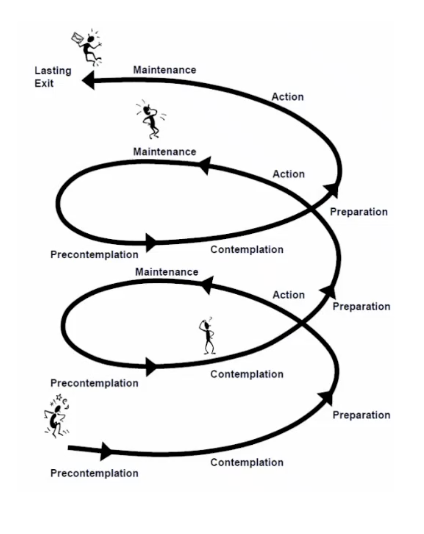
ACHIEVING CHANGE
1. Maintaining abstinence may be manageable in the short term, but sustaining it over the long term is more challenging.
2. Relapse is common: approximately 60% of people relapse within 3 months, and 90% within 12 months.
3. One of the biggest challenges for therapists is helping clients prevent or manage relapse.
Lapse vs Relapse
• Lapse: A single episode of substance use after a period of abstinence (a “slip”).
• Relapse: A return to a pattern of problematic substance use after a period of abstinence. It may involve repeated lapses and increasing use.
• The distinction is not always clear: A lapse does not necessarily lead to a relapse.
• Negative view of a lapse: Seeing it as a failure may lead to guilt, hopelessness, and further substance use.
• Positive view of a lapse: Treating it as a learning opportunity can help clients identify triggers, understand what contributed to the lapse, and develop strategies to prevent future lapses.
CAUSES OF RELAPSE
Factors influence relapse (Marlatt, 1996):
Intrapersonal factors:
1. Coping with negative emotional states
2. Enhancement of positive emotional states
3. Testing personal control
4. Giving to temptations and urges
5. Low commitment and self-efficacy
6. Lack of coping skills and efforts
Interpersonal factors
1. Interpersonal conflicts
2. Social pressure
Relapse in Australian Population?
• According to the AIHW, in Australia, 60% of clients receiving alcohol and other drug treatment in 2024–25 had previously received treatment.
• Although this does not directly measure relapse, it highlights that many people have repeated contact with treatment services
Craving and Relapse
• Cravings can occur after a period of abstinence or even when substance use has been reduced.
• People may experience intense urges to resume substance use, even after being abstinent for a long time.
• A common thought is: “Just one little drink can’t hurt.”
• Giving in to these urges can put recovery at risk and may lead to further substance use.
Retrospective evidence on craving
• Retrospective self-reports are a major source of information about factors that trigger relapse.
• People often attribute relapse to crises or emotional distress. However, these explanations may not always capture the full picture, as people may unintentionally or deliberately present their reasons in ways that reduce blame or seek understanding.
• Retrospective reports have limitations, including inaccurate recall, unintentional distortions, excuses, and deliberate misreporting.
Prospective study on craving
• Prospective studies use near-real-time methods, such as ecological momentary assessment (EMA), to record experiences and behaviours as they occur.
• These studies reduce reliance on retrospective recall and help identify factors that may trigger relapse.
• A limitation: Repeatedly monitoring or asking participants about their thoughts, feelings, and substance use may influence their behaviour or the processes being studied. This is known as measurement reactivity.
Models of relapse
• Classical conditioning models
Positive appetitive model (early drug use)
Compensatory response model (development of tolerance)
Conditioned withdrawal model (withdrawal symptoms)
• Neurophysiological models – the role of dopaminergic pathways in substance use and relapse.
• Social learning model – how learning, observation, and reinforcement influence substance use.
• Marlatt’s relapse prevention model – how high-risk situations, coping skills, and expectations influence the likelihood of relapse.
Classical conditioning Models and Cue Exposure
• Three classical conditioning models leading to relapse
• Cue exposure, involves exposing user to drug-related cues, but refraining from use.
• This technique delays the relapse and leads to less consumption of drug temporarily.
• But exposure to drug-related cues can backfire and may increase the likelihood of relapse.
Neurophysiological Models
Prolonged drug use may cause changes in neurophysiology underlying development and persistence of addictive behaviour:
the mesolimbic pathway involving the release of dopamine in the nucleus accumbens (NAc) in the reward system
The mesocortical pathway involving the prefrontal cortex
Impaired ability to assess the consequences of one’s actions; and
Lack of self-control over potentially harmful behaviours such as drug addiction.
Classical conditioning models and Neurophysiological Models
In sum, the conditioning and neurophysiological models attributed relapse to factors that may operate with low awareness and volition on the user part
Social Learning Theory
In relapse prevention, Social Learning Theory emphasises:
The importance of cognitive control (e.g., expectancy) and behavioural coping skills
An active involvement by the user in the process
By learning how to identify high-risk situations for lapse, one may avoid such situations.
Having good coping skills would allow individuals to resist temptations when facing high risk situations
The importance for self-efficacy (belief that one can control outcomes, can deal effectively with the urges)
Ability to resist temptation may also be strengthened further by support and reinforcement of significant others.
Marlatt’s Model of Relapse
Two stage process involves factors that lead to initial use after abstinence (lapse) & those leading to continued use (relapse):
1. Initial use is determined by the interaction between high risk situation, availability of coping skills, self-efficacy and positive outcome expectancies
2. Continued use depends on cognitive, affective reaction to lapse (i.e., abstinence violation effect (AVE) - attributions of cause of lapse & emotional reaction of that attribution)

• Reducing use gives user a sense of control
• The longer the abstinence the greater the sense of coping → increase in self-efficacy
• Inadvertent mini decisions start chain of behaviours, potentially leading to relapse (e.g., try to reduce drinking but buy a bottle of wine for incoming guests)
• These are referred to as Apparently Irrelevant Decisions (AIDS) –(e.g., attempted to quit smoking but inadvertently decided to visit a smoker) → increases likelihood of relapse
if person fails to cope, he/she would be set for a lapse.
if lapse occurs, perception is abstinence has been violated
The intensity of AVE will vary according to cognitive dissonance and personal attribution
The person may seek relief from this self-conflict through AOD use
If failure was attributed to self, indulgence may continued
if AOD use reduces discomfort, further use may ensue
Marlatt’s Model of Relapse - Attribution of AVE
Self or Internal attribution
“My drinking is my weakness in self-control in refusing the offer”
“I am always weak when offered a drink”
“I am weak in all situations where alcohol is offered”
More likely to relapse
External attribution:
“I am only a human and humans make mistakes, and I will learn from my mistakes”
“The situation was too tempting and it was hard to resist”
Less likely to relapse
Relapse Prevention Procedures
The order of procedures is followed during Relapse Prevention:
Motivation and commitment
Decision making
Cognitive restructuring
Coping skills training
Cognitive structuring – altering the way that people think to help developing rational interpretation of attitudes and feelings
Marlatt’s Relapse Prevention Model

Strengths of Marlatt’s model of relapse
good face validity
applicable to wide range behaviours
Criticisms of Marlatt’s model of relapse
Has mixed empirical support (especially the AVE effect)
Has emphasis on coping skills & high risk situations but having skills is not same as using them
It is in isolation and not linked to process of change (Prochaska and DiClemente’s Stages of Change)
PHARMACOTHERAPIES IN RELAPSE PREVENTION
• available for nicotine, alcohol, opiates, but not yet available for amphetamines.
• most indicative for clients with an extensive history of substance use, heavily dependent, or those who have attempted to quit unsuccessfully before.
• effective in reducing cravings, anxiety and other negative affects, and cue reactivity to some degree
• No magic bullets!
Relapse Prevention for Addictive Behaviors - Hendershot et al. (2011)
Marlatt's Relapse Prevention Model
The original model proposes that relapse is influenced by high-risk situations and an individual's ability to cope.
Key factors:
High-risk situations: Circumstances that increase relapse risk (e.g., stress, negative emotions, social pressure).
Coping responses: Effective coping strategies reduce relapse likelihood.
Self-efficacy: Confidence in one's ability to resist substance use. Higher self-efficacy generally reduces relapse risk.
Outcome expectancies: Beliefs about the consequences of substance use (e.g., believing alcohol will relieve stress).
Abstinence Violation Effect (AVE): Feeling guilt or failure after a lapse, potentially increasing the likelihood of further substance use.
Main idea: Effective coping increases self-efficacy and reduces relapse risk, whereas ineffective coping can increase vulnerability.
Relapse Prevention for Addictive Behaviors - Hendershot et al. (2011)
Reformulated Cognitive-Behavioural Model
Witkiewitz and Marlatt (2004) proposed that relapse is more complex and unpredictable than originally suggested.
Two types of influences interact:
Tonic processes | Phasic processes |
|---|---|
Relatively stable risk factors | Temporary, changing risk factors |
Genetics, personality, dependence history | Cravings, mood, motivation, coping |
Influence overall vulnerability | Influence when relapse may occur |
Relapse can happen suddenly due to interactions between multiple factors.
Small changes in mood, confidence or cravings can sometimes trigger substantial changes in behaviour.
Relapse risk varies across individuals and situations.