2. Nuclear Structure and Decay
 Call Kai
 Learn
 Practice Test
 Spaced Repetition
 Match
 Flashcards
 Knowt Play
1/77

There's no tags or description
Looks like no tags are added yet.
78 Terms
nucleon
either proton or neutron that makes up atomic nucleus of atom
what is nucleus composed of
protons and neutrons
coulomb force
+/+ or -/- of same charge = repel
+/ - will attract
what is the problem with having p/n in nucleus (+ solution)
problem = all p+ have pos charge and coulomb force will repel
solution ⟹ neutrons!
1) strong nuclear force: attractive force (short distances) that pull nucleons tog (‘glue’)
nucleus will hold tog if strong nuclear force > coulomb force
2) increase proton-proton distance
neutrons = neutrals — help in ↓ electrostatic repulsion force
what causes unstable nucleus
too many protons or wrong neutro-proton ratio
relationship between size of Z vs proton/neutron ratio
small Z = approx # of protons = # of neutrons
large Z = larger nucleus = # of neutrons > # of protons to counteract repulsion
stable nucleus means…
shell is completely filled + better if magic number (specific counts of protons/neutrons that form quantum shells in nucleus, making it stable)
what are the magic numbers
2, 8, 20, 28, 50, 82, 126
doubly magic nuclei
when proton = magic number, neutron = magic number
⟹ ∴ VERY stable
eg. He-4, O-16
do protons and neutrons have diff shells
yes. has diff shells
pauli exclusion
2 identical fermions (p/p or n/n) cannot occupy the exact same quantum state
∴ shells can only hold a limited # of nucleons, and once the shell is full, the next nucleon must go to a higher energy shell
photo nuclear absorption
atomic nucleus absorbs high-energy γ-ray/xray → enter excited state and release nucleon
allow nucleons to be promoted into higher energy level
… and if unstable, will jump back down into ground state

what does top number, bottom number represent, X
top = A, atomic mass (protons and neutrons)
bottom = atomic # (# of protons)
X = element type
how to calculate # of neutrons
neutrons = atomic mass - atomic number
isotones
atoms w the same # of neutrons, but diff # of protons (∴ belong to diff chemical element)
isotopes
elements w diff # of neutrons
radioisotopes
radioactive isotopes (unstable element w diff # of neutrons compared to a stable atom)
bc unstable = may undergo radioactive decay and emit alpha-particles/beta-particles/gamma-rays ⟹ in order to be more stable
isotone, isotopes, radioisotopes: which ones have excited states
all of them
excited state
speciifc state where a particle (eg. electron) has absorbed external energy and jumped to a higher energy orbital/shell — typcially really short-lived, or longer if metastable state
isomer
An isomer is a nucleus with the same number of protons and neutrons as another nucleus but with a different energy state (ū higher)
nucleus in a long-lived, excited energy state (compared to ground state)
For example:
Tc-99 (ground state)
Tc-99m (metastable excited state)
⟹ both isomers of each other
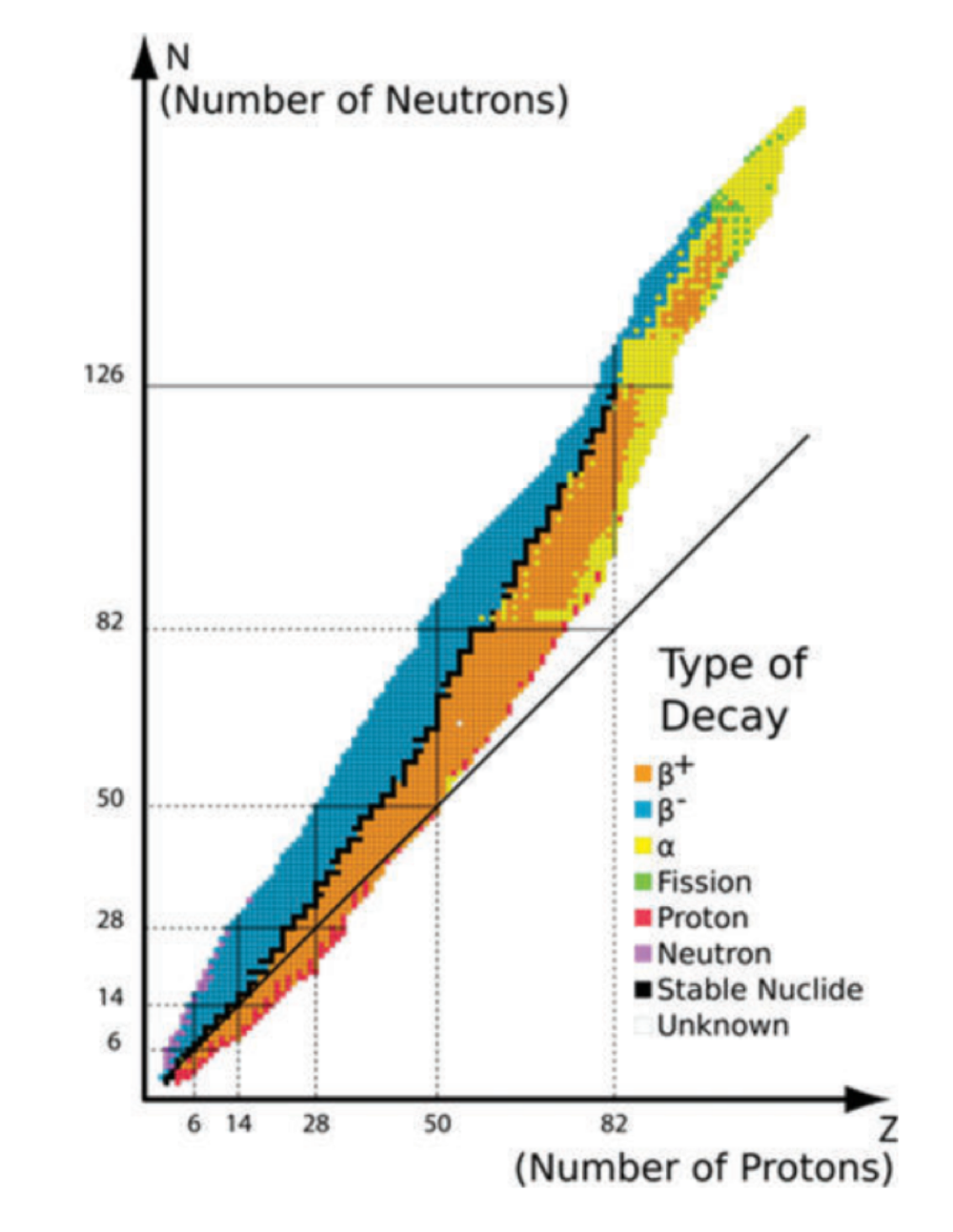
chart of isotopes: above blue vs below orange vs super high yellow
above blue = too many neutrons, undergo B-minus decay, neutrons ⟹ protons
below orange = too many protons, undergo B+ decay, protons ⟹ neutrons
super high yellow = very heavy nuclei, emit alpha-particle (He nucleus), reduce 2 protons and 2 neutrons
nuclei w Z> _____ is unstable
83 — has no stable form
amu
atomic mass unit, mass of a single atom
1amu = 1/12 of mass of carbon-12 atom
1amu = 1.66×10⁻²⁷ kg
1amu = 931.48MeV
mass of stable carbon atom = 12 amu
binding energy
amount of energy needed to pull all protons/neutrons apart OR the energy released when nucleus is formed
why is there a carbon mass deficient (show calculations)
carbon 12 (6 protons, 6 neutrons, 6 electrons) add all the mass together = 12.099006 amu
atomic mass is 12.00 amu
mass difference of 0.099006amu
energy difference = 0.099006 amu x 931.48 Mev (where 1amu = 931.48MeV)
BE = 92.22MeV
∴ need 92.22MeV to hold nucleus together//92.22 Mev to break nucleus into separate nucleons
what is the most stable element in terms of nuclear binding energy
iron 56 bc it has the higher binding energy/nucleon (around 8.8MeV/nucleon)

explain this graph of fission vs fusion
both fission and fusion move nuclei towards max stability of highest BE/nucleon
fission very heavy nuclei (Uranium, plutonium) with lower BE/nucleon than iron
will split heavy nucleus into small pieces and move towards peak (iron)
fusion release energy —> light nuclei (H, He) has low BE/nuclei
will fuse together ⟹ tighter/stable with higher BE/nucleon

nuclear fusion
low Z nuclei combine to form heavier nucleus
massive energy released
not spontaneous under normal conditions
nuclear fission
nucleus splits into 2+ small nucleus and massive energy released
spontaneous decay or simulated by neutrons
more stable isotopes are created with ↑ BE/nucleon
radioactivity
spontaneous emission of radiation from unstable atomic nucleus
radioactive decay
the release of energy particles as a way for an unstable nucleus to become stable
radioactive isotopes
occurs if nucleus is unstable (bc too many neutrons/protons/energy in nucleus
what determines decay mode
neutron-proton ratio
B-minus decay
occurs when nucleus has too many neutrons
Z ⟹ Z+1 + e- + antineutrino
e- = B-minus particle
B-minus vs B-plus decay: compare energy
B-minus
may not have maximum possible energy bc energy is shared with e- and antineutrinos
B-plus
ū higher max energy bc coulomb replusion btw positive charged particles and nucleus
B-minus vs B-plus decay: compare half life
B-minus
longer half-life
B-plus
shorter half-life
B-minus vs B-plus decay: compare where its produced
B-minus
produced in reactor
B-plus
produced in cyclotron
does B-minus/plus need a minimum energy threshold
only B-plus decay needs minimum energy threshold
need >1.022MeV to create positron
if <1.022MeV = will undergo electron capture
what happens if <1.022MeV when nucleus has too many protons
too many protons = beta-minus… but not enough energy to undergo that decay ⟹ ∴ will undergo electron capture
how to find average Energy
Eavg = Emax(1/3)
electron capture
when nucleus has too many protrons (similar to B-plus decay)
nucleus will capture its own inner-shell electron (ū K-shell or whatever is closer to nucleus)
protons (from nucleus) + electrons (from K-shell e) ⟹ neutron + neutrino
electron capture = cause vacancy
vacancy filled by electron in higher orbitals
energy released in either…
1) characteristic xray
energy difference between 2 shells is released as characteristic xray photon
2) auger electrons
no emission of xray, but energy diff between 2 shells is transferred directly to another outer-shell electron
and if that energy exceeds that electron’s BE ⟹ e- will be expelled from atom and emit as a auger electron
beta-plus decay
occurs when nucleus has too many protons
Z ⟹ Z-1 + e+ (positron) + neutrino + energy
alpha decay
occurs in very heavy nuclei (Z>82)
alpha-particle = AKA helium nucleus (2 p, 2 n)
Z ⟹ Z-2 + He + E
general eqn for electron capture
proton + electron ⟹ neutron + neutrino (Z-1)
when does alpha decay happen
very heavy nuclei (Z>82)
general eqn of alpha decay
Z ⟹ A-2/Z-2 + 4-2He + E
possibilities after electron capture
gamma decay
nucleus is excited
will emit gamma ray to lower back down to ground state
internal conversion
nucleus is excited and nucleus transfers excess energy to orbital (K-shell)
e- is ejected from atom (internal conversion electron)
E must be > BE of e-’s shell
ejected e- causes vacancy and its filled by characterisitc xray or auger electron
isometric transition
isometric transition: transition from excited/metastable state down to lower (excited atomic nucleus releases excess energy without changing its number of protons or neutrons)
eg. 99mTc ⟹ 99Tc
metastable nuclei
long lived excited nuclei
is radioactive decay random? what does it depend on
yes random
only able to predict proabbility of decay
depends on # of nuclei and time
activity + units
decays per second
Becqureals (Bq)
or Ci (1Ci = 3.7×10¹⁰Bq)
formulas for activity
A = λN

specific activity + formula
activity per unit mass — how concentrated radioactivte isotope is

half life + formula
amt of time which acitivity of isotope reaches half of initial activity

mean life + formula
avg of all individual lifetimes of nucleus in sample

secular equilibrum vs transiten equilibrium
secular equil =
daughter isotope activty = parents isotope activity (parents half life is longer> than daughters halflife)
anal. when mom ages slow and daughter ages faster and catches up… secular equil = when mom age = daughter age
transitent equil =
parents halflife > daughters half life (more similar half life difference compared to secular)
daughter grows and falls
eg. 99Mo and 99mTc (milking cow)

temporary implants vs permanent implants… compare:
permancy
halflife
energy of photons
treatment speed
fractionations

LDR brachy
dose
speed
half life
emit photons?
permanancy?
examples
low dose rate: < 2Gy/h
shorter half life (bc in body for life)
ū permanant implant
emit low energy photons
eg. I-125, Pd-103
formula for total dose (permanent implant)

is LDR or HDR used in prostate brachy
LDR
HDR brachy
dose
half life
fractionation?
permanency?
examples
high dose rate: >12 Gy/h
dose delivered quickly
longer half life
treatment ū fractionated
temporary implant ū
eg. Ir-192
medium dose rate dose?
2-12Gy/hr
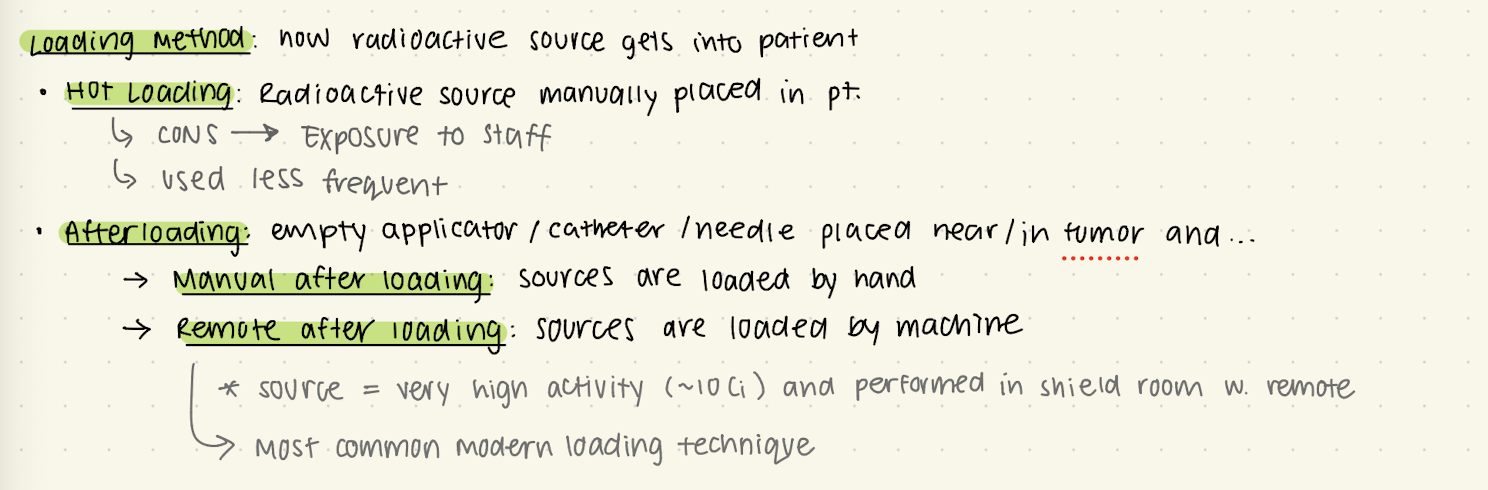
historical brachy sources isotopes used
Cs-137
Ra-226
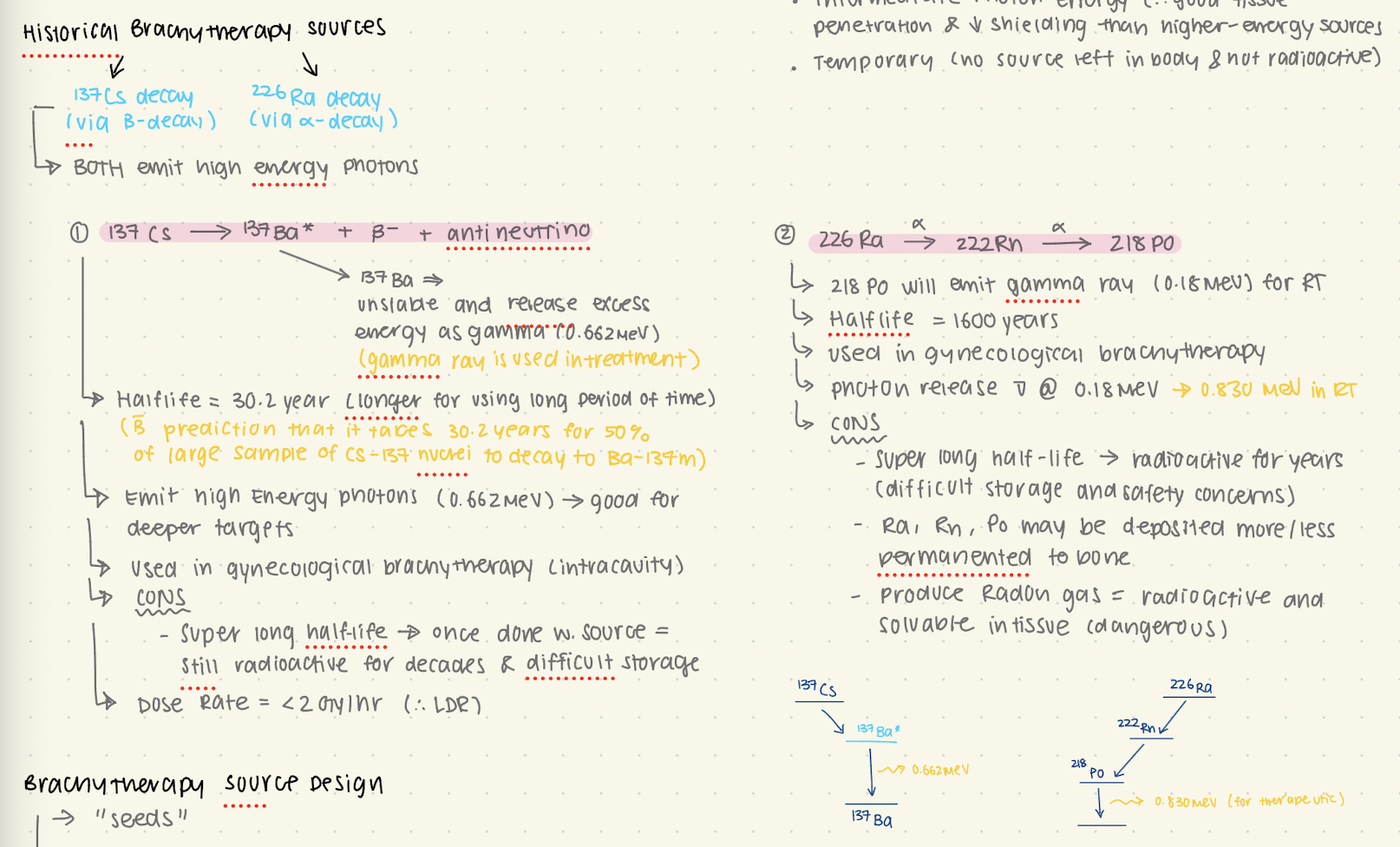
hot loading vs afterloading methods
hotloading: The clinician manually places the already-radioactive material directly into the body site.
afterloading = empty applicator/catherer/needle loaded into body first…
manual = then radioactive source loaded by hand
remote = then radioactive source loaded by machine
what is… coated/encapsulated with
I-125 amersham model 6711 seed
Pd-103 model 200 seed
I-192 nucletron inc
I-125 amersham model 6711 seed
coated in silver rod // encapsulated in titanium (absorb b-minus)
Pd-103 model 200 seed
coated w graphite // encapsulated in titanium
I-192 nucletron inc
encap in stainless steel
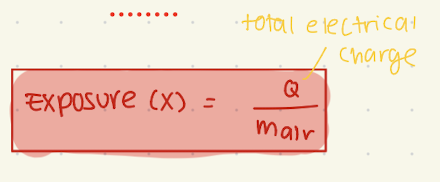
exposure + units + special unit
total electrical charge (Q) produced by photon ionizng a specific mass of air
SI unit = C/kg
special unit = R (1R = 2.58 × 10⁻⁴ C/kg)

eqn for exposure
X = Q/mair
exposure rate + unit + special unit + formula
change in exposure per unit time
SI unit: C/kg s
special unit: R/h

exposure rate from point source formula

rls btw exposure dose and distance to radiation source
inverse fallout rate
↑ distance to radiation source (farther) = ↓ exposure dose
dose
avg ionizing radiaiton energy absorbed per unit mass by biological tissue
KERMA vs air KERMA
kinetic energy released per unit mass
kerma by photons interacting in mass of air
air kerma eqn

air kerma strength eqn

what does radial dose function account for
g(r)
accounts for scatter and attenutation of photon (fast for low energy// slow for high energy)
what does dose rate constant account for
inverse sq fallout
what does anisotropy function account for
photons absorbed by shielfing capsule of source
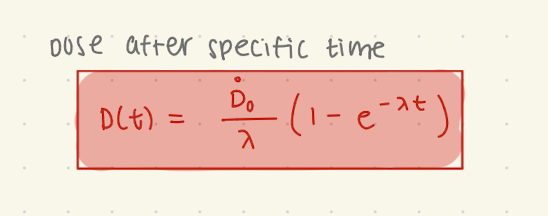
formula for dose after specific time