Macromolecules

0.0(0)
Studied by 0 people
call kaiCall Kai
learnLearn
examPractice Test
spaced repetitionSpaced Repetition
heart puzzleMatch
flashcardsFlashcards
GameKnowt Play
Card Sorting

1/126

encourage image

There's no tags or description

Looks like no tags are added yet.

127 Terms

1
New cards

what are monosaccarides

simplest form of carbs

2
New cards

the positioning of what structural component of a monosaccaride differentiates ketones and aldoses

the carbonyl group

3
New cards
<p>what is C=O</p>

what is C=O

carbonyl group

4
New cards

whats an asymmetric carbon

carbon bonded to 4 different elements


5
New cards

where is the carbonyl group in aldoses

at end of carbon skeleton

6
New cards

where is the carbonyl group in ketones

within the carbon skeleton

7
New cards

examples of aldoses

glyceraldehyde, ribose, glucose, galactose

8
New cards

examples of ketoses

dihydroxyacetone, ribulose, fructose

9
New cards

what is starch

to store excess glucose produced during photosynthesis

10
New cards

where is starch

within plastids, as granules

11
New cards

examples of starch

potato tubers, grains, rice, wheat, corn

12
New cards

where is glycogen stored

liver and muscles

13
New cards

how does amylose and amylopectin differ

amylose has alpha glucoses with 1-4 bondages

amylopectin has alpha glucoses with 1-4 bondages with a 1-6 bond at branches

14
New cards

what is cellulose used for

providing strength to the plant cell wall

15
New cards

what holds microfibrils of β glucoses together in cellulose

hydrogen bonds

16
New cards

example of microfibrils of cellulose contructured material

cotton

17
New cards

what is the most abundant chemical compound

cellulose

18
New cards

what does “cellulose is an insoluble fiber” mean

most animals do not digest it because our enzymes are mostly built for hydrolyzing alpha glucose bonds not beta glucoses

when it passes through the digestive system, it abrades the lining, stimulating mucus production (good effect)

19
New cards

what is chitin for

building the exoskeleton in anthropods

20
New cards

what chemical allows chitin to harden in crabs

calcium carbonate

21
New cards

what is the cell wall made of in fungi vs plants

chitin for fungi, cellulose for plants

22
New cards

are lipids polar or non polar

non polar

23
New cards

what are triacylglycerols made of

one glycerol, three glycerides

<p>one glycerol, three glycerides</p>
24
New cards

what is an ester bond

bond between carbonyl group and hydroxyl group

25
New cards

difference between carbonyl group and carboxyl group

carboxyl = one of the R groups in carbonyl is OH

<p>carboxyl = one of the R groups in carbonyl is OH</p>
26
New cards

which has more H, saturated or unsaturated fats?

saturated

<p>saturated</p>
27
New cards

why are polysaccarides a better form of storage for plants compared to animals

polysaccarides require bulkier storage (starch), and plants don’t move
animals move so they perfer storing energy in fats

28
New cards

what is adipose tissue

contains fat storing cells: adipocytes

shrinks to store more fat

29
New cards

how are phospholipids differentiated

the phosphate group can bond to different compounds, like choline

<p>the phosphate group can bond to different compounds, like choline</p>
30
New cards

whats the difference between a fatty acid and a phospholipid

the 3rd hydroxyl group of the glycerol is bonded to a phosphate group

31
New cards

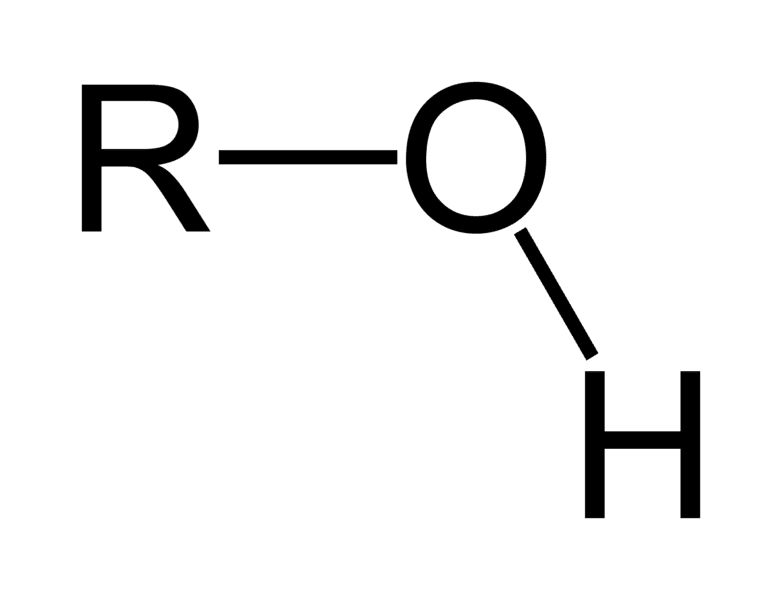
hydroxyl group

O-H

<p>O-H</p>
32
New cards

what is a steroid

organic compound with 4 fused rings

Cholesterol & Steroids | Premier MCAT Prep


33
New cards

where do steroids come from

diet or liver

34
New cards

what does cholesterol do

core building block for cells, hormones, and vitamins
ex: builds and maintains the outer structure and fluidity of every cell
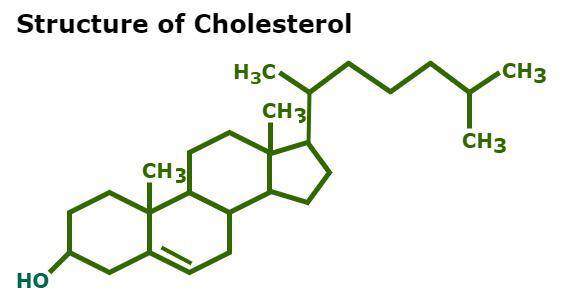
<p>core building block for cells, hormones, and vitamins<br>ex: builds and maintains the outer structure and fluidity of every cell</p>
35
New cards

what do enzymes do

catalysts, not consumed

36
New cards

describe amino acid structure

knowt flashcard image
37
New cards

what is the amine group end of a polypeptide called

N-terminus

38
New cards

what is the carboxyl group end of a polypeptide called

C-terminus

39
New cards

name all 9 essential amino acids

Histidine, isoleucine, leucine, lysine, methionine, phenylalanine, threonine, tryptophan, valine

40
New cards

name all 11 non essential amino acids

Alanine, asparagine, aspartic acid, glutamic acid, serine, arginine, cysteine, glutamine, glycine, proline, tyrosine

41
New cards

which amino acids have non polar side chains and are hydrophobic

Glycine, alanine, valine, leucine, isoleucine, methionine, phenylalanine, tryptophan, and proline

<p>Glycine, alanine, valine, leucine, isoleucine, methionine, phenylalanine, tryptophan, and proline</p>
42
New cards

which amino acids have polar side chains and are hydrophilic

Serine, threonine, cysteine, asparagine, glutamine, and tyrosine

<p>Serine, threonine, cysteine, asparagine, glutamine, and tyrosine</p>
43
New cards

which amino acids have negatively charged side chains and are hydrophilic

Aspartic acid (aspartate) and glutamic acid (glutamate)

<p>Aspartic acid (aspartate) and glutamic acid (glutamate)</p>
44
New cards

which amino acids have positively charged side chains and are hydrophilic

Lysine, arginine, and histidine
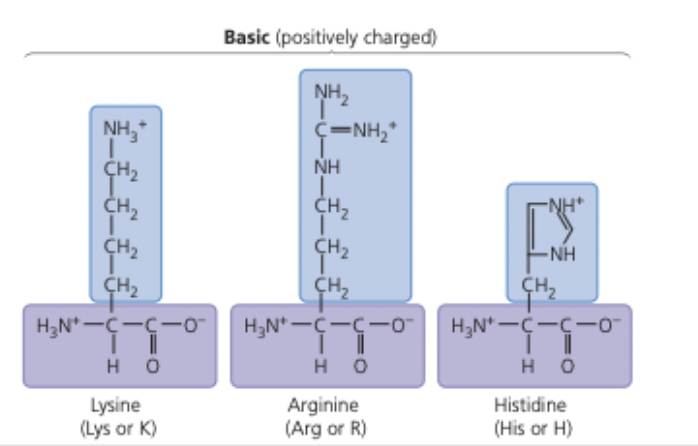
<p>Lysine, arginine, and histidine</p>
45
New cards
How are macromolecules constructed?
By linking organic monomers (subunits) into polymers; macromolecules make up the vast majority of a cell's dry mass
46
New cards
Name the monomer → polymer pairs for the three main macromolecule classes
Sugars → polysaccharides; amino acids → proteins (polypeptides); nucleotides → nucleic acids (DNA and RNA)
47
New cards
Which reaction joins monomers into a polymer, and which breaks the polymer apart?
Condensation (dehydration) reaction joins them and releases H2O; hydrolysis breaks them by adding H2O
48
New cards
What determines the unique function of a protein, RNA, or DNA polymer?
The specific sequence of its subunits (which in turn determines how it folds)
49
New cards
Why are polymer chains flexible?
Most single covalent bonds between subunits allow the atoms to rotate, so the chain can twist into an unlimited number of shapes
50
New cards
What is a conformation?
One specific three-dimensional shape that a polymer chain adopts
51
New cards
What makes a polymer chain adopt one particular conformation?
Weak noncovalent bonds between different regions of the chain constrain its free movement
52
New cards
Name the four weak noncovalent bonds/forces that help fold macromolecules
Hydrogen bonds, electrostatic attractions, van der Waals attractions, and the hydrophobic force
53
New cards
Why do weak noncovalent bonds still give macromolecules specific binding?
Each is individually weak (thermal energy can break it), but many acting together give strong, highly specific binding between macromolecules or to selected small molecules
54
New cards
What fraction of a cell's dry mass is protein?
About half
55
New cards
Give an example of a protein that works as an enzyme
Ribulose bisphosphate carboxylase (Rubisco)
56
New cards
Why are proteins the most diverse and versatile macromolecules?
They are built from 20 types of amino acids and can have thousands of functions (e.g. enzymes)
57
New cards
Are lipids true polymers of a repeating monomer like polysaccharides, proteins, and nucleic acids?
No. Lipids are not built as long polymers of one repeating monomer, so they are usually not counted among the three macromolecule polymer classes
58
New cards
What is the general formula for a monosaccharide, and an example?
(CH2O)n; for example glucose is C6H12O6
59
New cards
How many carbons do trioses, pentoses, and hexoses have?
3, 5, and 6 respectively
60
New cards
Give a triose, pentose, and hexose for aldoses and ketoses
Aldoses: glyceraldehyde (triose), ribose (pentose), glucose/galactose (hexoses); Ketoses: dihydroxyacetone (triose), ribulose (pentose), fructose (hexose)
61
New cards
What is the relationship between D-glucose and L-glucose?
They are mirror-image isomers (enantiomers); D-glucose is the natural and abundant form
62
New cards
What bond links monosaccharides into oligosaccharides and polysaccharides?
Glycosidic bond, formed by a condensation reaction
63
New cards
What is the difference between an oligosaccharide and a polysaccharide?
An oligosaccharide is a short chain of sugars; a polysaccharide is a long chain
64
New cards
Which linkage is found in starch and glycogen versus cellulose?
Starch and glycogen: alpha-glucose (1-4 with 1-6 branches); cellulose: beta-glucose (1-4)
65
New cards
How does glycogen compare structurally with amylopectin?
Both are alpha-glucose polymers with 1-4 chains and 1-6 branches, but glycogen is more extensively branched
66
New cards
What is chitin a polymer of?
A linear polymer of the sugar derivative N-acetylglucosamine
67
New cards
What is the main energy role of sugars in the cell?
Sugars are a primary source of chemical energy and can be joined into oligosaccharides or polysaccharides
68
New cards
What is the essential function of fatty acids in cells?
To form lipid molecules that assemble into sheet-like cell membranes (they are also a richer energy source than sugars)
69
New cards
Describe the structure of a fatty acid
A carboxyl group head attached to a long hydrocarbon tail
70
New cards
Give an example of a saturated and an unsaturated fatty acid
Saturated: palmitic acid (hydrocarbon tail is saturated); Unsaturated: oleic acid
71
New cards
Compare the energy in fat and carbohydrate per gram
Fat stores roughly twice the energy per gram of carbohydrate (about 9 vs 4 kcal per g)
72
New cards
Why do unsaturated fatty acids stay liquid at room temperature?
Cis double bonds put kinks in the hydrocarbon tails so they cannot pack tightly
73
New cards
What bonds join the fatty acids to glycerol in a triacylglycerol?
Ester bonds between the glycerol hydroxyls and the fatty acid carboxyl groups
74
New cards
What does amphipathic mean for a phospholipid?
It has a hydrophilic head (phosphate group) and hydrophobic fatty acid tails, so in water it self-assembles into a lipid bilayer
75
New cards
How many fatty acids does a phospholipid have?
Two fatty acids plus a phosphate group attached to glycerol
76
New cards
Describe the general structure of an amino acid
A central (alpha) carbon bonded to an amino group (NH2), a carboxyl group (COOH), a hydrogen atom, and a variable side chain (R group)
77
New cards
How many types of amino acids are used to build proteins?
20
78
New cards
What is a peptide bond and how is it formed?
A covalent bond between the carboxyl carbon of one amino acid and the amino nitrogen of the next, formed by a condensation reaction that releases water
79
New cards
Which end of a polypeptide is synthesized first?
The N-terminus (amino end); the chain grows toward the C-terminus
80
New cards
Which amino acid forms covalent disulfide bonds?
Cysteine (S-S bonds between side chains)
81
New cards
Which amino acid has no D and L forms and why?
Glycine; its side chain is H so its alpha carbon is not asymmetric
82
New cards
Which optical isomer of amino acids is found in proteins, and where is a D form used?
L forms are in proteins; D-serine is used in the brain
83
New cards
Where do nonpolar amino acid side chains tend to end up in a folded protein in water?
Clustered in the interior, driven by the hydrophobic force
84
New cards
What are nucleic acids built from?
Long chains of nucleotides joined by phosphodiester bonds
85
New cards
What is a nucleotide made of?
A nitrogenous base + a five-carbon sugar + a phosphate group
86
New cards
What is a nucleoside?
A nitrogenous base + a five-carbon sugar (no phosphate)
87
New cards
Name the nitrogenous bases in DNA and RNA
DNA: adenine, guanine, cytosine, thymine; RNA: adenine, guanine, cytosine, uracil
88
New cards
Name the nucleosides
Adenosine, guanosine, cytidine, deoxythymidine, uridine
89
New cards
Which bases are pyrimidines and what is their structure?
Cytosine, thymine, uracil; a single six-membered ring
90
New cards
Which bases are purines and what is their structure?
Adenine and guanine; a five-membered ring fused to a six-membered ring
91
New cards
Are adenosine and adenine the same thing?
No. Adenine is the purine base; adenosine is the nucleoside (adenine + ribose)
92
New cards
What bond links nucleotides in a nucleic acid?
A phosphodiester bond between the phosphate attached to the sugar of one nucleotide and the hydroxyl group on the sugar of the next nucleotide
93
New cards
What are the sugars in DNA and RNA?
DNA: deoxyribose; RNA: ribose
94
New cards
What is the role of DNA?
Long-term repository of hereditary information
95
New cards
Why is DNA suited for long-term storage?
It is a more stable hydrogen-bonded double helix (and its sugar lacks the 2' hydroxyl of ribose)
96
New cards
What is the role of RNA?
Transient carrier of molecular instructions
97
New cards
What is the structure of ATP?
Adenine + ribose + three phosphates
98
New cards
What bonds link the three phosphates of ATP and what happens when they break?
Phosphoanhydride bonds; breaking them releases free energy
99
New cards
Which bases pair in DNA and how many hydrogen bonds link each pair?
A-T with 2 hydrogen bonds; G-C with 3 hydrogen bonds
100
New cards
Which of the following is NOT a ketose? A. Dihydroxyacetone B. Ribulose C. Fructose D. Galactose
D. Galactose is an aldose; its carbonyl group is at the end of the carbon skeleton