Non-ideal solutions
 Call Kai
 Learn
 Practice Test
 Spaced Repetition
 Match
 Flashcards
 Knowt Play
1/24

There's no tags or description
Looks like no tags are added yet.
25 Terms
how do non-ideal solutions compare to ideal solutions
Px doesn't = Nx x Px°, μx doesn’t = μx° + RTln[x], dH mix doesn’t = 0
non ideal solutions in molecular terms
molecules in solution don’t interact with each other identically, behaviour of a given molecule depends on the composition of the solution
distribution of molecules in ideal solutions
arrangement of molecules is non-random as molecules don’t interact identically, direct consequence of the differing interactions between different types of molecules
why is the arrangement of non-ideal solutions non random
two molecules that attract each other will be located closer together than predicted by a random distribution
equation for activity coefficient
effective coefficient (ax) / actual concentration [x]
chemist potential equation that is correct for all solutions
μx = μx° + RTln(activity coefficient[x])
what does activity coefficient convert and why is it useful
converts real concentration into effective concentration, has physical significance as it can be used as a measure of how much a solution deviated from ideality
what does it mean if activity coefficient = 1
solution behaves ideally
what does it mean if activity coefficient < 1
x is more stable than predicted by the ideal model
what does it mean if activity coefficient > 1
x is less stable than predicted by the ideal model
what is effective concentration
concentration predicted by the ideal model to gave the same chemical potential as the actual solution
what happens for a non-ideal solution when Px > value predicted by Raoult’s law
dH mix > 0, heat is absorbed upon mixing, endothermic, total volume is greater than sum of volume of components
what happens for non-ideal solution when Px < value predicted by Raoult’s law
dH mix < 0, heat is evolved upon mixing, endothermic, total volume is less than sum of volume of components
why are ionic solutions non-ideal solutions
water is strongly hydrogen bonded, O is far more electronegative than H so there is a strong attraction between solvent-solvent molecules, add ions that disrupt water-water interactions
dilute ionic solutions, effect on enthalpy
ion-water electrostatic interactions more than compensate for the loss of water-water hydrogen bonds, so the enthalpy change of transferring an ions from gas phase to solution is negative
dilute ionic solutions, effect on entropy
water around ions are losing microstates as they can’t arrange as freely round the ion as they could in bulk water, entropy of the solution decreases when ions are added to water
what happens to ions in concentrated ionic solutions
concentration of ions in fixed solution increases, average distance between ions decreases, ion-ion electrostatic interactions become significant, like charges will repel as opposite charges attract, distribution of ions isn’t random, ions will be surrounded by others of opposite charge, each ion is stabilised relative to the hydrated ion, chemical potential is lower than that predicted by the ideal model, so y < 1, as concentration of ions increases, y becomes smaller
what is the Debye-huckel theory
why electrolyte solutions + plasmas deviate from ideal behaviour
equation for ionic strength
I = ½ x sum of (cx*zx²), c = concentration of ion x, z = charge
Debye-huckel equation that describes how the presence of ions in a solution affects their behaviour (activity)
log10 (activity coefficient of the ions) = -A|zxzy|I^1/2
what is salting in effect
at low salt concentrations protein solubility is increased
what is salting out effect
at high salt concentrations protein solubility is decreased

protein solubility in ionic solutions (at low salt concentrations, yellow area)
ions transiently interact water with polar and charged groups on the protein (no competition between both processes)

protein solubility in ionic solutions (at high salt concentrations, red area)
ions co-ordinate water around them at the expense of ion protein interactions, essentially removing water from the protein , leading to participation
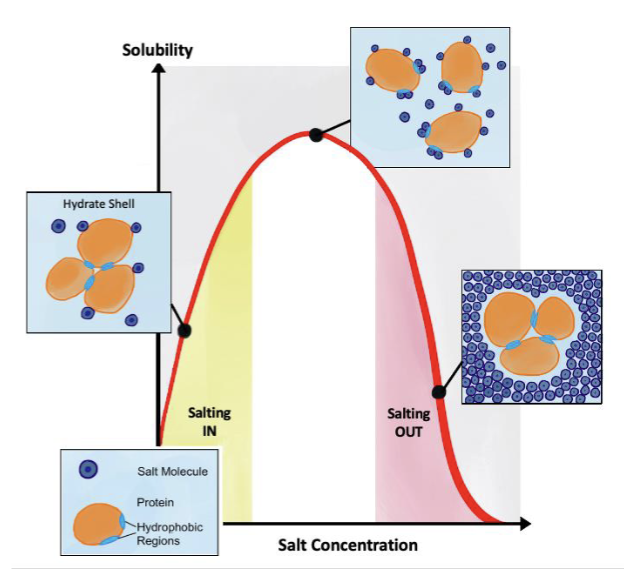
explain in terms of entropy
folded state of proteins is stabilised by increase in water entropy as compared to the unfolded state, but in presence of high ion concentrations the ions induce a significant loss of microstates of the water, entropic gain of water upon folding is diminished, consequence = unfolded state of the protein is more favourable