(9) Skeletal Muscle Physiology: Excitation Contraction Coupling
 Call Kai
 Learn
Learn Practice Test
 Spaced Repetition
 Match
Match Flashcards
 Knowt Play
1/55

There's no tags or description
Looks like no tags are added yet.
Name | Mastery | Learn | Test | Matching | Spaced | Call with Kai | Chat |
|---|
No analytics yet
Send a link to your students to track their progress
56 Terms
Step 1 of Excitation-Contraction Coupling
Motor neurons secrete ACh

Step 2 of Excitation-Contraction Coupling
The ACh receptors are non specific cation channels. The effect of Na influx is greater than K

End Plate Potential
Depolarization resulting from ACh receptors opening (excitatory), resulting in AP
What does depolarization trigger?
Depolarization triggers a muscle action potential that travels across cell membrane
Step 3 of Excitation-Contraction Coupling
The AP travels down T-tubules and alters the shape of DHP receptors

Step 4 of Excitation-Contraction Coupling
The shape change of DHP receptors physically opens the gate of ryanodine receptors (RyR)
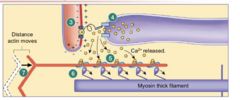
What are ryanodine receptors
Gated ion channels on the SR and open when Ca2+ moves from SR into ICF
Step 5 of Excitation-Contraction Coupling
Ca2+ binds to troponin in the sarcomeres, moving tropomyosin and allowing crossbridges to form

Step 6 of Excitation-Contraction Coupling
Contractile cycling occurs

Step 7 of Excitation-Contraction Coupling
Actin slides toward the M-line, shortening the sarcomere

Step 8 - Relaxation
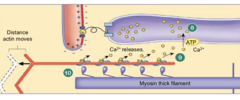
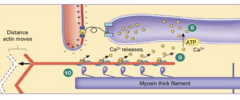
Ca2+ - ATPase pumps move Ca2+ back into the SR; they are always active

Step 9 - Relaxation
As free Ca2+ in the ICF decreases, Ca2+ unbinds from troponin
Step 10 - Relaxation
Contraction cycling stops as tropomyosin covers myosin binding sites of actin
Twitch
Muscle contraction and relaxation resulting from one AP
Latent Period
Delay between AP and start of contraction (because Ca2+ movement)
What are the three pathways that supply additional ATP to muscles
Phosphocreatine, Oxidative phosphorylation, and glycolysis
Phosphocreatine
Molecule that stores energy through a Pi
What is the first source of ATP at the onset of contractile activity
Phosphocreatine
There is ______ times more ATP stored in _______ than in free ICF
Five, phosphocreatine
Creatine Kinase
Enzyme that catalyzes reversible reaction
What provides ATP for prolonged periods? (Light-medium exercise)
Oxidative phosphorylation
Myoglobin
Stores small amounts of O2 and increases O2 transfer rate from blood to muscle fibers
Oxidative Phosphorylation produces ______ amounts of ATP, but is _______ and requires O2
Large, slow
What occurs during high intensity exercise? (Low O2 delivery or ox. phos. cannot keep up with ATP need)
Glycolysis
Glycolysis produces ATP _______ but _________
Quickly, inefficiently
Glycogen
Limited quantities of glucose stored in cells as glycogen ; quickly depleted
Lactate
Produced when pyruvate cannot enter oxidative phosphorylation
Muscle Fatigue
Reversible state where exercising muscle can no longer respond to stimulation with the same contractile activity
Central Fatigue
The feeling of fatigue, protective mechanism to prevent damage from overexertion
Peripheral Fatigue
A failure of the processes in the nerve or muscle tissue of contraction
Hypothesized source for peripheral fatigue (Nervous)
Cannot process ACh enough to keep up with stimulation. Usually a diseased state and not a cause of fatigue
What are 3 muscular hypothesized sources for peripheral fatigue?
- Too much Pi in the ICF prevents Pi release from myosin
- Ca2+ decrease because it binds to phosphates
- K+ imbalance in ECF because of T-tubules
What type of myosin isoform do Slow Twitch Fibers (Type I) have?
Type 1 myosin isoform, relatively slow
How do Slow Twitch Fibers generate ATP?
They rely on oxidative phosphorylation to generate ATP
What amount of capillaries, mitochondria, and myoglobin do slow twitch fibers have?
High amounts of capillaries, mitochondria, and myoglobin
What is the diameter of Slow Twitch Fibers compared to other fiber types?
Fibers have a smaller diameter
What is the fatigue resistance of Slow Twitch Fibers?
They are resistant to fatigue
In which type of muscles are Slow Twitch Fibers primarily found?
They are found in muscles used for posture
How quickly do Slow Twitch Fibers develop force?
Force develops slowly and the twitch is longer
What type of myosin isoforms do Fast Twitch oxidative glycolytic (FOG, Type IIA) fibers have?
Type II myosin isoforms
What is the Ca2+ - ATPase activity level in Fast Twitch oxidative glycolytic (FOG, Type IIA) fibers?
Higher than in other fiber types
What metabolic pathway do Fast Twitch oxidative glycolytic (FOG, Type IIA) fibers primarily use?
Glycolysis
Can Fast Twitch oxidative glycolytic (FOG, Type IIA) fibers be trained to rely more on oxidative phosphorylation?
Yes
What amount of capillaries, mitochondria, and myoglobin do Fast Twitch oxidative glycolytic (FOG, Type IIA) fibers have?
Moderate
How does the diameter of Fast Twitch oxidative glycolytic (FOG, Type IIA) fibers compare to other types?
Medium diameter
What is the fatigue resistance level of Fast Twitch oxidative glycolytic (FOG, Type IIA) fibers?
Resistant to fatigue
In what type of activities are Fast Twitch oxidative glycolytic (FOG, Type IIA) fibers primarily found?
Walking and other moderate exercise
How quickly do Fast Twitch oxidative glycolytic (FOG, Type IIA) fibers develop force?
Quickly
What is the twitch duration of Fast Twitch oxidative glycolytic (FOG, Type IIA) fibers?
Short
What type of myosin isoform is found in Fast Twitch glycolytic (FG, Type IIX) fibers?
Type II myosin isoform
What metabolic process do Fast Twitch glycolytic (FG, Type IIX) fibers rely on to generate ATP?
Glycolysis
What amount of capillaries, mitochondria, and myoglobin do Fast Twitch glycolytic (FG, Type IIX) fibers have?
Very few
How does the diameter of Fast Twitch glycolytic (FG, Type IIX) fibers compare to other cell types?
They have a larger diameter.
How quickly do Fast Twitch glycolytic (FG, Type IIX) fibers develop force?
Force develops quickly.
Are Fast Twitch glycolytic (FG, Type IIX) fibers easily fatigued?
Yes, they are easily fatigued.
What types of movements are Fast Twitch glycolytic (FG, Type IIX) fibers used for?
Short powerful movements (like jumping) or fine movements.