Week 11: Food Quality; Biofortification
 Call Kai
 Learn
 Practice Test
 Spaced Repetition
 Match
 Flashcards
 Knowt Play
1/59

There's no tags or description
Looks like no tags are added yet.
60 Terms
What are methods we can use to measure micronutrient deficiency
hard, lots of issues in all & thus, lot of crtitque
dietary intake (comparing what they eat vs reccomended diet)
biochemical status (blood testing)
functional/clinical outcomes (As many deficiencies are associated with disease)
Describe why measuring dietary intake allows measurement of micronutrient deficiency & note limitations
can compare what individual is eating vs reccomended intake
limitations:
people may not accurately recall what they ate (subjective)
bioavailability is also a factor that affects micronutrient intake (Efficiency it absorbs into the gut)
intensive to conduct as need to recruit lots of participants & survey etc.
fails to consider demographical differences (different health burden, age, etc. may mean different reccomended intake)
Describe why measuring biochemical status allows measurement of micronutrient deficiency & note limitation
blood testing to measure (e.g. ferratin - Fe or serum retinol - vitamin A)
more objective
limitations:
can be confounded by various states
e.g. when sick ferratin levels spike, similar with serum retinol
Describe why observing functional/clinical outcomes allows measurement of micronutrient deficiency & note limitation
many micronutrient deficiencies are assoicated with diseases - observing incidence can alert to various deficiencies
limitations
counfounded by other causes of disease
List what these functional/clinical outcomes are due to:
anaemia
night blindness
goitres
neural tube defects
Wernicke-Korsakoff syndrome
Anaemia - low RBC count; associated with iron deficiency
Night blindness - vitamin A deficiency
Goitres - inflammation of thyroid - iodine deficiency
Often associated with increased consumption of pink himalyan salt (is not fortified with iodine unlike regular salt)
Folic acid (especially important for pregant mothers for developing infant) -> neural tube defects (NTD)
Thiamine (vitamine B1) -> Wrnicke-Korsakoff syndrome (fatal neurological disorder)
What is the best method to measure micronutrient deficiency?
Thus, there is no single best method
biochemical status tends to be the most objective but also can be confounded
need to carefully word statements to not overstate what our measurement tell us (e.g. insufficient consumption vs deficieny = dietary intake can only inform us of the former!)
Is micronutrient deficiency prevelant across the world? What is a study that illustrated this
Consumption of 24hrs
Observed distribution acorss population and modelled/projected this onto other countries
Estimated that 68% of global population have dietary iodine inadequacy, 48% Vitamine A, 46% Zinc
What are measures to combat micronutrient deficiency
supplementation (if deficient)
food fortification (food manufacturers and farmers incorporate into food - add)
biofortification (plant is fortified thus food is too)
What are limitations of supllementation & when is it applicable
Take if reccomeneded (actually deficient)
Feasbility is heavily dependent on consumer (behaviour)
Economic status (Affordability)
Acess to supplements (rural communities may not have)
Need to consistently take - requires a behavioural change by the consumer (problematic)
What are limitations/benefits of food fortification & what is it
Food manufacturers and farmers incorporate micronutrients into food already consumed by people (e.g. wheat, rice, bread)
Works well as there are foods the vast majority consume
No change required by consumer; change is required by food manufacturers or bakers (problematic)
Describe food fortification in australia & methods (not highly important card)
Fortification of certain micronutrients is mandated:
Thiamine fortficiation in 1991 into wheat flour
Later, in 2009 iodine and folic acid
This enabled a 40% reduction in Wernickes-Korkakoff syndrome (thiamine)
14% national reduction in neural tube defects (folic acid); 74% in Aboriginal and Torres Strait Islander
Higher in Indigenous Australians as originally had higher deficiency incidence
Often micronutrient deficiencies disproportionately affect vulnerable communities
Iodine - reduced 60% -> 9% in women of 'child-bearing age'
Common methods:
Ferrous iron - blue powder appearance - common fortficant
Has a strong flavour + colour; not consumer appealing as alter flavour and texture
Iodine -> bread simply through iodised salt (instead of salt without iodine)
What is biofortification & what are the methods
Fortification of certain micronutrients is mandated:
Thiamine fortficiation in 1991 into wheat flour
Later, in 2009 iodine and folic acid
This enabled a 40% reduction in Wernickes-Korkakoff syndrome (thiamine)
14% national reduction in neural tube defects (folic acid); 74% in Aboriginal and Torres Strait Islander
Higher in Indigenous Australians as originally had higher deficiency incidence
Often micronutrient deficiencies disproportionately affect vulnerable communities
Iodine - reduced 60% -> 9% in women of 'child-bearing age'
Common methods:
Ferrous iron - blue powder appearance - common fortficant
Has a strong flavour + colour; not consumer appealing as alter flavour and texture
Iodine -> bread simply through iodised salt (instead of salt without iodine)
Why do biofortification & food fortification offer far reach across populations?
Can deliver to vast majority as people generally consume the same food:
Rice - 16.5-20% of global calories; wheat - 15-19%; maize - 5% (more if consider animal feed (that we then eat))
Thus rice + wheat + maize = 50% global calories
Targetting these crops is highly effective
Compare impact across various measures to combat micronutrient deficiency
$80 million dollars across each provides,
Supplementation: vitamin A - 80 million women and children (1/5 population) in south asia - for 2 years (50 cents for 2 pills each effective for 6 months)
Forfication: iron for 33% south asian population for 2 years (10 cents per person/ year)
Biofortification (genetic): develop 6 nutrient dense crops
More economically effective/ viable
Describe prevelance of vitamin A deficiency
400 million people at risk
Particularly in Asia and Africa; phillipines is severely affected
What is the other name for vitamin A
retinol
From what nutrient is vitamin A obtained
Beta-carotene
What is required for beta-carotene bioavailability in the gut?
Beta-carotene is highly hydrophobic thus needs to be consumed with fat/micelles for absorption
What cells absorb and metabolise beta-carotene & into what
enterocytes of small intestinal villi; convert into retinyl esters
What is a really good source of vitamine A & why
rich source of vitamin A is cod liver oil (already fatty and liver rich in vitamin A - retinyl ester form)
Describe the metabolic pathway of beta-caroten conversion into final useage sites
in enterocytes:
beta-caroten converted by BCO1 into 2x retinal
retinal converted by retinal reductase into retinol
LRAT enzyme converts retinol into retinyl esters
retinyl esters enter lymph/blood and reach the liver
at the liver they are stored (80-90%) and when required converted back into retinol via hydrolases
retinol reenters the blood stream and reaches usage sites
in photoreceptors:
via enzyme RDH5/ RPE655 (remember first & sight second)
retinol converted into 11-cis-retinal
this is combined with opsin, to form rhodopsin
in other cells
via enzyme RDH10
retinol converted into retinal
then retinal → retinoic acid → RAR/RXR
What is the function of rhodopsin in photoreceptors?
Conformational shape change triggers electrical signal -> brain for sight
What is the function of retinoic esters in cells?
combined with proteins to transcribe genes important for retinol homeostasis
What are roles of vitamin A and what does deficiency cause?
Roles of vitamin A:
Vision
Gene transcription
Immune function
Embryonic development
Bone metabolism
Haematopoiesis
Skin health
Antioxidant activity
Vitamin A deficiency causes:
Increased heart disease risk
Vulnerability to infection
Higher risk of measles and diarrhoea
Night blindness & blindness
Implicated in 350,000 children going blind per year
Implicated in 670,000 child deaths (under 5 yrs old) per year
Why is rice a good target for vitamin A fortification?
Countries affected by VAD also have high rice consumption; thus, rice crop is a good target
Describe beta-carotene synthesis pathway in plants (only molecules)
GGPP → Phytoene → zeta-carotene → lycopene → beta-carotene
grace pissed zack lost babe
Name enzymes required for each step in beta-carotene synthesis in plants
PSY: converts GGPP → Phytoene
PDS + Z-ISO: converts phytoene → zeta-carotene
ZDS + CRTISO: converts zeta-carotene → lycopene
LYCB: converts lycogene → beta-carotene

Why can rice not produce much beta-carotene for us?
While rice plants have all genes necessary for enzymes, these are silenced in the endosperm/ rice grain (the part we consume); they are only expressed in vegeative tissue (As needed for photosynthesis)
Thus, needed to activate enzyme expression in endosperm

What are the 3 genes added into golden rice 1 (GR1) & explain why & where from
Gt1::NpPSY
Explaining gene name:
Part before :: is the promoter; part after :: is the gene
Gt1 promoter expressed specifically in the rice endosperm
Glutelin promoter
NpPSY: part capilised is the coding sequence
Np is the origin of gene - Np means daffodil
PSY - PSY enzyme
The PSY enzyme was thought as a rate limiting step, thus this gene was incorporated
CaMV 35S::CRT1
CaMV 35S - constitutively active promoter
CRT1 - does the role of 4 enzymes (in typical pathway) - converts phytoene directly into lycopene
Simplifies process as now require less DNA to be incorporated
Gt1::NpLCY
Endosperm promoter Gt1
Np = daffodil origin
LCY = enzyme gene
Thought was also rate limiting step thus added

Was GR1 successful?
Produced 1.6 micrograms/g B-carotene
Crtiqued heavily by Greenpeace (an anti-GM originisation)
This is below the recommended intake - would need to consume 9kg to achieve this
Describe changes made to GR1 to produce golden rice 2
Removed LCY gene which was found to actually not be rate limiting
This meant only had one T-DNA strand that needed to be inserted (simplified)
Changed daffodil PSY into maize PSY gene which is more efficient
GR2 produces 31 microgram/g B-carotene (meeting the reccomended daily intake)

Compare T-DNA of GR1 & GR2
Always need a terminator sequence (to stop polymerase)
Tp - transit peptide gene required
B-carotene production usually occurs in the plastids
However, these enzymes are taken from soil bacterium thus don’t have a method to to enter the plastids
Thus needed for enzyme ability to enter plastids (organelles in plants) to carry out function
Hygromycin in GR1 for selectable marker (hygromycin resistence gene)
In GR2 pmi gene - pmi gene was used instead as a selectable marker,
Allows rice to metabolise mannose during tissue culture
| GR1 | GR2 |
Number of T-DNA strands | 2 | 1 |
enzymes incorporated | PSY, CRT1, LCY | Only PSY and CRT1 |
Origin of PSY | Daffodil (Np) | Maize |
Selectable marker | Hygromycin resistence | Pmi (mannose metabolism) |

Describe how patents was provided & how GR was distributed? + critique/ challenges
Technology for production was protected by 70 patents across 32 organisations
Would be expensive to pay the patent fee (for farmers) and hard to push for consumers, as this was intended as a humanitarian cause
Parternered with Syngenta which obtained commercial rights without liscencing fee in any developing country
Additionally, was able to get approval for seed collection, and re-use by the farmers (if making less than USD 10K in developing countries)
Greenpeace attacked the parternship - as Syngenta was a private coorporation (may be corporate greed)
Humanitarian board including ingo and peter to drive roll out to various countries
Primarily given to international rice research institute (IRRI) in phillipines
Describe findings of GR1 field trials
Conducted field trials for GR1 in 2004
Found there was no difference in yield or agronomic performance
This is crucial for farmer appeal
Describe relative amounts of beta-carotene across rice (wt, gr1, gr2)

Describe experimental evidence - feeding trials that affirmed GR improved vitamin A
No evidence yet demonstrated that GR2 leads to increase vitamin A in humans
Attacked by greenpeace
Experiment conducted with only 5 healthy people; it was difficult to conclude whether vitamin A improvements were due to golden rice or other dietary sources
To resolve this,
Grew golden rice in heavy water (water with an extra neutron in the hydrogen atom) (hydroponic growth)
This was very expensive
The heavy water incorporated into the beta-carotene -> retinol making them slighlty heavier than usual
In blood tests, the retinol with slightly heavier mass is linked to golden rice
Demonstrated promising results similar to that of supplements
Replicated this study in China,
While the previous studies were only conducted on healthy adults, the target demongraphic for vitamin A deficiency is children
Demonstrated that GR provides 60% dietary intake
However, the study had to be retracted as later discovered researchers did not collect parental permission to feed the children GM rice
Despite being quite controversial, it demonstrates promising results
Describe challenges associated with GR & events
In 2013 protesters uprooted all the field trial plants
Luckily other trials were there
However represents strong animosity toward GM
IRRI released GR2 data showing it had a yield penalty (2016)
This was as the GR2 line had transgene intergration that disrupted the auxin gene (2017)
This greatly reduced root development
Luckily had progressed another line of GR2 that had the transgene insert into an intragenic (gene-less reigon) - GR2-R & transferred to GR2-E
2016: nobel lauretes signed a letter to request Greenpeace to stop protests particularly regarding golden rice
2018: FSANZ approved commercial sale of GR (not growth)
2021: Phillipines additionall approved a growing liscence however,
Greenpace and anti-GMO organisations filed a lawsuit to the court of appeals
Under the precuationary principle (which declares that if there is no scientific consensus, the government can ban technologies to protect environmental safety or human rigjts)
Can argue there is scientific consensus on safety
2026 - collated all field trials until the phillipine ban and published; demonstrated no agronomic penality in GR2-E event
Appeal to ban is pending
Why is Fe important in the body
Iron is critical for function of several enzymes and proteins; particularly for haemoglobin in red blood cells
It aids the storage of 2/3 of oxygen in the body & helps transport it
Is Fe deficiency common?
It represents one of the most common micronutrient deficiencies globally

How is Fe and Zn produced in monocots (wheat & rice)>
Iron is not synthesised by plants, as it is a metal (atom)
It is abundant in soil & intaken from there
However, plants are not effective at intaking iron from soil
Why does wheat and rice not normally provide much Fe & Zn
However, plants are not effective at intaking iron from soil
Overall only 2-4 ppm Fe is present in rice grain, with most in the brain & germ
Bran and germ are removed when rice is polished to make white rice
Additionally, iron is bound to phytate in the aleurone (outer part of rice; also part of brain)
Phytate is a bioavailability inhibitor
What is the target for Zn/Fe fortification in rice?
14ppm in endosperm
Describe Fe & Zn absorption in rice/wheat - process & controls
In soil, iron is present in its insoluble form as ferric ions (Fe3+)
Roots will secrete DMA (a metabolite) which chelates the insoluble (Ferric) form of iron
The chealated complex can be absorbed into root cells
There is an iron sensing gene network that tightly regulated iron uptake
This is because excessive iron can cause oxidative stress
Additionally, low iron reduces chlorophyll synthesis
The gene network provides an opportunity for modification!

Describe biosynthesis of DMA
NAS enzyme produces Nicotianamine (NA) -> NAAT/DMAS enzyme produces DMA
Compare various Fe & Zn chelators & effects on bioavailability (of Fe in particular)
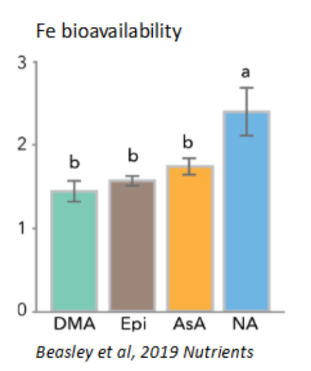
NA increases iron bioavailability greater than DMA, vitamin C, and Epi
This was experimentally tested by growing intestinal cells & feeding them the iron + chelator complex and measuring ferratin production
Ferratin is a strong indicator for Fe bioavailability
What is the function of nicotianamine in Fe intake?
Nicotianamine (NA) is also an iron & Zn chelator,
Increases greater Fe and Zn transport into the rice grain (within plant not soil)
Additionally increase NA -> some increase in DMA to increase uptake from soil itself
Additionally, NA increases iron bioavailability greater than DMA, vitamin C, and Epi
What are the NA synthase genes in rice & which is most important
These are OsNAS1, OsNAS2, OsNAS3 (note Os = rice; NAS = gene)
Experimentally disocvered OsNAS2 was the most effective gene
Describe T-DNA for Fe & Zn fortified rice
Constitutive promoter: 35S
OsNAS2
Additionally, 35S + nptII (neomycin resistence selective marker)

How were OsNAS2 rice plants grown & tested for increased Fe uptake?
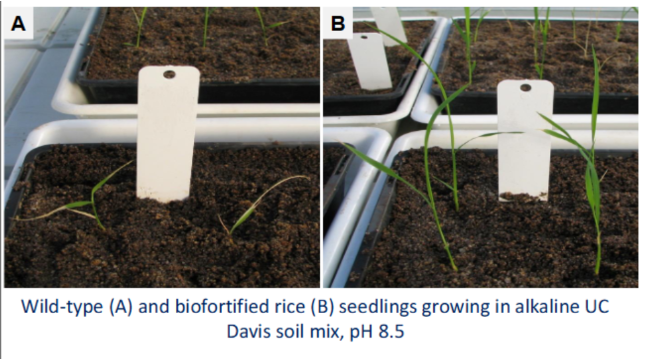
Placed in micronutrient-limiting conditions
Highly alkaline soil which promotes ferric ion formation in soil
This is the insoluble form of Fe, making it harder for plants to intake it
WT plants grew poorly
OsNAS2 plants demonstrated vigorous growth
This suggests increasing OsNAS2 expression, increases NA, which increases Fe
Describe field trials for OsNAS2 rice
Partnered with global organisations to conduct field trials at IRRI (phillipines) and South America at the International Centre for Tropical Agriculture
Here found there was no agronomic (yield and growth) impact on the GM plants
How was Fe & Zn content in OsNAS2 rice & wheat quantified?
Utilised synchrotron x-ray fluroescence microscopy
Takes place in a giant circular building
The machine will shoot photons / x-ray
When these hit atoms they cause emission of an electron
The electron from outer shells will therefore jump to lower energy level (to replace the removed on)
This jumping form high to low, emits energy
This energy can be detected & corresponded to an atom
very hard to do but snchotron allows!

Compare WT & OsNAS2 fe & Zn in rice?
Found 35S:OsNAS2 rice lines was 4x Fe and 2x more Zn in the endosperm
Not only this, but higher NA presence in endosperm also increases bioavailability during consumption

Describe final liscnecing & creation of OsNAS2 rice for distribution
gave to IRRI (phillipines - international rice research insitutte)
Added an extra apple ferratin gene, Mbfer
Mbfer attached to two promoters to express in different endosperm parts
Choice of apple vs soy genes:
Soy is a common allergen - precautionary
Stacking OsNAS2 & Mbfer greately increased Fe in rice!
What is the target for Fe & Zn content in OsNAS2 wheat
WT wheat already has 35-40ppm of Fe; biofortification presents a target of 59ppm
Why is wheat a useful crop to biofortify in AUs
Wheat is a crucial crop as in Australia it is grown more than rice
Describe T-DNA design for OsNAS2 wheat
Ubi promoter (more suited to wheat) + OsNAS2
35S promoter + nptII (neomycin resistence marker); same as previous

How were single inert homozygous evetns isolated in OsNAS2 wheat trials
Must ensure that the transgene insertion is single & stable (this is easier to regulate and track)
However progeny may produce heterozygous offspring & gene will keep segregating out (lower and lower levels)
For homozygous single insert events must look through several plants & check how progency are segregating
Production of progeny through wheat breeding & growth takes 5-7 months (long long time)
If under bright purple light for 22hrs a day & 2hrs dark = this period shortens to 3 months
Describe liscencing approvals & field trials for OsNAS2 wheat in AUs & phillipines
In 2019, was graited dealing of intentional release by OGTR
Grown across the wheat belt
Different cultivars of wheat at different locations along this (to specifiy)
e.g. driver vs rainier climates
Need to consider agronomy to specific locations where typically grown
Grown in Dookie campus for years!
Hand sown different wheat types
is approved for growth in phillipines
compare WT wheat & OsNAS2 Fe and Zn content
more of both present in the starchy endosperm of wheat!

Describe alternative approaches (3) for genetic Fe biofortification in wheat that would be more socially acceptable
These are approaches that may help provide biofortified wheat to consumers faster, through the social pushback to GM crop
Currently only drought-resistence wheat is approved in australia; no rice yet approved for growth
GM crops such as canola and cotton are also approved (as not consuming the DNA; canola = only oil thus low risk); & feed corn (not human consumption)
Intragenesis
Intead of using rice NAS can derive from wheat
This is plausible as wheat also has 34 (Several) NAS genes
Experimentally profiled 7 of these and had promising results of their effectivness
Genome editing
CRISPR-Cas9
3 categories of gene editing: SDN1, SDN2, and SDN3
SDN1 is cuting DNA & allowing natural repair mechanisms to create small mutations:
SDN1 is no longer regulated as a GM crop in Aus
(considered acceptable regulatory-wise as these mutations can naturally occur as well)
SDN2 and SDN3 require large templates (HR)
Targetted mutagenesis of negative regulators of Fe uptake / NAS2 (can knocout & increase it) - not GM
Natural variation :
Conventional breeding approach
Must identify wheat varieties with higher grain NA and breed into crop
Challenging; limited success so far; because higher Fe uptake is associated with lower yield; agronomic penalities is not favourable for farmers (this is also vice-versa!)
Breeding for higher NAS might be more feasible