Respiratory System
 Call Kai
 Learn
 Practice Test
 Spaced Repetition
 Match
 Flashcards
 Knowt Play
1/43

There's no tags or description
Looks like no tags are added yet.
44 Terms
Respiratory system
Brings oxygen into the body and to carry carbon dioxide out of the body; phonation, body temperature regulation, acid base balance, and olfaction
Chondromalacia
The softening (chondromalacia) of the cartilage rings that support the trachea (windpipe); cause of tracheal collapse (goose cough when excited common in toy breeds)
Nose
Site where air molecules first enter the respiratory system; begins with nostrils (nares), the external openings of the respiratory tube leading to nasal passages
Stenosis
abnormal narrowing of a body passageway, blood vessel, or space; nasal stenosis is common in brachiocephalics
No stenosis (open nostrils)
Level of stenosis

Mild
Level of stenosis
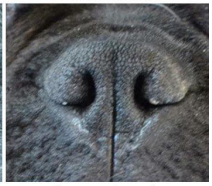
Moderate
Level of stenosis

Severe
Level of stenosis

Nasal passages
Located between the nostrils and the pharynx; seperated into left/right halves by the nasal septum; hard and soft palate seperates nasal cavity from oral cavity
Turbinates
Thin scroll like bones covered with nasal epithelium; divide each nasal passage into 3
Warming, humidifying, filtering
Three main conditioning roles of nasal passages
Allow air filtration before lungs (first line of defense)
Function of the turbinates
Paranasal sinuses
Outpouchings of the nasal passages that are contained within spaces in certain bones; examples are frontal and maxillary sinus
Ciliated lining
Sweep mucus produced in the sinuses down into the nasal passages
Prevents fluid and debris accumulation and the obstruction of nasal opening
Cilia function in the sinuses
Pharynx
Common passageway for both respiratory and digestive systems; the “throat”

Soft palate
Division between the dorsal nasopharynx and ventral oropharynx

Dorsally, ventral
Respiratory passageway starts ________ but as it comes caudally it becomes ________ to the digestive system
Larynx
Connects pharynx to trachea; made up of cartilage segments supported by the hyoid; the “voice box”
Epiglottis, arytenoid, thyroid, crioid
Cartilages of the larynx rostal to caudal
Epiglottis
Leaf-shaped rostal-most cartilage of the larynx; projects forward into the pharynx and pulled back to covering larynx opening when swallowing
Vocal cords
Attached to the arytenoid cartilages; muscles adjust the tension of the vocal cords by moving the cartilages
2
The larynx has _ fibrous connective tissue bands, as air passes over the cords they vibrate creating a sound
Less
As there is ____ tension in the vocal cords, sounds that come out are lower pitched
More
As there is ____ tension in the vocal cords, sounds that come out are higher pitched
Trachea
Tube of fibrous tissue and smooth muscle with cartilaginous rings (ciliated) that extends from the larynx to where it divides into the two main bronchi; the “windpipe”
Bifurcation of the trachea
The division of the trachea into two main bronchi
Cartilaginous rings of the trachea
Incomplete rings of hyaline cartilage spaced evenly along the length of the trachea, “C shaped”
Mucociliary escalator
Structure in the trachea where mucus traps small particles and cilia carry oit back to the pharynx to be swallowed
Lower respiratory tract
Tract that begins with the bronchi and ends with alveoli; comprised mostly of air passageways
Base (contact with diaphragm), apex, convex lateral surgace
Portions of the lung
Diaphragm
Thin muscle that directly aids in respiration
Mediastinum
Between the left and right sides of the lungs
Lung lobes
Left cranial (2 sections), left caudal, right cranial, right middle, right caudal, and right accessory
Nonfunctional
Before birth, the lungs of a fetus are (fully functional/nonfunctional)
Floats
A piece of lung tissue was placed into water, you can tell if a baby has died before birth if the lung _____ because there is no air in it
Bronchial tree
Air passageways that lead from the bronchus to the alveoli; diameter can be adjusted by smooth muscle fibers that line the wall; divides into smaller and smaller branches; begins at tracheal bifurcation
Relaxes
During times of intense exercise, the bronchial smooth muscle _____ allowing the air passageways to dilate and move more air
Constrict
When relaxed, smooth muscle fibers in the bronchial tree _______ to lessen amount of work
Tracheal bifurcation, principal bronchi (left and right), labor bronchi, segmental bronchi, bronchioles, alveolar ducts, alveoli
Flow of air in the brochial tree (cranial to caudal)
Alveolar sacs
Groups of alvoli at the end of alveolar ducts; resembles bunches of grapes
Alveoli
Site of external respiration (oxygen exchanged between blood and air for carbon dioxide); tiny and thinned wall sacs (composed of thin epithelium) surrounded by networks of capillaries
Asthma
Causes the brochial tree to becomes overly sensitive to certain irritants; exposure to irritants causes brochoconstriction that can range from mild-severe; frantic attempts for air can cause wheezing, coughing, dyspnea, and cyanosis
Emphysema
Damages the alveoli sacs, enlarges sacs and increases lung surface area; old air becomes trappped during exhalation as new air cannot enter the alveolar sacs and supply oxygen to the blood system