Psych Pharmacology
 Call Kai
 Learn
 Practice Test
 Spaced Repetition
 Match
 Flashcards
 Knowt Play
1/87

There's no tags or description
Looks like no tags are added yet.
88 Terms
Schizophrenia treatment
1st gen antipsychotics
2nd gen antipsychotics
Long acting injectable antipsychotics
first generation antipsychotics (FGAs) (General)
MX: chloropromazine
fluphenazine
Haloperidol
MOA: blocks dopamine receptors (d2 receptor antagonism)
AE:
cardiac changes: ekg change→QTc prolongation
Sudden cardiac death (rare)
Rash
photosensitivity
Hematologic complications (rare)
neuroleptic malignant syndrome (NMS)
Black box: elderly dementia pts→increased risk of death
more extrapyramidal sxs than SGAs
Acute dystonia (rigidity/stiffness in large muscles)
Txt: centrally-acting anticholinergic
-Diphenhydramine
-benztropineAkathisia (inability to remain still)
Txt: centrally-acting beta blocker
-propranolol
-benzodiazepenesPsudoparkinsonism (shuffling gait/cog-wheel rigidity/pill-rolling)
Txt: centrally-acting anticholinergic
-diphenhydramine
-benztropine
-amantadineTardive dyskinesia (abnormal and involuntary body movements of face)
Txt: second generation antipsychotic
VMAT-2 inhibitors
-valbenazine
-deutetrabenazine
or reduce dose of txt
Schizophrenia pathways
Mesolithic (basal ganglia):
elevated DA/DA hyperfunction
Positive symptoms
Mesocortical (prefrontal cortex):
decreased DA/DA hypofunction
Negative symptoms
Nigrostriatal (substantia nigra):
elevated DA/DA hyperactivity
Acute exacerbations
Second generation antipsychotics (General)
MX: clozapine
risperidone
aripiprazole
MOA: combine d2 antagonism with 5ht2a antagonism
ROA: PO
-IR
-XR
AE:
lower risk of EPS
Significant metabolic syndrome
weight gain
increased abdominal circumference
increased triglycerides
increased cholesterol
increased BP
increased insulin resistance=type 2 diabetes
Cardiac risk
Hematological complications
QTC prolongation:
ziprasidone=highest risk
aripiprazole=lowest risk
most=moderate-low risk
hyperprolactinemia:
risperidone/paliperidone=highest risk
aripirazole/partial agonists=low risk/correction
Black box: elderly patients with dementia death
pregnancy:
clozapine/luradisone=category b
other=category c (risk vs. benefit)
1st line: haloperidol
risk of gestational diabetes w/SGAs
Metabolic risk (weight) stratification
Low risk:
Ziprasidone
Luasidone
Aripiprazole
Moderate risk:
Risperidone
Paliperidone
iloperidone
Highest risk:
Clozapine
Olanzapine
Quetiapine
long acting injectable antipsychotics mxs+rationale
1st generation
haloperidol
fluphenazine
2nd generation
risperidone/paliperidone
aripiprazole
olanzapine
rationale
improves tx compliance in outpt setting
maintain more stable mx serum concentrations
decreased re-hospitalization rates
improved QOL
decrease stigma
provides peace of mind to pt+family+clinicians
decrease overall cost to healthcare system
bipolar disorder txt
first line:
lithium
valproic acid/valproate
SGA monotherapy (change agent during maintenance)
second line:
alternate first-line agent
carbamenzepine
lamotrigine
oxycarbazepine
lithium
MX: mood stabilizer
MOA: unknown
I: 1st line acute manic episodes (bipolar)
2nd line mixed episode (combo with quetiapine) (bipolar)
ROA: IR q2-3 x daily
onset=6-10 days
half life=18-36 hours (longer in elderly)
renally excreted (unchanged)
maintain hydration status
AE:
toxicity:
1.5-2.0 (mild)
NVD
lethargy
drowsiness
tremor
2.0-2.5 (moderate)
severe NVD
confusion
ataxia
slurred speech
EKG changes
greater than 2.5 (severe)
seizures
impaired consciousness
syncope
coma
renal insufficiency→can be fatal
CNS depression
hypothyroidism
renal dysfunction
leukocytosis
weight gain
polyuria
intentional overdose
DX : drawn 5 days post-initiation/dose change for steady state
therapeutic:
acute mania: 0.8-1.2
maintenance: 0.6-1.0
toxicity:
1.5-2.0 (mild)
2.0-2.5 (moderate)
greater than 2.5 (severe/fatal)
CI: 1st trimester pregnancy=ebstein’s anomaly (floppy baby syndrome)
increase lithium:
NSAIDS
ACE inhibitors
thiazide diuretics
decrease lithium:
caffeine
acetazolamide
theophylline
valproic acid (VPA)
MX: anticonvulsant
MOA: inhibits GABA catabolism
increases GABA synthesis
enhances GABA receptors activity
normalizes sodium + calcium channels
I: 1st line acute manic episode (bipolar)
2nd line mixed episode (bipolar)
aggression
impulsivity
ROA: IR TID (half life: 6-16 hours)
DR BID
sprinkle caps BID
ER QD
AE:
cns depression
hyperammonemia
thrombocytopenia
sedation
alopecia
Black box:
hepatotoxicity
pancreatitis
mitochondreal disease
DX: draw serum 3 days after txt
anticonvulsant: 50-100
mania/mood stabilization: 80-125
toxicity: over 150
CI: pregnancy (neural tube defect)
carbamazepine (CBZ)
MX: anticonvulsant
MOA: blocks voltage sensitive sodium channel
slow absorption in GI tract (highly absorpable)→blocks calcium and influx
CYP3A4+CYP3A4 substrate inducer
I: bipolar disorder
ROA: BID x increase 3-4 days
SIADH
DX: serum=8-12
recheck levels in 14 days
Asian→HLA-B*1052 allele testing
AE: SJS
-HLB testing in asians
thrombocytopenia
aplastic anemia (rare)
agranulocytosis
Hyponatrmeia
CI: pregnancy: neural tube defect
lamotrigine
MOA: blocks voltage sensitive sodium channels
modulates presynaptic aspartate and glutamate release
no effect on GABA/dopamine/acetylcholine/NE
I: bipolar
pregnancy
ROA:
onset: delayed→slow titration of dose
½ life: 24 hours
dose affected by enzyme inducers/inhibitors (carbamazepine/valproic acid)
monotherapy→QD x 2 weeks
+VPA→every other day x 2 weeks
+CBZ→every other day x 2 weeks
AE: no titration→SJS+rash
benign rash
sedation
ataxia
dizziness
headache
N/V
diplopia
blurred vision
hyponatremia
blood dyscrasias
hepatic dysfxn
DX: not required
oxcarbazepine
I: off-label→bipolar
ROA: IR QD
AE: similar to carbamazepine
biggest concern→hyponatremia
blood dyscrasias
hepatic dysfxn
DX: no mx level DX required
Asian→HLA B*1502 screening
CI: pregnancy
major depressive disorder txt
1st line: SSRI
SNRI
(general) antidepressants black box+maintenance
black box: suicidal thinking/behavior
increased: 18-24
decreased: 65+
risk vs. benefit: 24+
M: clinical worsening (check/visit often/weekly)
suicidality
unusual changes in behavior
family/caregivers for observations
serotonin syndrome
life threatening
increased serotonergic activity in CNS
increased risk: multiple serotonergic agents combined
mimic: neuroleptic malignant syndrome
HARM:
hyperthermia (over 38°C)
autonomic changes (diaphoresis/tachycardia/HTN)
reactivity (hyperreflexia/tremor/myoclonus/rigidity)
mental staus change
selective serotonin reuptake inhibitors (SSRI)
types:
paroxetine (half-life: 24 hours)
fluroxetine (half-life: 7-9 days)
sertaline (half-life: 24 hours)
citalopram (half-life: 35 hours)
escitalopram (half-life: 27-32 hours)
not FDA approved→fluvoxamine
MOA: inhibits presynaptic serotonin reuptake
I: MDD
fluoxetine→bullimia nervosa
-”oxes and bulls”
ROA:
half-life:
longest-fluroxetine
shortest-fluvoxamine
dosing:
renal dose: paroxetine
hepatic: paroxetine
citalopram
escitalopram
AE:
increased anxiety
insomnia
sedation
headache
nausea
diarrhea
m/c→sexual dysfunction
hyponatremia
serotonin syndrome
paroxetine→weight gain
-”fat parrot”
Withdrawal:
agitation
electric-shock like sensation in extremities or head
worst: paroxetine
txt: taper all slowly
-except fluoxetine
DX:
thyroid function test
electrolyte
renal function
liver function
pregnancy
urine drug screen
QT prolongation (Citalopram)
-”if you LONG for Quiet Time, ESCape the CITy”
sexual dysfunction
CI: NSAIDS
antiplatelets/anticoagulants
serotonin increase
Serotonin Norepinephrine Reuptake Inhibitors Mxs
duloxetine
venlafaxine
desvenlafaxine
levomilnacipran
SNRI MOA+I
inhibhit presynaptic serotonin+norepinephrine uptake
venlafaxine:
less than 150→increased 5ht
greater than 450→increased dopamine
duloxetine/desvenlafaxine:
5ht and NE transporters=equal affinity
levomilnacipran:
affinity for NE transporters
I: MDD
duloxetine→chronic pain syndromes (“dual-oxetine”)
-fibromyalgia
-diabetic peripheral neuropathy
-chronic musculoskeletal pain
SNRI half life
duloxetine: 12 hours
venlafaxine: 5 hours
desvenlafaxine: 10-11 hours
levomilnacipran: 12 hours
SNRI renal dosing adjustments
Duloxetine:
crcl under 30= do not use
venlafaxine:
mid-mod→decrease dose by 25 to 50%
hemodialysis→decrease by 50%
desvenlafaxine:
crcl 30-50→max 50 mg/day
crcl under 30→max 50 mg/every other day
levomilnacipran:
crcl 30-59→max 80 mg/day
crcl 15-29→max 40 mg/day
crcl under 15→don’t use
SNRI AE
HTN
duloxetine:
sedation
dry mouth
sexual dysfunction
venlafaxine:
sexual dysfunction
increased DBP
desvenlafaxine:
elevated cholsterol+triglycerides
hypersomnia
levomilnacipran:
dry mouth
tachycardia/palpitations/increased BP
urinary hesitancy
SNRI CI
increased levels of serotonin=serotonin syndrome risk increase
NSAIDS=risk of bleeding
SNRI M
adherence
efficacy
tolerability
baseline monitoring:
thyroid function test
electrolyte
renal function
liver function
pregnancy
tricyclic antidepressants types
tertiary amines:
amitriptyline
clomipramine
imipramine
doxepin
secondary amines:
nortriptyline
desipramine
protriptyline
tricyclic antidepressants MOA
inhibits serotonin/norepinephrine reuptake in synapse
inhibits a1/h1/m1 acetylcholine receptors
similar to SSRI/SNRI
tricyclic antidepressants half life
tertiary amines:
amitriptyline (15 hours)
clomipramine (32 hours)
imipramine (9-20 hours)
doxepin (15.3 hours)
secondary amines:
nortriptyline (26 hours)
desipramine (15-24 hours)
protriptyline (54-92 hours)
tricyclic antidepressants SE
tertiary amines better than secondary amines
CNS:
sedation
decrease seizure threshold
confusion
anxiety
tremor
anticholinergenic (ANTI-SLUDG):
blurred vision
urinary retention
dry mouth
constipation
cardiovascular:
orthostatic hypotension
ekg changes
ventricular tachycardia
heart block
other:
weight gain
sexual dysfunction
increased LFT
discontinuation syndrome
monoamine oxidase inhibitors (MAOI) types
isocarboxazid
phenelzine
tranylcypromine
selegeline
monoamine oxidase inhibitors MOA
catabolism of catecholamines (serotonin/norepinephrine/dopamine)
inhibit→ increase of catecholamines
irreversile
MAOI half life
isocarboxazid (5 hours)
phenelzine (11 hours)
tranylcypromine (1.5-3.5 hours)
selegeline:
sublingual: 10 hours
translingual: 18-25 hours
MAOI dosing
irreversible (enzyme destroyed)
2 weeks to regenerate MAO→ must wait 2 weeks to increase catecholamines (aka other txts)
conversion to MAOI:
wait 4-5 half lives/14 days general of other drug
fluoxetine: wait 5 weeks after discontinuation
MAOI CI
serotonin increase (dextromethorphan)
other antidepressants (SSRI/SNRI/TCA)
stimulants:
amphetamine
decongestants
methylphenidate
ephedrine
carbamazepine
meperidine
MAOI SE
orthostatic hypotension
diarrhea/constipation
headache
dry mouth
weight gain
sexual dysfunction
hypertensive crisis
application site reaction (selegiline patch)
MAOI diet restrictions
tyramine containing foods (aged/smoked/pickled/yeast/soy)=hypertensive crisis (BP greater than 180-110)
-medical emergency
selegiline patch: greater than 9mg/24 hours
bupropion MOA
inhibition of norepinephrine/dopamine reuptake pumps → increased norepinephrine+dopamine in synapse
buproprion pharmacokinetics (half life+ROA)
metabolized→ active metabolites
half-life: 20 hours
peak concentration:
immediate release: 2 hours
sustained release: 3 hours
extended release: 5 hours
buproprion dosing
immediate release: BID x 3 days → TID
max single dose: 150 mg
sustained release: QAM x 3 days → BID
max single dose: 200 mg
extended release: QAM x 3 days → daily
max single DAILY dose: 450 mg
buproprion SE
CNS:
lowers seizure threshold
headache
insomnia
GI:
nausea
dry mouth
Cardiovascular:
hypertension
tachyarrhythmias
buproprion monitoring
adherence
efficacy
tolerability
other:
anxiety
BP
pulse
Mirtazapine MOA
presynaptic alpha-2 antagonist
5ht2+5ht3 antagonist
Mirtazapine half life
male: 26 hours
female: 37 hours
Mirtazapine dosing
initial: 7.5-15 x bedtime
increase every 1-2 weeks
max dose: 45 mg
Mirtazapine AE
sedation
increased appetite
dizziness
triglyceride increase
dry mouth
Mirtazapine DX
adherence
efficacy
tolerability
baseline:
thyroid function test
electrolyte
renal function
liver function
pregnancy
other:
CBC
lipid panel
trazodone/nefazodone usage
FDA: major depressive disorder
off label:
T: insomnia
N: PTSD
trazodone/nefazodone MOA
weak inhibition of serotonin+norepinephrine reuptake
weak alpha 1 antagonist
serotonin 5ht2 antagonist
histamine antagonist (trazodone better)
trazodone AE
sedation
nausea
constipation/diarrhea
dry mouth
dizziness
headache
orthostatic hypotension
priapism (rare)
nefazodone AE
nausea
constipation
dry mouth
hepatic failure
headache
dizziness
somnolence
blurred vision
orthostatic hypotension
trazodone/nefazodone monitoring
adherence
efficacy
tolerability
baseline:
thyroid function test
electrolyte
renal function
liver function
pregnancy
periodic monitoring:
nefazodone rarely used: life threatening hepatic failure
liver functioning tests every 3-6 months
vilazodone
FDA use: major depressive disorder
MOA: inhibits presynaptic serotonin reuptake → increased synapse serotonin
partial agonist 5ht1a receptor
ROA:
initial: 10 mg x 7 days→20 mg x 7 days→ target dose 40 mg/day
take with food
half life: 25 hours
AE:
NVD
insomnia
M: same as SSRI
vortioxetine
FDA: major depressive disorder
MOA: inhibition of 5-HT reuptake
5ht3 ANTAgonism
5ht1a Agonism
ROA:
initial: 5-10 mg daily
max: 20 mg/day
2D6 poor metabolizers=max 10 mg/day
half life: 66 hours
AE:
nausea
diarrhea
dry mouth
sexual dysfunction
weight gain
increased bleeding risk (anticoagulants/antiplatelets/NSAIDS)
CI:
mod-strong 2nd inhibitors
tx: reduce dose by 50%
mod to strong 3A4 inhibitors
tx: increase dose (with inhibitor: no more than 3x original dose more than 14 days→ return to usual dose within 14 days of discontinuing)
anxiety tx
1st line: SSRI
2nd line: Benzodiazepenes
GAD: bridge therapy with SSRI (until effects)
PD: acute axiolysis
OCD: no role
PTSD: do not use
short acting benzodiazepenes
Agent |
Onset (hrs) |
Action duration |
½ life (hrs) |
Max/day (mg) |
Equivalent Potency | Indication (besides acting as anxiolytics)
|
Formulation |
Liver metabolism |
Active metabolite |
Midazolam | 0.25 | Short | 2-6 | 10 | - | Anesthesia | PO syrup, intranasal, IM or IV injection | Yes | No |
Triazolam | 0.5 | Short | 2-5 | 0.5 | 0.25 | Insomnia | PO tablets | Yes | No |
Alprazolam | 1 | Short
| 6-12 | 10 | 0.5 | Panic disorder Phobias
| PO (ER) and ODT tablets, solution | Yes | No |
Oxazepam | 3 | Short | 4-15 | 120 | 15 | Alcohol withdrawal | PO capsules | No | No 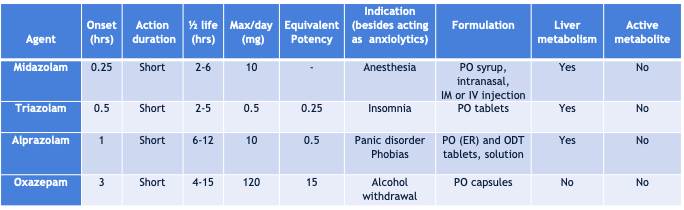 |
intermediate/long acting benzodiazepenes types
Agent |
Onset (hrs) |
Action duration |
½ life (hrs) |
Max/day (mg) |
Equivalent Potency | Indication (besides acting as anxiolytics)
|
Formulation |
Liver metabolism |
Active metabolite |
Temazepam | 0.5 | Intermediate | 8-22 | -- | 30 | Insomnia | PO capsules
| No | No |
Lorazepam | 2 | intermediate | 10-20 | 10 | 1 | Anesthesia Psychosis/ mania Seizures | PO tablets and solution IM or IV injection | No | No |
Clonazepam | 1 | Long | 18-50 | 20 | 0.25 | Panic disorder Seizures | PO and ODT tablets
| Yes | No |
Clorazepate | 1 | Long | 36-200 | 90 | 7.5 | Alcohol withdrawal Seizures | PO tablets
| Yes | Yes |
Diazepam | 1 | Long | 36-200 | 30 | 5 | Alcohol withdrawal Muscle relaxant Seizures | PO tablets, solution Rectal gel IM or IV Injection | Yes | Yes |
Chlordiazepoxide | 1.5 | Long | 36-200 | 300 | 10 | Alcohol withdrawal | PO capsules | Yes | Yes 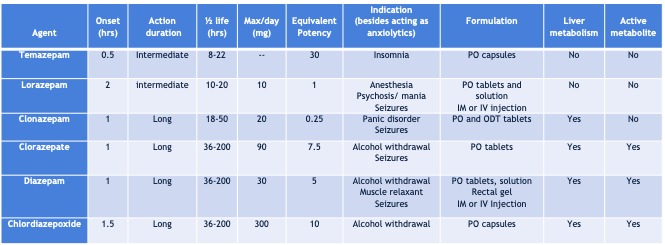 |
benzodiazepenes MOA
binding of gamma sub-unit of GABAa receptor
allosteric modification of receptor →increased GABAa
increased channel opening→conducting chloride ions/inhibition of action potentials
benzodiazepenes AE
CNS related:
drowsiness
sedation
confusion
depression
memory impairment
paradoxical excitation/disinhibition
increased risk of falls
misuse
rebound anxiety
buspirone
MOA: 5ht1 partial agonist activity at the pre-synaptic 5-ht receptor
d2 receptor affinity
ROA: BID-TID (NO PRN)
TI:
not for acute anxiolysis
delayed onset of effect: 2 weeks
AE:
dizziness
nausea
headache
serotonin syndrome
hydroxyzine
MOA: histamine receptor antagonist
5ht2 receptor antagonist
active metabolite: cetirizine
ROA: PO BID/PRN x Q6H
IM BID/PRN x Q6H
NO IV
AE:
anticholergenic:
dry mouth
dry eyes
constipation
urinary retention
cognitive alteration
antihistaminergic: sedation
CI: pregnancy
lactation
pregabalin
MOA: inhibits alpha-2-delta subunit of voltage dependent calcium channels
TI: short-term GAD
ROA: TID/BID x 1 week
dose adjustment: crcl under 60
dose tapered upon discontinuation
sleep disorder txt
goal: promote ability to fall asleep+maintain sleep or awaken refreshed
nonpharm:
look for:
untreated medical condition
medication reaction
environment change
pharm:
benzodiazepenes:
estazolam
temazepam
triazolam
non-benzodiazepene receptor agonists
melatonin receptor agonists:
ramelton
donexepin
orexin receptor antagonist
non-benzodiazepene receptor agonists
MOA: bind+inhibit GABAa
Black Box: sleep-related behaviors
AE: no full night of sleep (7-8 hrs)= eszopiclone+zolpidem products
angiodema
anaphylaxis
benzodiazepene-like addiction
hepatic impairment
Pearls:
sedative effects only (no muscle or anxiolytic)
empty stomach before bedtime
short half-life
class IV prescription
avoid in substance abuse pts.
ramelton
MOA: melatonin type 1 and type 2 receptor antagonist
reduces brain signals
promotes sleep
synchronize sleep-wake phases
ROA:
PO QD x daily
onset: 30 min
max effect: 3 weeks
max dose: 6 months continuously
CI:
increase conc. (inhibitors):
1a2
3a4
2c9
donezepil
doxepin
decrease conc. (inducers):
1a2
3a4
Pearls:
no drowsy feeling
30 mins before bedtime
mtr prolactin+tesosterone
Doxepin
MOA:
low dose: H1 receptor antagonist
sedation
effects fast (1st night)
ROA:
elderly: QHS
duration of action: 7 hours
duration of tx: 12 weeks
AE:
with food: next day solemnence
HTN
diarrhea
nausea
dry mouth
Pearls:
14 days of MOI
30 minutes before bed
take 3+ hours after eating
reduces waking up at night
Orexin Receptor Antagonists MOA
orexin type 1/type 1 receptor antagonists
lemorexant: binds both
higher affinity for OX2
daridorexant/suvorexant: high affinity for both
improvements fast (1st day)
Orexin Receptor Antagonists types
Drug | Dose | Adverse effects | Indication |
Lemborexant (DayVigo) | Initial: 5 mg QHS Range: 5-10 mg QHS | Next-day somnolence greater than other agents | Sleep onset or sleep maintenance |
Daridorexant (Quviviq) | Initial: 25-50 mg QHS Range: 25-50 mg QHS | Dizziness, nausea, and gait disturbance | Sleep onset or sleep maintenance |
Suvorexant (Belsomra) | Initial: 10 mg QHS Range: 5-20mg HS | Next-day somnolence less than lemborexant; cough, dry mouth, diarrhea, dizziness | Sleep onset or sleep maintenance |
Orexin Receptor Antagonists AE
next-day solomnence
narcolepsy events
abnormal dreams
mild cataplexy
Orexin Receptor Antagonists ROA
4+ weeks not recommendded
all 3 together=1 year
Orexin Receptor Antagonists pearls
no:
CI: narcolepsy
moderate/severe OSA/COPD
7+ hours before taking
sleep-related behaviors common during txt
bariturates
FDA approved (for insomnia)
2+ weeks usage=benefit lost
not recommended
sedating antidepressants
not FDA approved (for insomnia)
-trazodone
-mirtazapine (lower dose)
antipsychotics
not FDA approved (for insomina)
-quetiapine (low dose for comorbid psychiatric disorder)
OTC antihistamines
diphenhydramine
doxylamine
3-4 days=tolerance
melatonin
circadian rhythm disorders
kids: sleep latency
herbal supplements
not recommended
dementia txt
only slow progression of disease
not cure/restore memory loss
AChEIs (rivastigmine/donezipil)
Memantine
aducanumab
acetylcholinesterase inhibitors
Name | Dosage Forms (mg) | Initial Dose (mg) | Avg Dose (mg) | Max Dose (mg) | Hepatic Adj? | Renal Adj? |
Donepezil | Tab – 5,10, 23 ODT – 5, 10 | 5 | Mild-Mod 5-10 titrate after 4-6 weeks Mod-Severe 10-23 | 23 | No | No |
Galantamine | ER cap: 8,16,24 Solution: 4mg/mL Tab: 4,8,12 | 8 In divided doses, unless using ER | 8-24 Titrate after 4 weeks | 24 | Max dose 16 | CrCl<60, max dose 16 CrCl<10, not recommended |
Rivastigmine | Cap: 1.5,3,4.5,6 Patch 4.6,9.5,13.3 | Oral 3 – in divided doses Patch 4.6 | Oral 6-12 Titrate after 2 weeks Patch 9.5-13.3 Titrate after 4 weeks | Oral 12 Patch 13.3 | Oral None Patch Consider max of 4.6 mg in mild-mod Impairment | No |
acetylcholinesterase inhibitors AE
GI:
nausea
vomiting
diarrhea
CV:
bradychardia
headaches
weight loss
abnormal dreams
acetylcholinesterase inhibitors MOA
inhibit acetylcholinesterase
increases synaptic transmission in CNS→better cognition
memantine
MOA: receptor antagonist
no prevent/reverse neurodegeneration
AE: headache
dizziness
hallucinations
insomnia
confusion
constipation
ROA:
Name | Dosage Forms (mg) | Initial Dose (mg) | Avg Dose (mg) | Max Dose (mg) | Hepatic Adj? | Renal Adj? |
Memantine | ER cap: 7,14,21,28 Sol 2mg/mL Tab 5,10 | ER cap: 7 Sol/Tab: 5 | ER cap: 28 Titrate after 1 week Sol/Tab: 20 In divided doses Titrate after 1 week | ER cap: 28 Sol/Tab: 20 | No | CrCl<30 ER cap: 14 Sol/Tab: 10 CrCl<5 Not recommended 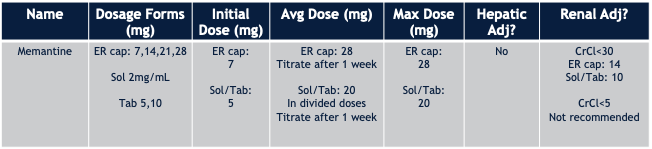 |
vascular dementia txt
NP:
modify risk factors:
DM
HTN
HLD
etc
P: acetylcholinesterase inhibitors?
lewy body dementia txt
rivastigmine
donezipil
memantine (systemic symptoms)
Mania: DIGFAST
Distractibility
Indiscretion
Grandiosity
Flight of ideas
Activity increase
Sleep deficit
Talkative
Depression: SIGECAPS
Sleep change
Interest loss
Guilt/worthlessness
Energy loss
Concentration loss
Appetite change
Psychomotor change
Suicidal ideation
Bipolar: Acute Mania Episode Mx Tx
1st line
lithium
valproic acid (VPA) derivatives
monotherapy→2nd gen antipsychotics (SGA)
2nd line→alternate to another 1st line agent
3rd line
lithium
VPA+SGA
Bipolar: Mixed Episode Mx Tx
1st line
olanzapine
olanzapine+fluoxetine combo
2nd line
newer 2nd gen antipsychotics (SGA)
-asenapine
-cariprazine
-paliperidonequetiapine+lithium
valproic acid (VPA)
3rd line
clozapine
ECT
ziprasidone
etc.
Xanomeline-Trospium Chloride/Cobenfy
MX: 1st-in-class antipsychotic
MOA: xanomeline→M1+M4 receptor agonist (in CNS)
trospium chloride→peripheral muscarinic antagonist
I: schizophrenia
ROA: BID x2 days→increased dose x5 days→increased dose x based on response+tolerability
no food
AE: HTN
constipation
N/V
EPS
no severe dxs
CI: urinary retention
moderate-severe hepatic dysfxn
gastric retention
untxd narrow angle glaucoma
FGA Mx-Specific AEs
chloropromazine
pseudoparkinsonism
purple-gray skin
metabolic syndrome
seizures→dose-dependent
haloperidol
hyperprolactinemia
EPS→especially dystonia
fluphenazine
hyperprolactinemia
EPS
Neuroleptic Malignant Syndrome
I: 1st generation antipsychotics
1-3 days
HTN
tachycardia
tachypnea
hyperthermia
sialorrhea
pallor
diaphoresis
decreased bowel sounds
“lead-pipe” rigidity of all muscle groups
bradyreflexia
stupor
alert mutism
coma
High-Risk Metabolic Risk Second-Generation Antipsychotics
clozapine
olanzapine
quetiapine
Second-Generation Antipsychotics Mx-Specific Adverse Effects (General)
akathisia
hyperprolactinemia
weight gain
ziprasidone+quetiapine→QTc prolongation