AP Bio Unit 3 CELLS
 Call Kai
 Learn
 Practice Test
 Spaced Repetition
 Match
 Flashcards
 Knowt Play
1/41

There's no tags or description
Looks like no tags are added yet.
42 Terms
Prokaryote
Cells that do NOT contain a nucleus or other membrane bound organelles; bacteria
Eukaryote
Cells that contain a nucleus and other membrane bound organelles (ER, GA, lysosome, vacuole, mitochondria, etc)
Fluid mosaic model
Model that describes the plasma membrane as a mosaic (mixture) of protein molecules bobbing in a fluid (moves) bilayer of phospholipids
Vesicle
Membrane surrounded container used to ship or store materials for the cell
Endomembrane system
System of organelles that are continuous or connected through the transfer of vesicles; example: ER --> GA --> plasma membrane

Nucleus
Contains most of the DNA in a eukaryotic cell
Asexual reproduction
The generation of offspring from a single parent, without the fusion of reproductive cells
Plasma membrane
The membrane at the boundary of every cell that acts as a selective barrier, regulating the cell's chemical composition; a phospholipid bilayer with embedded proteins
Selectively permeable
Allows only some substances to cross
Free ribosomes
Uses mRNA to build proteins that remain in cytosol (such as cytoskeleton or motor proteins); NOT attached to ER
Bound ribosomes
Attached to endoplasmic reticulum; builds proteins that need to enter the endomembrane system (such as excreted from the cell, integrated into the plasma membrane, found inside an organelle)
Smooth ER
Organelle that synthesizes lipids, metabolizes carbohydrates, detoxifies drugs and poisons, stores calcium ions; no ribosomes
Rough ER
Has attached ribosomes that make proteins found in membrane & secreted proteins, distributes transport vesicles, and is a membrane factory for the cell

Golgi apparatus (GA)/ Golgi complex
Modifies certain products of the ER;
Manufactures certain macromolecules;
Sorts and packages materials into transport vesicles, adds molecular "ID tags" for proper delivery

Lysosome
Vesicle containing hydrolytic enzymes that can digest macromolecules
Vacuole
Organelle that store molecules, mainly water
Mitochondria
Organelle that uses sugar & oxygen to generate ATP (process called cellular respiration)
Contains circular DNA, ribosomes, double phospholipid membrane, cristae (folds)

Chloroplast
Organelle that uses light energy to generate oxygen & sugars (process called photosynthesis)
Contains circular DNA, ribosomes, double phospholipid membrane, thylakoids, stroma

Endosymbiosis theory
The theory that mitochondria and chloroplast originated as prokaryotic cells engulfed by host cells
Evidence includes that they both contain:
Phospholipid membrane
Free-floating circular DNA
Ribosomes
Similar size (1-10 mm)
Similar reproduction
Diffusion
The tendency for molecules to spread out evenly into the available space
A substance will move from where it is MORE concentrated to where it is LESS concentrated

Osmosis
Diffusion of water
Lysis
To break; the disintegration of a cell by rupture of the cell wall or membrane; example: when an animal cell is placed in a hypotonic solution
Salinity
Measure of all the salts dissolved in water
Hypertonic solution
Solute concentration is greater than that of the other solution; cell placed in a hypertonic solution will shrink

Hypotonic solution
Solute concentration is less than that of the other solution; cell placed in a hypotonic solution will expand

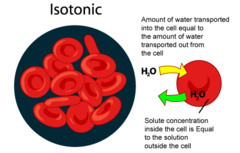
Isotonic solution
Solute concentration is the same as inside the cell; no net water movement across the plasma membrane
Osmoregulation
The control of solute concentrations and water balance; example: paramecium in freshwater (hypo) have contractile vacuoles to pump incoming water back out
Facilitated diffusion
Movement of specific molecules across cell membranes through protein channels; passive transport process (no energy required); example includes aquaporins

Water potential
Tendency of water to diffuse from one area to another;
= Water's potential energy;
Always moves from regions of higher water potential to regions of lower water potential
Exocytosis
transport vesicles migrate to the membrane, fuse with it, and release their contents
EXO= EXIT

Endocytosis
Cell takes in molecules and particulate matter by forming new vesicles from the plasma membrane
ENDO= ENTER

ATP
Adenosine triphosphate; Main energy source that cells use for most of their work
An organic molecule called adenosine attached to a string of three phosphate groups
Active transport
Moves substances against their concentration gradients
Requires energy, usually in the form of ATP
Solute
A substance that is dissolved in a solution.
Osmolarity
Total concentration of all solute particles in a solution
Homeostasis
Process by which organisms maintain a relatively stable internal environment
Proton pump
An active transport protein in a cell membrane that uses ATP to transport hydrogen ions against their concentration gradient, generating a membrane potential in the process.
Passive transport
Requires NO energy, Movement of molecules from high to low concentration, Examples include diffusion, osmosis, & facilitated diffusion
Plasmolyzed
Plant cell in hypertonic solution; Cell membrane Pulls away from cell wall
Turgid
Plant cell in hypotonic solution
Thylakoid
A flattened membrane sac inside the chloroplast, used to convert light energy into chemical energy.
Stroma
In plants, the fluid in a chloroplast