Quiz 10: Eudicots: PLANT FINAL
 Call Kai
 Learn
Learn Practice Test
 Spaced Repetition
 Match
Match Flashcards
 Knowt Play
1/26

There's no tags or description
Looks like no tags are added yet.
Name | Mastery | Learn | Test | Matching | Spaced | Call with Kai | Chat |
|---|
No analytics yet
Send a link to your students to track their progress
27 Terms
What is the synapomorphy of Eudicots?
vessels
vasculature in atactostele
Pollen tricolpate or tricolpate derived
Sieve tube plastid protenaceous
pollen tricolpate or tricolpate derived
How many species exist in this group? Monocots:
20%
How many species exist in this group? Eudicots:
75%
How many species exist in this group? Basal Angiosperm
<5%
Match the following species on the right family: Papaveraceae
Dendromecon Harfordii
Match the following species on the right family: Nelumbo nucifera
Nelumbonaceae
Match the following species on the right family: Argemone minuta
Papaveraceae
Match the following species on the right family: Platanus racemosa
Platanaceae
Match the following species on the right family: Telopeia speciosimmia
Proteaceae
Select all features found in the family Papaveraceae
axial placentation
usually numerous stamens
ovary inferior
loculicidal or poricidal capsule
perianth dichlamydeous, triseriate
numerous stamens; loculicidal or poricidal capsule; perianth dichlamydeous, triseriate

Look at the dichotomous key for Papaveraceae https://ucjeps.berkeley.edu/eflora/eflora_keys.php?key=214Links to an external site.
Determine what is this species.
Romneya trichocalyx
Argemone munita
Romneya coulteri
Meconella oregana
Fumaria officinalis
Argemone Munita
During your internship at the national herbarium you discover the specimen of an undescribed species. The specimen was collected in Australia a century ago. The flowers of this species has a perianth with only one series, the calix, The androecium is compound by four stamens and the superior gynecium is derived from one carpel only. To which of the following families does this species belong?
Nelumbonaceae
Platanaceae
Papaveraceae
Proteaceae
Crassulaceae
Proteaceae
Match the following species with the right family: Dudleya brevifolia
Crassulaceae
Match the following species with the right family:Crassula Ovata
Crassulaceae
Match the following species with the right family: Manihot esculenta
Euphorbiaceae
Match the following species with the right family: Euphorbia millii
Euphorbiaceae
Match the following species with the right family: Salix lasiolepis
Salicaceae
What of the following families is well known by its medicinal properties due to the presence of acetylsalicylic acid?
Platanaceae
Papaveraceae
Cannabaceae
Salicaceae
Salicaceae
What is true about Populus fremontii (Western Cottonwood)?
It has simple leaves with truncate base
It has simple leaves with parallel venation
It has male catkins on the top branches and perfect flowers on the lower branches
It belongs to the family Salicaceae
It is dioecious and the male flowers are produced in catkins
It has simple leaves with truncate base;
It belongs to the family Salicaceae;
It is dioecious and the male flowers are produced in catkins
What of the following families has CAM photosinthesis?
Agavaceae
Salicaceae
Crassulaceae
Cactaceae
Nelumbonaceae
Agavaceae, Crassulaceae, Cactaceae
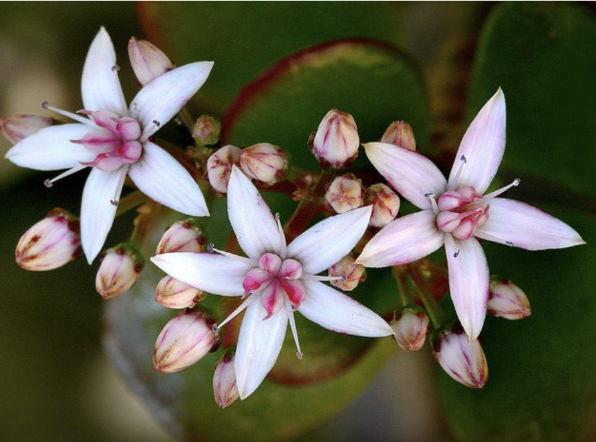
What is this plant?
A member of the family Cyperaceae
A member of the family Oxalidaceae
A member of the family Salicaceae
A member of the family Crassulaceae
Crassulaceae
Match the following trait to the right subfamily in Euphorbiaceae: inflorescence a Cyathium
Euphorbioideae
Match the following trait to the right subfamily in Euphorbiaceae: Milky (white) latex
Euphorbioideae
Match the following trait to the right subfamily in Euphorbiaceae: Colored latex
Crotonoideae
Match the following trait to the right subfamily in Euphorbiaceae: The genus Acalypha is in this family
Acalyphoideae
Which of the following families have the following attributes?
The leaves are often trifoliolate and the leaflets often folding at night and expand during the day. The flowers have both androecium and gynoecium and five petals, basal nectaries are often found at the base of the flower to attract pollinators. After fertilization occurs a loculicidal capsule or berry is formed.
Oxalidaceae
Crassulaceae
Papaveraceae
Salicaceae
Oxalidaceae

What genus does the following species belong to?
Papaver
Oxalis
Populus
Salix
Nelumbo
Papaver