1. Nature of Light
 Call Kai
 Learn
 Practice Test
 Spaced Repetition
 Match
 Flashcards
 Knowt Play
1/10

There's no tags or description
Looks like no tags are added yet.
11 Terms
What is a wave?
A propagating disturbance - a temporal and spatial variation of a physical entity that spreads in time and space
Electromagnetic waves
Propagate in a vacuum at the speed of light (3,000,000 m/s)
Huygens principle
Every point on a wavefront acts as a source of secondary wavelets spreading outward uniformly at the wave’s speed
All points on a wavefront travel at the same speed therefore same phase
Wavelength
Distance between two points of similar phases on a wave (in m)
Frequency
The number of complete waves generated per second (in Hz)
Wavelength = 1/frequency
Velocity
Speed (in m/s)
Velocity = wavelengths x frequency
Amplitude
Intensity and height of peak/trough
Electromagnetic spectrum
The perceived colour of light id dependent on the wavelength
High frequency = low wavelength
Light of a single wavelength is referred to as monochromatic light
Light rays
If an optical medium is isotropic and homogenous light will travel ata a constant speed in a straight line
Isotropic - same optical properties in all directions
Homogenous - same optical properties throughout its volumes
Light rays can be converging, diverging or parallel
Vergence of light
How converging or diverging light is (in Dioptres/D)
Vergence at a surfer is dependent on the distance the surface is away form the object
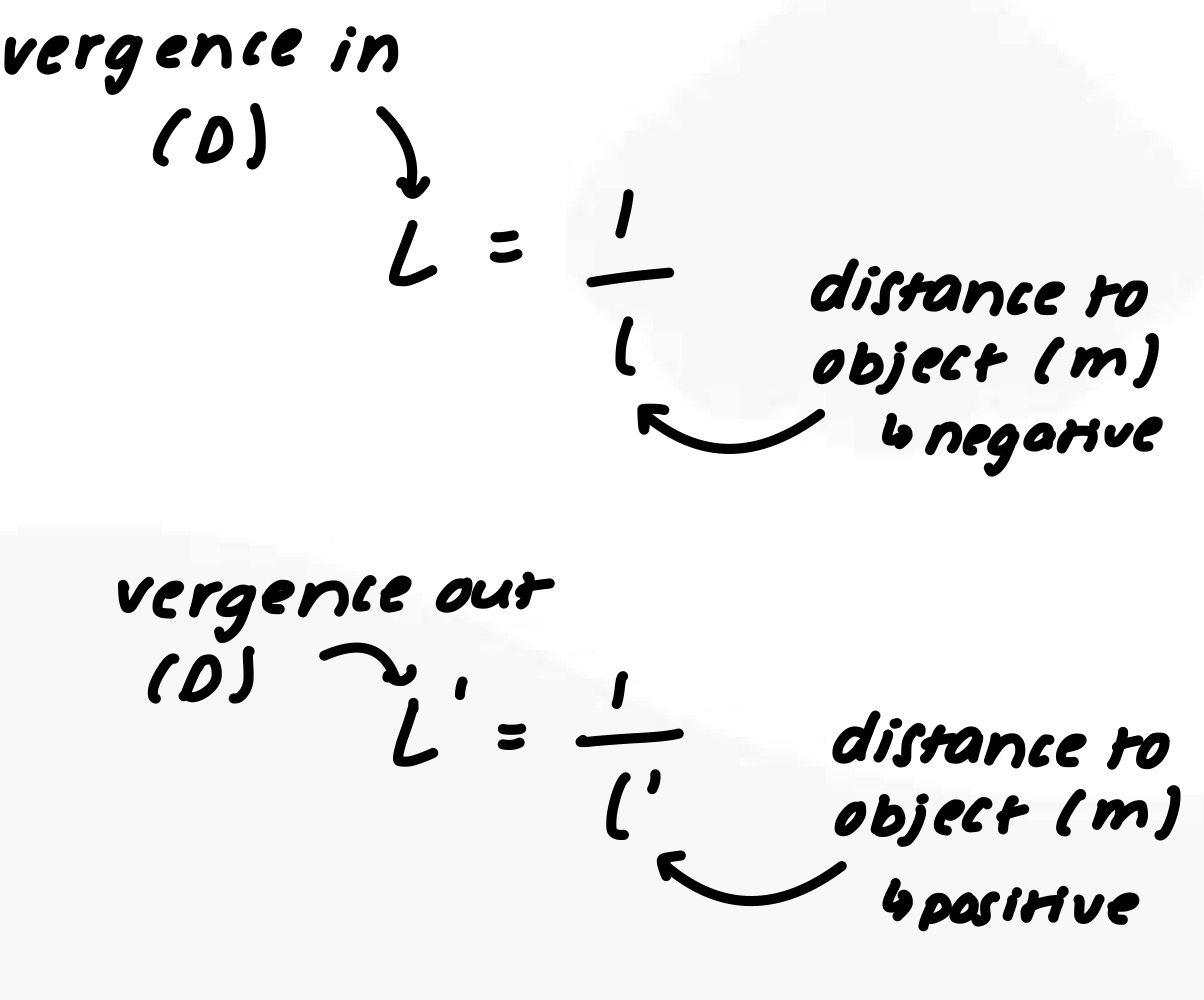
The Cartesian sign convention
Light travels from left to right with the optical surface in the centre
Negative distances - left
Positive distances - right