EXAM 2: Ruminant Carbohydrate digestion & metabolism
 Call Kai
 Learn
 Practice Test
 Spaced Repetition
 Match
 Flashcards
 Knowt Play
1/27

There's no tags or description
Looks like no tags are added yet.
28 Terms
T or F: Ruminants don’t directly utilize most of the carbohydrates they eat
True
GIT bacteria ferment them to end products - VFAs
70-80% of energy comes from VFA
Plant carbohydrates


Fiber

Primary and secondary cell wall

Cell wall components
Cellulose
Crystalline, resistant to hydrolysis
Must be moistened in rumen…can cause a lag time before digested
Hemicellulose
Easily hydrolyzed (in dilute acid/base); not crystalline like cellulose
Lignin
Randomly bound throughout cell wall
Fills space between cellulose, hemicellulose, etc
Gives structure & support to plant
Plant content increases with maturity Interferes with digestion of fiber
The cellulosome


Factors effecting cell wall digestion pt. 1
Grain in diet
Increased grain → Decreased pH → Reduced cellulolytic bacteria → Reduced cell wall digestion
Fats, particularly unsaturated oils
Toxic to cellulolytic bacteria → Reduced cell wall digestion
Limit dietary fat to 5% of DM
Factors effecting cell wall digestion pt. 2
Bacterial nutrition
N, and S increase fiber digestion
Increased rate of passage leads to reduced cell wall digestion
Factors increasing rate of passage of forages from the rumen
Increased feed intake
Grinding of feedstuffs
Things that decrease rumen size (Pregnancy)
Significance of VFA absorption
95% of VFA are absorbed before the abomasum
15% of VFA (primarily butyrate) entering rumen epithelium do not enter portal circulation
VFA absorption is through diffusion and facilitated transport modified by metabolism
No active transport
Bicarb enters rumen in exchange for VFA to facilitate absorption through specific transporters
Increases with increasing VFA concentration and decreasing ruminal pH
VFA metabolism in the ruminal epithelium
Acetate → None
Propionate → Approximately 2-5% converted to lactate
Butyrate → Approximately 90% converted to the ketones beta-OH-butyrate or acetoacetate
Butyrate metabolism in rumen epithelium
Butyrate extensively metabolized in rumen epithelium to ketone bodies

Liver metabolism of Butyrate
liver has low afinity for B-hydroxy-butyrate
only 20% is metabolized in the liver
Peripheral tissues use butyrate
Oxidation (TCA) by muscle for ATP production
Long chain fatty acid synthesis (lipogenesis) in adipose and mammary tissue
Propionate metabolism
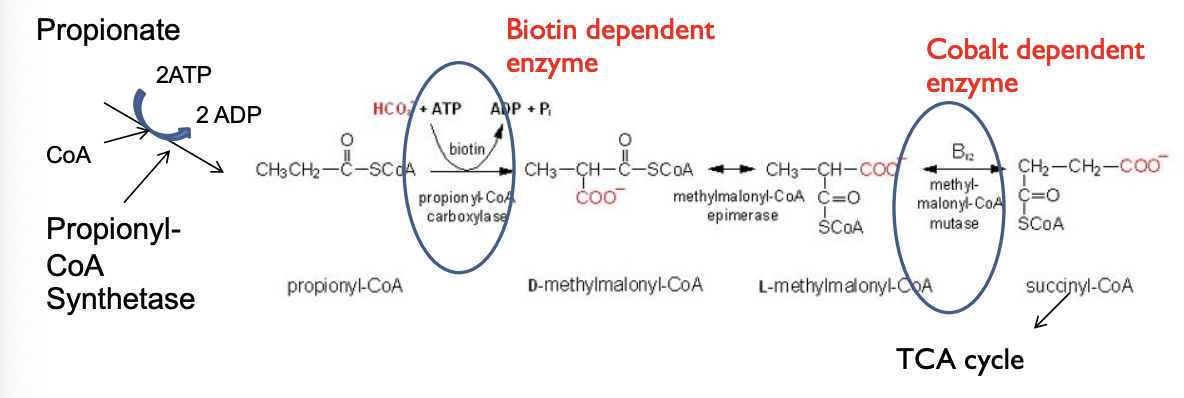
~94% of propionate entering liver converted to _________
Glucose (gluconeogenesis)
Mechanism of gluconeogenesis:
Hormones:
glucagon & glucorticoids (cortisol) stimulates
Insulin inhibits

Glucose conservation in ruminant
Typically have low blood glucose
Low glucokinase activity in the liver
Thus, little glycolysis occurs in liver, so net output of glucose from liver in ruminant
Unlike monogastrics-ruminants do not use glucose to supply carbon for long chain fatty acid synthesis
Instead, acetate (or butyrate) is used
Propionate use

Acetate metabolism
Very little removed by liver (~80% escapes)
Peripheral tissues use acetate for:
1) Oxidation (TCA cycle) as Acetyl CoA
2) Primary precursor for de novo lipogenesis in ruminant
Long chain fatty acid synthesis
Acetyl-Co A Synthetase activity in ruminant adipose tissue is 2-3 times higher than in rat adipose
Activation of Acetate to Acetyl-CoA so it can enter metabolic pathways
VFA pathways to ATP

Energetic efficient of VFA metabolism vs Direct glucose absorption

Feed carbohydrates fermented to ________ to ______ for bacteria needs
Feed carbohydrates fermented to pyruvate to ATP for bacteria needs
VFA waste products provide…
ATP, glucose, or lipid for animal
VFA must be ________ to enter pathways (like other fatty acids)
VFA must be activated to enter pathways (like other fatty acids)
T or F: Site of VFA utilization and end product differs
true