BIO 112 Lab Test #1
 Call Kai
 Learn
Learn Practice Test
 Spaced Repetition
 Match
Match Flashcards
 Knowt Play
1/110

There's no tags or description
Looks like no tags are added yet.
Name | Mastery | Learn | Test | Matching | Spaced | Call with Kai | Chat |
|---|
No analytics yet
Send a link to your students to track their progress
111 Terms
What is plasmodium vivax and what does it cause?
Plasmodium vivax is a protist that causes malaria. Misquito is the vector.
What are examples of protists?
1. paramecium 2. amoeba 3. pond water 4. radiolaria 5. foraminifera 6. diatoms 7. diatomaceous earth 8. porphyra 9. coralline algae 10. fucus 11. laminaria 12. volvox 13. spirogyra 14. plasmodium vivax 15. dinoflagellate
What are type of cells are fungi (eumycota)?
1. yeast budding 2. rhizopus 3. penicillium 4. candida albicans 5. morchella 6. boletus 7. lycoperdon 8. basidiomycota 9. lichen (fruticose, crustose, foliose)
When do endospores form?
Endospores form when there is a lack of nutrients that happen in Gram-positive bacteria. They can also occur in harsh environmental conditions. Spores are formed by organisms that reproduce asexually + can include bacteria, fungi, algae, + plants.
What are Chrysophyta and what do they help reduce?
Chrysophyta is a type of diatom that fall under protista + help reduce the effects of CO2 pollution.
What type of cell is saccharomyces cerevisiae?
Saccharomyces cerevisiae is a fungi (aka eumycota)
Describe a paramecium + what it looks like.
It looked purplish. They reproduce asexually through binary fission During this, the macronucleus splits by a type of amitosis + the micronuclei undergoes mitosis.

Describe an amoeba (rhizophyta) + what it looks like.
It looks pinkish.

Describe pond water + what it looks like.
It looks brownish with poopy spots + some of them were moving.

Describe a radiolaria + what it looks like.
It is brownish, greenish; most are extinct + used for fossil investigation. Spikes are made from minerals.

Describe a foraminifera + what it looks like.
It is brownish snail looking; unicellular but significant in size. Have intricate skelton, but "spikes" are similar to amoeba's + have very thin pseudopodia.

Describe diatoms + what they look like.
They are blue + belong to phylum Chrysophyta (golden algae) + among common types of algae forming phytoplankton. They reduce the effects of CO2 pollution. The cell wall of diatoms is made from silica. One larger half is epitheca + smaller half is hypotheca..

Describe diatomaceous earth + what they look like.
It is greenish brown.

Describe porphyra + what they look like.
It has a weird pinkish texture in square + in groupings of four. Contain marine algae or seaweed. Rhodophyta is a red algae phylum, encompassing large # of species many of which are old. Most are multicellular marine algae containing sea weed + is edible + is in sushi.

Describe coralline algae + what it looks like.
It's a sandy tan color that looks like a coral reef. It is in a ball shape w/ spikes. Has a hard thallus due to calcareous deposits in the cell walls. They're significant in coral reef ecology, serving as food for many organisms.
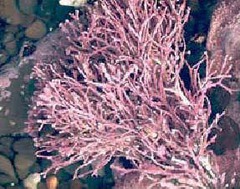
Describe fucus + what they look like.
They are a dark amber, burgundy color. It has small lighter dots on the pneumatic cyst + is seaweed looking. It is a brown algae + the tips branch in two ways. Phaeophyta (aka brown algae) have significant role in marine ecosystems + one of them is fucus which is easily recognizable due to dichotomous thallus (tips branching in 2) + a namesake color.

Describe laminaria + what it looks like.
It is a brown algae but its color is green. It forms kelp forests. It looks like finely sliced cooked onion w/ a greenish/yellow color. Plays a crucial role in marine ecosystems, forming kelp forests which is eaten by sea erchins. Sea urchins is eaten by otters, thus preventing the overpopulation of them which would lead to overgrazing of kelp. Kelp provides a structure + breeding place for a multitude of species. Keystone species (ex. otters) are their biggest predators + keep ecosystems healthy.
Describe volvox + what it looks like.
It is a green alga that belongs to Chlorophyta. It forms spherical colonies containing thousands of cells. It is a very old species.

Describe the fucus algae structure + what it looks like.
They are a dark amber, burgundy color. It has small lighter dots on the pneumatic cyst + is seaweed looking. It is a brown algae + the tips branch in two ways. Phaeophyta (aka brown algae) have significant role in marine ecosystems + one of them is fucus which is easily recognizable due to dichotomous thallus (tips branching in 2) + a namesake color.

Describe spirogyra + what they look like.
They are pond scum + slightly spread out light blue rod-like, but not completely smooth. Spirogyra got its name from its shape + pattern that the chloroplasts (tiny organelles in plants) + are arranged in. It belongs to Charophyta green algae phylum + is not branched + are the closest relatives to land plants..

Describe plasmdium vivax + what they look like.
They are small pink dots everywhere (can be blue or purple). It causes malaria via the bite of a female mosquito. It is an intracellular parasite entering immature red blood cells (reticulocytes)

Describe dinoflagellate+ what they look like.
They are pinkish, purple. They have flagella. They live in both fresh and saltwater. Sometimes they proliferate (go down more than 1 million per milliliter) causing red tide. They can produce high level of toxins that kill/poison marine organisms which can be passed on to humans who consume the contaminated fish. Gambierdiscus causes Ciguatera toxic.

Are protists unicellular or multicellular?
Most are single-celled (unicellular) eukaryotes that either exist as independent cells or, if they occur in colonies, do not show differentiation into tissues. A few algae species are actually multicellular protists.
How do protists reproduce?
Protists can reproduce 2 different ways (Plasmodium falciparum can do both): 1. Sexually through conjugation using gametes 2. Asexually through binary fission
What are protsists that are both heterotrophic + autotrophic called?
Protists both autotrophic + heterotrophic are called mixotrophs.
How do protists get their food?
Some protists are photosynthetic (autotrophy) meaning organism produce organic. The inorganic molecules used are carbon dioxide + water which are converted into organic material, sugar (glucose), to be used for energy. Other protists are heterotrophic meaning they can't produce complex organic molecules + must instead use organic carbon ingested from environment for growth.
What is a protists domain?
Protista
Are protists eukaryotic or prokaryotic?
Eukaryotic
Describe primary endosymbiosis vs secondary endosymbiosis.
1. Primary endosymbiosis occurs when a eukaryote engulfs a prokaryote. 2. Secondary endosymbiosis occurs when a eukaryotic organism engulfs a photosynthetic eukaryote. (green part is autotroph; everything else heterotroph)

What do protists have?
A cytoskeleton, nucleus, + other membrane bound organelles unlike prokaryotes (bacteria + archaea). Nucleus + membrane bound organelles contain DNA + perform photosynthesis. The cytoskeleton is network of proteins that helps cells maintain their shape + organization + is important for division + movement.
What are the roles of protists?
1. Cleaning intestines from excess bacteria, keeping their numbers in check 2. Breaking down cellulose (termites' guts) 3. Decomposing organic material (saprobes) 4. Primary producers (photosynthesis), especially in the marine ecosystems (70% of the oxygen comes from the ocean photosynthetic organisms) 5. Key role in food chain in multiple ecosystems 6. Food for human consumption, especially as source of iodine 7. Capturing CO2 + serving as a carbon dioxide sink, thus mediating the effects of the greenhouse gasses 8. Waterfall treatment (by consuming pathogenic bacteria + decomposing organic material) 9. Diatomaceous earth: multiple uses ranging from cleaning products to eliminating intestinal parasitic worms
What is trypanosoma?
Trypanosoma is a disease causing, protist. Trypanosoma lewisi is a parastie whose hosts are rats + are very similar to the sleeping sickness (vector for this = tsetse fly) causing human parasite: Trypanosoma brucei which can be found in blood of affected individuals.
What are different types of fungi (aka eumycota)?
1. yeast budding (saccaromyces cerevisiae) 2. rhizopus 3. penicillium 4. candida albicans 5. morchella 6. boletus 7. lycoperdon 8. basidiomycota 9. lichen (fruticose, crutose, foliose)
Describe penicillium.
Penicillium is a fungus. Penicillium is an antibiotic drug that fights bacteria in one's body. It only fights in Gram-positive bacteria though bcus it is hard for it to cross the polysaccharide/liposaccharide wall.
Describe mushrooms.
A mushroom is the reproductive structure produced by some fungi. The "seeds" it produces are millions of microscopic spores that form in the gills/pores under mushroom's cap. Mushroom's role is one of decomposition. It feeds itself by digesting the organic matter + at the same time returns nutrients to the soil. They can help trees get nutrients + water from the soil. An example of a mushroom is basidiomycota.
What type of fungi is Ascomycota?
A sac fungi or ascomycetes
What color are gram-positive bacteria? What color are gram-negative bacteria?
1. Gram-positive bacteria are dark blue or violet 2. Gram-negative bacteria are red or pink
What is an autoclave?
A strong heated container used for chemical reactions + other processes using high pressures + temperatures ex. Steam sterilizatio.
What does Trichophyton rubrum cause?
Trichophyton rubrum is a type of fungi that causes athlete's foot.
What are fungi important to humans for?
1. antibiotics (penicillium) 2. fermintation (yeast/saccharomyces cervisiae) 3. food (mushrooms)
What are some protists used for by humans.
Some marine protists are used as a food for human consumption, especially as a source of iodine.
Are fungi heterotrophs or autotrophs?
They're heterotrophs, meaning can't make own organic molecules + must ingest these materials as food. They obtain nutrients through decomposition of dead organisms making them detritivores which recycle nutrients w/in the ecosystem. Some obtain nutrients by secreting enzymes into environment where the enzymes digest dead organisms making them detritivores which recycle nutrients w/in the ecosystem
What is one benefit that fungi provide to the ecosystem?
They release nutrients that can be reused.
Are fungi unicellular or multicellular?
Most are unicellular or filamentous
What is one thing that fungi produce?
They can grow + produce delicate threads that fuse together. Individually the threads are known as hyphae + a mass of them is known as mycelium.
What is an example of filamentous thread?
An example of filamentous thread that is a paced tightly together is a mushroom.
What do many fungi use to attach to a substrate?
Many fungi use a specialized hyphae structure known as a rhizoid to attach to a substrate.
Describe haustoria.
Haustoria = specialized hyphae structure that parasitic fungi use to extract nutrients from other organisms in the environment.
How do fungi move?
Fungi are non-motile, but are able to move through the environment by increasing their mass during reproduction or by releasing spores.
Other than food, what is another use of fungi?
Uses of fungi other than food includes fermentation of wine + beer, antibiotic medication, + enzymes for industrial applications.
Are fungi good or bad?
Many compounds produced by fungi are good, but others can lead to toxicity + disease. Trichophyton rubrum = most common + produces athlete's foot.
Describe yeast budding (saccharomyces cervisiae) + what it looks like.
It helps in making bread, wine, + beer.

Describe rhizopus + what it looks like.
Rhizopus (zygomycota) (brownish/green + looks fuzzy + like it came from dirty pond). Common type of fungus found in many places. It has sporangium, sporangiospores, apophysis, stolen, + rhizoid.

Describe rhizopus + what its structure.
Rhizopus (zygomycota) (brownish/green + looks fuzzy + like it came from dirty pond). Common type of fungus found in many places. It has sporangium, sporangiospores, apophysis, stolen, + rhizoid.

Describe penicillium + what it looks like.
It is pinkish purple w/ purple skeleton fingers.

What are conidia?
Conidia are spores produced asexually by various fungi at the tip of a specialized hypha.
Describe candida albicans.
Candida albicans (ascomycota) = doesn't cause disease in healthy individuals, but leads to serious infections in individuals w/ compromised immune systems, such as HIV or cancer patients. (ex. thrush /yeast infection)
Describe difference in moral mushrooms + typical mushrooms.
Moral mushrooms have a cap covered in pils + ridges, but the typical mushrooms are more wavy + lobed.
What does a moral mushroom look like?
It has pits + ridges.
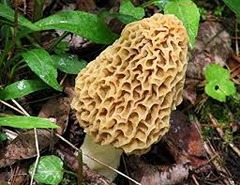
What does a typical mushroom look like?
It is wavy + lobed.

What does a bolete fungus (boletus) look like?

What does a puffball (lycoperdon) look like?

Describe fruticose lichen + what it looks like.hat are the 3 types of lichen bodies?
1. fruticose 2. crustose 3. foliose
Describe fruticose lichen + what it looks like.
It is free-standing branch tubes. Looks like a bush w/out leaves.

Describe crustose lichen + what it looks like.
It is crust-like + grows tight against a substrate. Looks like bark from tree.

Describe foliose lichen + what it looks like.
It is leaf-like w/ flat sheets of tissue against a substrate. It looks like normal lichen from tree.

What is one benefit of lichens?
They are excellent bioindicators of air quality.
What disease(s) does the pathogen Borrelia burgdorferi cause + what is its vector?
It causes Lyme disease from a tick.
What disease(s) does the pathogen Chlamydia trachomatis cause + what is its vector?
It causes Chlamydia (nongonococcal urethritis) from an STD.
What disease(s) does the pathogen Treponema pallidum cause + what is its vector?
It causes Syphilis from an STD.
What disease(s) does the pathogen Bacillus anthracis cause + what is its vector?
It causes Anthrax from insects/can be airborne.
What disease(s) does the pathogen Clostridium botulinum cause + what is its vector?
It causes Botulism by contaminated foods.
What disease(s) does the pathogen Escherichia coli cause + what is its vector?
It causes Intestinal/urinary tract infection, neonatal meningitis, travel's diarrhea through contaminated food + water.
What disease(s) does the pathogen Mycobacterium tuberculosis cause + what is its vector?
It causes Tuberculosis by respiratory contact (cough, sneezed on, breathed on).
What disease(s) does the pathogen Neisseria gonorrhoeae cause + what is its vector?
It causes Gonorrhea through STDs.
What disease(s) does the pathogen Rickettsia rickettsi cause + what is its vector?
It causes Rocky Mountain Spotted Fever through ticks.
What disease(s) does the pathogen Streptococcus pyrogens cause + what is its vector?
It causes Strep throat through contamination/airborne.
What disease(s) does the pathogen Staphylococcus aureus cause + what is its vector?
It causes Toxic shock syndrome through infection/cuts/scrapes.
What disease(s) does the pathogen Yersinia pestis cause + what is its vector?
It causes Bubonic plague through insects/fleas.
What disease(s) does the pathogen Clostridium difficile cause + what is its vector?
It causes CDIFF, pseudomembranous colitis through contaminated food/water.
What disease(s) does the pathogen Vibrio cholerae cause + what is its vector?
It causes Cholera through contaminated water.
What disease(s) does the pathogen Entamoeba histolytica cause + what is its vector?
It causes Amebic dysentery (bloody diarrhea), amebiasis through contaminated food, water/lysis of epithelial cells due to the insertion of pore-forming proteins into the membrane of the cell.
What disease(s) does the pathogen Acanthamoeba polyphaga cause + what is its vector?
It causes Granulomatous Amebic Encephalitis, Acanthamoeba Keratitus through water + soil, cut/wound.
What disease(s) does the pathogen Toxoplasma gondii cause + what is its vector?
It causes Toxoplasmosis through poorly cooked food + cat feces.
What disease(s) does the pathogen Plasmodium falciparum cause + what is its vector?
It causes Malaria through a female Anopheles mosquito.
What disease(s) does the pathogen Trypanosoma brucei cause + what is its vector?
It causes African Trypanosomiasis through the tsetse fly.
What disease(s) does the pathogen Trypanosoma cruzi cause + what is its vector?
It causes American Trypanosomiasis, Chagas through triatomine bugs.
What disease(s) does the pathogen Babesia microti cause + what is its vector?
It causes Babesiosis through ticks.
What disease(s) does the pathogen Giardia lamblia cause + what is its vector?
It causes Giardiasis through contaminated food/water + is airborne.
What disease(s) does the pathogen Trichomonas vaginalis cause + what is its vector?
It causes Trichomoniasis through STD.
What disease(s) does the pathogen Leishmania sp. cause + what is its vector?
It causes Leishmaniasis through sand flies.
What disease(s) does the pathogen Cryptosporidium parvum cause + what is its vector?
It causes Cryptosporidiosis (diarrhea) through contaminated food/water, fecal
What are archae?
Archea = extremophiles bcus can live in extreme conditions like volcanoes, jet fuel, + polar ice caps.
What are bacterial cell walls made up of.
Bacterial cell walls = made up of polymer, peptidoglycan, + lipopolysaccharide.
Describe cell wall composition/components.
Cell wall composition is important for classifying different types of bacteria using differential staining techniques such as Gram staining.
Cell wall components = not only help w/ differentiating species, but also target for many antibiotics + = important in antibiotic resistance which occurs due to natural selection for bacterial strains that are killed by antibiotics.
Some bacteria have minimal peptidoglycan cell wall (ex. Pathogen Mycoplasma) but contain tougher cell membrane that helps them survive certain antimicrobial agents.
What do some prokaryotes have outside cell wall?
Some prokarys have further outside cell wall called capsule = sticky layer of polyssacharides + is used to help them stick to surroundings
Bacteria w/ these = better able to cause urinary tract infections
Capsules make hard for phagocytes to engulf bacterium, thus resulting in greater pathogenicity. It is the clearing around the actually stained microbe.
Describe what bacterium + capsule look like.
Bacterium appears dark, while capsule looks like empty space around bacterial cell like halo.
What are the three shapes of prokaryotes?
1. Coccus (cocci) spherical/oval/flattened + have diplo arrangement or two cells attached
2. Bacillus (bacilli) rod-shaped/slender/tapered + have strepto arrangement or chain of cells 3. Spirochaeta + spirillum; spiral-shaped thin + thick + can have one or more twists + have staphylo arrangement or cluster of cells
Why are Gram-positive cells dark blue/violet?
Bcus it takes up stain crystal.
Why are Gram-negative cells red/pink?
Bcus unable to retain the crystal violet stain + instead take up counterstain (safranin or fuchsine).