Cleaning root
 Call Kai
 Learn
 Practice Test
 Spaced Repetition
 Match
 Flashcards
 Knowt Play
1/35

There's no tags or description
Looks like no tags are added yet.
36 Terms
Shaping
opens the root canal system for the irrigants and allows successive three dimensional obturation.Shaping→ cleaning→ obturation

1st upper molar, mesio-buccal root 2 canals
Objectives of irrigation
▪ To help avoid obstruction in the canals
▪ To remove the smear layer
▪ To lubricate the canal to enable file insertion
Smear layer- a surface film of debris on dentin after instrumentation with files or rotary. Uusallky dentin particles, pulp (vital or necrotic) and bacterial compinents.
Chemical objectives
▪ To dissolve organic tissues enabling their elimination
▪ To dissolve inorganic residue
▪ To act as calcium-chelating agents
We need 2 irrigants, 1 that acts on nerves (organic) and 1 that acts on dentin (inorganoc)
Bacteriological objectives
To eliminate bacterial flora. Bacteria present in necrosis, but when pulpitis not that much as pulp still vital.
Properties of iirgiants
1. Ability to dissolve organic and inorganic residue ▪
2. Germicidal and antibacterial ▪
3. Low surface tension to reach all areas that cannot be accessed by instruments ▪
4. Lubricating action ▪
5. Available and inexpensive ▪
6. Non-toxic and non-irritating to the periapical tissues ▪
7. Relatively harmless to patient and dentist ▪
8. Keep the dentinal debris in suspension
Disinfectants
▪ Sodium hypochlorite
▪ Chlorhexidine (main ones)
▪ Hydrogen peroxide
▪ Ozone
▪ Superoxydized water
Chelators (acts on dentin)
▪ Liquid EDTA (ethylene diaminetetraacetic acid)
▪ Citric acid & other acids
• Etidronate (HEDP): weak chelator for continuous chelation
Lubricants
▪ Urea peroxide
▪ Glycerin (wont do owt on dentin, use edta)
▪ Gel EDTA
Sodium hypochlorite (Naocl)
Main irrigating soloution.
Advantages-
▪ Broad antibacterial spectrum
▪ It also has activity against spores, fungi and virus
▪ Alkaline pH: 10,7-12,2
▪ Lubricant
▪ Low surface tension
▪ Dissolves organic tissues by releasing chlorine
▪ Slightly whitening
▪ Inexpensive
▪ Easy to buy
▪ Easy to handle
Dissolves organic tissues by releasing chlorine: Solvent action
▪ NaOCl can do a digestive effect on:
▪ Vital pulp tissue
▪ Non-vital pulp tissue
In vivo studies using a radiopaque irrigant provided visual evidence that irrigating solutions can dynamically circulate along the pathways of the pulp.
Low surface tension
▪ Because NaOCl has a low surface tension, it can access areas beyond the reach of instruments
▪ Lateral canals, resorptions, apical deltas
▪ Because of its low surface tension, it is not necessary to generate great force to make it reach the proximity of the apex, it will passively reach deeply into the canal, with the help of endodontic instruments.
Dont put too far down or can pass sthrough apex and is toxic
Lubricant: Preventing blockage
▪ Physical-mechanical role: it keeps the dentinal debris in SUSPENSION, preventing blockage of the apical portion of the canal
▪ The use of endodontic instruments generates dentinal shavings which must be kept under control by carefully and continuously refreshing the solution within the pulp chamber and root canal.
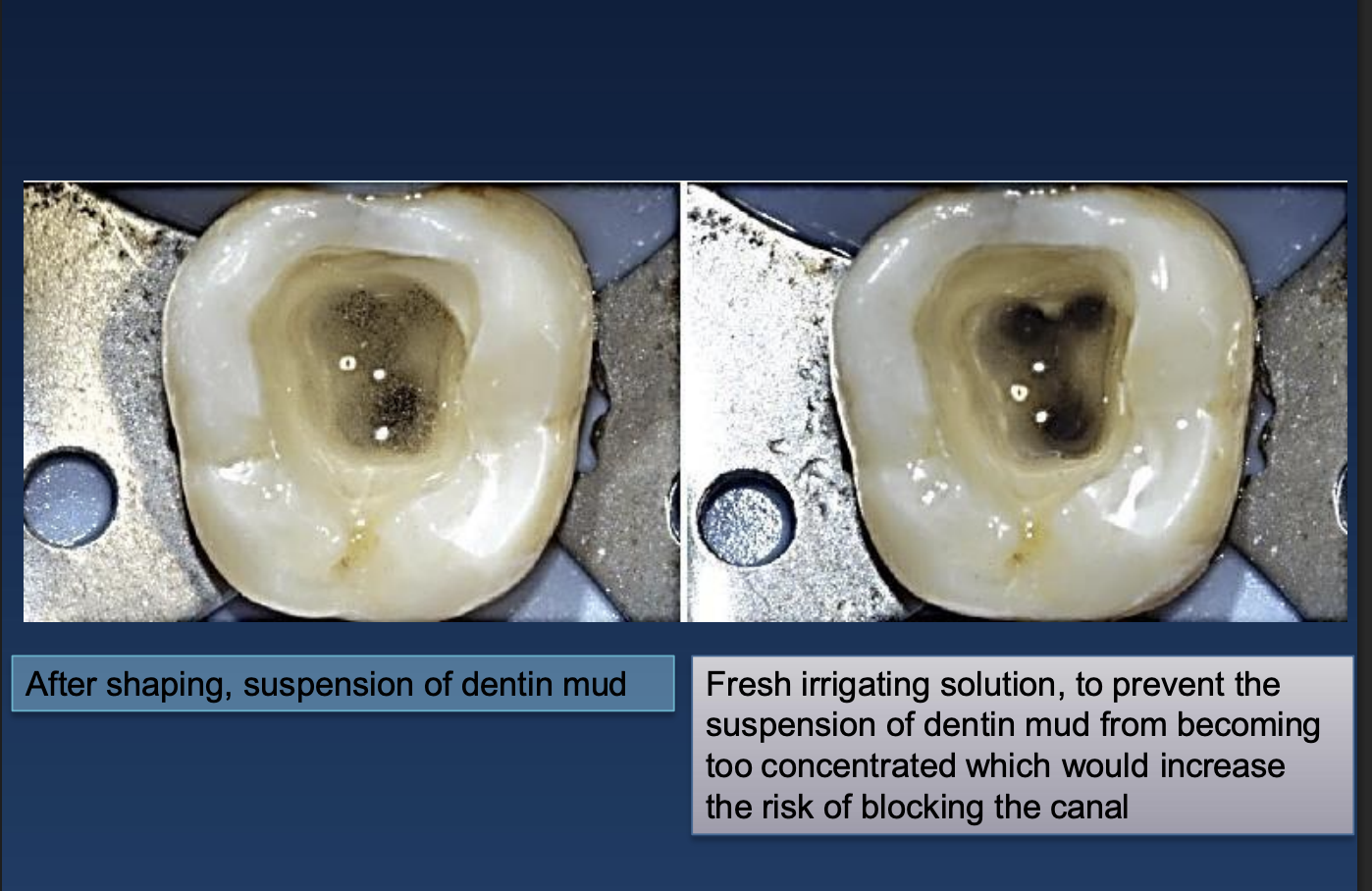
Preventing blockage
▪ Irrigation must be
▪ Frequent and delicate
▪ The goal is not to sprinkle the walls of the canal but to dilute the suspension of dentinal debris as much as possible.
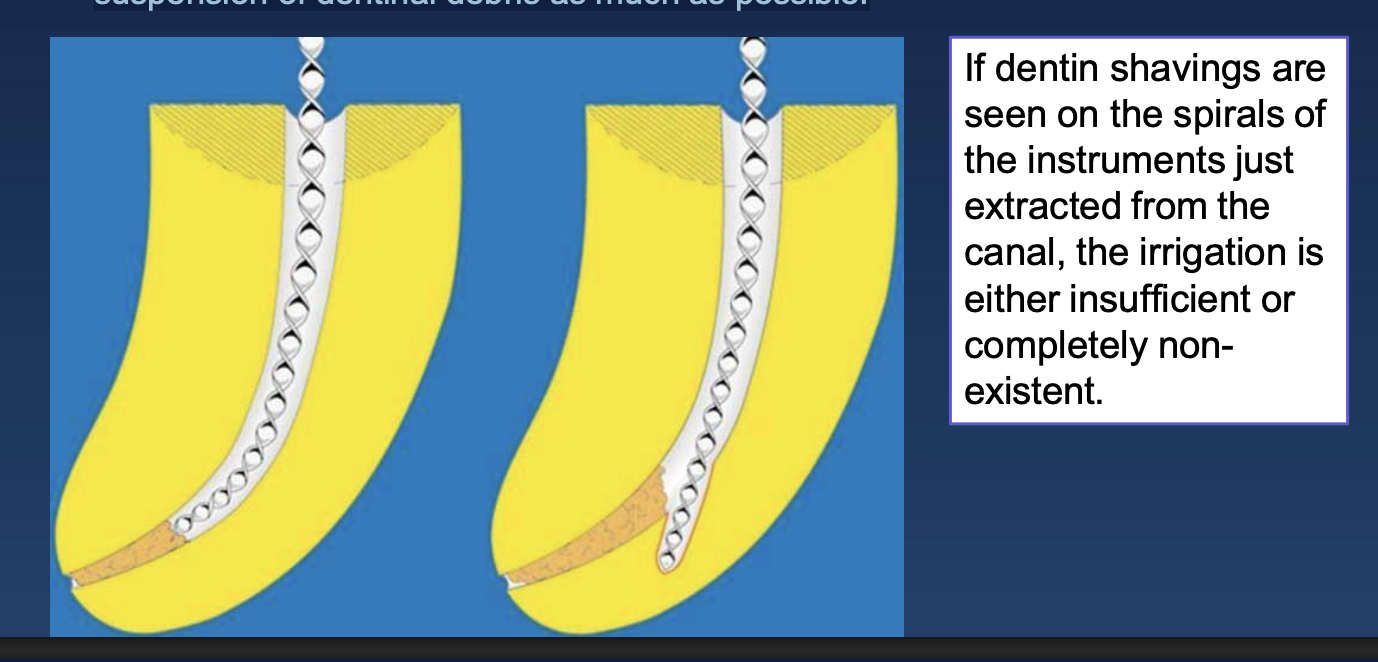
DISADVANTAGES
▪ Toxicity
▪ It doesn’t remove the smear layer (so we use edta)
▪ Sodium hypochlorite only acts on organic tissue, which is why it must be combined with other irrigants that do remove the smear layer.
▪ Corrosive
▪ It damages the instruments that come into contact with it.
▪ Taste
▪ Unpleasant
▪ Weakens dentin at high concentrations
Toxicity
▪ Its ability to dissolve organic tissue is its greatest advantage inside the root canal; however if it is extruded beyond the apex or comes into contact with oral tissues, it may cause:
▪ Inflammation
▪ Paraesthesia
▪ Necrosis
▪ Pain
To avoid this: It must be used with caution, verifying working length, using a rubber dam and the appropriate technique during irrigation to avoid extrusion.

How to use NaOCl efficiently and minimize its negative effects?
▪ MODIFY THE CONCENTRATION
▪ Clinical NaOCl concentrations vary from 0,5 to 6%
▪ At 5,25% it has the ability to penetrate, dissolve and remove organic tissue from areas unreachable to instruments.
▪ At a lower concentration:
▪ Decreased toxicity
▪ Decreased properties: antibacterial, tissue dissolution and canal debridement
How to use NaOCl efficiently and minimize its negative effects? 2
▪CONTROL THE DURATION
▪ Chlorine
▪ Responsible for the dissolution ability and antibacterial properties of NaOCl
▪ It is unstable and is rapidly consumed during the first 2 minutes (therefore fast, continuous replacement is essential)
NaOCl must be freshly prepared just before its use.
How to use NaOCl efficiently and minimize its negative effects? 3
▪CONTROL THE DURATION
▪ Pulp can take between 20 minutes to 2.5 hours to dissolve
▪ A minimum of 30 minutes is required to allow NaOCl to perform its activity
▪ Vital pulp (blood supply) takes longer to dissolve than necrotic pulp
▪ Shaping helps NaOCl to destructure live pulp and help with its dissolution
do patency so that the irrigant reduces the bacteria in the abcess but the abcess won’t be touched , it will resorb by itself (immune system)
use NaOCl efficiently and minimize its negative effects? 4
APPLY HEAT

Naocl controversy due to toxiicity
Present in OPEN APEX APICAL RESORPTION COMMUNICATION WITH THE MAXILLARY SINUS PERFORATION NaOCl ALLERGY
Can still be used vut adapt the conc, no use in allergy
Chlorohexadine
The recommended concentration is 2%, due to its antimicrobial efficiency.
▪ ADVANTAGES:
▪ Antiseptic (similar to NaOCl)
▪ Substantivity: Prolonged activity due to its adsorption to surfaces (oral mucosa, tooth structure), allowing it to be slowly released
▪ Low cytotoxicity
▪ Good odor
Antibacterial efficacy is concentration-dependent: - Bactericidal at high concentrations - Bacteriostatic at low concentrations
Chlorohexadine disadvantages
▪ No dissolution of organic or inorganic tissue
▪ This explains why it is not the first option as an endodontic irrigant
▪ Toxicity and staining
▪ When placed in contact with NaOCl it forms an orange precipitate which is very toxic and stains the tooth (difficult to remove)
If both irrigants are to be used in the same tooth, the canal must be thoroughly dried or abundantly rinsed with distilled water or a saline solution between them to avoid their contact. In any case, it is not recommended to use both products in the same tooth.
EDTA
▪ Chelating agent: a substance that exchanges ions.
▪ In endodontics, calcium chelators will remove calcium ions from dental structures and replace them with sodium. This softens the dentinal walls and allows the dissolution of inorganic residue, improving instrumentation efficacy.
▪ Introduced by Nygaard-Ostby in 1957 for the instrumentation of fine, calcified canals.
▪ The recommended concentration is 17%.
▪ PROPERTIES
▪ pH: 5-7.3 ▪ Self-limiting activity
▪ Softens dentin
▪ Emulsifier of debris resulting from instrumentation. This enables its elimination and therefore decreases the incidence of apical plugs
▪ Low antibacterial ability, therefore it must be used in combination with disinfectants such as NaOCl or CLX
No dissoloution of organic material
Edta smear layer removal
▪ Smear layer removal:
▪ Dentin mud that remains on the internal surface of the canal after the endodontic instruments have completed their action
▪ It occludes the dentinal tubules and is mostly constituted of inorganic material (therefore can’t be digested by NaOCl)
▪ LIQUID EDTA ▪ Easier penetration ▪ GEL EDTA ▪ Improves lubrication

Citric Acid
▪ Used at 10-17%
▪ Differences with EDTA:
▪ Higher chelating effect: higher dentinal erosion
▪ Use for no more than 20 seconds due to aggressive decalcification of radicular dentin
▪ It is safer to use EDTA as a chelator
▪ Lower pH: 1.8 (compared to 7.3)
▪ Tissue irritant
Irrigation protocol
▪ The most accepted protocol is to alternate NaOCl and EDTA.
▪ NaOCl is used as the main irrigant, performing abundant irrigation between every file.
▪ EDTA is used in calcified canals, and for a final, pre-obturation irrigation.
if my canal is not calcified I won’t be alternating with the EDTA the EDTA will only be used in the final irrigation
During patency and shaping:
▪ 5% NaOCl (37ºC) #30 gauge, sidevented, up to 3mm from WL
▪ Rejuvenate after every instrument ▪ Irrigate-permeate-irrigate
▪ 17% EDTA (gel) ▪ To help with initial permeation or calcified canals
Preobturation irrigation:
▪ 5% NaOCl (37ºC) #30 gauge, side-vented, up to 3mm from WL
▪ 3-5 minutes with sonic or ultrasonic activation (1 minute per canal)
▪ Rinse with saline and dry the canal
▪ 15-17% EDTA (liquid) #30 gauge, side-vented, up to 3mm from WL
▪ 3 minutes with sonic or ultrasonic activation (30 seconds per canal) ▪ Rinse with saline and dry the canal

Additional disinfection (severe necrosis):
▪ 2% CHX ▪ 1-2 minutes (after irrigating canals with a saline solution)
▪ It is absorbed into the dentin during the first hour after application, and has a substantivity that lasts for 2 weeks
Syringes and needles
▪ Pressure control
▪ Lateral exit
▪ Fine calibre
▪ Slow movements
▪ Loose

Manual Agitation
▪ Moving the endodontic file/gutta-percha point vertically and passively within the canal.
▪ This promotes:
▪ Irrigant penetration
▪ Reduces the presence of air bubbles
Some authors say this technique does not improve cleaning and suggested other sonic and ultrasonic tips
Passive Ultrasonic Irrigation
▪ PUI has been shown to be more effective that syringe needle irrigation in removing debris, bacterial reduction and smear layer removal
▪ Non cutting tip , like Endo-Ultra Tip
Always with irrigant in the canal, without touching the walls
Activation update: laser-activated irrigation
• Er:YAG laser activation (PIPS, SWEEPS)
• Laser pulses generate photoacoustic streaming and cavitation in the irrigant • 2025 systematic reviews of RCTs
• Less postoperative pain than ultrasonic activation during the first 24-48 h • Pulsed Er:YAG modalities, especially SWEEPS, showed the greatest benefit
• Both laser and ultrasonic activation outperform conventional syringe irrigation
• Evidence so far focuses on postoperative pain, not long-term healing
Apical negative pressure (EndoVac)
• How it works • Irrigant is delivered at the coronal level and aspirated through a microcannula placed at working length
• A constant flow of fresh irrigant reaches the apical third
• What the evidence says
• Meta-analysis: less apical extrusion of irrigant than conventional needle irrigation; no evidence for debris extrusion
• In vitro: less debris at 1 mm from working length than needle irrigation
• Some clinical trials report less postoperative pain; comparisons with laser or ultrasonic activation are inconsistent
• Requires adequate apical enlargement (size 35 or larger) for the microcannula tip