Soil Origins and Basic Soil Types in Geotechnical Engineering
 Call Kai
 Learn
 Practice Test
 Spaced Repetition
 Match
 Flashcards
 Knowt Play
1/49

There's no tags or description
Looks like no tags are added yet.
50 Terms
What are the three main types of soil deposits based on their origin?
Transported, Residual, and Organic.
How is soil defined in relation to rock?
Soil is an aggregate of mineral or rock grains that are separated by agitation, while rock is an aggregate of one or more minerals that are well bound together.
What are the particle size classifications of soil?
Boulders, Gravel, Sand, Silt, Clay, and Organic material.
What phases make up soil as a three-phase material?
Solid (soil grains), Liquid (typically water), and Gas (typically air).
What is a key characteristic of soil's engineering properties?
Soil properties are defined by the interaction between the soil grains and depend on the stress confining the soil.
What type of behavior does soil exhibit under loading conditions?
Soil has highly non-linear plastic behavior and can take time to react to changes in loading or conditions.
What are the characteristics of transported soils?
Transported soils are moved from their source and include types like Alluvium, Colluvium, Glacial, Aeolian, and Volcanic.

What is Alluvium?
Soil transported by rivers and streams, ranging from clay to gravel-sized particles depending on river flow rate.
What defines Colluvium?
Soil transported by mass movement and surface water flow, ranging from clay to boulder-sized particles.
What is the source of Glacial soils?
Soils transported by ice movement, which can range from silt to boulder-sized particles.

What are Aeolian soils?
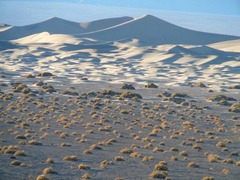
Soils transported by wind, typically consisting of silt-sized particles (loess) and fine sand.
What is the significance of stratigraphy in soil?
Stratigraphy refers to the layering of soils with different properties, similar to bedding in sedimentary rocks.
What are volcanic soils?
A special case of transported soils formed by volcanic processes, representing different volcanic events.
How are residual soils formed?
Residual soils are formed by weathering in place of the parent rock.

What processes contribute to the formation of residual soils?
Decomposition (chemical weathering) and disintegration (mechanical weathering).

What are organic soils and how are they formed?
Organic soils are formed by the growth and decay of plants and the accumulation of fragments of inorganic skeletons or shells of organisms.
What impact does the presence of organic materials have on soil behavior?
Organic materials can significantly influence soil behavior, often resulting in low strength and stiffness.
What are the key points that differentiate soil from other engineering materials?
Soil is natural, variable, multi-phase, and exhibits time-dependent behavior.
What factors influence soil formation?
Character of parent material, climate, topography, time, and biological and human activities.

What is the importance of understanding soil origins?
Understanding the origin of soil can inform its potential properties and behavior.
What is the typical behavior of transported soils in terms of sorting?
Sorting processes tend to produce more homogeneous deposits, especially for Alluvium and Aeolian soils.
What is the relationship between soil mechanics and transported soils?
Most soil mechanics is based on the behavior of transported soils.
What are the basic soil types?
Gravel, Sand, Silt, Clay
What is the grain size range for Gravel according to New Zealand standards?
60 - 2 mm
What is the grain size range for Sand according to New Zealand standards?
2 to 0.06 mm
What is the grain size range for Silt according to New Zealand standards?
0.06 to 0.002 mm
What is the grain size range for Clay according to New Zealand standards?
What is the total volume of soil composed of?
Volume of solids + Volume of voids

What influences the behavior of coarse-grained soils?
Particle sizes and the interaction between particles
What is a key characteristic of fine-grained soils?
Properties influenced by both particle size and composition
What are the two basic units that form clay building blocks?
Tetrahedral and Octahedral
What is the difference between 1:1 and 2:1 clay minerals?
1:1 has one tetrahedral and one octahedral sheet; 2:1 has one octahedral sheet between two tetrahedral sheets.
What type of bond is present in Kaolinite?
Strong hydrogen bonds that prevent water from entering between layers.
What type of bond is present in Montmorillonite?
Weak ionic bonds that allow water to enter between layers.
What is the visual classification of Gravels and Sands?
Easily visible to the naked eye with no cohesion when dry.
What is the typical appearance of clay particles?
Very small, typically flaky in shape and only visible under an electron microscope.
What is plasticity in relation to clay?
The ability of clay to be molded and remolded without separating.
What distinguishes Silts from Clays?
Silts exhibit dilatancy, while clays do not.
What are Organic Soils characterized by?
Distinctive odor and dark grey/black/brown color due to organic material.
What is the effect of water on clay properties?
Presence of water significantly influences swelling, shrinkage, and strength.
What is the significance of soil gradation?
It is a key aspect of soil classification and behavior.
What is the role of water in clay structure?
Water interacts with clay crystals, affecting their properties and behavior.
What is the typical behavior of silts when shaken?
They exhibit contractive behavior, reducing void space.
What are the engineering properties of Organic Soils?
Very different from other soil materials due to organic content.
What is the classification method for identifying soil types?
Visual methods and field classification techniques.
What is the typical size of clay particles?
Individual particles are not visible to the naked eye.
What happens to dry lumps of clay when exposed to water?
They disintegrate slowly.
What is the typical appearance of Silt particles?
Barely visible to the naked eye and finer than flour.
What is the significance of particle shape in soil classification?
It can influence the grading and behavior of the soil.
What is the impact of chemical weathering on clay formation?
It results in the formation of very small clay mineral particles.