Receptors and neurones
 Call Kai
 Learn
Learn Practice Test
 Spaced Repetition
 Match
Match Flashcards
 Knowt Play
1/17

There's no tags or description
Looks like no tags are added yet.
Name | Mastery | Learn | Test | Matching | Spaced | Call with Kai | Chat |
|---|
No analytics yet
Send a link to your students to track their progress
18 Terms
What is the structure of neurone
Cell body- contains nucleus and surrounded by cytoplasm
Dendrons- extensions of cell body, divide into dendrites and responsible for transmitting electrical impulses towards cell body
Axons- singular elongated nerve fibres that transmit impulse away from cell body

What are myelinated neurones
Some neurons covered in myelin sheath made of Schwann cells which produce layers by growing around axon many times
Myelin sheath acts like an insulator so impulses are carried much faster
Nodes of Ranvier between sheath in which impulses jump from one node to the next
What are types of receptor are there
Mechanical- pressure or bending opens ion channel
Thermoreceptors- temperature affects enzyme controlling ion channel
Photoreceptors- light alters membrane protein which controls ion channels
Chemoreceptors- chemical binds to receptor to open ion channels
How is resting potential reached
-70mV
Created due to protein pump Na+K+ATPase which uses ATP to pump 3 sodium ions out of cell and 2 potassium ions in
Sets up electrochemical gradient where charge outside higher than inside
Creates a higher Na⁺ concentration outside and a higher K⁺ concentration inside the axon.
K⁺ channels open, allowing K⁺ to diffuse out of the axon down its concentration gradient.
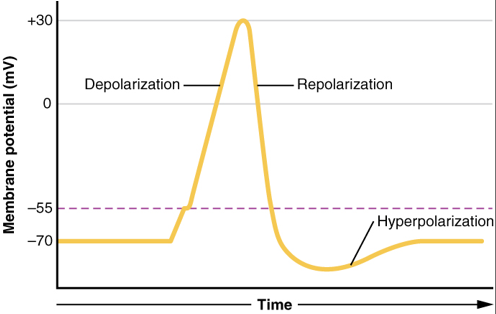
What is depolarisation
Stimulus results in sodium channels opening and sodium ions diffusing out of neurone
This occurs until threshold potential achieved at -55mV so voltage gated sodium ions open and more diffuse into cell until +40mV reached
What is repolarisation
Once potential difference reaches 40mV voltage gated sodium ions close and voltage gated potassium channels open
Potassium ions rush out of axon so it is more negative inside than outside
What is hyperpolarisation
Rush of K+ ions out of axon results in a resting potential more negative than -70mV so voltage gated potassium channels close
Action of sodium-potassium pump returns axon to resting potential
What is an action potential
A nerve impulse which is carried along neurone
What is a generator potential
Occurs when neurone becomes depolarised
Action potential graph
What are waves of depolarisation
When action potential occurs sodium ions enter neurone and diffuse sideways stimulating sodium channels in next region of neurone to open and sodium ions to diffuse into the area

What is the refactory period
Period of time in which ion channels cannot be stimulated again
This prevents propagation of action potentials backwards along axon
What is salutatory conduction
Only occurs in myelinated neurones as depolarisation can only occur at nodes of Ranvier
Electrical impulses jump from node to node as waiting for Na+ channels to open takes time

What other ways can action potential transmission be sped up
Axon diameter
Temperature
How can bigger stimulus be detected
As size of action potential is always the same the more frequent an action potential the bigger the stimulus

What is the action of neurotransmitter GABA
GABA reduces the number of action potentials in the postsynaptic neurone by opening chloride ion channels in the post-synaptic membrane which cause hyperpolarisation
What are transducers
Detect a stimulus
Stimulus energy can be converted into electrical energy
This can trigger generator potential
If threshold is reached action potential is generated transmitting impulses
How can the immune system damage the nervous system
Antigens on a neurone activate immune system
Antibodies against antigens produced
Phagocytes break down neurones