Anxiety
 Call Kai
 Learn
 Practice Test
 Spaced Repetition
 Match
 Flashcards
 Knowt Play
1/54

There's no tags or description
Looks like no tags are added yet.
55 Terms
Fear
Fear is an immediate response to a specific, identifiable threat occurring in the present, such as encountering a dangerous animal.
The response is generally proportional to the danger
It activates the sympathetic nervous system, producing increased heart rate, rapid breathing, muscle tension, and heightened alertness.
Fear usually decreases once the threat disappears.
Anxiety
Anxiety is a response to an anticipated, potential, or uncertain threat, often involving excessive worry about future events.
There is an activation of the natural survival mechanism in the absence of an immediate threat
It involves persistent vigilance and anticipation of possible negative outcome, accompanied by muscle tension and anticipation of future danger.
What is the difference between Fear and Anxiety?
Fear is primarily associated with an immediate threat, whereas anxiety involves anticipation of a future threat.
Both can produce similar physical symptoms, but anxiety may continue long after the immediate situation has passed.
Past Exam – 2024 Bet, Q17
Q: What characterizes anxiety?
A: A usually persistent feeling of an unclear threat.
Three components of Anxiety and the loop
threatening thoughts (cognitive) → physiological arousal (physiological) → avoidance or safety (behavior) → continued belief in danger
The avoidance cycle of Anxiety
Anxiety often becomes persistent through negative reinforcement.
1. the person encounters a trigger, leading to anxiety and physiological arousal.
2. To reduce this discomfort, they escape the situation or use a safety behavior.
3. Avoidance produces immediate emotional relief, which reinforces the behavior.
4. However, because the person never remains in the situation long enough to discover that the feared outcome may not occur, the anxiety continues.
Over time, avoidance prevents corrective learning and maintains the anxiety disorder.
Anxiety: Freud’s psychodynamic model explaining the core of anxiety
Freud's model of personality
Id (unconscious drives and impulses), Ego (reality-oriented decision-making), and Superego (internalized moral standards) have unresolved conflicts generating anxiety, and the ego attempts to reduce psychological distress through unconscious defense mechanisms: repression הדחקה, displacement התקה (redirecting feelings to someone uninvolved) and undoing ביטול (reverse or undo regretted action like buying flowers after a fight)
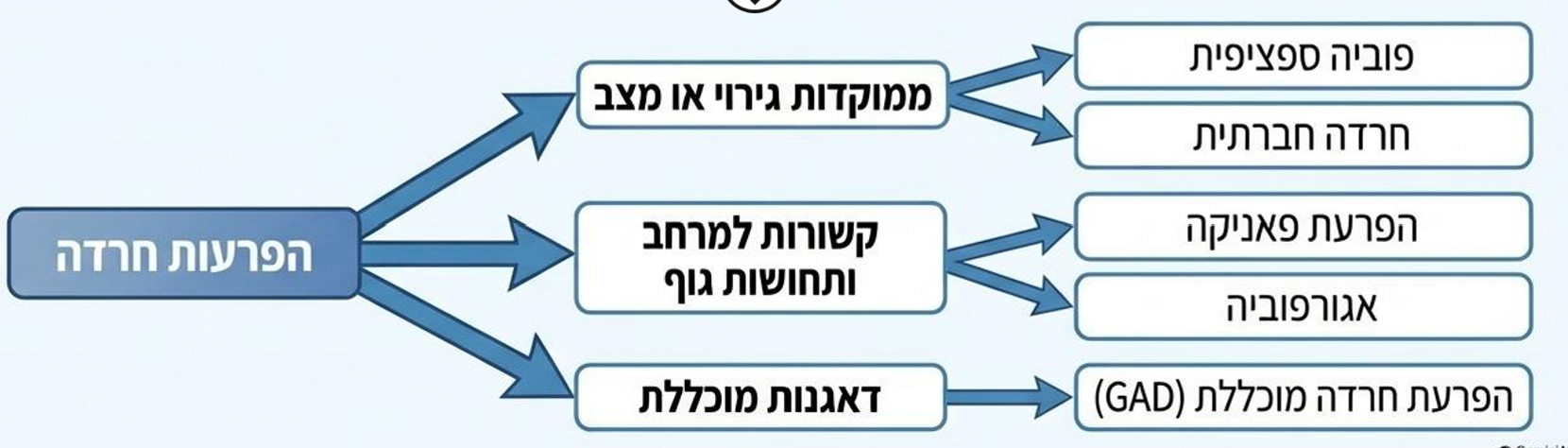
Anxiety disorders: Classification
Specific Phobia and Social Anxiety Disorder involve anxiety focused on particular objects, situations, or social evaluation. Panic Disorder involves recurrent panic attacks (which alone is not a pyshc disorder in the DSM-5,)
Agoraphobia involves fear of situations where escape or assistance may be difficult.
Generalized Anxiety Disorder (GAD) involves excessive, persistent worry across multiple areas of daily life.
Although these disorders differ in their triggers and symptoms, they share excessive fear or anxiety, avoidance behaviors, and clinically significant distress or impairment.
Anxiety: Panic Disorder
Panic disorder involves recurrent, unexpected panic attacks, characterized by sudden episodes of intense fear or discomfort that reach a peak within minutes. Symptoms may include palpitations, tachycardia, sweating, trembling, dyspnea, choking sensations, chest pain, dizziness, nausea, and fear of dying or losing control. - physiological anxiety and avoidance
To diagnose panic disorder, at least one attack must be followed by one month or more of persistent concern about additional attacks or their consequences, or maladaptive changes in behavior intended to prevent future attacks.’’
Treatment: Interoceptive Exposure
Note: experiencing a panic attack does not automatically establish panic disorder.
Anxiety: Interoceptive Exposure for Panic Disorder
Individuals with panic disorder may fear normal bodily sensations because they interpret them as signs of impending danger. Interoceptive exposure involves deliberately and safely reproducing feared physical sensations under professional supervision, such as increased heart rate, dizziness, or altered breathing sensations. Through repeated exposure, the patient learns that these sensations are uncomfortable but not necessarily dangerous, weakening catastrophic interpretations and fear of future panic attacks.
Anxiety: Panic Attack Specifier
A panic attack specifier can also describe panic attacks occurring in other psychiatric disorders;
Anxiety: Agoraphobia
Agoraphobia involves intense fear or anxiety about situations where escape may be difficult or help may be unavailable if panic-like, incapacitating, or embarrassing symptoms occur. Individuals often avoid these situations, require a companion, or endure them with significant anxiety. - physiological anxiety and avoidance
eg. public transportation, open spaces, enclosed spaces, crowds or lines, and being outside the home alone.
Diagnosis: According to DSM-5, the fear generally involves at least two of these five situations and persists for approximately six months or longer.
Past Exam – 2023 Aleph, Q5
Q: Which description is consistent with agoraphobia?
A: "I have a terrible fear of places where I do not know how I could escape."
Past Exam – 2023 Aleph, Q7
Q: A patient reports sudden episodes of trembling, sweating, and feeling that he is about to go crazy. What is the diagnosis?
A: Panic disorder.
Past Exam – 2023 Bet, Q22
Q: What characterizes a panic attack?
A: Rapid heart rate, trembling, and excessive sweating.
Past Exam – 2025 Bet, Q16
Q: What characterizes panic disorder?
A: Sudden anxiety attacks.
Past Exam – 2026 Aleph, Q14
Q: What is the main symptom of a panic attack?
A: Sudden onset of intense fear accompanied by various physical sensations
Anxiety: Generalized Anxiety disorder (GAD)
Generalized Anxiety Disorder (GAD) is characterized by excessive, persistent, and difficult-to-control worry about multiple areas of everyday life, including work, studies, health, finances, and family.
Rather than being focused on one specific situation, the worry shifts between concerns and often involves repeated thoughts about possible future problems or catastrophic outcomes.
Individuals may repeatedly seek reassurance, struggle with uncertainty, and devote excessive time to anticipating or preparing for negative events.
Diagnosis: According to DSM-5, anxiety and worry must occur on more days than not for at least six months.
Symptoms: physical and cognitive symptoms, including restlessness, fatigue, difficulty concentrating, irritability, muscle tension, and sleep disturbances. In adults, DSM-5 requires at least three of these six associated symptoms.
Treatment: CBT
Clinical distinction: GAD involves chronic, generalized worry across several life domains, rather than sudden attacks of intense fear or anxiety restricted to one particular situation.
Past Exam – 2024 Aleph, Q17
Q: A 25-year-old has years of excessive worries about work, studies, and relationships with irritability, restlessness, and muscle pain. What is the likely diagnosis?
A: Generalized anxiety disorder.
Past Exam – 2024 Bet, Q16
Q: Which statement most strongly supports generalized anxiety disorder?
A: "I do not sleep at night; problems in all areas of my life bother me."
Past Exam – 2025 Aleph, Q17
Q: What characterizes generalized anxiety disorder?
A: Excessive and persistent anxiety about a variety of issues.
Past Exam – 2025 Bet, Q14
Q: A person has excessive fear about family members dying together with worries about other areas of life. What is the most likely diagnosis?
A: Generalized anxiety disorder (GAD).
anxiety: CBT
CBT is a structured, goal-oriented treatment that identifies the relationship between thoughts, emotions, physiological sensations, and behaviors.
In generalized anxiety, therapy focuses on identifying automatic thoughts, recognizing cognitive distortions, particularly catastrophizing, and examining the evidence supporting feared outcomes. The patient learns to develop more balanced interpretations, improve tolerance of uncertainty, and reduce maladaptive coping behaviors.
Past Exam – 2023 Aleph, Q49
Q: What best characterizes CBT?
A: Transparency and mutuality: the patient defines the difficulties, and together with the therapist they define treatment goals and action plans.
Past Exam – 2023 Bet, Q49
Q: What is the basic assumption of CBT?
A: Difficulties result from learning and adopting maladaptive and limiting patterns of thought and behavior; treatment focuses on changing ineffective patterns and acquiring more appropriate skills through practice.
Past Exam – 2025 Aleph, Q49
Q: What characterizes CBT treatment?
A: A focused intervention aimed at solving a defined problem
Anxiety: Social Anxiety
Social anxiety disorder involves intense fear of social situations in which the individual may be observed, evaluated, embarrassed, criticized, or rejected by others.
Common triggers include public speaking, eating in front of others, meeting unfamiliar people, or performing tasks while being watched.
The individual fears behaving in a way that will lead to negative evaluation and consequently avoids social situations or experiences substantial anxiety during them.
Symptoms usually persist for six months or longer and cause significant impairment in social, academic, or occupational functioning
Anxiety: Specific Phobia
Specific phobia involves marked fear or anxiety associated with a particular object or situation, such as needles, spiders, heights, flying, or enclosed spaces.
Exposure to the feared stimulus produces an almost immediate anxiety response, often with physical symptoms.
The individual typically avoids the stimulus or endures it with intense distress.
The fear is disproportionate to the actual danger, generally persists for six months or longer, and interferes with functioning.
Past Exam – 2023 Aleph, Q4
Q: Which of the following descriptions characterizes a specific phobia?
A: "When I see a spider, I immediately run home."
Past Exam – 2024 Aleph, Q14
Q: What is the overall intervention goal for a patient with social phobia and social isolation?
A: The patient will participate in group activities.
Past Exam – 2024 Aleph, Q16
Q: Which behavior characterizes a specific phobia?
A: Dizziness and feeling faint before receiving a COVID-19 vaccination.
Past Exam – 2025 Aleph, Q14
Q: A person fears public speaking and eating around others and avoids these situations. What is the most likely diagnosis?
A: Social phobia.
Anxiety: OCD diagnosis and treatment
Obsessive-Compulsive Disorder (OCD) involves recurrent obsessions, compulsions, or both.
Diagnosis generally requires symptoms that are time-consuming (for example, more than one hour per day) or cause clinically significant distress or impairment.
Treatment: The preferred psychological intervention is Exposure and Response Prevention (ERP), a specialized form of CBT.
The individual gradually confronts feared situations or thoughts while resisting the compulsive response, allowing new learning that anxiety and uncertainty can be tolerated without rituals.
Anxiety: OCD - Obsessions
Obsessions are persistent, intrusive, and unwanted thoughts, urges, or images that produce significant anxiety or distress. These thoughts are often experienced as inconsistent with the person's values or intentions.
eg. fears of contamination, harming another person, or making a serious mistake.
Anxiety: OCD - Compulsions
Compulsions are repetitive behaviors or mental acts performed in response to obsessions or according to rigid internal rules. Their purpose is usually to reduce anxiety or prevent a feared event, even when the behavior has no realistic connection to preventing that outcome.
Examples include excessive handwashing, checking, counting, and repeating phrases.
Anxiety: OCD Cycle
An intrusive obsession generates anxiety, which leads the individual to perform a compulsion. The ritual produces temporary relief, reinforcing the behavior through negative reinforcement. However, because the underlying fear is not resolved, the obsession returns and the cycle continues.

Past Exam – 2023 Aleph, Q6
Q: What does "compulsion" refer to in OCD?
A: Actions that a person performs repeatedly in order to reduce anxiety.
Past Exam – 2023 Aleph, Q8
Q: Why does a patient with OCD repeatedly clean?
A: Cleaning reduces the intensity of anxiety and produces temporary relief.
Past Exam – 2023 Bet, Q23
Q: What describes an obsession?
A: An intrusive thought that causes anxiety.
Past Exam – 2025 Aleph, Q16
Q: What is the overall nursing-education goal for a patient with OCD?
A: The patient will reduce the frequency of compulsive rituals.
Past Exam – 2026 Aleph, Q15
Q: What is the treatment recommendation for a patient with OCD?
A: Have an open discussion about the rituals and gradually reduce them.
Anxiety: Differential Diagnosis
Other factors may produce similar psychological and physiological symptoms
Medications and Drugs, Cardiovascular conditions, Endocrine and metabolic conditions like hyperthyroidism, Resp. conditions, Caffeine, alcohol, withdrawal
Anxiety: Clinical assessment, Hamilton Anxiety rating scale
MSE - mental status examination
Hamilton Anxiety rating scale - HAM-A: a clinician-rated instrument used to evaluate the severity of psychological and somatic anxiety symptoms. It may help monitor response to treatment but does not independently establish a diagnosis.
Therapeutic communication
Anxiety: Nursing management during
Safety and physical examination
reduce Environmental stimulation (lights, sound etc.)
Emotional support, communication, help regulate
education and continued treatment
Anxiety: Exposure therapy and inhibitory learning: subjective units of distress (SUDS)
Anxiety intensity using Subjective Units of Distress (SUDS), typically rated from 0 to 100
eg. a patient afraid of crowded locations may rate standing outside a store as 20/100, entering the store as 50/100, and traveling on a crowded bus as 90/100.
Anxiety: Exposure therapy and inhibitory learning
Anxiety hierarchy using SUDS (subjective units of distress) - rates anxiety 0-100 for certain situations
Gradual and repeated Exposure חשיפה מבוקרת - The patient is guided through feared situations in progressively more challenging steps, ideally remaining engaged without unnecessary avoidance or safety behaviors
Inhibitory learning: למידה מעכבת Exposure produces new learning that competes with the original fear association
Anxiety: Flooding vs. Gradual exposure
Flooding: direct confrontation with highly feared stimuli. Gradual exposure is generally more tolerable and widely used.
Past Exam – 2024 Bet, Q14
Q: For which diagnosis would treatment likely include gradual exposure?
A: Specific phobia.
Anxiety: Mindfulness and other therapies
Acceptance and Commitment Therapy
Acceptance
Cognitive Defusion
Values-Based Action
Mindfulness - awareness of present-moment experiences without judgment, reducing automatic reactions to distressing thoughts and sensations.
Past Exam – 2025 Aleph, Q50
Q: What is one of the main benefits of mindfulness-based treatment for mental disorders?
A: Developing awareness and attention to the present moment in order to reduce stress and anxiety.
Note on pharma treatments

Note on Peplau’s levels of anxiety
Mild, Moderate, Severe, Panic level

Note on Holistic & Multidisciplinary Treatment

Clinical Presentation: A patient arrives at the emergency department reporting shortness of breath, rapid pulse, intense fear, sweating, chest tightness, and a feeling of impending death. The patient states, "I am having a heart attack." Although these symptoms may be consistent with a panic attack, potentially serious medical conditions must be assessed before attributing the presentation to anxiety.
What is the initial intervention, how to do a clinical assessment, environmental interventions…
