lecture 4: different method of drug administation
 Call Kai
 Learn
 Practice Test
 Spaced Repetition
 Match
 Flashcards
 Knowt Play
1/15

There's no tags or description
Looks like no tags are added yet.
16 Terms
what are the 3 different method of administration
repeated dosing
infusion
loading dosage
what is dosing interval
time between 2 consecutive dose
what is repeated dosing
the drug is being administrated repeatedly at a regular time inteval
the administrated drug will replace the amount of drug being excreted
the administrated drug will also build up on the remaining dose from the pevious dosing residual
describe the process of repeated dosing
1. after each dose plasma concentration increase
2. elimination occur between 2 doeses, cause decrease in blood plasma concentration
3. the next dose applied added up to the previous remaining dose, this will build up the blood plasma concentration
4. the plasma concentration need to be within the therapeutic window between the MEC and MTC.
5. Eventually the drug will reach the steady state.(between Cmax and Cmin)
-shorter dosing interval will cause more fluctuation in the blood plasma
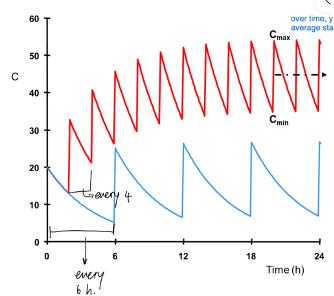
how does the dosing interval and half-life affect the repeated dose
what is infusion
small amount of drug will be administrated at constant rate (mg/h) constantly, and it corresponded to the zero-order administration
the steady state concentration will be reached after 5 half-live
the declined in the plasma concentration is usually caused by the one compartment model and 2-compartment model

what is the rate of infusion and the related infusion rate
the amount of drug administraed into the bloodstream per unit time during IV

what are the 3 factors affect the blood concentration for infusion
rate of iinfusion
volume distribution of the drug
elimination half-life of the drug
what is the advantage of applying infusion
stable blood plasma concentration
- unlike the repeated dosing, infusion can provide a stable plasma drug concentrationsuitable for drug with short half-life
what is the disadvantage of the infusion
long-time is needed to reach the steady state: 5 half-life
what is loading dose and maintainance dose
loading dose: increase the blood plasma concentration within a short time
Maintainance dose: the drug needed to maintain the steady state of the drug after loading dosage
How to combine the loading dose with the maintainance dose
the loading dose can be first used to increase the blood plasma concentration to an desired level within a short time
after reach the desired blood plasma concentration, we can use the maintainance dose to keep the blood plasma concentration at a steady state
equation for the loading dose
Vd: volume of distribution
Css: steady state concentration

compare the repeated dose, infusion, loading dose, in terms of
1. main purpose
administration route
time to reach the steady state
disadvantage
| Repeated dose | Infusion | Loading dose |
Main purpose | Maintain the therapeutic exposure over time | Maintain stable plasma concentration | Achieve the target concentration with one dose |
Administration method | Intermittent | Continuous | Single bolus injection |
Time to reach steady state | 4-5half-life | -5half-life | Immediately |
Disadvantage | Fluctuation | Requires IV access; slow approach to steady state | Risk of excessive initial concentration if incorrectly calculated |
what is therapeutic drug monitoring
periodically analyse the drug concentration in the blood
what are the 3 functions of the therapeutic drug monitoring
standard care for specific drug
to adjust the dose
- Prevent the drug is below MEC (absence of effect)- Intoxication(>MET)
to check patient compliance
-eg. for certain anti-depressant, to check if the patient follow the treatment