1.1 Nature of Economics
 Call Kai
 Learn
 Practice Test
 Spaced Repetition
 Match
 Flashcards
 Knowt Play
1/68

Earn XP
Description and Tags
Theme 1: Microeconomics, Introduction to markets and market failure
69 Terms
What is the basic economic problem?
the problem of scarcity
The main economic problem
The main economic problem is the problem of scarcity
there are unlimited wants but limited resources
decisions have to be made about how to allocate resources
decisions must be made about what to allocate, how to allocate and who to allocate resources to
these decisions incur opportunity costs
What are opportunity costs?
The next best alternative is forgone
What are the two types of resources?
renewable, non-renewable
What are non renewable resources?
resources that are finite/limited in supply
There is an ___________ ____ in the use of non renewable resources
opportunity cost
Opportunity cost example non renewable resources
oil- if used in one way, other possible uses are forgone (since oil is finite)
Examples of non-renewable resources
coal, oil, natural gas
What are renewable resources?
Resources that can be replenished as they are used
Examples of renewable resources
solar, wind, tidal, wave energy
What are the three economic agents?
consumers
producers
government
What does a consumer do?
use or buy goods/services
Main incentive for a (rational) consumer
maximise utility (usefulness of money)
What does a producer do?
make and sell goods/services
Main incentive for a (rational) producer
maximise profit
The exchange of money between consumers and producers is called a..
transaction
Producers and consumers interact within a…
market
Who may sometimes intervene in the market?
government
Main incentive for the government
maximise consumer welfare
What are the two types of statement?
positive
normative
What makes a statement positive?
factual statement
backed with evidence
evidence or records can be checked
this evidence proves the statement to be true or false
What makes a statement normative?
it is an opinion based statement/ value judgement
cannot be proven true or false
often uses terminology ‘should’ ‘could’ ‘ought’
the statement is subjective
What type of science is economics?
a social science
What is economics the study of?
how societies allocate scarce resources to meet unlimited wants
What do economists use to simplify and analyse complex economic situations?
models
Economic models use ___________
assumptions
What are assumptions?
simplifications made in economic models to focus on key variables
Advantages of economic models
they allow economists to make predictions, test theories and guide policy
Limitations of economic models
models are simplifications of reality and may not capture all complexities
assumptions can be unrealistic, leading to inaccurate predictions
What assumption is made in making models?
ceteris paribus
Define ceteris paribus
only one thing changes at a time and all other things remain constant
Importance of ceteris paribus
simplifies complex economic relationships and makes them more understandable
helps identify cause-and-effect relationships between variables
Critique of ceteris paribus
in the real world, it is challenging to hold all variables constant because changes in one variable often lead to changes in others
Economic models full answer
Economics is a social science and therefore focuses on the study of society. However, society is complex. As a result, economists use models to simplify and predict complex human behaviours. These models use the assumption of ceteris paribus which is the idea that only one thing changes at a time and all other things remain constant
In economics, is it possible to make scientific experiments
no
What are the characteristics of scientific experiments?
controlled conditions, manipulation of variables and replication
The inability in economics to make scientific experiments
economics deals with complex, dynamic human behaviour influenced by numerous variables
economic experiments are often uncontrolled, making it difficult to isolate variables
What type of experiments do economists use?
natural experiments (real world events)
What does PPF stand for?
production possibility frontier
Production possibility frontier definition
maximum combination of two goods a country can make when all resources are fully and efficiently used
Types of resources
Capital (machines)
Enterprise (entrepreneurs and ideas)
Land (physical space and raw materials)
Labour (the work force)
Two types of goods
consumer
capital
What are capital goods?
goods used to produce other goods and services
What are consumer goods?
final good ready for use and consumption
Investment in which type of good leads to economic growth?
capital
What do consumer goods satisfy?
immediate needs and wants
PPF showing economic growth
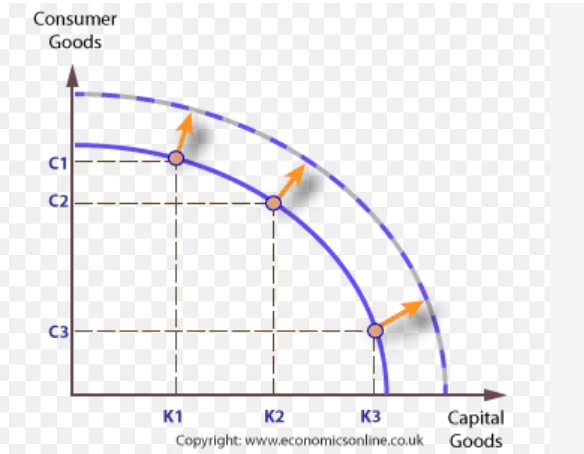
Factors causing economic growth
increased population
new discoveries
better technologies
Economic growth is represented by an _______ _____ of the PPF
outward shift
PPF showing economic decline
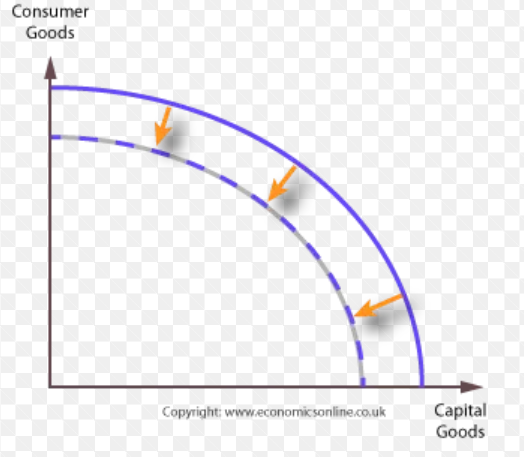
Factors causing economic decline
war
natural disasters
Economic decline is represented by an ______ _____ of the PPF
inward shift
PPF showing efficient vs inefficient vs unattainable use of resources
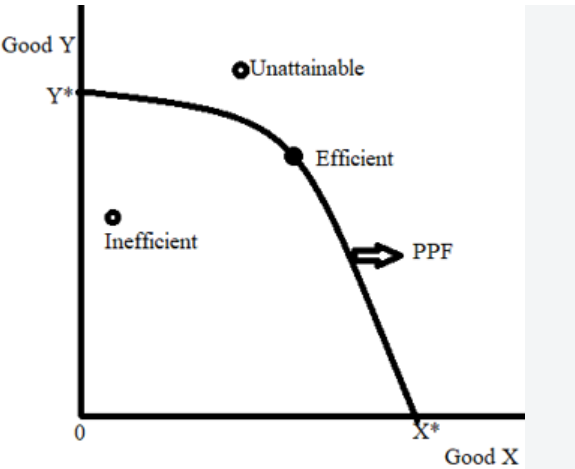
PPF showing movement

Movement along the PPF causes an…
opportunity cost
Max productive potential on a PPF
start and end points of the curve
Define division of labour
the splitting of a task into stages which are assigned to different members of labourD
Define specialisation
one member of labour is given a specific job or task
Adam Smith’s contribution to specialisation & division of labour
emphasized the benefits of specialisation
observed in a pin factory that pins could be made more quickly through division of labour + specialisation
Advantages of specialisation
Increased productivity
→ Specialisation allows workers to become more skilled in specific tasks, leading to higher efficiencyIncreased production
→ Specialisation = less time wasted, increased use of machinery = increased production of goodsLower costs
→ Reduced training time, reduced waste
Disadvantages of specialisation
Monotony
→ workers may find repetitive tasks boring
→ increased worker turnoverLoss of skills
Dependency
→ An economy heavily dependent on a single industry or export can be vulnerable to economic shocks
Advantages of specialisation for trade
Comparative Advantage
→ nations can focus on producing goods and services where they have a comparative advantage
→ leads to higher efficiencyIncreased standard of living
→ trade allows access to wider variety of goods and services
Disadvantages of specialisation for trade
over dependence
→ war or conflict may lead to goods no longer being available
→ reliance on trade exposes nations to risks such as changes in global demand or supply disruptionsincome inequality
→ may benefit certain industries or regions more than othersmay cause mass unemployment
What are the functions of money?
Measure of value
→ provides a common measure of the value of goods and servicesStore of value
→ can be stored or saved for future use, preserving value over timeMethod of deferred payment
→ allows for transactions where payment occurs at a later dateMedium of exchange
→ facilitates the exchange of goods and services
What are the three different types of market?
Free market economy
Command economy
Mixed economy
Free market economy
individuals are free to make their own choices
resources are allocated through the price mechanism
no government intervention
Advantages of the free market
the system is automatic due to the invisible hand
consumers have freedom of choice (consumer sovereignty)
profit incentive drives efficiency, innovation and entrepreneurship
competition leads to lower prices and better quality
Disadvantages of the free market
inequality and poverty
little control of demerit goods
there may be monopolies'
Command economy
an economy where the government controls the allocation of resources and distribution of goods and services