Market Structures
 Call Kai
 Learn
 Practice Test
 Spaced Repetition
 Match
 Flashcards
 Knowt Play
1/21

Earn XP
Description and Tags
ECON127 L4
22 Terms
Types of Market structures
Perfect competition
Monopoly
Monopolistic competition
Oligopoly
Factors to classify markets
number of firms - (one firm - monopoly, lots - perf)
freedom of entry to industry - (cost/ start up costs, how easy to enter)
nature of product
nature of demand curve

Learn this table and extra info
More competition - good for consumer
Less competition - less good for consumer but good for firm
How easy to enter marketplace
Monopoly - Not easy
Oligopoly - Not as easy to enter the market
Easy to hardest
Undifferentiated - not much differences between the products
Differentiated etc - mono- is not the same as anything else
Olgi - Is but also isnt in the same time
Quality of cabbage wont be the same and type but cabbage is a cabbage
Perf - have to take the price that is given, cant really change
Monopolistic -
Less control to more control
All apart from perfect competition - price making takes place.
Perfect competition cannot control the price

Perfect competition assumptions
Firms are price takers
Freedom of entry
Identical products
Perfects knowledge as there are lots of firms already
extra info
Best thing for consumer
Worst for firms to make money
Anyone can open up a company
Selling identical things
Most level of competition you can have

The short term equilibrium of industry and firm under perfect competition
A - Whole industry (whole market) all the firms
Pe = equilibrium price for item
B - One company
Not selling millions but thousands, makes up the millions of the industry
If u deviate, no one will buy, if u go below the price, you will make a loss
AR is equal on both
Best thing AR = MC
Qe is the profit maximising value
If u choose a smaller price, would attract the market, but lose money on every item u sell so therefore losing overall.
Cant be sustained for a long time at all
Put out of business in long term
In short term there would be profit but long term not sustained
Shaded blue section- revenue> cost = short term

The short term supply curve
If they decide P1 is equib
Hypothetical demand
In the short term - it is profit maximisation even though you might not get a lot of money but it is the best price could be picked.
If D2 is what dictates the demand , P2 would be the Price, less quantity, but
Dictating short term supply

In the long run of perfect competition
All supernormal profits are competed away
LRAC = AC = MC = MR = AR
Businesses dont have control over the price
Eg - A company started making more profit than others, other firms would enter the market, take all the market away from you, so profit will decrease. So profits will get back to normal. Therefore go back to equib.
One company high profit - short term will then convert to the same profit in long term.
As new firms enter, more supply , therefore will be lower price as more supply.

The benefits and negatives of perfect competition
Benefits
price = marginal cost - (allocative efficiency)
firms must be efficient to survive - (productive efficiency)
least cost output - production at bottom of LRAC
prices kept low
most efficient outcome for the market
no waste, efficient in supply and demand, no excess
Negatives
incompatibility of economies of scale
good for customer as cheap - worse for business
not the best for own profit
What is a Monopoly?
One producer supplying the whole market. No competition at all. It is the whole industry.
How the monopoly maintain their power
Economies of scale: natural monopoly - only one place can supply specific item like oil
Absolute cost advantages: superior tech - producing smth new, input controls etc.
High switching cost, legal protection, M&A
How does the monopolist’s demand curve look like
downward sloping
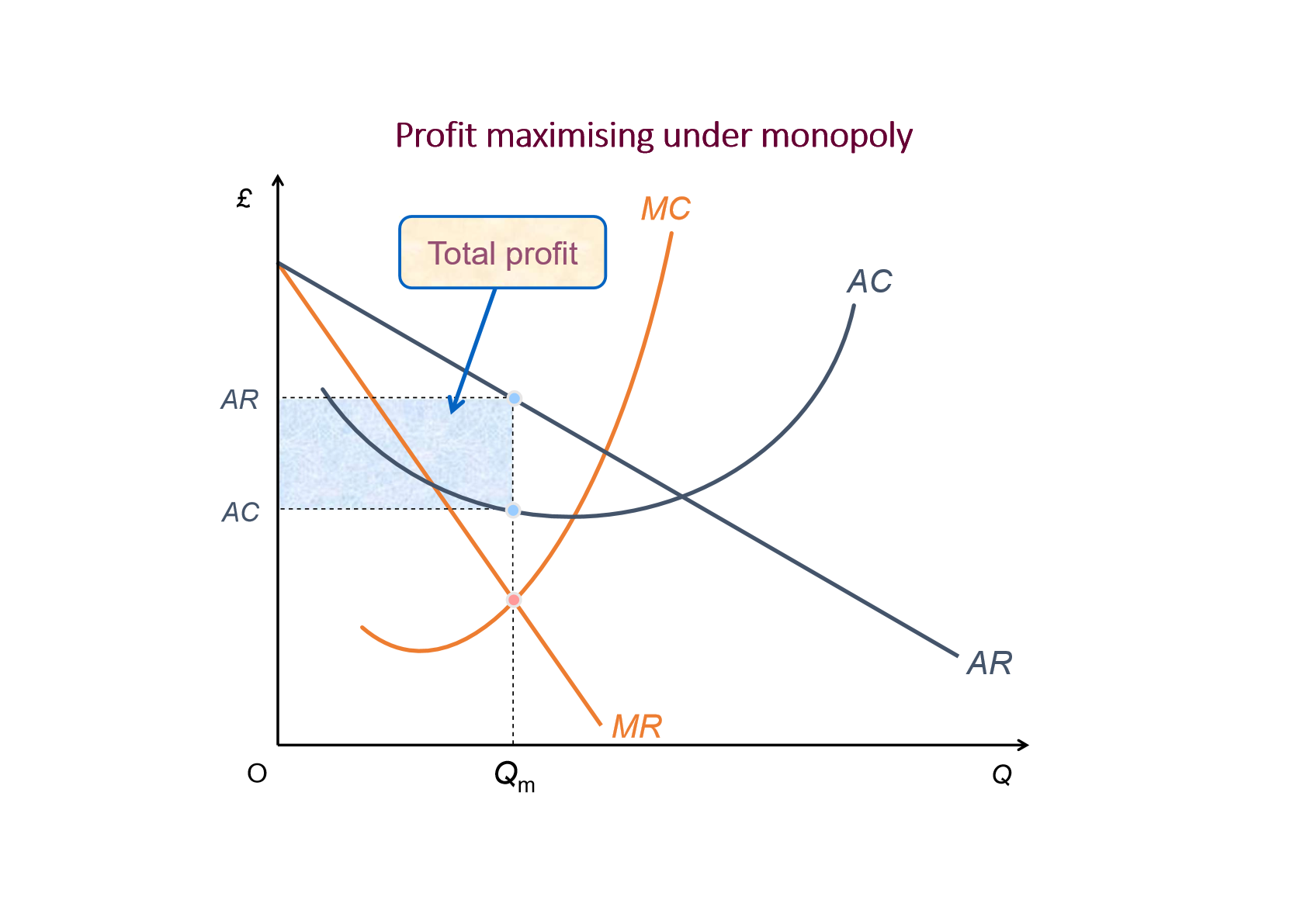
MR below AR
equib output =MC = MR
industry = market bc only one firm

Finding equib price and profit from demand curve
AR>AC therefore profit is made. Profit made in the long term is the blue shaded section. The best that the monopoly can do.
Advantages and disadvantages of a monopoly
Advantages
Economies of scale
Disadvantages
High prices/low output: short run and long run
lack of incentive to innovate

GRAPH MISSRD
another graph
What is monopolistic competition?
quite a large number of firms
freedom of entry
product differentiation
The short run equilibrium of the firm under monopolistic competition
Not the only company, firm decides the price. Depending on the quantity, thats the price you set. Blue shaded region = profit. Not as extreme as monopoly.

The long run equilibrium of the firm under monopolistic competition
