General Science - Life Science - The Animal Kingdom: Vertebrates
 Call Kai
 Learn
 Practice Test
 Spaced Repetition
 Match
 Flashcards
 Knowt Play
1/143

There's no tags or description
Looks like no tags are added yet.
144 Terms

How should position A be labeled?
Warm-Blooded
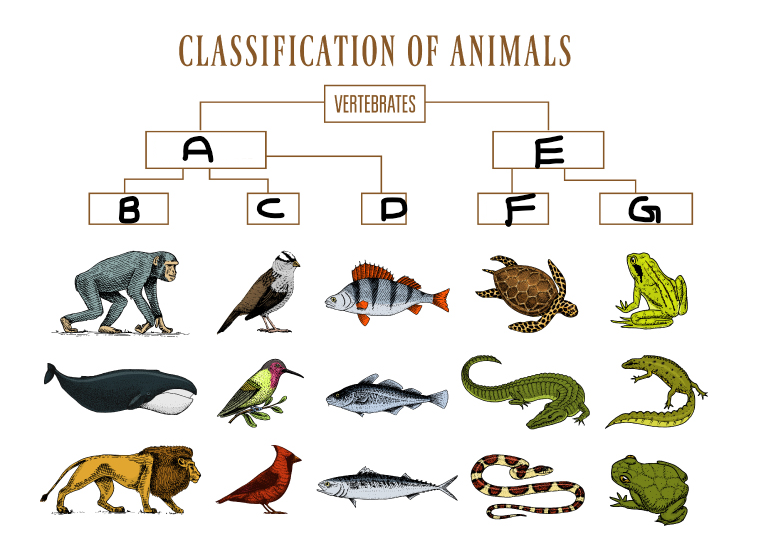
How should position B be labeled?
Mammals

How should position C be labeled?
Birds

How should position D be labeled?
Fish

How should position E be labeled?
Cold-Blooded

How should position F be labeled?
Reptiles

How should position G be labeled?
Amphibians
Which of the following accurately identifies the five distinct classes of vertebrates that make up the phylum Chordata?
Fish, Amphibians, Reptiles, Birds, and Mammals
What structural relationship exists between the phylum Chordata and the five vertebrate groupings?
The phylum Chordata encompasses five principal classes of vertebrates, including fish, amphibians, reptiles, birds, and mammals.
Fish are classified as __________, meaning their internal body temperature varies with their surrounding environment.
cold-blooded
Which statement best describes the primary physiological property of fish regarding temperature regulation?
They are cold-blooded organisms whose body temperature adapts to ambient water conditions.
What specialized internal respiratory organ do fish use to extract oxygen from water?
Internal gills
How do the respiratory mechanisms of fish differ from land-dwelling adult vertebrates?
Fish utilize internal gills for respiration, whereas many adult land vertebrates breathe air through lungs.
For aquatic locomotion and steering, fish rely primarily on specialized anatomical structures known as __________.
fins
What are the primary structural properties of fish regarding movement through water?
They utilize fins for propulsion and steering in aquatic environments.
Which of the following aquatic vertebrates is explicitly classified as a fish?
Bass
Which of the following organisms is NOT an example of a fish?
Toad
Which of the following swimming chordates is categorized as a fish?
Perch
Which of the following creatures is NOT recognized as a fish?
Snake
Which of the following marine animals is identified as a fish?
Shark
Which of the following options correctly lists representative examples of fish?
Bass, trout, perch, mackerel, and shark.
Which vertebrate class is specifically defined by the ability to live both in the water and on land?
Amphibians
What environmental relationship defines the habitat adaptability of amphibians?
They possess dual-habitat capabilities, allowing them to thrive both in aquatic and terrestrial environments.
Similar to fish, amphibians are __________ vertebrates whose body temperature matches their external environment.
cold-blooded
Which property characterizes the metabolic temperature regulation of amphibians?
They exhibit cold-blooded thermal characteristics dependent on environmental heat sources.
During their life cycle, amphibians undergo developmental changes where they specifically develop __________ in the adult stage.
lungs
How does respiratory development shift across the lifecycle of amphibians according to the notes?
They develop functional lungs specifically upon reaching the adult stage.
Which of the following organisms is a well-known amphibian?
Frog
Which of the following animals is NOT classified as an amphibian?
Turtle
Which of the following creatures is categorized as an amphibian?
Salamander
Which of the following options correctly lists representative examples of amphibians?
Frog, toad, and salamander.
Reptiles are __________ animals whose body temperature varies with the external environment.
cold-blooded
Which property describes the thermal classification of reptiles?
They share a cold-blooded metabolic profile.
How do reptiles primarily accomplish respiration according to their physiological traits?
Breathe air through lungs
What distinguishes the respiratory method of reptiles from that of fish?
Reptiles breathe air through lungs, whereas fish use internal gills for respiration.
Most reptiles utilize __________ for physical movement, with the notable exception of snakes.
legs
What characteristic defines locomotion across the reptile class?
They possess legs for movement, with snakes serving as the sole exception.
In terms of reproduction, most reptiles lay eggs equipped with __________ shells.
tough
How do the egg shell characteristics of reptiles compare to those of birds?
Most reptiles lay eggs with tough shells, whereas birds lay eggs with brittle shells.
Which of the following creatures is classified as a reptile?
Alligator
Which of the following animals is NOT considered a reptile?
Salamander
Which of the following is identified as a reptile?
Lizard
Which of the following organisms is NOT a reptile?
Turkey
Which of the following is a reptile?
Turtle
Which of the following options correctly lists representative examples of reptiles?
Alligator, crocodile, lizard, snake, and turtle.
Birds are uniquely classified as __________ animals that possess specialized anatomical structures including feathers and wings.
warm-blooded
What key combination of properties defines the class of birds?
Warm-blooded metabolism accompanied by feathers and wings.
Regarding their reproductive cycle, birds lay eggs characterized by having __________ shells.
brittle
How do bird eggs structurally differ from reptile eggs based on the provided notes?
Birds lay eggs with brittle shells, whereas most reptiles lay eggs with tough shells.
What economic and biological property regarding bird diversity is correct?
There are many different kinds of birds, with some species specifically raised for human consumption.
What relationship exists between the vast diversity of birds and human agricultural practices?
The broad diversity of birds includes select varieties that humans raise for consumption purposes.
Which of the following birds is commonly raised for human consumption?
Chicken
Which of the following animals is NOT classified as a bird?
Alligator
Which of the following feathered vertebrates is classified as a bird?
Turkey
Which of the following options correctly lists representative examples of birds raised for human consumption?
Chicken, goose, and turkey.
Mammals constitute one of the five official classes of vertebrates belonging to the phylum __________.
Chordata
Mammals maintain a stable internal body temperature regardless of environmental conditions, classifying them as __________ animals.
warm-blooded
Which of the following describes the metabolic thermal regulation property of mammals?
Mammals are warm-blooded.
The bodily surface of a mammal is covered with __________.
hair or fur
What anatomical surface feature is characteristic of all mammals?
Hair or fur on their bodies
Which respiratory organ is used by mammals to breathe?
Lungs
Mammals perform gas exchange and breathe by means of __________.
lungs
What is the relationship between newborn mammals and their mother's physiological adaptations?
Newborns are fed milk from the mother's mammary glands.
From which glands do newborn mammals receive milk from their mothers?
Mammary glands
On what basis are mammals divided into many distinct taxonomic orders?
Differences in body structure
Mammals are divided into many orders based on variations in __________.
body structure
Which of the following organisms is classified as a mammal?
Duckbill platypus
Which of the following organisms is NOT classified as a mammal?
Ostrich
Which of the following belongs to the class of mammals?
Beaver
Which of the following organisms is NOT classified as a mammal?
Lizard
Which of the following organisms is classified as a mammal?
Rat
Which of the following organisms is NOT a mammal?
Chameleon
Which of the following organisms is categorized as a mammal?
Dolphin
Which of the following organisms is NOT a mammal?
Tuna
Which of the following organisms is a mammal?
Whale
Which of the following animals is NOT classified as a mammal?
Parrot
Which of the following animals is classified as a mammal?
Dog
Which of the following animals is NOT a mammal?
Owl
Which of the following is classified as a mammal?
Lion
Which of the following animals is NOT a mammal?
Vulture
Which of the following animals is categorized as a mammal?
Cow
Which of the following animals is NOT classified as a mammal?
Pheasant
Which of the following animals is classified as a mammal?
Horse
Which of the following animals is NOT a mammal?
Duck
Which of the following animals is classified as a mammal?
Sheep
Which of the following organisms is NOT a mammal?
Toucan
Which of the following organisms is classified as a mammal?
Human
Which of the following organisms is NOT classified as a mammal?
Tree frog
Which of the following options correctly lists representative examples of mammals?
Duckbill platypus, kangaroo, beaver, mouse, rat, squirrel, dolphin, porpoise, whale, cat, dog, fox, lion, wolf, cow, deer, horse, pig, sheep, ape, human, and monkey.
Which order represents the most primitive mammals, defined by laying eggs?
Monotremes
What are the defining evolutionary characteristics of monotremes?
They are the most primitive mammals and lay eggs.
Which of the following egg-laying mammals is classified as a monotreme?
Duckbill platypus
Which option lists an example of the order Monotremes?
Duckbill platypus
Marsupials are mammals that carry their young in a __________ on the mother's body.
pouch
What key physical characteristic defines marsupial mammals?
They carry their young in a pouch on the mother's body.
Which pouch-bearing mammal belongs to the marsupial order?
Kangaroo
Which option identifies a representative example of a marsupial?
Kangaroo
How are rodents defined structurally and behaviorally?
Gnawing mammals
The mammal order defined specifically by their gnawing adaptations is the __________.
Rodents
Which animal is classified as a rodent?
Beaver