Sustainable development
 Call Kai
 Learn
Learn Practice Test
 Spaced Repetition
 Match
Match Flashcards
 Knowt Play
1/52

There's no tags or description
Looks like no tags are added yet.
Name | Mastery | Learn | Test | Matching | Spaced | Call with Kai | Chat |
|---|
No analytics yet
Send a link to your students to track their progress
53 Terms
What is sustainable development ?
development that meets the needs of the present without compromising the ability of future generations to meet their own needs
3 pillars:
society
economy
environment
Why is it so difficult to achieve sustainable development ?
Jevons Paradox
Population growth
What is the Jevons paradox
Increased efficiency in the use of a resource can lead to increased consumption of that resource, offsetting or even exceeding the expected savings.
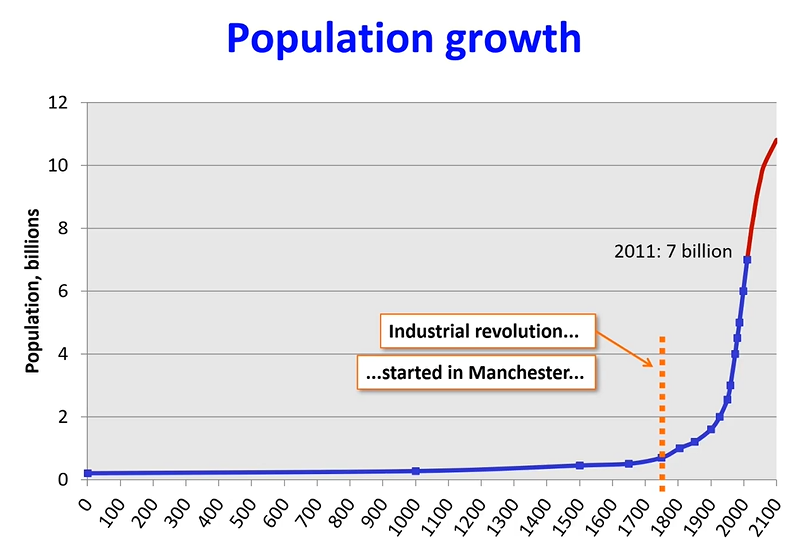
Why is population growth a challenge for sustainable development?
A growing population increases demand for food, water, energy and shelter, putting greater pressure on resources and the environment.
Why is population growth generally higher in less economically developed countries?
Lower access to education, healthcare and contraception contributes to higher birth rates and faster population growth.
What are some environmental issues ?
climate change
ozone layer depletion
acid rain
loss of biodiversity
summer and winter smogs
eutrophication
human and eco-toxicity
resource depletion
What are the main causes for loss of biodiversity ?
Habitat destruction/degradation
hunting
ocean acidification
competition for resources
causing extinction rates far above natural background levels
What is resource depletion ?
The consumption of natural resources faster than they can be replenished, including water, land, fossil fuels, minerals and metals.
What are the main social and economic sustainability issues?
Unequal global wealth distribution, poverty and unsustainable levels of debt


What does life cycle thinking consider when meeting consumer needs?
It considers the resources, environmental impacts, economic costs and benefits, and social impacts and benefits across a product’s whole life cycle.
Food life style thinking
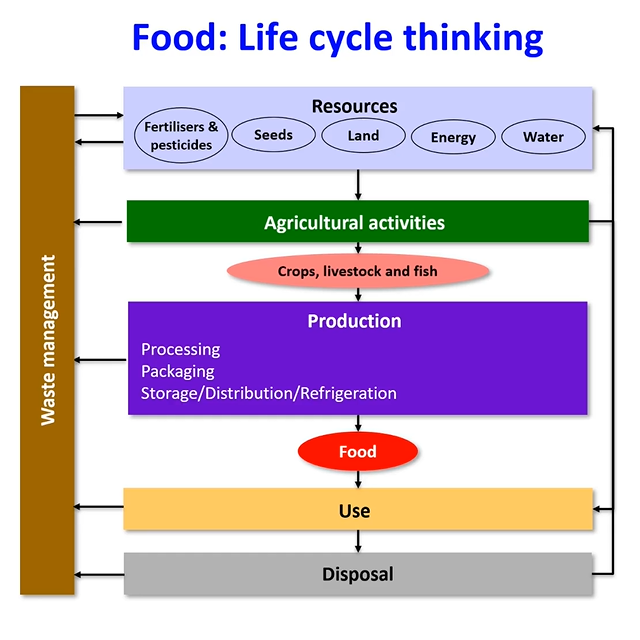

What does the carbon footprint of tomatoes demonstrate?
The same food can have a very different carbon footprint depending on where and how it is produced; UK tomatoes have a much higher GWP than Spanish tomatoes
Transport life style thinking


What does comparing the carbon footprints of different fuels show?
Carbon footprint depends on the fuel and how it is produced; some biofuels have lower emissions than petrol, while others can be higher
What are our energy supply options ?
Fossil fuels
Renewables
Nuclear
Hydrogen
What are the sustainability issues associated with fossil fuels?
Sufficient to meet energy demand this century
Climate change implications make them an unsustainable option
Carbon capture and storage: reduces efficiency and can leak
Efficiency improvements: crucial, but still reliant on fossil fuels
What are the sustainability issues associated with renewables?
High costs
Often high resource depletion
Social issues
What are the sustainability issues associated with nuclear?
High risks
Socially unacceptable
What are the sustainability issues associated with hydrogen?
Not a source! Not sustainable if from fossil-based resources
Consumer resistance - explosive
The ultimate solution to improve our efficiency with energy use is
to reduce our demand
Energy life cycle thinking


Direct emissions vs life cycle emissions
Life cycle emissions are higher than direct emissions because they include the entire life cycle (e.g. extraction, construction and decommissioning)
Water life cycle thinking

What are the solutions to water sustainability issues?
Provision of water to developing countries.
Increased efficiency of use – e.g. using grey water for toilets or gardens.
Reducing demand – changes in consumer behaviour.
New water sources – e.g. seawater desalination.
Housing life style thinking

What are the sustainability issues associated with housing?
Energy use in buildings constitutes 30–50% of total energy requirements of a society
Contributes to more CO₂ emissions than traffic or industry.
What are the reasons for sustainability issues related to housing ?
Poor insulation and inefficient combustion systems.
Relatively cheap fuels and excessive use of energy.
What are the sustainability benefits of eco-houses?
Reduced use of energy.
Reduction of CO₂ emissions.
Reduced water use.
Savings on bills.
Healthy and pleasant to live in.
Why is sustainable development important for chemical engineers ?
What is a Life Cycle Assessment (LCA)?
An environmental sustainability tool that applies life cycle thinking to assess environmental consequences of human activities
What does Life Cycle Assessment (LCA) involve?
Quantification of environmental burdens of a product, process or activity
Quantification of environmental impacts:.
Identification of opportunities for environmental improvements along the whole life cycle of a product, process or activity.
What can Life Cycle Assessment (LCA) be used for?
Assessing environmental sustainability.
Identifying improvement opportunities.
Comparing alternatives.
Sustainable design.
How do you conduct a LCA?
Goal and scope definition
Inventory analysis
Impact assessment
Interpretation
What is the goal and scope definition stage of LCA?
Defining the goal – Why the LCA is being conducted (e.g. identifying hotspots, improvement opportunities or comparing alternatives).
Defining the scope – Establishing the system boundaries and functional unit.
What is the difference between cradle-to-gate and cradle-to-grave in LCA?
Cradle-to-gate: Includes raw material extraction, processing and manufacturing, up to the point where the product leaves the factory.
Cradle-to-grave: Includes the entire life cycle, from raw material extraction through manufacturing, transport and use to recycling or final disposal.
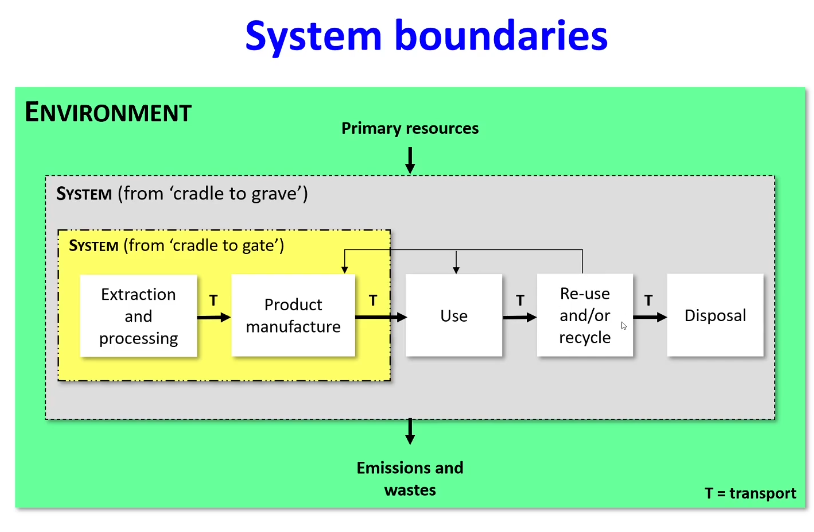
What is cradle-to-cradle in Life Cycle Assessment (LCA)?
Where materials from a product at the end of its life are reused or recycled back into the first processing stage rather than being disposed of as waste.
What is a functional unit in LCA?
defines the function of the system being studied and provides a basis for comparing alternatives on an equivalent basis.
Example: Packaging 1 litre of water using:
A 600 g glass bottle
A 35 g PET bottle
What does inventory analysis involve in LCA?
Flow diagrams.
Data collection.
Calculation of environmental burdens:
Materials and energy used.
Emissions to air, water and solid waste

What are the inputs and outputs of the flow diagram ?
Inputs: materials and energy
Outputs: emissions

What is the equation for total environmental burdens ?

What is impact assessment ?
. Selection of impact categories
. Estimation of impacts
What are some environmental impacts ?
Resource depletion
Global warming
Ozone layer depletion
Acidification
Photochemical smog
Eutrophication
Ecotoxicity
Human toxicity
What is characterisation ?
Quantification of potential impacts based on burdens already found
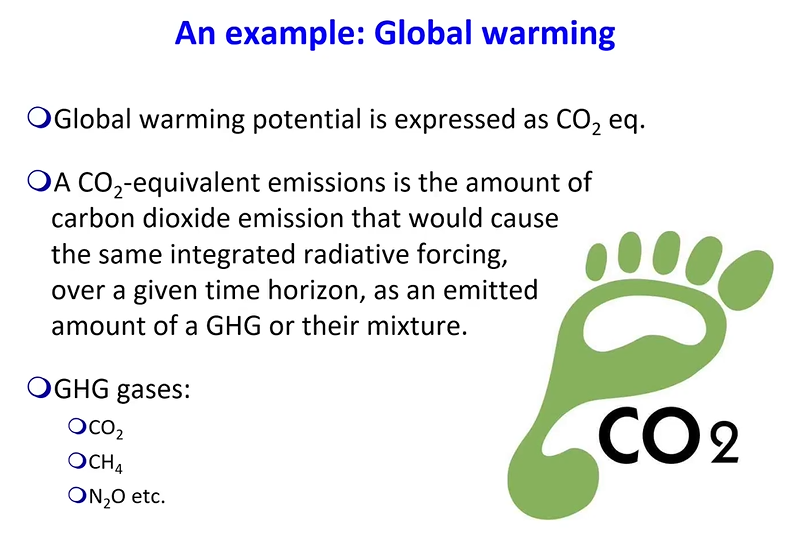
What is the equation for total environmental impact (Total global warming potential) ?

What is global warming potential ?
Can be used to describe the impact category like ‘carbon footprint’ or characterisation factor
What is the definition of global warming potential as a characterisation factor ?
A CO₂-equivalent emission is the amount of carbon dioxide emission that would cause the same integrated radiative forcing, over a given time horizon, as an emitted amount of a GHG or their mixture.
What is normalisation in LCA?
An optional step in impact assessment that involves comparing the environmental impact of a system with the total environmental impact in a certain area over a given period of time.

What is valuation in LCA and what is its equation?
Valuation is an optional step in impact assessment that involves weighting environmental impacts to reflect social values and preferences.

What does interpretation of results involve in LCA?
Identification of major environmental burdens and impacts.
Identification of hotspots.
Evaluation of results.
Sensitivity analysis.
Selection of the best alternative.
What are some impact categories ?
Global warming potential/carbon foot print
Acidification
Eutrophication
Human toxicity
Abiotic depletion potential
Ozone layer depletion
Photochemical smog creation
Terrestrial ecotoxicity
Freshwater and marine ecotoxicity
How do emissions lead to environmental impacts in LCA?
Emissions are released into the air, water or land.
They are transported and dispersed through the environment.
Humans and ecosystems are exposed through different pathways

What is the difference between midpoint and endpoint impacts in LCA?
Midpoint impacts: Potential environmental impacts at an intermediate stage of the cause-and-effect chain (e.g. global warming)
Endpoint impacts: Final damage caused to humans and ecosystems (e.g. loss of human life or species extinction)

What is the recipe methodology ?
