Microbio: Module 4: Eukaryotic Cell Structure
 Call Kai
 Learn
Learn Practice Test
 Spaced Repetition
 Match
Match Flashcards
 Knowt Play
1/34

There's no tags or description
Looks like no tags are added yet.
Name | Mastery | Learn | Test | Matching | Spaced | Call with Kai | Chat |
|---|
No analytics yet
Send a link to your students to track their progress
35 Terms
Eukaryotic Microorganisms
what r they prominent members of?
useful as ____ systems
Some are major human _____
name the two grps of eukaryotes?
Prominent members of ecosystems. Useful as model systems and in industrial microbiology. Some are major human pathogens.
Two groups of eukaryotes:
Protists
Fungi
5.1 Eukaryotic Cells Are Diverse but Share Some Common Features
Common Features of Eukaryotic Cells
morphologically diverse or not?
are they typically smaller or larger than bacterial and archael cells?
Shape and Size
Morphologically diverse to adapt to environments.
Typically larger than bacterial and archaeal cells.
Large and small extremes do exist.
5.1 Eukaryotic Cells Are Diverse but Share Some Common Features
Common Features of Eukaryotic Cell Organization
what do membranes do?
Membrane-delimited nuclei.
Membranes play important role in the structure of organelles.
Membranes partition structures that perform specific functions so that processes can take place simultaneously with proper coordination.
Intracytoplasmic membrane complex serves as transport system to move material throughout the cell.
5.1 Eukaryotic Cells Are Diverse but Share Some Common Features
Structure of Two Representative Eukaryotic Microbes

5.2 Eukaryotic Cell Envelopes
what does the cell envelope consist of ?
plasma membrane is what kind of layer?
what lipids does the plasma membrane include?
Cell envelope consists of the plasma membrane and external coverings.
Plasma membrane is a lipid bilayer.
Lipids include sphingolipids, sterols, and phospholipids.
Microdomains made of different lipid and proteins participate in variety of cellular processes

5.2 Eukaryotic Cell Envelopes
Eukaryotic Cell Envelopes—Cell Walls
is chem composition of eukaryotic cell walls diverse?
examples of photosynthetic algae
example of fungal cells
The chemical composition of eukaryotic cell walls is diverse, based on the type of microbe
Photosynthetic algae
Cellulose
Pectin
Silica
Calcium carbonate
Fungal cells
Chitin
Glucan
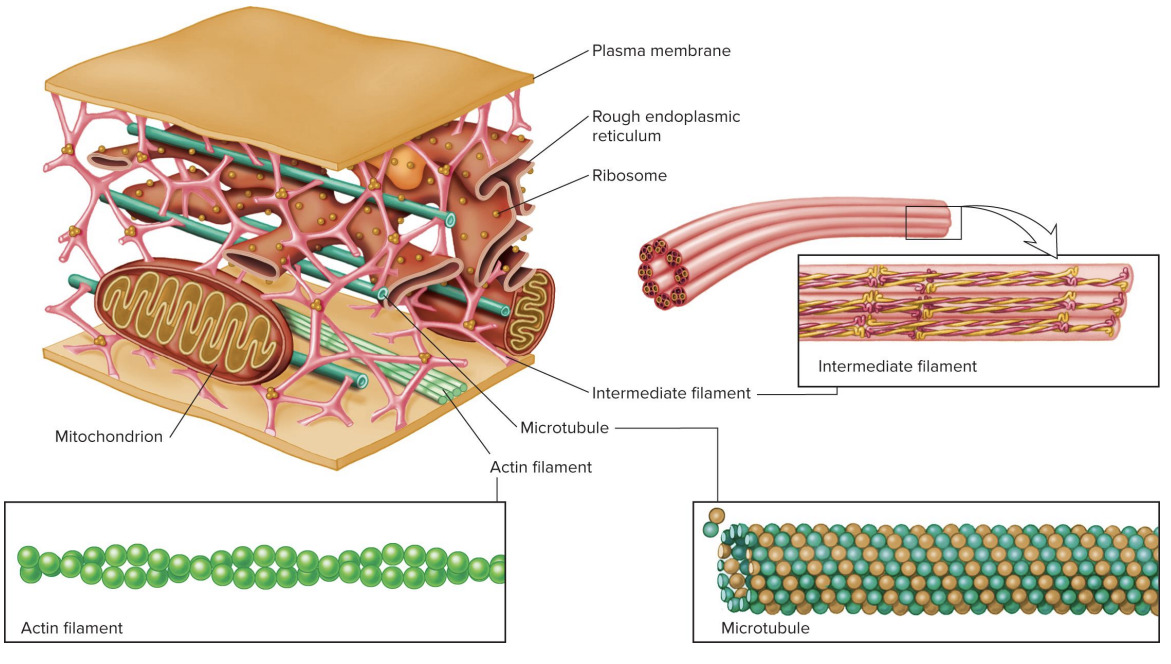
5.3 The Eukaryotic Cytoplasm Contains a Cytoskeleton and Organelles
The Cytoplasm of Eukaryotes
The cytoplasm contents include what and explain them
Cytoplasm contents
Cytosol—Liquid component where organelles are located.
Cytoskeleton—helps organize the cytoplasm.
Three interconnected filaments:
Microfilaments (actin)
Intermediate filaments
Microtubules
Plays role in cell shape and motor proteins associated with filaments guide cell movement.
5.3 The Eukaryotic Cytoplasm Contains a Cytoskeleton and Organelles
Actin Filaments
what r actin filaments?
what are they composed of
functions
Small protein filaments, 4 to 7 nm in diameter. Composed of actin protein.
Functions:
• Moving cellular structures.
• Amoeboid movement
• Help cells change shape.
• Endocytosis
• Cytokinesis

5.3 The Eukaryotic Cytoplasm Contains a Cytoskeleton and Organelles
Intermediate Filaments
are what?
whats used to assemble intermediate filaments
functions?
Flexible yet very strong.
10 nm in diameter.
Keratin and vimentin proteins used to assemble intermediate filaments.
Functions:
Play structural role.
Some shown to form nuclear lamina, supporting the nuclear envelope.
Others help link cells together to form tissues
5.3 The Eukaryotic Cytoplasm Contains a Cytoskeleton and Organelles
Microtubules
what do they look like?
what r their protein subunits?
functions?
Shaped like thin cylinders approximately 25 nm in diameter.
Two protein subunits: α- and β-tubulin.
Form a helical cylinder with 13 subunits per turn.
Functions:
Form spindle apparatus that separates chromosomes during mitosis and meiosis.
Cell movement
Maintain cell shape and support.

5.4 Several Organelles Function in the Secretory and Endocytic Pathways
Movement of Materials Into and Out of Cells
what move materials within and out of the cell?
whats the two pathways?
Cytoplasm is permeated with membranous organelles and vesicles that move materials.
Endocytic pathway—movement into the cell from the outside.
Secretory pathway—movement out of the cell and within the cell.
5.4 Several Organelles Function in the Secretory and Endocytic Pathways
Endoplasmic Reticulum (ER)
what does it look like?
explain rough ER
explain smooth ER
functions of ER
Irregular network of branching and fusing membranous tubules and flattened sacs (cisternae).
Rough ER
Ribosomes attached to outer surface.
Important in cells that synthesize many proteins to be secreted.
Smooth ER
Devoid of ribosomes.
Important in cells that synthesize lipids.
Functions:
Hub for molecular synthesis and transport.
Cell membrane synthesis
5.4 Several Organelles Function in the Secretory and Endocytic Pathways
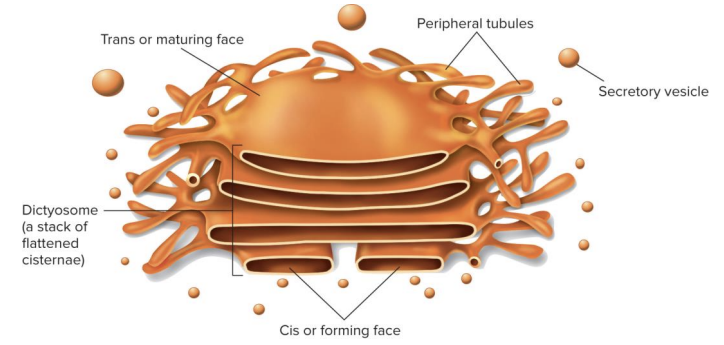
The Golgi Apparatus
Made of flattened, saclike cisternae stacked on each other (some exceptions).
4 to 8 cisternae in a stack.
Two faces that differ in thickness and content:
Cis face—forming face closest to the ER.
Trans face—maturing face farthest from the ER.
Function:
Packages materials and prepares them for secretion.
5.4 Several Organelles Function in the Secretory and Endocytic Pathways
Lysosomes
Roughly spherical organelle, enclosed in a single membrane.
Average 500 nm in diameter.
Involved in digestion of nutrients.
Contain digestion enzymes.
Hydrolases—enzymes that hydrolyze molecules and function best under slightly acidic conditions.
Maintain an acidic environment by pumping protons into their interior.
5.4 Several Organelles Function in the Secretory and Endocytic Pathways
Transport and Secretory Pathways
Used to move materials to various sites within the cell, into the plasma membrane or outside the cell.
General pathway:
Proteins synthesized by ribosome with an amino acid sequence that targets them to the lumen.
Protein moves through lumen.
Released from lumen in a small vesicle that buds from the ER.
Vesicle moves to cis face of the Golgi apparatus then to the trans.
Proteins modified to target them to final location.
Transport vesicles released from trans face of Golgi and move to final location.
5.4 Several Organelles Function in the Secretory and Endocytic Pathways
The Secretory Pathway—After the Golgi
If final destination is plasma membrane, one of two secretory pathways can be used:
what are the two?
If final destination is plasma membrane, one of two secretory pathways can be used:
Constitutive delivery to membrane, unregulated.
Regulated secretory pathway
Requires a signal before vesicles fuse to plasma membrane and release their contents.
5.4 Several Organelles Function in the Secretory and Endocytic Pathways
Degradation of Proteins in Cells
explain process
Quality assurance mechanism
Unfolded or misfolded proteins are secreted into cytosol, targeted for destruction by ubiquitin polypeptides.
Proteasomes destroy targeted proteins

5.4 Several Organelles Function in the Secretory and Endocytic Pathways
The Endocytic Pathway
endocytosis does what?
Endocytosis
Used by all eukaryotic cells to bring materials into the cell.
Vesicles pinched off from the plasma membrane.
How it works: The cell's outer skin (plasma membrane) pinches inward around the material, forming a tiny bubble called a vesicle that carries the material inside.
2 main types: drink, eat
Pinocytosis—solutes
Phagocytosis—particles
Mechanism for recycling molecules in the membrane.
Receptor-mediated endocytosis
Binding of a ligand to a receptor triggers endocytosis.
5.4 Several Organelles Function in the Secretory and Endocytic Pathways
Types of Endocytosis
what does they all ultimately do? (like the main process)
whats phgocytosis?
whats clathrin-dependent dendocytosis?
whats caveolin-dependent endocytosis?
Many types, but all generate a vesicle that is eventually delivered to a lysosome for degradation.
Phagocytosis—use of cell surface protrusions to surround and engulf particles.
Clathrin-dependent endocytosis—clathrin protein-coated pits used to internalize hormones, growth factors, iron, and cholesterol.
Caveolin-dependent endocytosis: caveolin coated vesicles involved in signal transduction and transport of small molecules.
5.4 Several Organelles Function in the Secretory and Endocytic Pathways
Endocytosis
As soon as material is endocytosed where does it get delivered to?
explain vesicle route
explain phagosome route
Next, endocytosed material is delivered to lysosomes.
Clathrin-coated vesicles and caveolin-coated vesicles deliver contents to early endosomes.
Early endosomes develop into late endosomes which fuse with lysosomes.
Phagosomes fuse directly with lysosomes.
The Regular Route (Vesicles):
Small bubbles created during endocytosis (like clathrin- or caveolin-coated vesicles) first hand off their contents to early endosomes (a temporary sorting room).
These early endosomes mature into late endosomes, which then fuse directly with a lysosome to dump their contents for digestion.
The Fast Track (Phagosomes):
Larger particles swallowed whole (like bacteria or solid food) form a bigger bubble called a phagosome.
Phagosomes skip the middle steps and fuse directly with lysosomes.

5.4 Several Organelles Function in the Secretory and Endocytic Pathways
Autophagy
wht is it
macroautophagy?
autophagosome?
Delivery of materials to be digested by a route that does not involve endocytosis.
Macroautophagy—(general process) nonselectively digests and recycles cytoplasmic components—floating debris, damaged parts old organelles etc.
Autophagosome—double membrane surrounding materials to be digested
Autophagosome fuses with a lysosome.

5.4 Several Organelles Function in the Secretory and Endocytic Pathways'
Once Lysosome Is Formed
Digestion occurs without release of lysosome enzymes into cytoplasmic matrix.Safe Digestion: The lysosome acts like a sealed stomach—it breaks down materials using harsh enzymes, keeping them safely locked inside so they don't damage the rest of the cell.
As contents are digested, small products of digestion leave the lysosome and are used as nutrients or for other purposes.
Resulting lysosome called a residual body contains undigested material. Anything the cell can't digest gets left behind inside the lysosome. At this point, the leftover-filled lysosome is called a residual body (essentially a tiny trash pouch).
Contents can be released to the cell exterior.
5.4 Several Organelles Function in the Secretory and Endocytic Pathways
Extracellular Vesicles
can contain what?
formed by?
where can u find them?
Extracellular vesicles can contain proteins, lipids, and nucleic acids.
Formed by pinching off membrane that then surrounds their molecular cargo.
Can be on plasma membrane or organelle membranes.

5.5 The Nucleus and Ribosomes Are Involved in Genetic Control of the Cell
The Nucleus
the presence of a nucleus for ___ storage is the most profund diff btwn eukaryotes and bacterial and archael cells.
the nucleus houses what that contain genetic information.
It contains what which is a complex of DNA and proteins?
what are the five types of histones that form the nucleus?
Histones wrap what around them
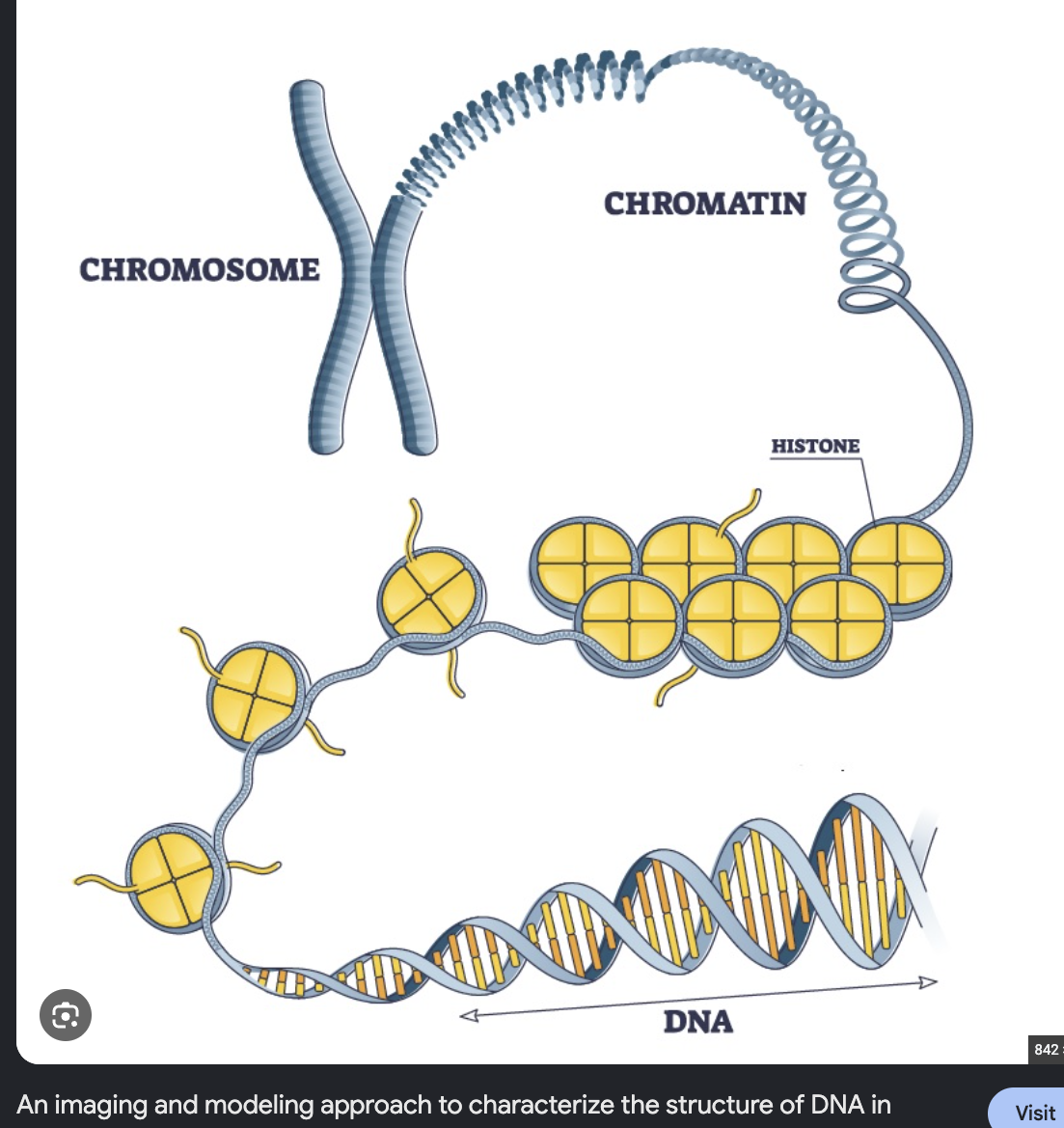
The presence of a nucleus for DNA storage is the most profound difference between eukaryotes and bacterial and archaeal cells.
Membrane-bound spherical structure that houses chromosomes, that contain genetic information.
Contain chromatin, a complex of DNA and proteins (histones).
Five types of histones form nucleosomes: H1, H2A, H2B, H3, and H4.
Histones wrap DNA around them.
5.5 The Nucleus and Ribosomes Are Involved in Genetic Control of the Cell
The Nuclear Envelope
What kind of membrane surrounds the nucleus?
What is it connected to?
Outer membrane is covered with what?
Whats the nuclear pore complex? What do these pores do?
Two lipid bilayer membrane that surrounds the nucleus.
Continuous(connected) with ER.
Outer membrane is covered with ribosomes.
Nuclear pore complex— proteins that make pores that penetrate the envelope.
Pores allow materials to be transported into or out of nucleus.
5.5 The Nucleus and Ribosomes Are Involved in Genetic Control of the Cell
The Nucleolus
site of what synthesis?
Describe its membrane
how is the needed number of nucleous in a cell determined by?
important in what synthesis? Explain
Site of ribosomal RNA (rRNA) synthesis.
Organelle that is not membrane enclosed.
Number of nucleolus in a cell depends on how many ribosomes the cell needs.
Important in ribosome synthesis.
Directs assembly of rRNA that combines with proteins to form partial ribosomal subunits.
These partial ribosomes leave nucleus and mature in cytoplasm.
5.5 The Nucleus and Ribosomes Are Involved in Genetic Control of the Cell
Eukaryotic Ribosomes
Describe size (smaller/larger) to 70s bacterial and archael ribosome.
whats its size in subunits?
You can find ribosomes in EITHER 2 places: bound to ____ or free in the ____
What do ribosomes from ea group produce like location wise?
Larger than the 70S bacterial and archaeal ribosomes.
80S in size: 60S + 40S subunits.
Can be either bound to ER or free in the cytoplasm.
When attached to ETR, 60S is bound.
RER ribosomes: synthesize integral membrane or secreted proteins.
Free ribosomes: synthesize nonsecretory or nonmembrane proteins
Rough ER ribosomes make proteins that are:
secreted OUT of cell
bc part of membrane
Free ribosomes make proteins that STAY inside cell

5.6 Mitochondria, Related Organelles, and Chloroplasts Are Involved in Energy Conservation
Endosymbiotic Hypothesis
Mitochondria, hydrogenosomes, and chloroplasts are all thought to have evolved from bacterial cells that invaded or were ingested by early ancestors of eukaryotic cells.

5.6 Mitochondria, Related Organelles, and Chloroplasts Are Involved in Energy Conservation
Mitochondria
what it known as for most eukaryotic cells
site of what cycle?
site where ___ is generated by ___ transport and ___ ____.
describe size difference fr bacterial cells
“Powerhouses” of most eukaryotic cells.
Site of tricarboxylic acid cycle. which helps break down food molecules for energy.
Site where ATP is generated by electron transport and oxidative phosphorylation.
About the same size and shape of bacterial cells

5.6 Mitochondria, Related Organelles, and Chloroplasts Are Involved in Energy Conservation
Mitochondrial Structure
Describe membrane and what they contain
Mitochondrial matrix is enclosed by what? And what does it contain
Two membranes:
Outer membrane
Contains porin proteins similar to Gram-negative bacteria.
Inner membrane
Contains cristae, infoldings that increase surface area.
Mitochondrial matrix enclosed by inner membrane.
Contains ribosomes, mitochondrial DNA, and large phosphate granules.

5.6 Mitochondria, Related Organelles, and Chloroplasts Are Involved in Energy Conservation
Hydrogenosomes
what r they?
theyre for microbes that live in what condition?
describe membrane
what do they usually lack
how is ATP generated?
Small energy capture organelles in some anaerobic protists.
Double membrane, no cristae, usually lack DNA.
ATP is generated by fermentation process rather than respiration.

5.6 Mitochondria, Related Organelles, and Chloroplasts Are Involved in Energy Conservation
Chloroplasts
type of what? and explain what it means
site of what?
surrounded by what kind of membrane single or double membrane?
Type of plastid—Pigment-containing organelles observed in plants and algae.
Site of photosynthetic reactions.
Surrounded by double membrane.
5.6 Mitochondria, Related Organelles, and Chloroplasts Are Involved in Energy Conservation
Chloroplast Structure
stroma? site of what kind of reactions of photosynthesis? produces what?Stroma contains what?
What are thylakoids? site of what kind of reactioins of photosynthesis? Produces what?
Stroma–a matrix surrounded by the inner membrane.
Site of dark reactions of photosynthesis (formation of carbohydrates from water and CO2 ).
Contains DNA, ribosomes, lipid droplets, starch granules, and thylakoids.
Thylakoids
Site of light reactions of photosynthesis (ATP and NADPH production)

5.7 Many Eukaryotic Microbes Have External Structures Used for Motility
Cilia and Flagella
which is longer?
how do they move?
Flagella (s., flagellum)
100 to 200 μm long
Long whiplike filaments.
Move in undulating fashion.
Cilia (s., cilium)
5 to 20 μm long
Short hairlike structures.
Beat with two phases, working like oars.

5.7 Many Eukaryotic Microbes Have External Structures Used for Motility
Flagella and Cilia Structure
basal body? what does it do?
Membrane-bound cylinders approximately 0.2 μm in diameter.
Axoneme: set of microtubules in a 9+2 arrangement.
Basal body
At base of flagellum or cilium in cytoplasm.
Directs synthesis of flagella and cilia.
